吉林大学学报(医学版) ›› 2025, Vol. 51 ›› Issue (3): 763-769.doi: 10.13481/j.1671-587X.20250321

• 临床研究 • 上一篇    

动脉瘤性蛛网膜下腔出血患者发生急性脑积水的危险因素分析

冯佳慧,刘仁杰,陈儇()   

  1. 吉林大学第一医院神经血管病外科,吉林 长春 130021
  • 收稿日期:2024-06-17 接受日期:2024-08-30 出版日期:2025-05-28 发布日期:2025-07-18
  • 通讯作者: 陈儇 E-mail:chen_xuan@jlu.edu.cn
  • 作者简介:冯佳慧(1998-),女,吉林省白城市人,住院医师,医学硕士,主要从事神经血管病外科基础及临床方面的研究。
  • 基金资助:
    吉林省卫健委科研项目(JLSWSRCZX2023-18)

Analysis on risk factors of development of acute hydrocephalus in patients with aneurysmal subarachnoid hemorrhage

Jiahui FENG,Renjie LIU,Xuan CHEN()   

  1. Department of Neurovascular Disease,First Hospital,Jilin University,Changchun 130021,China
  • Received:2024-06-17 Accepted:2024-08-30 Online:2025-05-28 Published:2025-07-18
  • Contact: Xuan CHEN E-mail:chen_xuan@jlu.edu.cn

摘要:

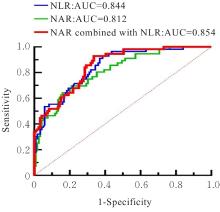
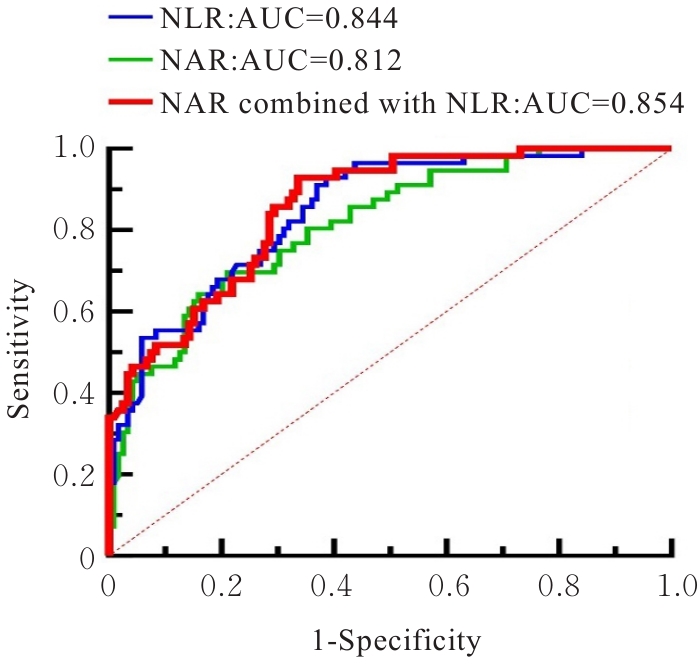
目的 探讨与动脉瘤性蛛网膜下腔出血(aSAH)并发急性脑积水(aHCP)相关的危险因素,为该病患者的早期识别及干预提供临床参考。 方法 回顾性分析175例aSAH患者的临床资料和实验室指标,根据发病后是否出现aHCP将患者分为aHCP组(n=56)和非aHCP组(n=119)。采用单因素分析和二元Logistic回归分析aSAH患者发生aHCP的危险因素,采用受试者工作特征(ROC)曲线和曲线下面积(AUC)评价分析结果对aSAH患者发生aHCP的预测价值。 结果 纳入的175例aSAH患者中,共计56例(32.0%)在发病后出现aHCP。与非aHCP组比较,aHCP组患者中性粒细胞计数、血糖水平、中性粒细胞与白蛋白比值(NAR)、血小板与淋巴细胞比值(PLR)、中性粒细胞与淋巴细胞比值(NLR)、单核细胞与淋巴细胞比值(MLR)、全身免疫炎症指数(SII)、系统炎症反应指数(SIRI)和全身炎症综合指数(AISI)均明显升高(P<0.05),淋巴细胞计数明显降低(P<0.05),Hunt-Hess分级和改良Fisher分级更高(P<0.05),出现脑室积血的概率更高(P<0.05)。二元Logistic回归分析,NAR升高[比值比(OR)=2.237,95%置信区间(CI):1.063~4.708,P=0.034]和NLR升高(OR=1.210,95%CI:1.095~1.337,P<0.01)是aSAH后发生aHCP的独立危险因素。ROC曲线分析,NAR 的AUC 为0.812(95%CI:0.745~0.878,P<0.001),NLR的AUC为0.844(95%CI:0.785~0.903,P<0.001),NAR与NLR联合AUC为0.854(95%CI:0.798~0.910,P<0.001)。 结论 NAR和NLR是aSAH患者发生aHCP的独立危险因素。

关键词: 动脉瘤性蛛网膜下腔出血, 急性脑积水, 神经炎症反应, 危险因素

Abstract:

Objective To explore the risk factors associated with aneurysmal subarachnoid haemorrhage (aSAH) complicated with acute hydrocephalus (aHCP), and to provide the clinical reference for the early identification and intervention of these patients. Methods The clinical data and laboratory indexes of 175 patients with aSAH were retrospectively analysed, and the patients were divided into aHCP group (n=56) and non-aHCP group (n=119) according to whether they presented with aHCP after the onset of the disease. Univariate analysis and binary logistic regression were applied to identify the risk factors for the aHCP in aSAH patients, and receiver operating characteristic (ROC) curve analysis with area under the curve (AUC) was used to evaluate the predictive value of these factors. Results A total of 56 (32.0%) out of 175 aSAH patients included developed aHCP after the onset of the disease. Compared with non-aHCP group,the levels of neutrophil count, blood glucose, neutrophil-albumin ratio (NAR), platelet-lymphocyte ratio (PLR), neutrophil-lymphocyte ratio (NLR), monocyte-lymphocyte ratio (MLR), systemic immune-inflammatory index (SII), systemic inflammatory response index (SIRI), and systemic inflammation composite index (AISI) of the patients in aHCP group were significantly increased(P<0.05), the level of lymphocyte count was significantly decreased (P<0.05), the Hunt-Hess grade and modified Fisher grade were higher (P<0.05), and the incidence of ventricular haematochezia was more high (P<0.05). The binary Logistic regression analysis results showed that the elevated levels of NAR (OR=2.237, 95%CI: 1.063-4.708, P=0.034) and NLR (OR=1.210, 95%CI: 1.095-1.337, P<0.01) were the independent risk factors for the development of aHCP after aSAH. The ROC curve analysis showed that the AUC of NAR was 0.812 (95%CI: 0.745-0.878, P<0.001), the AUC of NLR was 0.844 (95%CI: 0.785-0.903, P<0.001), and the combined AUC of NAR and NLR was 0.854 (95%CI: 0.798-0.910, P<0.001). Conclusion NAR and NLR are independent risk factors for the development of aHCP in aSAH patients.

Key words: Aneurysmal subarachnoid hemorrhage, Acute hydrocephalus, Neuroinflammatory response, Risk factor

中图分类号: 

  • R651.1