吉林大学学报(医学版) ›› 2025, Vol. 51 ›› Issue (5): 1358-1362.doi: 10.13481/j.1671-587X.20250523

• 临床医学 • 上一篇    

分化型甲状腺癌患者术后行碘-131治疗致胸腺生理性摄取1例报告及文献复习

吴鹏清,曾令鹏,罗朝霞,雷洋洋,苟瑞琴,张庆()   

  1. 南昌大学江西医学院 南昌大学第一附属医院核医学科,江西 南昌 330006
  • 收稿日期:2024-11-05 接受日期:2024-12-13 出版日期:2025-09-28 发布日期:2025-11-05
  • 通讯作者: 张庆 E-mail:ndyfy01933@ncu.edu.cn
  • 作者简介:吴鹏清(1999-),男,江西省宜春市人,在读硕士研究生,主要从事甲亢和分化型甲状腺癌碘治疗方面的研究。
  • 基金资助:
    国家自然科学基金项目(82260356)

Thymus physiological uptake in patient with differentiated thyroid carcinoma after postoperative iodine-131 treatment: A case report and literature review

Pengqing WU,Lingpeng ZENG,Zhaoxia LUO,Yangyang LEI,Ruiqin GOU,Qing ZHANG()   

  1. Department of Nuclear Medicine,First Affiliated Hospital,Jiangxi Medical College,Nanchang University,Nanchang 330006,China
  • Received:2024-11-05 Accepted:2024-12-13 Online:2025-09-28 Published:2025-11-05
  • Contact: Qing ZHANG E-mail:ndyfy01933@ncu.edu.cn

摘要:

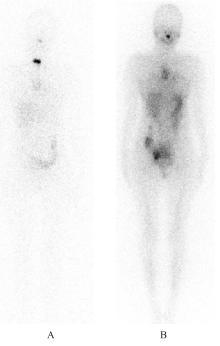
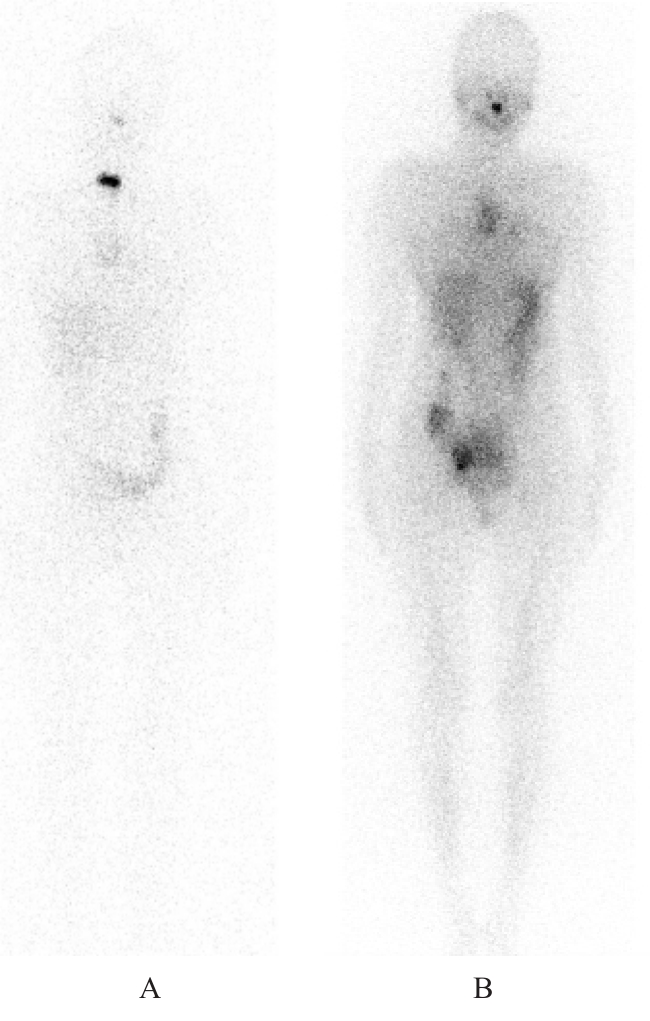
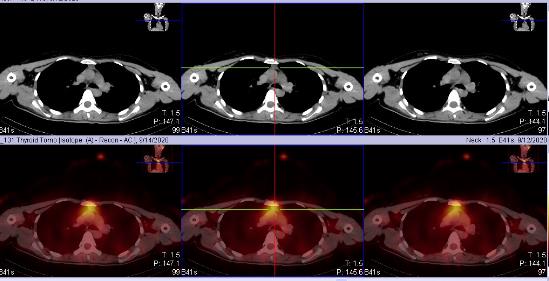
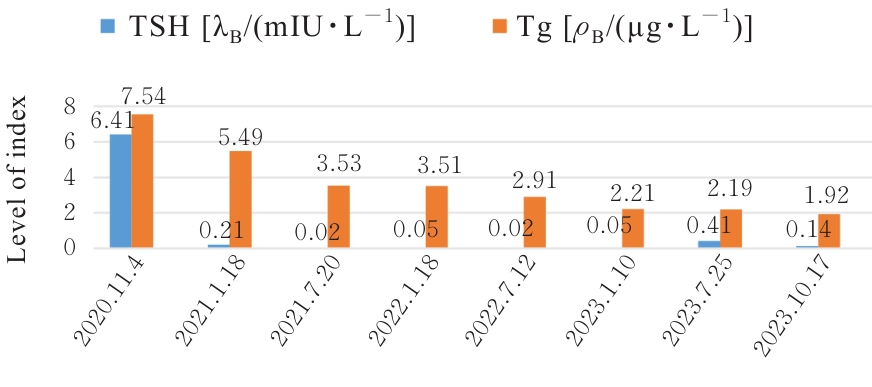
分析1例分化型甲状腺癌(DTC)患者术后行碘-131(131I)治疗后发生胸腺生理性摄取的临床资料及该患者治疗后3年的随访病情变化,复习相关文献并结合诊疗过程探讨DTC术后行131I治疗后全身扫描可能出现假阳性的原因及胸腺良性摄取131I的发生机制、临床特点和鉴别方法等,以提高临床医师对该类情况的认识及鉴别能力,避免不必要的多次碘治疗。患者,女性,28岁,第1次131I治疗后即出现纵隔部位显影,第2次纵隔摄碘更明显,经过单光子发射计算机断层成像技术/计算机断层(SPECT/CT)扫描定位于增大的胸腺组织,该患者2次131I治疗前的刺激状态下甲状腺球蛋白(Tg)水平均较高,但Tg水平逐渐下降,除胸腺部位摄取外,无其他相关检查证据提示该患者存在DTC转移灶,随访3年,胸腺未发生病变,证实为胸腺组织生理性摄取。胸腺摄取131I是甲状腺癌术后患者全身扫描假阳性的常见原因之一,当131I治疗后的全身显像仅显示纵隔摄取时,尤其是多次131I治疗的年轻患者出现胸腺对131I的摄取浓聚程度随131I治疗次数增加而愈加明显时,即使Tg水平升高,也应充分结合SPECT/CT等影像学检查结果明确其是否为正常胸腺,从而避免不必要的重复治疗。

关键词: 分化型甲状腺癌, 碘-131治疗, 胸腺, 生理性摄取, 病例报告

Abstract:

The clinical data of a patient with differentiated thyroid carcinoma (DTC) who developed physiological thymic uptake after postoperative iodine-131 (131I) therapy were analyzed, and the 3-year follow-up changes in the patient’s condition were reviewed. Combined with the literatures and the diagnosis and treatment process, the causes of possible false positives in whole-body scans after iodine therapy for DTC and the mechanism, clinical features, and identification methods of benign thymic 131I uptake were discussed to improve clinicians’ understanding and diagnostic ability regarding such conditions and avoid unnecessary multiple iodine treatments. The patient, a 28-year-old female, showed mediastinal imaging after the first 131I treatment, with more pronounced mediastinal iodine uptake during the second treatment. SPECT/CT localized the uptake to enlarged thymus tissue. The stimulated thyroglobulin (Tg) levels before two 131I treatments were high but gradually decreased. Apart from thymic uptake, no other examination evidence suggested DTC metastases. Subsequent follow-up for 3 years showed no pathological changes in the thymus, confirming physiological thymic uptake. Thymic 131I uptake is a common cause of false-positive whole-body scans in post-thyroidectomy patients. When post-131I therapy whole-body imaging shows only mediastinal uptake, especially in the young patients undergoing multiple 131I treatments where thymic 131I uptake intensity increases with successive treatments, even with elevated Tg levels, comprehensive use of imaging results such as SPECT/CT is essential to determine if it is normal thymus, thereby avoiding unnecessary repeated therapies.

Key words: Differentiated thyroid carcinoma, Iodine-131 therapy, Thymus, Physiological uptake, Case report

中图分类号: 

  • R736.1