吉林大学学报(工学版) ›› 2026, Vol. 56 ›› Issue (8): 2177-2190.doi: 10.13229/j.cnki.jdxbgxb.20250074
• 交通运输工程·土木工程 • 上一篇
基于交互信息融合网络的车辆行驶风险预测模型
王江锋1( ),贺丹1,罗冬宇1,李云飞1,齐崇楷1,闫学东2
- 1.北京交通大学 综合交通运输大数据应用技术交通运输行业重点实验室,北京 100044
2.西南交通大学 交通运输与物流学院,成都 611756
Vehicle traveling risk prediction based on interactive information fusion network
Jiang-feng WANG1(),Dan HE1,Dong-yu LUO1,Yun-fei LI1,Chong-kai QI1,Xue-dong YAN2
- 1.Key Laboratory of Transport Industry of Big Data Application Technologies for Comprehensive Transport,Ministry of Transport,Beijing Jiaotong University,Beijing 100044,China
2.School of Transportation and Logistics,Southwest Jiaotong University,Chengdu 611756,China
摘要:
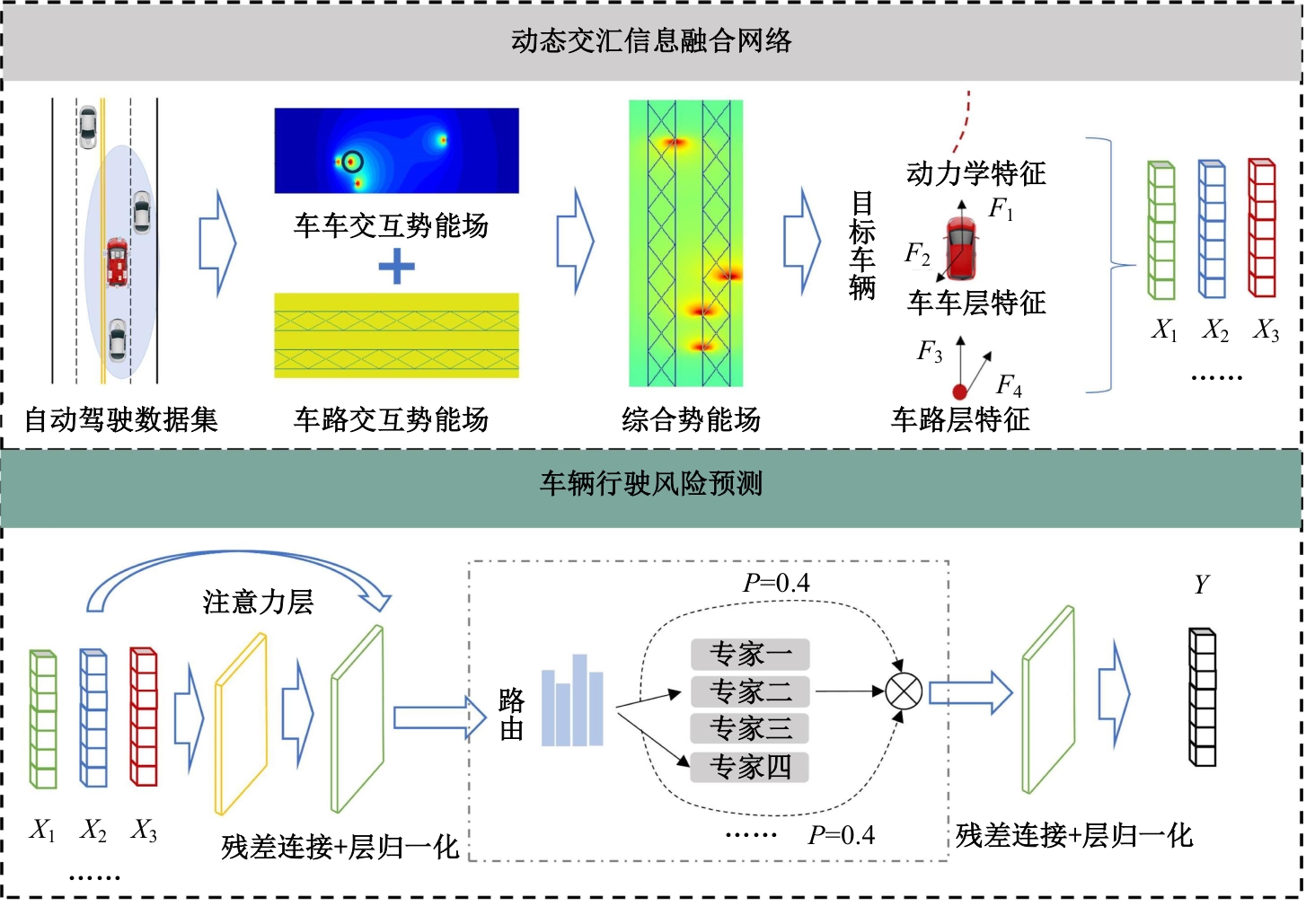
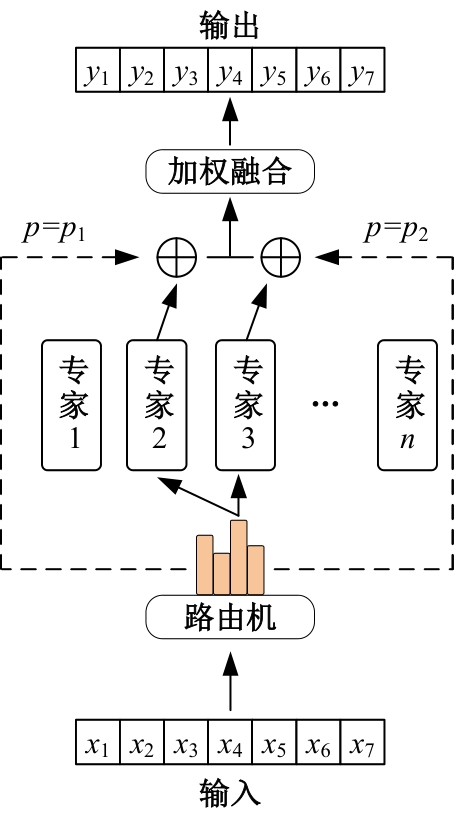
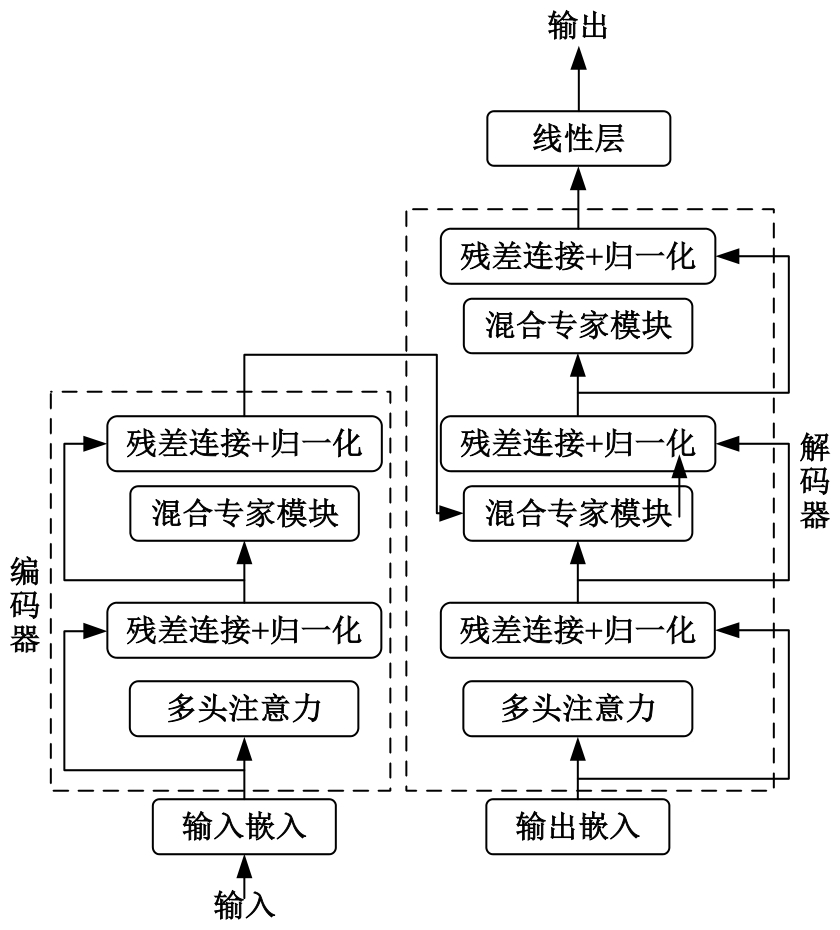
针对车路协同环境下车辆行驶风险影响因素复杂未知、传统数据驱动和物理模型驱动的预测模型可解释性与自适应性不足的问题,提出了利用自车车载传感器获取周围车辆行驶状态信息构建自车行驶势能场,并融入自车行驶状态信息建立广义力模型以构建车车交互信息网络的方法。同时,基于自车车载传感器采集道路标志标线信息构建车路交互信息网络,进而构建两种信息网络协同的动态交互信息融合网络。引入路由机制,针对不同自车广义力动态交互过程设计了Transformer和混合专家模型相结合构建切换变换器,提出了基于交互信息融合网络的车辆行驶风险预测模型。实证分析结果显示,在综合测试集中,切换变换器模型相比Transformer的预测性能有较大提升,MAE降低了3.48%,RMSE降低了2.19%,R2提升了1.39%。在换道测试集中,切换变换器模型体现出更好的适应性,与Transformer相比MAE降低了11.1%,RSME降低了9.0%,R2提升了5.4%。在风险预测结果中,模型在跟驰、停车、驶出、变道加驶出混合场景中分别高于碰撞时间倒数0.288 7、0.200 5、0.714 2、0.288 8。
中图分类号:
- U491.1

| [1] | Li L, Sui X, Lian J, et al. Vehicle interaction behavior prediction with self-attention[J]. Sensors, 2022, 22(2): No.429. |
| [2] | 涂辉招, 鹿畅, 陆淼嘉, 等. 基于避险脱离的自动驾驶路测安全影响因素[J]. 吉林大学学报:工学版, 2024, 54(7): 1935-1943. |
| Tu Hui-zhao, Lu Chang, Lu Miao-jia, et al. Safety influencing factors of autonomous driving road tests based on evasion maneuvers[J]. Journal of Jilin University(Engineering and Technology Edition), 2024, 54(7): 1935-1943. | |
| [3] | 陈吉清, 翁楚滨, 兰凤崇. 智能车辆换道潜在冲突分析与风险量化方法[J]. 汽车工程, 2021, 43(11): 1565-1576. |
| Chen Ji-qing, Weng Chu-bin, Lan Feng-chong. Potential lane change conflict analysis and risk quantification method for intelligent vehicles[J]. Automotive Engineering, 2021, 43(11): 1565-1576. | |
| [4] | 温惠英, 何梓琦, 李秋灵, 等.高速公路货车换道冲突预测及其影响因素分析[J].吉林大学学报:工学版,2024,54(10):2827-2836. |
| Wen Hui-ying, He Zi-qi, Li Qiu-ling, et al. Prediction of lane change conflicts for trucks on highways and analysis of influencing factors[J]. Journal of Jilin University(Engineering and Technology Edition), 2024, 54(10): 2827-2836. | |
| [5] | Messaoud K, Yahiaoui I, Verroust-Blondet A, et al. Attention based vehicle trajectory prediction[J]. IEEE Transactions on Intelligent Vehicles, 2020, 6(1):175-185. |
| [6] | Li G, Yang Y, Zhang T, et al. Risk assessment based collision avoidance decision-making for autonomous vehicles in multi-scenarios[J]. Transportation Research Part C: Emerging Technologies, 2021, 122: No.102820. |
| [7] | 王明强, 王震坡, 张雷. 基于碰撞风险评估的智能汽车局部路径规划方法研究[J]. 机械工程学报, 2021, 57(10): 28-41. |
| Wang Ming-qiang, Wang Zhen-po, Zhang Lei. Research on local path planning method for intelligent vehicles based on collision risk assessment[J]. Journal of Mechanical Engineering, 2021, 57(10): 28-41. | |
| [8] | 张诗波, 查治涌, 胡文浩. 智能网联汽车行驶的安全风险评价模型[J]. 重庆理工大学学报 :自然科学, 2023, 37(4): 57-63. |
| Zhang Shi-bo, Zhi-yong Cha, Hu Wen-hao. Safety risk assessment model for intelligent connected vehicles[J]. Journal of Chongqing University of Technology(Natural Science), 2023, 37(4): 57-63. | |
| [9] | 朱西产, 魏昊舟, 马志雄. 基于自然驾驶数据的跟车场景潜在风险评估[J]. 中国公路学报, 2020, 33(4): 169-181. |
| Zhu Xi-chan, Wei Hao-zhou, Ma Zhi-xiong. Potential risk assessment of car-following scenarios based on natural driving data[J]. China Journal of Highway and Transport, 2020, 33(4): 169-181. | |
| [10] | Sheikh M, Peng Y. Improved collision risk assessment for autonomous vehicles at on-ramp merging areas[J]. IEEE Access, 2023,11: 130974-130989. |
| [11] | Yu S, Malawade A, Muthirayan D, et al. Scene-graph augmented data-driven risk assessment of autonomous vehicle decisions[J]. IEEE Transactions on Intelligent Transportation Systems, 2021, 23(7): 7941-7951. |
| [12] | Shi X, Wong Y, Chai C, et al. An automated machine learning(AutoML) method of risk prediction for decision-making of autonomous vehicles[J]. IEEE Transactions on Intelligent Transportation Systems, 2022, 22(11): 7145-7154. |
| [13] | Xia T, Chen H, Yang J, et al. Geometric field model of driver's perceived risk for safe and human-like trajectory planning[J]. Transportation Research Part C: Emerging Technologies, 2024, 159: No.104470. |
| [14] | 宋东鉴, 赵健, 朱冰, 等.考虑风险时空分布特征的跟驰工况行驶风险预测[J]. 汽车工程, 2024, 46(5): 766-775, 753. |
| Song Dong-jian, Zhao Jian, Zhu Bing, et al. Driving risk redicption for car-following conditions considering the spatiotemporal distribution characteristics of risk[J]. Automotive Engineering, 2024, 46(5): 766-775, 753. | |
| [15] | Katrakazas C, Quddus M, Chen H. A new integrated collision risk assessment methodology for autonomous vehicles[J]. Accident Analysis & Prevention, 2019, 127: 61-79. |
| [16] | Bai C, Jin S, Jing J, et al. A multimodal data-driven approach for driving risk assessment[J]. Transportation Research Part E: Logistics and Transportation Review, 2024, 189: No.103678. |
| [17] | 王建强, 吴剑, 李洋. 基于人-车路协同的行驶风险场概念、原理及建模[J]. 中国公路学报, 2016, 29(1): 105-114. |
| Wang Jian-qiang, Wu Jian, Li Yang. Concept, principles, and modeling of driving risk field based on human-vehicle-road collaboration[J]. China Journal of Highway and Transport, 2016, 29(1): 105-114. | |
| [18] | Cao Y, Shang G, Cai B, et al. Predictive trajectory planning for on-road autonomous vehicles based on a spatiotemporal risk field[J]. IEEE Intelligent Transportation Systems Magazine, 2022, 15(1): 400-420. |
| [19] | Li L, Gan J, Yi Z, Qu X, et al. Risk perception and the warning strategy based on safety potential field theory[J]. Accident Analysis & Prevention, 2020, 148: No.105805. |
| [20] | Li L, Gan J, Ji X, et al. Dynamic driving risk potential field model under the connected and automated vehicles environment and its application in car-following modeling[J]. IEEE Transactions on Intelligent Transportation Systems, 2022, 23(1): 122-141. |
| [21] | Arun A, Haque, M M, Washington S, et al. A physics-informed road user safety field theory for traffic safety assessments applying artificial intelligence-based video analytics[J]. Analytic Methods in Accident Research, 2023, 37: No.100252. |
| [22] | Cheng Y, Liu Z, Gao L, et al. Traffic risk environment impact analysis and complexity assessment of autonomous vehicles based on the potential field method[J]. International Journal of Environmental Research and Public Health, 2022, 19(16): No.10337. |
| [23] | Han J, Zhao J, Zhu B, et al. Spatial-temporal risk field for intelligent connected vehicle in dynamic traffic and application in trajectory planning[J]. IEEE Transactions on Intelligent Transportation Systems, 2023, 24(3): 2963-2975. |
| [24] | 赵高士, 陈龙, 蔡英凤, 等. 融合复杂网络和记忆增强网络的轨迹预测技术[J]. 汽车工程, 2023, 45(9): 1608-1616, 1636. |
| Zhao Gao-shi, Chen Long, Cai Ying-feng, et al. Trajectory prediction technology integrating complex networks and memory-augmented networks[J]. Automotive Engineering, 2023, 45(9): 1608-1616, 1636. | |
| [25] | Geng M, Cai Z, Zhu Y, et al. Multimodal vehicular trajectory prediction with inverse reinforcement learning and risk aversion at urban unsignalized intersections[J]. IEEE Transactions on Intelligent Transportation Systems, 2023, 24(11): 12227-12240. |
| [26] | Liu K, Wang H, Fu Y, et al. A dynamic path-planning method for obstacle avoidance based on the driving safety field[J]. Sensors, 2023, 23(22): No.9180. |
| [27] | 曲大义, 邴其春, 贾彦峰, 等.基于分子动力学的车辆换道交互行为特性及其模型[J]. 交通运输系统工程与信息, 2019, 19(3): 68-74. |
| Qu Da-yi, Bing Qi-chun, Jia Yan-feng, et al. Vehicle lane change interaction behavior characteristics and their model based on molecular dynamics[J]. Journal of Traffic and Transportation Engineering & Information, 2019, 19(3): 68-74. | |
| [28] | Yu R, Zheng Y, Qu X. Dynamic driving environment complexity quantification method and its verification[J]. Transportation Research Part C: Emerging Technologies, 2021, 127: No.103051. |
| [29] | Li G, Yang Y, Li S, et al. Decision making of autonomous vehicles in lane change scenarios: Deep reinforcement learning approaches with risk awareness[J]. Transportation Research Part C: Emerging Technologies, 2022, 134: No.103452. |
| [30] | Li Y, Luo D, Wang J, et al. Mitigating cascading effects of vehicle lane changes: a hyperedge game approach[J]. Transportation Research Part C: Emerging Technologies, 2025, 171: No.104971. |
| [31] | 王江锋, 齐崇楷, 罗冬宇, 等. 通信时延下考虑行驶状态时空价值的编队安全控制[J]. 中国公路学报,2025,38(3):13-30. |
| Wang Jiang-feng, Qi Chong-kai, Luo Dong-yu, et al. Safety control of formation considering the spatiotemporal value of driving state under Communication delay[J]. China Journal of Highway and Transportation,2025,38(3): 13-30. | |
| [32] | Arun A, Haque M, Bhaskar A, et al. A systematic mapping review of surrogate safety assessment using traffic conflict techniques[J]. Accident Analysis & Prevention, 2021, 153: No.106016. |
| [33] | Caesar H, Bankiti V, Lang H, et al. Nuscenes: A multimodal dataset for autonomous driving[C]∥Proceedings of the IEEE/CVF Conference on Computer Vision and Pattern Recognition, 2020: 11621-11631. |
| [34] | Wang H, Lu B, Li J, et al. Risk assessment and mitigation in local path planning for autonomous vehicles with LSTM based predictive model[J]. IEEE Transactions on Automation Science and Engineering, 2021, 19(4): 2738-2749. |
| [35] | Li Q, Cheng R, Ge H. Short-term vehicle speed prediction based on BiLSTM-GRU model considering driver heterogeneity[J]. Physica A: Statistical Mechanics and its Applications, 2021, 610: No.128410. |
| [36] | Yuan H, Zhang J, Zhang L, et al. Vehicle trajectory prediction based on posterior distributions fitting and TCN-Transformer[J]. IEEE Transactions on Transportation Electrification, 2024,10(3):7160-7173. |
| [37] | Han L, Abdel-Aty M, Yu R, et al. LSTM+Transformer real-time crash risk evaluation using traffic flow and risky driving behavior data[J]. IEEE Transactions on Intelligent Transportation Systems, 2024, 25(11): 18383-18395. |
| [1] | 刘照霞,付锐,牛世峰. 基于极值理论与智能网联信息的超车风险评估[J]. 吉林大学学报(工学版), 2025, 55(3): 925-937. |
|
||