吉林大学学报(工学版) ›› 2026, Vol. 56 ›› Issue (9): 2467-2475.doi: 10.13229/j.cnki.jdxbgxb.20250138
• 计算机科学与技术 • 上一篇
基于前馈卷积神经网络的多模块自监督降噪模型
郭晓新1,2( ),李广宇1,2,杨广奇1,2
- 1.吉林大学 计算机科学与技术学院,长春 130012
2.吉林大学 符号计算与知识工程教育部重点实验室,长春 130012
Multi-modular self-supervised image denoising network based on feed-forward convolutional neural network
Xiao-xin GUO1,2(),Guang-yu LI1,2,Guang-qi YANG1,2
- 1.College of Computer Science and Technology,Jilin University,Changchun 130012,China
2.Key Laboratory of Symbol Computation and Knowledge Engineering of Ministry of Education,Jilin University,Changchun 130012,China
摘要:
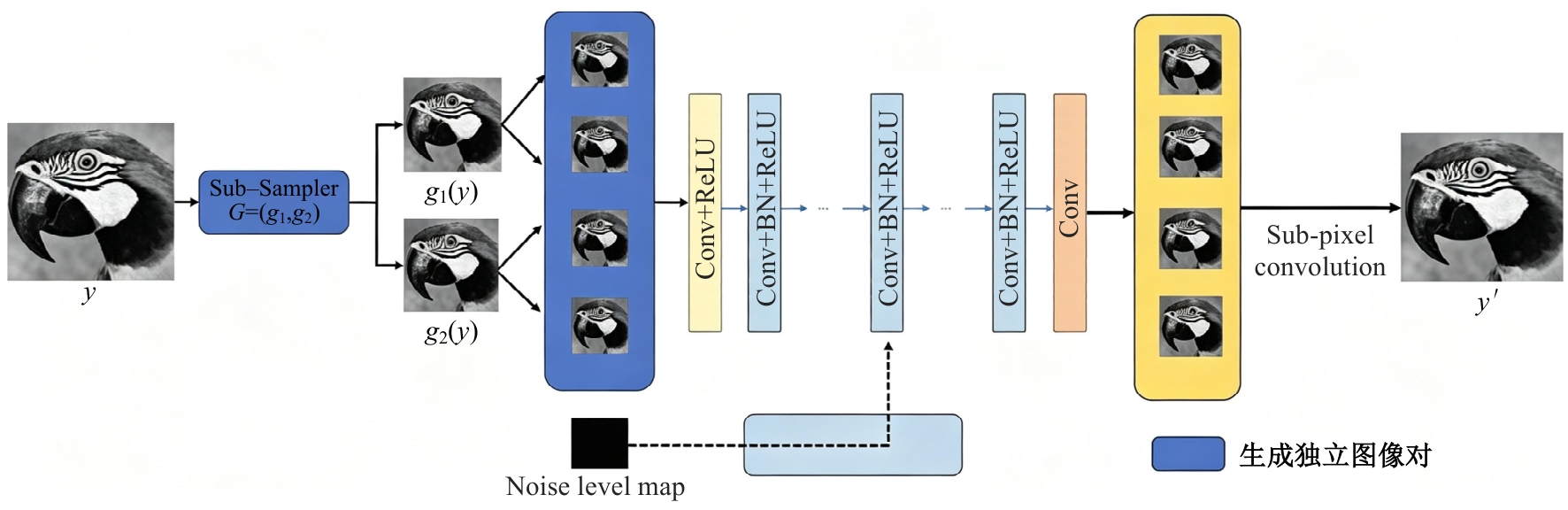
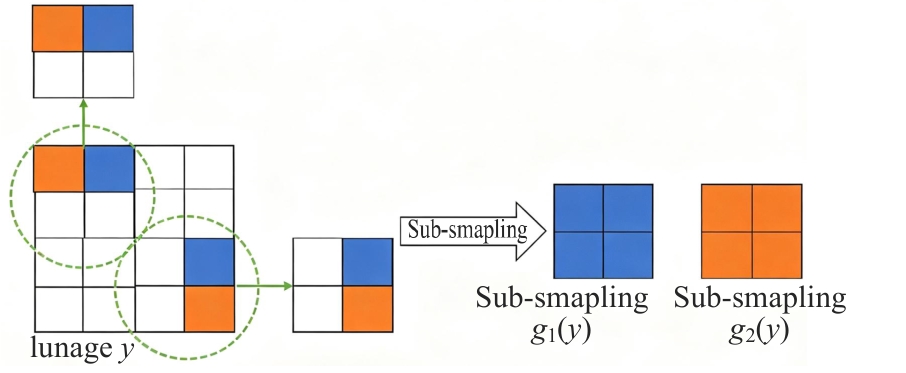
针对降噪过程中成对的噪声图像和干净图像难以获取的问题,提出了一种基于前馈降噪卷积神经网络的多模块自监督降噪模型(MMS-DNet)。该模型采用改进的DnCNN架构,通过添加结合原图下采样和全局噪声水平估计的多元输入模块,生成多张输入子图的同时弥补了生成过程中的信息丢失;通过添加子像素卷积模块,避免了图像重建过程中冗余信息的引入。实验结果表明:本文模型在灰度数据集BSD68和Set12上的效果优于现有的自监督学习模型,在彩色数据集CBSD68和Kodak24上同样表现出良好的效果。
中图分类号:
- TP751



| [1] | Su J, Xu B, Yin H. A survey of deep learning approaches to image restoration[J]. Neurocomputing, 2022, 487: 46-65. |
| [2] | Liu D, Wen B X, Liu X M, et al. When image denoising meets high-level vision tasks: A deep learning approach[C]∥Proceedings of the Twenty-Seventh International Joint Conference on Artificial Intelligence, Stockholm, Sweden, 2018: 842-848. |
| [3] | Tomasi C, Manduchi R. Bilateral filtering for gray and color images[C]∥Proceedings of Sixth International Conference on Computer Vision, Bombay, India, 1998: 839-846. |
| [4] | Gu S H, Zhang L, Zuo W M, et al. Weighted nuclear norm minimization with application to image denoising[C]∥Proceedings of the IEEE Conference on Computer Vision and Pattern Recognition, Columbus, USA, 2014: 2862-2869. |
| [5] | Buades A, Coll B, Morel J M. A non-local algorithm for image denoising[C]∥2005 IEEE Computer Society Conference on Computer Vision and Pattern Recognition, San Diego, USA, 2005: 60-65. |
| [6] | Dabov K, Foi A, Katkovnik V, et al. Image denoising by sparse 3-D transform-domain collaborative filtering[J]. IEEE Transactions on Image Processing, 2007, 16(8): 2080-2095. |
| [7] | Zhang K, Zuo W M, Gu S H, et al. Learning deep CNN denoiser prior for image restoration[C]∥2017 IEEE Conference on Computer Vision and Pattern Recognition, Honolulu, USA, 2017: 2808-2817. |
| [8] | Valsesia D, Fracastoro G, Magli E. Deep graph-convolutional image denoising[J]. IEEE Transactions on Image Processing, 2020, 29: 8226-8237. |
| [9] | Lehtinen J, Munkberg J, Hasselgren J, et al. Noise2Noise: learning image restoration without clean data[C]∥Proceedings of International Conference on Machine Learning, Stockholm, USA, 2018: 2965-2974. |
| [10] | Goodfellow I, Pougetabadie J, Mirza M, et al. Generative adversarial networks[J]. Communications of the ACM, 2020, 63(11): 139-144. |
| [11] | Chen J W, Chen J W, Chao H Y, et al. Image blind denoising with generative adversarial network based noise modeling[C]∥2018 IEEE/CVF Conference on Computer Vision and Pattern Recognition, Salt Lake City, USA, 2018: 3155-3164. |
| [12] | Chen H T, Wang Y H, Guo T Y, et al. Pre-trained image processing Transformer[C]∥2021 IEEE/CVF Conference on Computer Vision and Pattern Recognition, Nashville, USA,2021:12294-12305. |
| [13] | Vaswani A, Shazeer N, Parmar N, et al. Attention is all you need[J]. Advances in Neural Information Processing Systems, 2017, 30: 5998-6008. |
| [14] | Deng J, Dong W, Socher R, et al. ImageNet: A large-scale hierarchical image database[C]∥2009 IEEE Conferenceon Computer Vision and Pattern Recognition, Miami, USA,2009: 248-255. |
| [15] | Pang T Y, Zheng H, Quan Y H, et al. Recorrupted-to-recorrupted: Unsupervised deep learning for image denoising[C]∥Proceedings of the IEEE/CVF Conference on Computer Vision and Pattern Recognition, Nashville, USA,2021: 2043-2052. |
| [16] | Martin D, Fowlkes C, Tal D, et al. A database of human segmented natural images and its application to evaluating segmentation algorithms and measuring ecological statistics[C]∥Proceedings Eighth IEEE International Conference on Computer Vision, Vancouver, Canada, 2001: 416-423. |
| [17] | Zhang K, Zuo W M, Chen Y J, et al. Beyond a gaussian denoiser: residual learning of deep CNN for image denoising[J]. IEEE Transactions on Image Processing, 2017, 26: 3142-3155, |
| [18] | Franzen R. Kodak lossless true color image suite[EB/OL]. [2026-08-23]. |
| [19] | Huynh-Thu Q, Ghanbari M. Scope of validity of PSNR in image/video quality assessment[J]. Electronics Letters, 2008, 44(13): 800-801. |
| [20] | Wang Z, Bovik A C, Sheikh H R, et al. Image quality assessment: from error visibility to structural similarity[J]. IEEE Transactions on Image Processing, 2004, 13(4): 600-612. |
| [21] | Zhang K, Zuo W M, Zhang L. FFDNet: toward a fast and flexible solution for CNN-based image denoising[J]. IEEE Transactions on Image Processing, 2018, 27(9): 4608-4622. |
| [22] | Gu S H, Zhang L, Zuo W M, et al. Weighted nuclear norm minimization with application to image denoising[C]∥IEEE Conference on Computer Vision and Pattern Recognition, Columbus, USA,2014: 2862-2869. |
| [23] | Wang Z J, Liu J Z, Li G Q, et al. Blind2unblind: Self-supervised image denoising with visible blind spots[C]∥Proceedings of the IEEE/CVF Conference on Computer Vision and Pattern Recognition, New Orleans, USA,2022: 2017-2026. |
| [24] | Mikhail P, Chizhov P, Parts L. SwinIA: self-supervised blind-spot image denoising with zero convolutions[C]∥2025 IEEE/CVF Winter Conference on Applications of Computer Vision, Tucson, Arizona, USA,2023: 7071-7080. |
| [1] | 刘迪仁,马澳. 基于非局部自相似性的低对比度图像降噪算法[J]. 吉林大学学报(工学版), 2025, 55(7): 2378-2382. |
| [2] | 程德强,王伟臣,韩成功,吕晨,寇旗旗. 基于改进密集网络和小波分解的自监督单目深度估计[J]. 吉林大学学报(工学版), 2025, 55(5): 1682-1691. |
| [3] | 田婧,马社强,赵丹,陈发城. 单全球导航卫星系统信号下基于自监督双向长短时记忆网络的车辆速度估计方法[J]. 吉林大学学报(工学版), 2025, 55(12): 3852-3861. |
| [4] | 郭昕刚,何颖晨,程超. 抗噪声的分步式图像超分辨率重构算法[J]. 吉林大学学报(工学版), 2024, 54(7): 2063-2071. |
| [5] | 白琳,刘林军,李轩昂,吴沙,刘汝庆. 基于自监督学习的单目图像深度估计算法[J]. 吉林大学学报(工学版), 2023, 53(4): 1139-1145. |
| [6] | 赵宏伟,张健荣,朱隽平,李海. 基于对比自监督学习的图像分类框架[J]. 吉林大学学报(工学版), 2022, 52(8): 1850-1856. |
| [7] | 周大可,张超,杨欣. 基于多尺度特征融合及双重注意力机制的自监督三维人脸重建[J]. 吉林大学学报(工学版), 2022, 52(10): 2428-2437. |
| [8] | 李文军,华强,谭立东,孙悦. DV⁃HOP和接收信号强度指示结合的改进算法[J]. 吉林大学学报(工学版), 2019, 49(5): 1689-1695. |
| [9] | 张田, 孙延奎, 田小林. 二进小波与扩散滤波结合的光学相干层析图像降噪[J]. 吉林大学学报(工学版), 2013, 43(增刊1): 340-344. |
|
||