吉林大学学报(医学版) ›› 2026, Vol. 52 ›› Issue (4): 914-920.doi: 10.13481/j.1671-587X.20260404

• 基础研究 • 上一篇    下一篇

脑源性神经营养因子脂质体对阿尔茨海默病模型大鼠学习和记忆能力的改善作用及其机制

徐磊1,刘玉珍2,武小萱1,张欣1,史新秀1,邢影1()   

  1. 1.吉林大学中日联谊医院神经内科,吉林 长春 130033
    2.山东省济南市第五人民医院神经内科,山东 济南 250022
  • 收稿日期:2025-08-26 接受日期:2025-12-30 出版日期:2026-07-28 发布日期:2026-07-27
  • 通讯作者: 邢影 E-mail:xingying@jlu.edu.cn
  • 作者简介:徐 磊(1986-),男,吉林省吉林市人,副教授,副主任医师,主要从事脑血管病和认知障碍、眩晕和运动障碍疾病方面的研究。
  • 基金资助:
    吉林省教育厅科研项目(JJKH20201058KJ)

Improvement effect of brain-derived neurotrophic factor liposomes on learning and memory abilities in Alzheimer’s disease model rats and its mechanism

Lei XU1,Yuzhen LIU2,Xiaoxuan WU1,Xin ZHANG1,Xinxiu SHI1,Ying XING1()   

  1. 1.Department of Neurology,China-Japan Union Hospital,Jilin University,Changchun 130033,China
    2.Department of Neurology,Fifth People’s Hospital,Jinan City,Shandong Province,Jinan 250022,China
  • Received:2025-08-26 Accepted:2025-12-30 Online:2026-07-28 Published:2026-07-27
  • Contact: Ying XING E-mail:xingying@jlu.edu.cn

摘要:

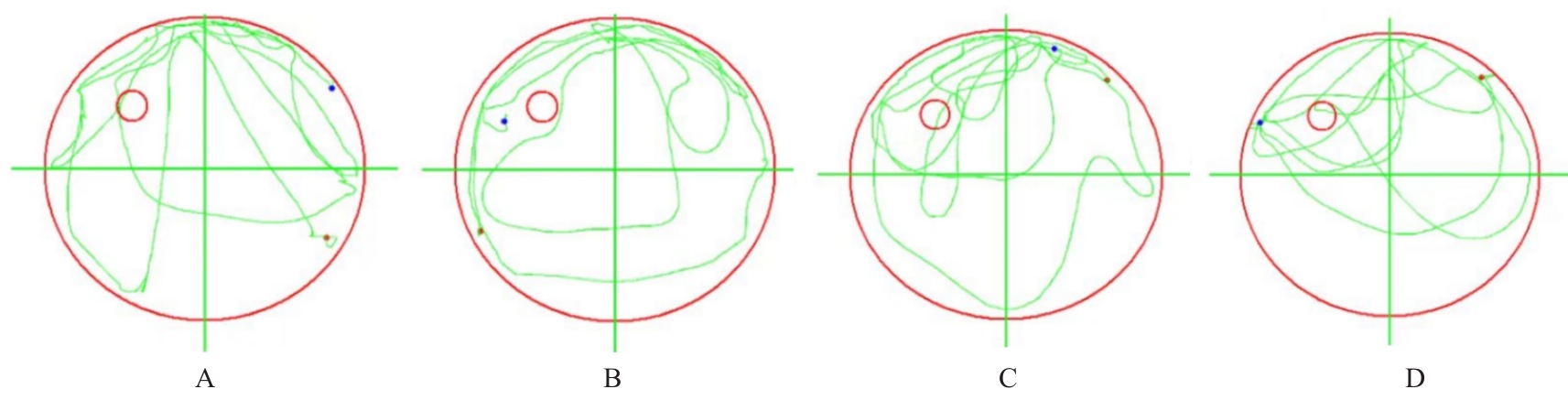
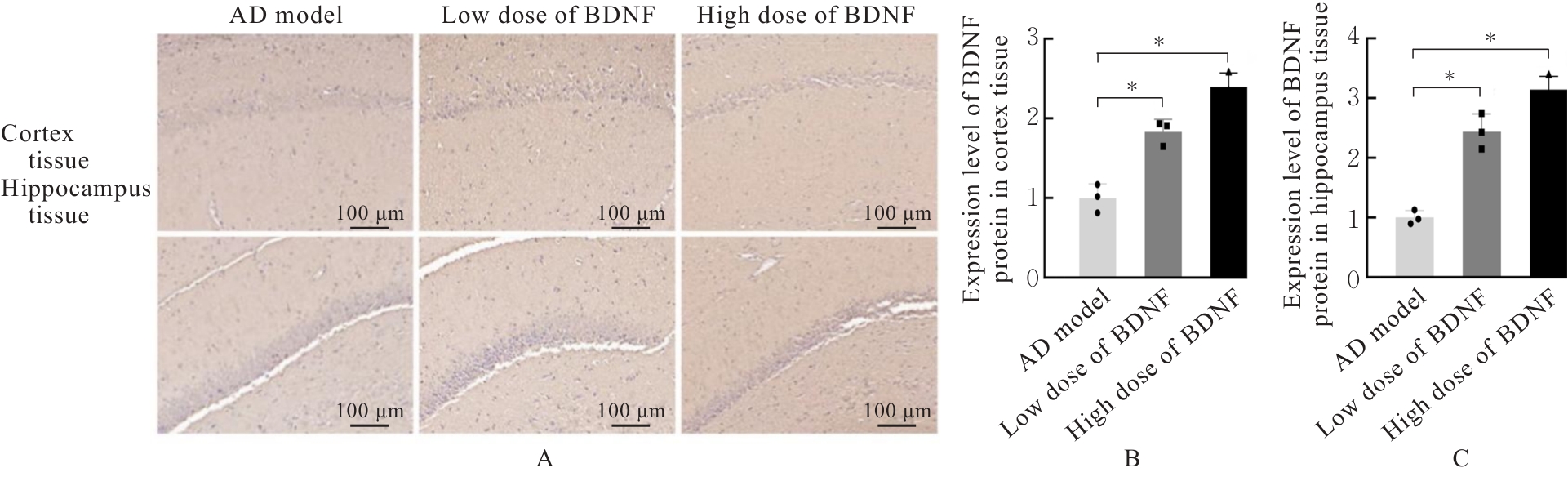
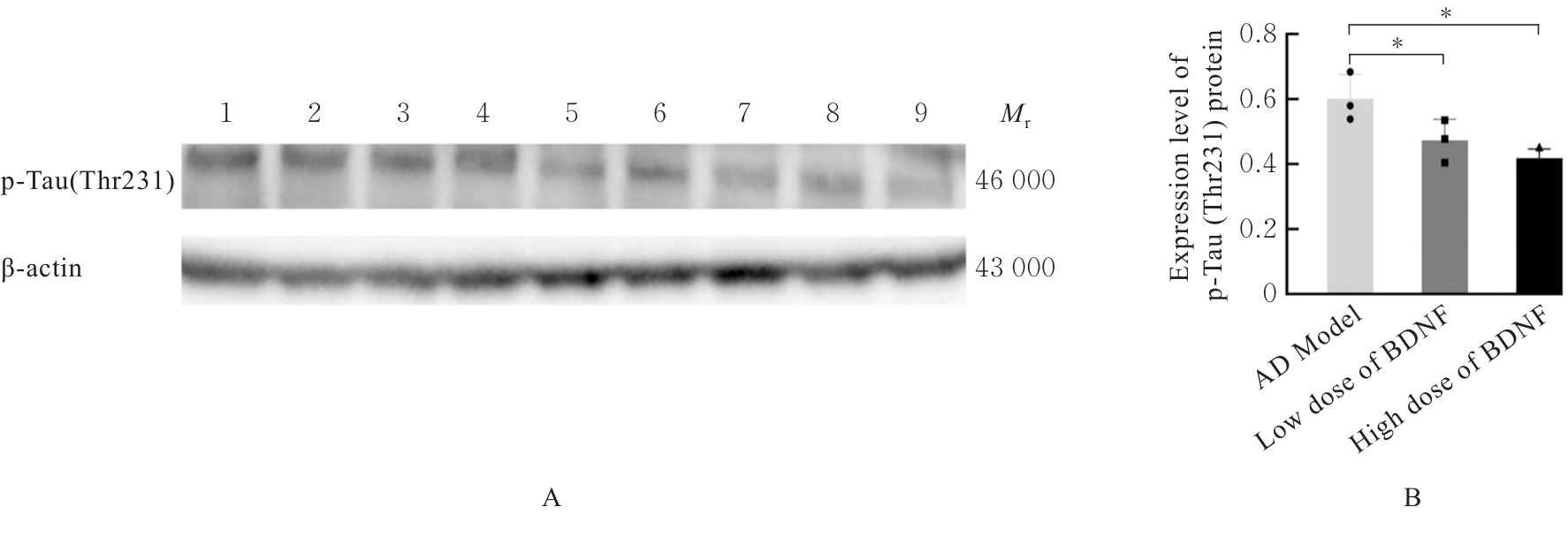
目的 探讨外源性脑源性神经营养因子(BDNF)靶向脂质体对阿尔茨海默病(AD)模型大鼠学习和记忆能力的改善作用,并阐明其可能作用机制。 方法 32只SD雄性大鼠随机分为假手术组、AD模型组、低剂量BDNF组和高剂量BDNF组。除假手术组外,其余各组大鼠制备AD模型。低和高剂量BDNF组大鼠分别经尾静脉注射1及2 μL外源性BDNF脂质体。采用Morris水迷宫实验检测各组大鼠学习记忆能力,免疫组织化学染色法检测各组大鼠海马组织中BDNF蛋白表达水平和分布,Western blotting法检测各组大鼠海马组织中磷酸化Tau(p-Tau)(Thr231)蛋白表达水平。 结果 Morris水迷宫实验,与假手术组比较,AD模型组大鼠逃避潜伏期明显延长(P<0.05);与AD模型组比较,低和高剂量BDNF组大鼠穿越平台次数及目标象限停留时间明显增多(P<0.05)。免疫组织化学染色法,与AD模型组比较,低和高剂量BDNF组大鼠皮层及海马组织中BDNF蛋白表达水平均明显升高(P<0.01)。Western blotting法,与AD模型组比较,低和高剂量BDNF组大鼠海马组织中p-Tau(Thr231)蛋白表达水平均明显降低(P<0.01);与低剂量BDNF组比较,高剂量BDNF组大鼠海马组织中p-Tau(Thr231)蛋白表达水平差异无统计学意义(P>0.05)。 结论 静脉给予外源性BDNF脂质体可改善AD模型大鼠学习和记忆能力,其机制可能与上调脑皮层和海马组织中BDNF蛋白表达水平及降低海马组织中p-Tau(Thr231)蛋白表达水平有关。

关键词: 外源性脑源性神经营养因子脂质体, 阿尔茨海默病, 学习能力, 记忆能力, 大鼠, SD

Abstract:

Objective To discuss the improvement effect of exogenous brain-derived neurotrophic factor (BDNF) targeted liposomes on the learning and memory abilities of Alzheimer’s disease (AD) model rats, and to clarify its possible mechanism. Methods Thirty-two SD male rats were randomly divided into sham operation group, AD model group, low dose of BDNF group, and high dose of BDNF group. Except for sham operation group, the rats in the other groups were prepared as AD models. The rats in low and high doses of BDNF groups were injected with 1 and 2 μL of exogenous BDNF liposomes via tail vein, respectively. Morris water maze test was used to detect the learning and memory abilities of the rats in various groups; immunohistochemistry staining was used to detect the expression level and distribution of BDNF protein in hippocampus tissue of the rats in various groups; Western blotting method was used to detect the expression levels of phosphorylated Tau (p-Tau) (Thr231) protein in hippocampus tissue of the rats in various groups. Results The Morris water maze test results showed that compared with sham operation group, the escape latency of the rats in AD model group was significantly prolonged (P<0.05); compared with AD model group, the numbers of crossing platform position and the residence time in target quadrant of the rats in low and high doses of BDNF groups were significantly increased (P<0.05). The immunohistochemistry staining results showed that compared with AD model group, the expression levels of BDNF protein in cortex and hippocampus tissues of the rats in low and high doses of BDNF groups were significantly increased (P<0.01). The Western blotting method results showed that compared with AD model group, the expression levels of p-Tau (Thr231) protein in hippocampus tissue of the rats in low and high doses of BDNF groups were significantly decreased (P<0.01); compared with low dose of BDNF group, the expression level of p-Tau (Thr231) protein in hippocampus tissue of the rats in high dose of BDNF group had no statistically significant difference (P>0.05). Conclusion Intravenous administration of exogenous BDNF liposomes can improve the learning and memory abilities of AD model rats, and the mechanism may be related to up-regulating the expression level of BDNF protein in cerebral cortex and hippocampus tissue and decreasing the expression level of p-Tau (Thr231) protein in hippocampus tissue.

Key words: Exogenous brain-derived neurotrophic factor liposomes, Alzheimer’s disease, Learning ability, Memory ability, Rats,SD

中图分类号: 

  • R743