Journal of Jilin University(Medicine Edition) ›› 2025, Vol. 51 ›› Issue (3): 831-838.doi: 10.13481/j.1671-587X.20250330
• Review • Previous Articles Next Articles
Research progress in therapeutic strategy of human immunodeficiency virus type 1 latenty by targeting Tat
Haobo HU,Chen HUAN( )
)
- Institute of Virology and AIDS Research,First Hospital,Jilin University,Changchun 130021,China
-
Received:2024-03-15Accepted:2024-05-11Online:2025-05-28Published:2025-07-18 -
Contact:Chen HUAN E-mail:lmsxsml@jlu.edu.cn

CLC Number:
- R512.91
Cite this article
Haobo HU,Chen HUAN. Research progress in therapeutic strategy of human immunodeficiency virus type 1 latenty by targeting Tat[J].Journal of Jilin University(Medicine Edition), 2025, 51(3): 831-838.
share this article
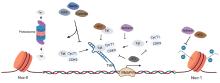
Fig. 1
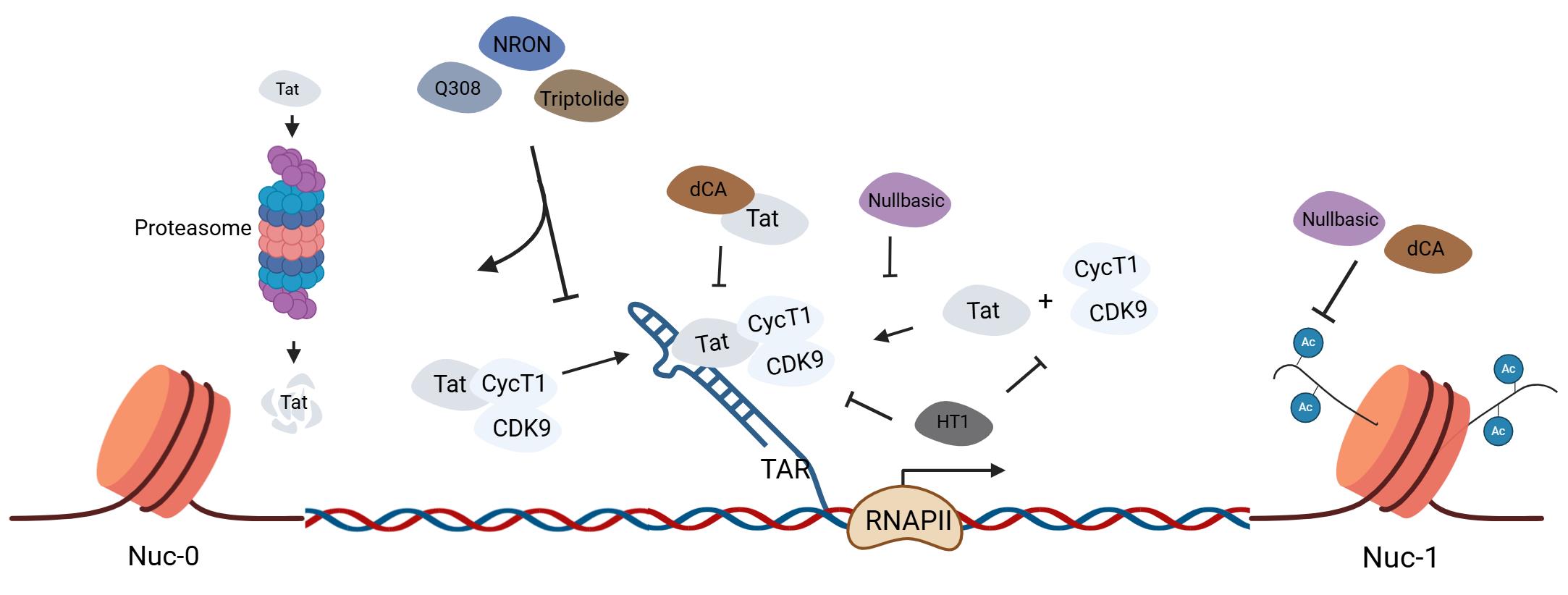
Mechanism of LPAs by targeting Tat proteinNote: dCA hinders the interaction between Tat and TAR by binding Tat; Nullbasic inhibits the trans-activating function of Tat; HT1 inhibit the interaction between Tat and P-TEFb (CycT1 and CDK9); dCA and Nullbasic inhibit the acetylation of Nuc-1 histone; Triptolide, NRON and Q308 induce Tat degradation via the proteasom."
| [1] | VAN HEUVEL Y, SCHATZ S, ROSENGARTEN J F, et al. Infectious RNA: human immunodeficiency virus (HIV) biology, therapeutic intervention, and the quest for a vaccine[J]. Toxins (Basel), 2022, 14(2): 138. |
| [2] | CHEN J, ZHOU T, ZHANG Y, et al. The reservoir of latent HIV[J]. Front Cell Infect Microbiol, 2022, 12: 945956. |
| [3] | JIN H P, LI D S, LIN M H, et al. Tat-based therapies as an adjuvant for an HIV-1 functional cure[J]. Viruses, 2020, 12(4): 415. |
| [4] | KAMORI D, UENO T. HIV-1 tat and viral latency: what we can learn from naturally occurring sequence variations[J]. Front Microbiol, 2017, 8: 80. |
| [5] | PAU A K, GEORGE J M. Antiretroviral therapy: current drugs[J]. Infect Dis Clin North Am, 2014, 28(3): 371-402. |
| [6] | GARCÍA F, PLANA M, VIDAL C, et al. Dynamics of viral load rebound and immunological changes after stopping effective antiretroviral therapy[J]. AIDS, 1999, 13(11): F79-F86. |
| [7] | VANSANT G, BRUGGEMANS A, JANSSENS J, et al. Block-and-lock strategies to cure HIV infection[J]. Viruses, 2020, 12(1): 84. |
| [8] | LI C, MOUSSEAU G, VALENTE S T. Tat inhibition by didehydro-Cortistatin A promotes heterochromatin formation at the HIV-1 long terminal repeat[J]. Epigenetics Chromatin, 2019, 12(1): 23. |
| [9] | SILICIANO R F, GREENE W C. HIV latency[J]. Cold Spring Harb Perspect Med, 2011, 1(1): a007096. |
| [10] | GARCÍA M, BUZÓN M J, BENITO J M, et al. Peering into the HIV reservoir[J]. Rev Med Virol, 2018, 28(4): e1981. |
| [11] | KO A, KANG G B, HATTLER J B, et al. Macrophages but not astrocytes harbor HIV DNA in the brains of HIV-1-infected aviremic individuals on suppressive antiretroviral therapy[J]. J Neuroimmune Pharmacol, 2019, 14(1): 110-119. |
| [12] | CASTRO-GONZALEZ S, COLOMER-LLUCH M, SERRA-MORENO R. Barriers for HIV cure: the latent reservoir[J]. AIDS Res Hum Retroviruses, 2018, 34(9): 739-759. |
| [13] | POMERANTZ R J, SESHAMMA T, TRONO D. Efficient replication of human immunodeficiency virus type 1 requires a threshold level of rev: potential implications for latency[J]. J Virol, 1992, 66(3): 1809-1813. |
| [14] | EMILIANI S, FISCHLE W, OTT M, et al. Mutations in the tat gene are responsible for human immunodeficiency virus type 1 postintegration latency in the U1 cell line[J]. J Virol, 1998, 72(2): 1666-1670. |
| [15] | DEEKS S G. HIV: shock and kill[J]. Nature, 2012, 487(7408): 439-440. |
| [16] | BOUCHAT S, GATOT J S, KABEYA K, et al. Histone methyltransferase inhibitors induce HIV-1 recovery in resting CD4+ T cells from HIV-1-infected HAART-treated patients[J]. AIDS, 2012, 26(12): 1473-1482. |
| [17] | QI X H, KOYA Y, SAITOH T, et al. Efficient induction of HIV-1 replication in latently infected cells through contact with CD4+ T cells: involvement of NF-kappaB activation[J]. Virology, 2007, 361(2): 325-334. |
| [18] | KHOURY G, MOTA T M, LI S, et al. HIV latency reversing agents act through Tat post translational modifications[J]. Retrovirology, 2018, 15(1): 36. |
| [19] | GALLO R C. Shock and kill with caution[J]. Science, 2016, 354(6309): 177-178. |
| [20] | SCARBOROUGH R J, GATIGNOL A. RNA interference therapies for an HIV-1 functional cure[J]. Viruses, 2017, 10(1): 8. |
| [21] | XIAO Q Q, GUO D Y, CHEN S L. Application of CRISPR/Cas9-based gene editing in HIV-1/AIDS therapy[J]. Front Cell Infect Microbiol, 2019, 9: 69. |
| [22] | MEDIOUNI S, CHINTHALAPUDI K, EKKA M K, et al. Didehydro-cortistatin A inhibits HIV-1 by specifically binding to the unstructured basic region of tat[J]. mBio, 2019, 10(1): e02662-18. |
| [23] | ZHOU C L, HUANG Y F, LI Y B, et al. A new small-molecule compound, Q308, silences latent HIV-1 provirus by suppressing tat- and FACT-mediated transcription[J]. Antimicrob Agents Chemother, 2021, 65(12): e0047021. |
| [24] | CAFARO A, SCHIETROMA I, SERNICOLA L, et al. Role of HIV-1 tat protein interactions with host receptors in HIV infection and pathogenesis[J]. Int J Mol Sci, 2024, 25(3): 1704. |
| [25] | AJASIN D, EUGENIN E A. HIV-1 tat: role in bystander toxicity[J]. Front Cell Infect Microbiol, 2020, 10: 61. |
| [26] | ASAMITSU K, FUJINAGA K, OKAMOTO T. HIV tat/P-TEFb interaction: a potential target for novel anti-HIV therapies[J]. Molecules, 2018, 23(4): 933. |
| [27] | RAZOOKY B S, PAI A, AULL K, et al. A hardwired HIV latency program[J]. Cell, 2015, 160(5): 990-1001. |
| [28] | DONAHUE D A, KUHL B D, SLOAN R D, et al. The viral protein Tat can inhibit the establishment of HIV-1 latency[J]. J Virol, 2012, 86(6): 3253-3263. |
| [29] | DEMARCHI F, D’ADDA DI FAGAGNA F, FALASCHI A, et al. Activation of transcription factor NF-kappaB by the Tat protein of human immunodeficiency virus type 1[J]. J Virol, 1996, 70(7): 4427-4437. |
| [30] | TA T M, MALIK S, ANDERSON E M, et al. Insights into persistent HIV-1 infection and functional cure: novel capabilities and strategies[J]. Front Microbiol, 2022, 13: 862270. |
| [31] | LIN X, IRWIN D, KANAZAWA S, et al. Transcriptional profiles of latent human immunodeficiency virus in infected individuals: effects of Tat on the host and reservoir[J]. J Virol, 2003, 77(15): 8227-8236. |
| [32] | ALI A, MISHRA R, KAUR H, et al. HIV-1 Tat: an update on transcriptional and non-transcriptional functions[J]. Biochimie, 2021, 190: 24-35. |
| [33] | LIANG T Z, ZHANG Q, WU Z Y, et al. UHRF1 suppresses HIV-1 transcription and promotes HIV-1 latency by competing with p-TEFb for ubiquitination-proteasomal degradation of tat[J]. mBio, 2021, 12(4): e0162521. |
| [34] | KONG W L, BISWAS A, ZHOU D W, et al. Nucleolar protein NOP2/NSUN1 suppresses HIV-1 transcription and promotes viral latency by competing with Tat for TAR binding and methylation[J]. PLoS Pathog, 2020, 16(3): e1008430. |
| [35] | LU H S, LI Z C, XUE Y H, et al. Viral-host interactions that control HIV-1 transcriptional elongation[J]. Chem Rev, 2013, 113(11): 8567-8582. |
| [36] | AOKI S, WATANABE Y, SANAGAWA M, et al. Cortistatins A, B, C, and D, anti-angiogenic steroidal alkaloids, from the marine sponge Corticium simplex[J]. J Am Chem Soc, 2006, 128(10): 3148-3149. |
| [37] | RICE A P. Unexpected mutations in HIV-1 that confer resistance to the tat inhibitor didehydro-cortistatin A[J]. mBio, 2019, 10(4): e01547-19. |
| [38] | KESSING C F, NIXON C C, LI C, et al. In vivo suppression of HIV rebound by didehydro-cortistatin A, a “block-and-lock” strategy for HIV-1 treatment[J]. Cell Rep, 2017, 21(3): 600-611. |
| [39] | MOUSSEAU G, KESSING C F, FROMENTIN R, et al. The tat inhibitor didehydro-cortistatin A prevents HIV-1 reactivation from latency[J]. mBio, 2015, 6(4): e00465. |
| [40] | LI C, MORI L, VALENTE S T. The block-and-lock strategy for human immunodeficiency virus cure: lessons learned from didehydro-cortistatin A[J]. J Infect Dis, 2021, 223(12 ): 46-53. |
| [41] | MEDIOUNI S, JABLONSKI J, PARIS J J, et al. Didehydro-cortistatin A inhibits HIV-1 Tat mediated neuroinflammation and prevents potentiation of cocaine reward in Tat transgenic mice[J]. Curr HIV Res, 2015, 13(1): 64-79. |
| [42] | MEREDITH L W, SIVAKUMARAN H, MAJOR L, et al. Potent inhibition of HIV-1 replication by a tat mutant[J]. PLoS One, 2009, 4(11): e7769. |
| [43] | JIN H P, LI D S, SIVAKUMARAN H, et al. Shutdown of HIV-1 transcription in T cells by nullbasic, a mutant tat protein[J]. mBio, 2016, 7(4): e00518-16. |
| [44] | RUSTANTI L, JIN H P, LOR M, et al. A mutant Tat protein inhibits infection of human cells by strains from diverse HIV-1 subtypes[J]. Virol J, 2017, 14(1): 52. |
| [45] | LIN M H, SIVAKUMARAN H, JONES A, et al. A HIV-1 Tat mutant protein disrupts HIV-1 Rev function by targeting the DEAD-box RNA helicase DDX1[J]. Retrovirology, 2014, 11: 121. |
| [46] | FRALDI A, VARRONE F, NAPOLITANO G, et al. Inhibition of tat activity by the HEXIM1 protein[J]. Retrovirology, 2005, 2: 42. |
| [47] | LEOZ M, KUKANJA P, LUO Z P, et al. HEXIM1-Tat chimera inhibits HIV-1 replication[J]. PLoS Pathog, 2018, 14(11): e1007402. |
| [48] | LUO H, VONG C T, CHEN H B, et al. Naturally occurring anti-cancer compounds: shining from Chinese herbal medicine[J]. Chin Med, 2019, 14: 48. |
| [49] | LIANG X, XIE R X, SU J F, et al. Inhibition of RNA polymerase Ⅲ transcription by Triptolide attenuates colorectal tumorigenesis[J]. J Exp Clin Cancer Res, 2019, 38(1): 217. |
| [50] | WAN Z T, CHEN X L. Triptolide inhibits human immunodeficiency virus type 1 replication by promoting proteasomal degradation of Tat protein[J]. Retrovirology, 2014, 11: 88. |
| [51] | HERMAN A B, TSITSIPATIS D, GOROSPE M. Integrated lncRNA function upon genomic and epigenomic regulation[J]. Mol Cell, 2022, 82(12): 2252-2266. |
| [52] | LI J, CHEN C C, MA X C, et al. Long noncoding RNA NRON contributes to HIV-1 latency by specifically inducing tat protein degradation[J]. Nat Commun, 2016, 7: 11730. |
| [53] | JEONG E, MARTINA J A, CONTRERAS P S, et al. The FACT complex facilitates expression of lysosomal and antioxidant genes through binding to TFEB and TFE3[J]. Autophagy, 2022, 18(10): 2333-2349. |
| [1] | Jiaxiang ZHANG,Yang CAO,Chen HUAN. Research progress in impact of post-translational modifications of HIV-1 Tat protein on regulatory mechanisms of HIV-1 transcription and replication [J]. Journal of Jilin University(Medicine Edition), 2026, 52(3): 854-862. |
| [2] | Guofeng HUANG,Congyi LI,Hong WANG,Wenyan ZHANG. Research progress in inhibitors of structural protein Gag-Pol of human immunodeficiency virus and its mechanism [J]. Journal of Jilin University(Medicine Edition), 2024, 50(4): 1156-1163. |
| [3] | GUO Wei,MENG Xiao-jun,QIU Bai-hong,MENG Xiang-dong,WANG Lu,QIN Qian-qian,DING Zh. Estimation and projection of HIV epidemic among high-risk population in Jilin province [J]. J4, 2011, 37(4): 754-758. |
| [4] | YANG Huai-ning,XU Hui,PU Yun,YU Xiang-hui,ZHANG Yu,ZHAO Da-li,SUN Zhi-wei. Expression and preliminary activity identification of several linked antigen epitopes of consensce genes of HIV [J]. J4, 2008, 34(2): 217-220. |
|