Journal of Jilin University(Medicine Edition) ›› 2026, Vol. 52 ›› Issue (4): 1086-1095.doi: 10.13481/j.1671-587X.20260421
• Research in clinical medicine • Previous Articles
Construction and validation of machine learning-based prediction models for esophageal cancer using routine clinical laboratory data
Rui LI,Xiaoyan HAO,Liu YANG,Jiayun LIU,Mu HE( )
)
- Department of Clinical Laboratory Medicine,First Affiliated Hospital,Air Force Medical University,Xi’an 710032,China
-
Received:2025-11-06Accepted:2026-01-04Online:2026-07-28Published:2026-07-27 -
Contact:Mu HE E-mail:394092811@qq.com

CLC Number:
- R446
Cite this article
Rui LI,Xiaoyan HAO,Liu YANG,Jiayun LIU,Mu HE. Construction and validation of machine learning-based prediction models for esophageal cancer using routine clinical laboratory data[J].Journal of Jilin University(Medicine Edition), 2026, 52(4): 1086-1095.
share this article

Tab.1
Baseline characteristics of subjects in training set and test set"
| Variable | All subjects | Training set | Test set | P |
|---|---|---|---|---|
| Diagnosis [n(%)] | 0.972 4 | |||
| HC | 3 297(54.41) | 2 747(83.32) | 550(16.68) | |
| EC | 2 763(45.59) | 2 303(83.35) | 460(16.65) | |
| HC | ||||
| Age (x±s, year) | 57.25 | 57.81 | 56.64 | 0.099 8 |
| Gender [n(%)] | 0.495 0 | |||
| Male | 1 800(54.60) | 1 507(54.86) | 293(53.27) | |
| Female | 1 497(45.40) | 1 240(45.14) | 257(46.73) | |
| Smoking status [n(%)] | 271(8.22) | 229(8.34) | 42(7.64) | 0.585 4 |
| Alcohol consumption [n(%)] | 73(2.21) | 59(2.14) | 14(2.55) | 0.562 9 |
| EC | ||||
| Age (x±s, year) | 59.98 | 59.37 | 60.75 | 0.776 9 |
| Gender [n(%)] | 0.384 9 | |||
| Male | 1 547(55.99) | 1281(55.62) | 266(57.83) | |
| Female | 1 216(44.01) | 1022(44.38) | 194(42.17) | |
| Smoking status [n(%)] | 223(8.07) | 188(8.16) | 35(7.61) | 0.690 1 |
| Alcohol consumption [n(%)] | 69(2.50) | 58(2.52) | 11(2.39) | 0.873 2 |
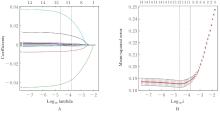
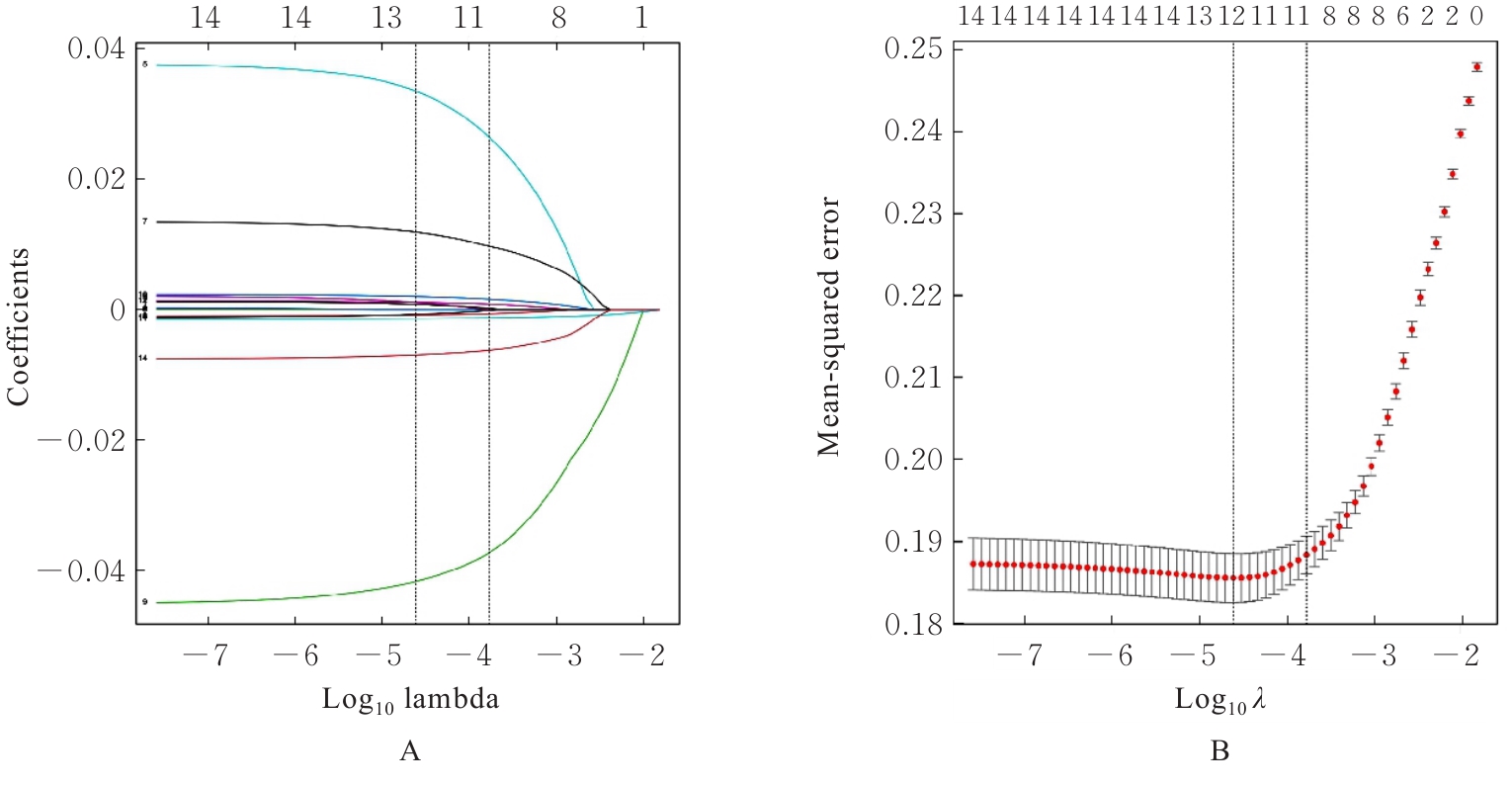
Fig. 1
Feature factors selected by LASSO regression analysis"
Tab.2
Clinical indicators of subjects in HC group and EC group"
| Group | ALP [λB/(IU·L-1)] | UA [cB/(μmol·L-1)] | Cr [cB/(μmol·L-1)] | TP [ρB/(g·L-1)] | CEA [ρB/(μg·L-1)] |
|---|---|---|---|---|---|
| Control | 75.000(65.000,87.000) | 325.000(271.000,388.000) | 73.000(59.000,91.000) | 74.300(70.900,77.600) | 1.790(1.180,2.640) |
| EC | 85.000(71.000,100.000) | 269.000(226.000,317.000) | 85.000(69.000,97.000) | 71.900(68.200,75.659) | 2.430(1.560,3.680) |
| Z | -17.582 | 26.263 | -15.869 | 16.571 | -18.885 |
| P | <0.001 | <0.001 | <0.001 | <0.001 | <0.001 |
| Group | UCQ(V/μL) | RDW-SD(V/fL) | PLT(×109 L-1) | PDW(V/fL) | ALT[λB/(IU·L-1)] |
| Control | 0.000(0.000,0.140) | 42.900(41.500,44.700) | 220.000(186.000,257.000) | 15.500(12.800,16.200) | 20.000(15.000,28.000) |
| EC | 0.400(0.130,0.883) | 44.000(41.900,47.000) | 205.000(162.000,254.000) | 12.500(10.800,14.600) | 15.000(11.000,21.000) |
| Z | -34.378 | -13.597 | 8.967 | 25.673 | 20.740 |
| P | <0.001 | <0.001 | <0.001 | <0.001 | <0.001 |
Tab.3
Algorithm performance of six machine learning models in distinguishing subjects in HC group and EC group"
| Modol | SENa | SPEb | ACCc | PPVd | NPVe | F1 score | Kappa | AUCf |
|---|---|---|---|---|---|---|---|---|
| Training cohort | ||||||||
| XGBoost | 0.999 (0.999-1.000) | 1.000 (1.000-1.000) | 1.000 (0.999-1.000) | 1.000 (0.999-1.000) | 0.999 (0.999-1.000) | 1.000 (0.999-1.000) | 0.999 (0.998-1.000) | 1.000 (1.000-1.000) |
| LR | 0.808 (0.795-0.820) | 0.778 (0.771-0.786) | 0.792 (0.786-0.798) | 0.753 (0.747-0.759) | 0.828 (0.820-0.837) | 0.779 (0.772-0.786) | 0.583 (0.571-0.594) | 0.866(0.856-0.876) |
| LightGBM | 0.977 (0.973-0.981) | 0.981 (0.976-0.985) | 0.979 (0.977-0.981) | 0.977 (0.972-0.983) | 0.981 (0.977-0.984) | 0.977 (0.975-0.979) | 0.958 (0.954-0.961) | 0.998(0.997-0.999) |
| RF | 0.999 (0.998-0.999) | 0.998 (0.996-0.999) | 0.998 (0.997-0.999) | 0.997 (0.995-0.999) | 0.999 (0.998-0.999) | 0.998 (0.997-0.999) | 0.996 (0.994-0.998) | 1.000(1.000-1.000) |
| AdaBoost | 0.851 (0.833-0.870) | 0.882 (0.862-0.902) | 0.868 (0.866-0.871) | 0.859 (0.842-0.876) | 0.877 (0.865-0.888) | 0.855 (0.853-0.857) | 0.734 (0.729-0.738) | 0.942(0.936-0.948) |
| DT | 1.000 (1.000-1.000) | 1.000 (1.000-1.000) | 1.000 (1.000-1.000) | 1.000 (1.000-1.000) | 1.000 (1.000-1.000) | 1.000 (1.000-1.000) | 1.000 (1.000-1.000) | 1.000 (1.000-1.000) |
| Test cohort | ||||||||
| XGBoost | 0.865 (0.851-0.879) | 0.887 (0.876-0.898) | 0.877 (0.875-0.879) | 0.865 (0.855-0.875) | 0.887 (0.878-0.896) | 0.865 (0.862-0.868) | 0.752 (0.747-0.756) | 0.948(0.937-0.960) |
| LR | 0.803 (0.791-0.814) | 0.775 (0.757-0.794) | 0.788 (0.777-0.798) | 0.750 (0.735-0.765) | 0.824 (0.816-0.833) | 0.775 (0.766-0.785) | 0.575 (0.555-0.595) | 0.865(0.844-0.885) |
| LightGBM | 0.869 (0.852-0.886) | 0.890 (0.879-0.901) | 0.880 (0.873-0.888) | 0.869 (0.858-0.880) | 0.890 (0.878-0.903) | 0.869 (0.860-0.877) | 0.759 (0.744-0.774) | 0.953(0.942-0.964) |
| RF | 0.851 (0.831-0.870) | 0.883 (0.872-0.894) | 0.868 (0.862-0.874) | 0.859 (0.850-0.869) | 0.876 (0.863-0.889) | 0.855 (0.847-0.863) | 0.734 (0.722-0.747) | 0.941(0.929-0.954) |
| AdaBoost | 0.835 (0.812-0.858) | 0.869 (0.835-0.903) | 0.854 (0.843-0.864) | 0.845 (0.813-0.876) | 0.863 (0.851-0.876) | 0.839 (0.831-0.847) | 0.705 (0.685-0.725) | 0.929(0.915-0.943) |
| DT | 0.796 (0.790-0.802) | 0.827 (0.820-0.834) | 0.813 (0.808-0.818) | 0.794 (0.787-0.801) | 0.829 (0.824-0.833) | 0.795 (0.790-0.800) | 0.623 (0.612-0.633) | 0.811 (0.789-0.834) |
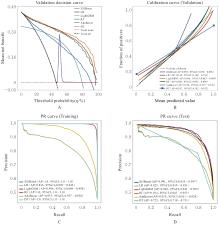
Fig. 2
Comprehensive performance analysis of six ML models"
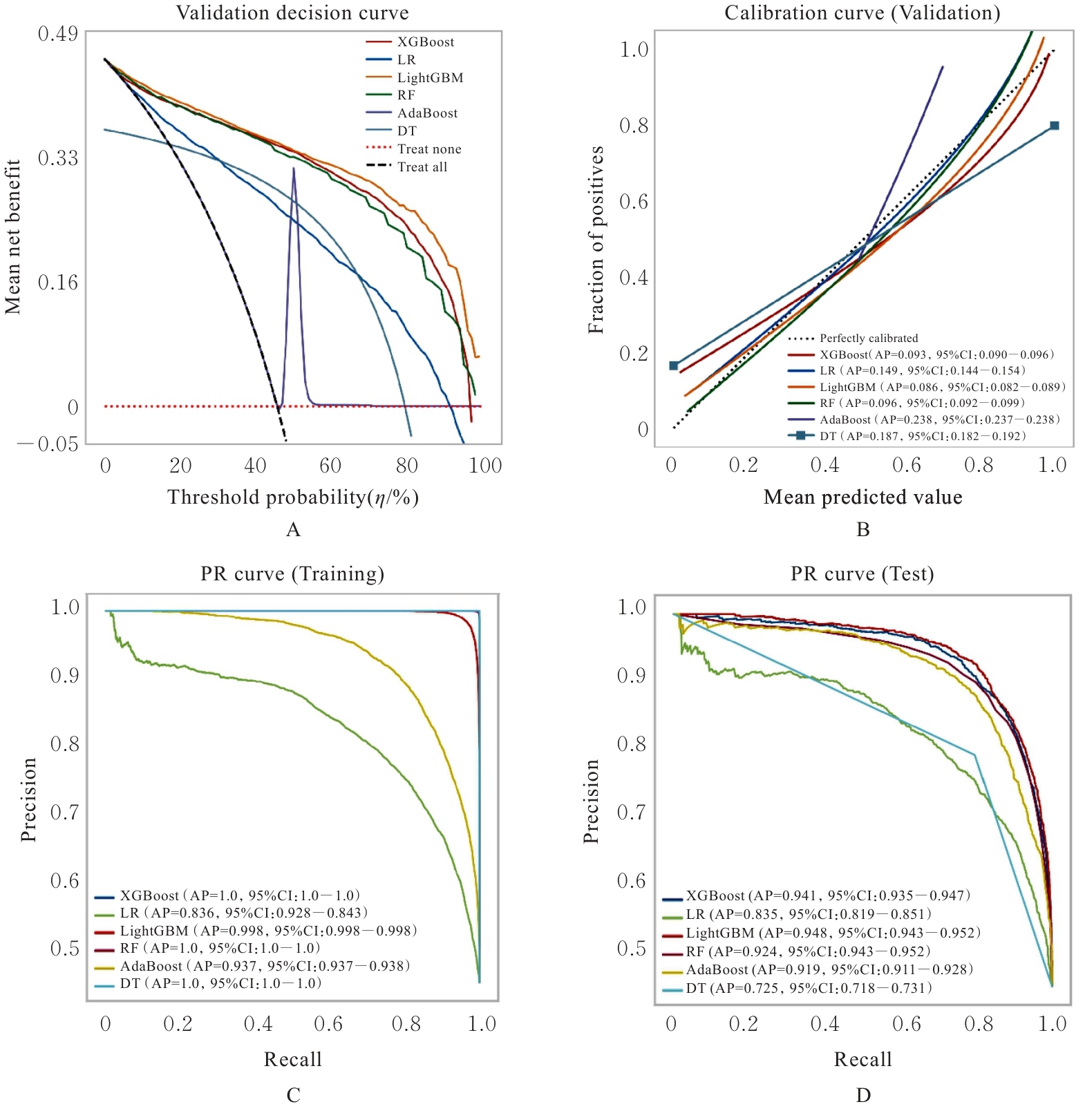
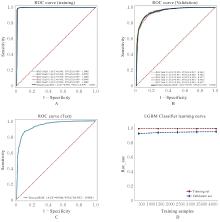
Fig. 3
Training, validation, and testing of LightGBM model"
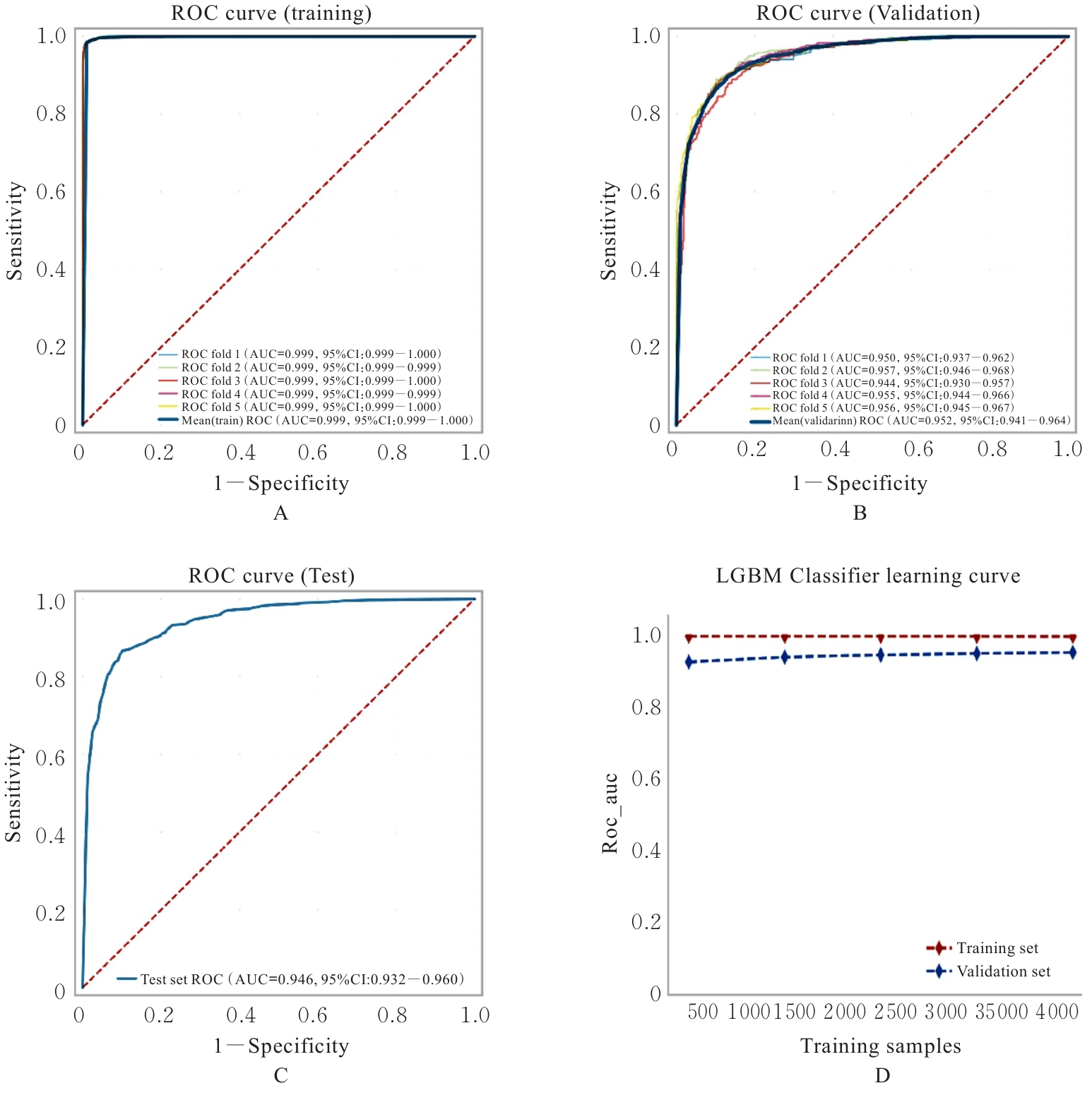
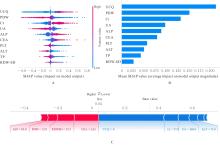
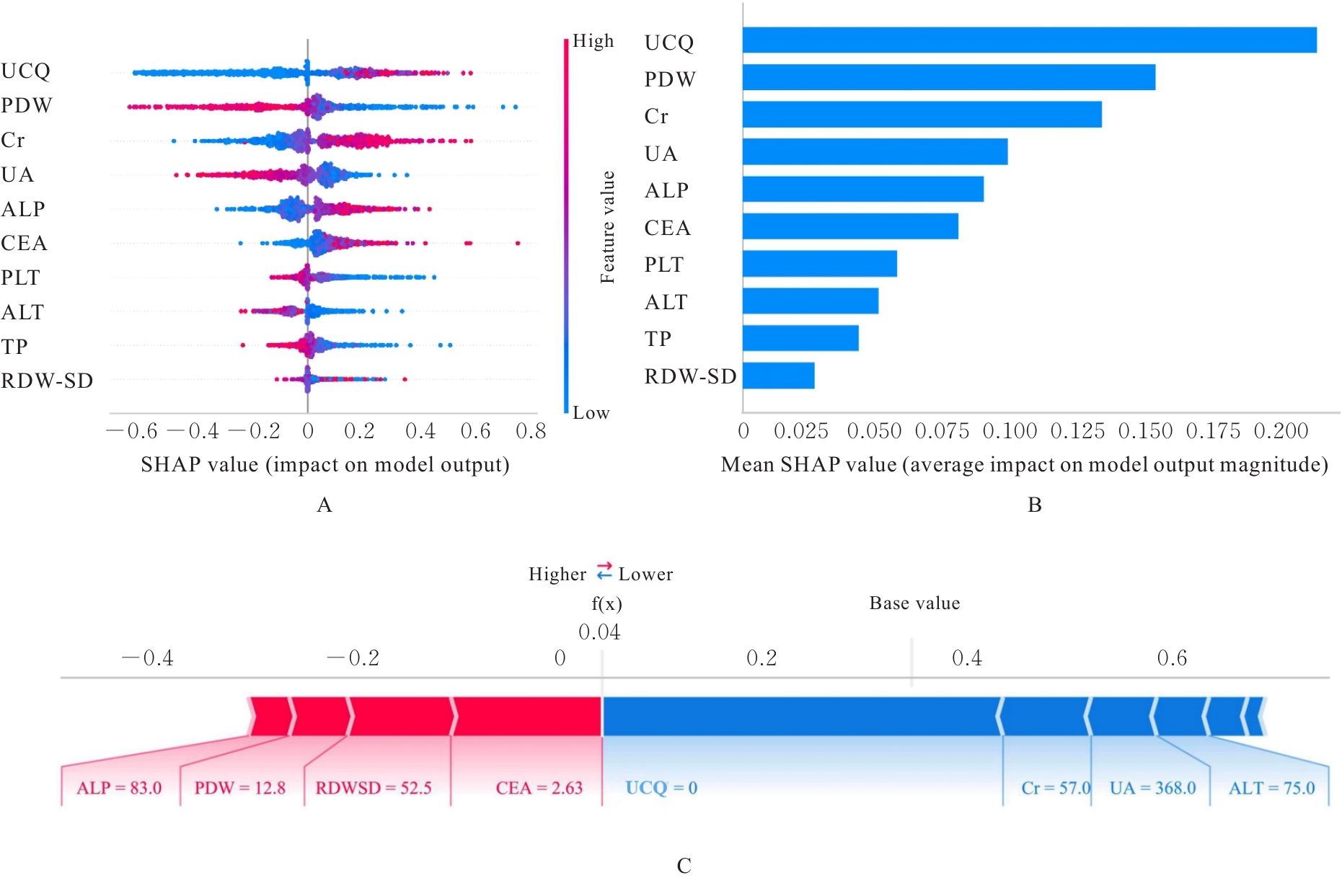
Fig. 4
SHAP of EC risk prediction model"
| [1] | ZHU H C, MA X, YE T, et al. Esophageal cancer in China: Practice and research in the new era[J]. Int J Cancer, 2023, 152(9): 1741-1751. |
| [2] | SHEIKH M, ROSHANDEL G, MCCORMACK V, et al. Current status and future prospects for esophageal cancer[J]. Cancers, 2023, 15(3): 765. |
| [3] | ZHANG K Q, WU X W, WANG J H, et al. Circulating miRNA profile in esophageal adenocarcinoma[J]. Am J Cancer Res, 2016, 6(11): 2713-2721. |
| [4] | CRAIG M P, RAJAKARUNA S, PALIY O, et al. Differential microRNA signatures in the pathogenesis of Barrett’s esophagus[J]. Clin Transl Gastroenterol, 2020, 11(1): e00125. |
| [5] | WANG L, JI F, LIU G, et al. Upregulation of circulating miR130a is correlated with development of Barrett’s esophagus and esophageal adenocarcinoma[J]. Onco Targets Ther, 2018, 12: 1-7. |
| [6] | KAZ A M, GRADY W M. Epigenetic biomarkers in esophageal cancer[J]. Cancer Lett, 2014, 342(2): 193-199. |
| [7] | ERGUN P, KIPCAK S, BOR S. Epigenetic alterations from Barrett’s esophagus to esophageal adenocarcinoma[J]. Int J Mol Sci, 2023, 24(9): 7817. |
| [8] | YU Y, CHEN X X, CANG S D. Cancer-related long noncoding RNAs show aberrant expression profiles and competing endogenous RNA potential in esophageal adenocarcinoma[J]. Oncol Lett, 2019, 18(5): 4798-4808. |
| [9] | BHATT A, PARSI M A, STEVENS T, et al. Volatile organic compounds in plasma for the diagnosis of esophageal adenocarcinoma: a pilot study[J]. Gastrointest Endosc, 2016, 84(4): 597-603. |
| [10] | DEO R C. Machine learning in medicine[J]. Circulation, 2015, 132(20): 1920-1930. |
| [11] | DU Y H, MCNESTRY C, WEI L, et al. Machine learning-based clinical decision support systems for pregnancy care: a systematic review[J]. Int J Med Inform, 2023, 173: 105040. |
| [12] | OBUCHOWSKI N A, BULLEN J A. Receiver operating characteristic (ROC) curves: review of methods with applications in diagnostic medicine[J]. Phys Med Biol, 2018, 63(7): 07TR01. |
| [13] | FENLON C, O’GRADY L, DOHERTY M L, et al. A discussion of calibration techniques for evaluating binary and categorical predictive models[J]. Prev Vet Med, 2018, 149: 107-114. |
| [14] | LI W K, GUO Q H. Plotting receiver operating characteristic and precision-recall curves from presence and background data[J]. Ecol Evol, 2021, 11(15): 10192-10206. |
| [15] | BELKIN M, HSU D, MA S Y, et al. Reconciling modern machine-learning practice and the classical bias-variance trade-off[J]. Proc Natl Acad Sci U S A, 2019, 116(32): 15849-15854. |
| [16] | SAUERBREI W, ROYSTON P, BINDER H. Selection of important variables and determination of functional form for continuous predictors in multivariable model building[J]. Stat Med, 2007, 26(30): 5512-5528. |
| [17] | 国家卫生健康委员会医疗应急司. 食管癌筛查与早诊早治方案(2024年版)[J]. 中华肿瘤杂志, 2024, 46(10): 913-914. |
| [18] | MUSCHELLI J. ROC and AUC with a binary predictor: a potentially misleading metric[J]. J Classif, 2020, 37(3): 696-708. |
| [19] | HAN F Y, LIU Y Q, CHENG S Q, et al. Diagnosis and survival values of neutrophil-lymphocyte ratio (NLR) and red blood cell distribution width (RDW) in esophageal cancer[J]. Clin Chim Acta, 2019, 488: 150-158. |
| [20] | SU R X, ZHU J Y, WU S S, et al. Prognostic significance of platelet (PLT) and platelet to mean platelet volume (PLT/MPV) ratio during apatinib second-line or late-line treatment in advanced esophageal squamous cell carcinoma patients[J]. Technol Cancer Res Treat, 2022, 21: 15330338211072974. |
| [21] | ZHOU X Y, CHEN H, ZHANG W F, et al. Predictive value of routine blood test in patients with early esophageal cancer: a matched case-control study[J]. J Cancer, 2021, 12(15): 4739-4744. |
| [22] | WEI X L, ZHANG D S, HE M M, et al. The predictive value of alkaline phosphatase and lactate dehydrogenase for overall survival in patients with esophageal squamous cell carcinoma[J]. Tumour Biol, 2016, 37(2): 1879-1887. |
| [23] | HUANG J J, MI N N, YANG J L, et al. U-shaped relationship between serum uric acid and gastric cancer risk: a large prospective cohort study[J]. Front Oncol, 2024, 14: 1482814. |
| [24] | HADAVI S M S, OLIAEI S, SAIDI S, et al. Using data mining and association rules for early diagnosis of esophageal cancer[J]. Gulf J Oncolog, 2022, 1(40): 38-46. |
| [1] | Linrui XU,Yiyu ZHANG,Jiaqi CUI,Xianzhu CONG,Shuang LI,Jiayu GE,Yujia KONG,Suzhen WANG,Fuyan SHI,Jinrong WANG. Construction of diagnostic model for Alzheimer’s disease and immune analysis based on bioinformatics and machine learning [J]. Journal of Jilin University(Medicine Edition), 2025, 51(4): 1039-1051. |
| [2] | Pengli WU,Fengyu LI,Bo LIU,Yang LYU. Effect of silencing DDX39A gene on proliferation, migration and invasion of esophageal cancer TE-1 cells and its mechanism [J]. Journal of Jilin University(Medicine Edition), 2025, 51(1): 115-123. |
| [3] | Wenqing RUAN,Zerun FU,Yi HUANG,Longyun LI,Yao SUN,Kai LI. Application of hypotension prediction index in intraoperative hemodynamic management of robot-assisted laparoscopic cystectomy:A case report and literature review [J]. Journal of Jilin University(Medicine Edition), 2024, 50(4): 1130-1136. |
| [4] | Chunyan KANG,Xiuzhi ZHANG,Huicong ZHOU,Jie CHEN. Effect of downregulating proline-rich protein 11 expression on drug resistance of esophageal cancer drug resistant cell EC9706/DDP and its mechanism [J]. Journal of Jilin University(Medicine Edition), 2024, 50(1): 113-119. |
| [5] | Canfei XU,Yan HUANG,Kaizhi ZHANG. Acute ischemic stroke patients with onset time within 4.5 h identified by machine learning combined with magnetic resonance diffusion weighted imaging [J]. Journal of Jilin University(Medicine Edition), 2023, 49(6): 1635-1641. |
| [6] | Yandi MA,Xiangyun LU,Shangfeng HE,Xueyan YU,Yunhua HU,Haixia GAO,Yunzhao CHEN,Jie YU,Wenjie WANG,Feng LI,Xiaobin CUI. Expression of m6A methylation binding protein YTHDF2 in esophageal carcinoma tissue and its effect on proliferation and migration of esophageal carcinoma cells [J]. Journal of Jilin University(Medicine Edition), 2022, 48(4): 962-970. |
| [7] | Chaofeng ZHOU,Shifan ZHOU,Qing TIAN,Sai WANG,Honglin LI,Chunzheng MA. Effect of lncRNA-NORAD overexpression on biological behaviors of esophageal cancer Eca-109 cells and its mechanism [J]. Journal of Jilin University(Medicine Edition), 2022, 48(1): 33-43. |
| [8] | LIU Yi, ZHU Lin, KANG Min. Effect of miR-302b-3p on proliferation and apoptosis of esophageal cancer EC-109 cells and its mechanism [J]. Journal of Jilin University(Medicine Edition), 2019, 45(06): 1346-1352. |
| [9] | ZHANG Ning, WANG Jianfeng, CHENG Guanghui, HE Mingyuan. Evaluation on curative effect of Xihuang Capsule in patients with advanced esophageal cancer treated with chemoradiotherapy [J]. Journal of Jilin University Medicine Edition, 2017, 43(04): 812-817. |
| [10] | WANG Qin, DU Liqing, WANG Yan, XU Chang, LI Jin, LIU Qiang. Inhibitory effect of Rb94 gene combined with radiotherapy on growth of esophageal carcinoma cells of tumor-bearing nude mice [J]. Journal of Jilin University Medicine Edition, 2017, 43(02): 220-224. |
| [11] | SUN Xiaohong, FANG Fuyuan, LI Hui, YIN Na, PANG Zuoliang, LI Huiwu. Expressions of MMP-2 and MMP-9 in tumor tissue of patients with esophageal squamous cell carcinoma and their significances [J]. Journal of Jilin University Medicine Edition, 2015, 41(04): 814-819. |
| [12] | KOU Wei,DOU Chun-jiang,ZHOU Yun-song,LAN Yong-mei,GU Qiao-ling. Expressions of MTSS1 and Cap43 in esophageal squamous cell carcinoma tissue and their clinical significances [J]. Journal of Jilin University Medicine Edition, 2014, 40(04): 842-846. |
| [13] | ZHANG Lu-chuan,WANG Feng,FAN Qing-xia . Expressions of TFPI-2 and MMP-9 in esophageal squamous cell carcinoma tissue and their relationship with vasculogenic mimicry [J]. Journal of Jilin University Medicine Edition, 2014, 40(03): 664-667. |
| [14] | WANG Xiu-lan,ZHAO Tong,CHEN Dan-feng,LI Lei,GUO Hai-yan,CHI Bao-rong. Relationship between p18 mRNA expression and esophageal cancer [J]. J4, 2011, 37(5): 919-922. |
| [15] | SUN Xun, MENG Xiang-Wei, ZOU YA-Bin, LIU Yan, WANG Xin-Hong. Application of immunohistochemical staining in diagnosis of esophageal spindle cell tumor [J]. J4, 2010, 36(5): 962-964. |
|
||