Journal of Jilin University(Medicine Edition) ›› 2021, Vol. 47 ›› Issue (1): 203-209.doi: 10.13481/j.1671-587x.20210128
• Imageology • Previous Articles Next Articles
Effects of three-dimensional transrectal ultrasound and MRI in evaluation of extramural vascular invasion degrees of middle and lower rectal cancer
Dong CHEN1,Haitao CHEN1,Zhiyao LI1,Fengming RANG2,Xi ZHANG3,Zhirui CHUAN1,Shicong TANG4( ),Xiaomao LUO1()
- 1.Department of Ultrasound,Cancer Hospital of Yunnan Province,Third Affiliated Hospital,Kunming Medical University,Kunming 650118,China
2.Department of Pathology,Cancer Hospital of Yunnan Province,Third Affiliated Hospital,Kunming Medical University,Kunming 650118,China
3.Department of Clinical Laboratory,Cancer Hospital of Yunnan Province,Third Affiliated Hospital,Kunming Medical University,Kunming 650118,China
4.Department of Breast Surgery,Cancer Hospital of Yunnan Province,Third Affiliated Hospital,Kunming Medical University,Kunming 650118,China
-
Received:2020-09-27Online:2021-01-28Published:2021-01-27 -
Contact:Shicong TANG,Xiaomao LUO E-mail:tang_shicong@126.com;blueskyluoxiaomao@163.com

CLC Number:
- R735.37
Cite this article
Dong CHEN,Haitao CHEN,Zhiyao LI,Fengming RANG,Xi ZHANG,Zhirui CHUAN,Shicong TANG,Xiaomao LUO. Effects of three-dimensional transrectal ultrasound and MRI in evaluation of extramural vascular invasion degrees of middle and lower rectal cancer[J].Journal of Jilin University(Medicine Edition), 2021, 47(1): 203-209.
share this article
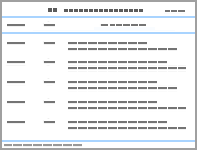
Tab.1
Positive rates of EMVI of rectal cancer patients with different clinicopathological features"
| Clinicopathological feature | n | EMVI(-) | EMVI(+) | χ2 | P |
|---|---|---|---|---|---|
| Gender | |||||
| Male | 54 | 44(81.5) | 10(18.5) | 0.029 | 0.864 |
| Female | 40 | 34(85.0) | 6(15.0) | ||
| Age(year) | |||||
| <60 | 42 | 40(95.2) | 2 (4.8) | 8.079 | 0.004 |
| ≥60 | 52 | 38(73.1) | 14(26.9) | ||
| Pathological T stage | |||||
| Tis/T1/T2 | 27 | 27(100.0) | 0 ( 0.0) | 8.524 | 0.014 |
| T3 | 22 | 18(81.8) | 4(18.2) | ||
| T4 | 45 | 33(73.3) | 12(26.7) | ||
| Pathological N stage | 11.119 | 0.004 | |||
| N0 | 60 | 53(88.3) | 7(11.7) | ||
| N1 | 19 | 17(89.5) | 2(10.5) | ||
| N2 | 15 | 8(53.3) | 7(46.7) | ||
| Histological type | |||||
| Poor differentiation | 5 | 1(20.0) | 4(80.0) | 17.566 | 0.001 |
| Poor-moderate differentiation | 12 | 10(83.3) | 2(16.7) | ||
| Moderate differentiation | 60 | 54(90.0) | 6(10.0) | ||
| Moderate/ Well differentiation | 12 | 8(66.7) | 4(33.3) | ||
| CEA level(ng·L-1) | |||||
| <5 | 67 | 61(91.0) | 6 (9.0) | 10.745 | 0.001 |
| ≥5 | 27 | 17(63.0) | 10(37.0) |
Tab.2
Results of 3D-ERUS and MRI in diagnosis of EMVI of patients with rectal cancer and pathological results"
| Method | EMVI(+) | EMVI(-) |
|---|---|---|
| 3D-ERUS | ||
| EMVI(+) | 13 | 3 |
| EMVI(-) | 6 | 72 |
| MRI | ||
| EMVI(+) | 12 | 4 |
| EMVI(-) | 8 | 70 |

Fig.1
3D-ERUS and MRI images of patients with positive rectal cancer"


Fig.2
ROC curves of efficiencies of 3D-ERUS and MRI in diagnosis of EMVI in patients with rectal cancer"

Tab.3
Efficiencies of 3D-ERUS and MRI in diagnosis of EMVI in patients with rectal cancer"
| Method | Sensitivity | Specificity | PPV | NPV |
|---|---|---|---|---|
| 3D-ERUS | 81.25 | 92.31 | 68.42 | 96.00 |
| MRI | 75.00 | 89.74 | 60.00 | 94.59 |
| 1 | BRAY F, FERLAY J, SOERJOMATARAM I,et al. Global cancer statistics 2018: GLOBOCAN estimates of incidence and mortality worldwide for 36 cancers in 185 countries[J]. CA Cancer J Clin, 2018, 68(6): 394-424. |
| 2 | BENSON A B, VENOOK A P, AL-HAWARY M M, et al. Rectal cancer,version 2.2018, NCCN clinical practice guidelines in oncology[J]. J Natl Compr Canc Netw, 2018, 16(7): 874-901. |
| 3 | SHIN Y M, PYO J S, PARK M J. The Impact of extramural venous invasion in colorectal cancer: a detailed analysis based on tumor location and evaluation methods[J]. Int J Surg Pathol, 2020, 28(2): 120-127. |
| 4 | DRESEN R C, PETERS E E, RUTTEN H J, et al. Local recurrence in rectal cancer can be predicted by histopathological factors[J]. Eur J Surg Oncol, 2009, 35(10): 1071-1077. |
| 5 | CHAND M, PALMER T, BLOMQVIST L, et al. Evidence for radiological and histopathological prognostic importance of detecting extramural venous invasion in rectal cancer: recommendations for radiology and histopathology reporting[J]. Colorectal Dis, 2015, 17(6): 468-473. |
| 6 | ALE ALI H, KIRSCH R, RAZAZ S, et al. Extramural venous invasion in rectal cancer: overview of imaging, histopathology, and clinical implications[J]. Abdom Radiol (NY), 2019, 44(1): 1-10. |
| 7 | GU C Y, YANG X Y, ZHANG X B, et al. The prognostic significance of MRI-detected extramural venous invasion, mesorectal extension, and lymph node status in clinical T3 mid-low rectal cancer[J]. Sci Rep, 2019, 9(1): 12523. |
| 8 | KENNEDY E D, SIMUNOVIC M, JHAVERI K, et al. Safety and feasibility of using magnetic resonance imaging criteria to identify patients with “good prognosis” rectal cancer eligible for primary surgery: The phase 2 nonrandomized QuickSilver clinical trial[J]. JAMA Oncol, 2019, 5(7): 961-966. |
| 9 | PINTO R A, CORREA NETO I J, NAHAS S C, et al. Efficacy of 3-dimensional endorectal ultrasound for staging early extraperitoneal rectal neoplasms[J]. Dis Colon Rectum, 2017, 60(5): 488-496. |
| 10 | SMITH N J, RARBACHANO Y, NORMAN A R, et al. Prognostic significance of magnetic resonance imaging-detected extramural vascular invasion in rectal cancer[J]. Br J Surg, 2008, 95(2): 229-236. |
| 11 | TALBOT I C,RITCHIE S,LEIGHTON M, et al. Invasion of veins by carcinoma of rectum: method of detection, histological features and significance[J]. Histopathology,1981, 5(2): 141-163. |
| 12 | SHIRAISHI T, SASAKI T, IKEDA K, et al. Predicting prognosis according to preoperative chemotherapy response in patients with locally advanced lower rectal cancer[J]. BMC Cancer, 2019, 19(1): 1222. |
| 13 | BROWN G, RADCLIFFE A G, NEWCOMBE R G, et al. Preoperative assessment of prognostic factors in rectal cancer using high-resolution magnetic resonance imaging[J]. Br J Surg, 2003, 90(3): 355-364. |
| 14 | CHAND M, EVANS J, SWIFT R I, et al. The prognostic significance of postchemoradiotherapy high-resolution MRI and histopathology detected extramural venous invasion in rectal cancer[J]. Ann Surg, 2015, 261(3): 473-479. |
| 15 | SERRA-ARACIL X, GALVEZ A, MORA-LOPEZ L, et al. Endorectal ultrasound in the identification of rectal tumors for transanal endoscopic surgery: factors influencing its accuracy[J]. Surg Endosc, 2018, 32(6): 2831-2838. |
| 16 | CHAN B P H, PATEL R, MBUAGBAW L, et al. EUS versus magnetic resonance imaging in staging rectal adenocarcinoma: a diagnostic test accuracy meta-analysis[J].Gastrointest Endosc, 2019, 90(2):196-203.e1. |
| 17 | OIEN K, FORSMO H M, ROSLER C,et al. Endorectal ultrasound and magnetic resonance imaging for staging of early rectal cancers: how well does it work in practice?[J]. Acta Oncol, 2019, 58(Sup1): S49-S54. |
| 18 | KOLEV N Y, TONEV A Y, IGNATOV V L, et al. The role of 3-D endorectal ultrasound in rectal cancer: our experience[J]. Int Surg, 2014, 99(2): 106-111. |
| 19 | TSAI C, HAGUE C, XIONG W, et al. Evaluation of endorectal ultrasound (ERUS) and MRI for prediction of circumferential resection margin (CRM) for rectal cancer[J]. Am J Surg, 2017, 213(5): 936-942. |
| 20 | YE D L, ZHU Z M, CHEN F, et al. Correlation between endorectal ultrasound and magnetic resonance imaging for predicting the circumferential resection margin in patients with mid-low rectal cancer without preoperative chemoradiotherapy[J]. J Ultrasound Med, 2020, 39(3): 569-577. |
| 21 | SOHN B, LIM J S, KIM H, et al. MRI-detected extramural vascular invasion is an independent prognostic factor for synchronous metastasis in patients with rectal cancer[J]. Eur Radiol, 2015, 25(5): 1347-1355. |
| 22 | SIDDIQUI M R S, SIMILLIS C, HUNTER C, et al. A meta-analysis comparing the risk of metastases in patients with rectal cancer and MRI-detected extramural vascular invasion (mrEMVI) vs mrEMVI-negative cases[J]. Br J Cancer, 2017, 116(12): 1513-1519. |
| [1] | Chuwen WU,Mengling PENG,Yu FU,Shanshan ZHOU. Comparison of clinical characteristics and prognostic influence factors between patients with or without hypertrophic cardiomyopathy complicated by microvascular dysfunction [J]. Journal of Jilin University(Medicine Edition), 2025, 51(6): 1630-1637. |
| [2] | Hongli LI,Mengyao WANG,Yangyang LIU,Hui ZHANG,Li LI. Effect of KHSRP on biological behavior of colorectal cancer cells through activation of JAK/STAT signaling pathway [J]. Journal of Jilin University(Medicine Edition), 2025, 51(4): 996-1006. |
| [3] | Chong LIU,Boyuan WANG,Yang JIANG,Aizhuo SONG,Minghe LI. Clinical analysis on temporomandibular joint disc anchorage for treatment of irretrievable forward displacement of temporomandibular joint disc [J]. Journal of Jilin University(Medicine Edition), 2025, 51(3): 770-777. |
| [4] | Fanjun SUN,Xingchen PAN,Dan TONG. Research progress in MRI neuroimaging for patients with functional gastrointestinal diseases and inflammatory bowel disease [J]. Journal of Jilin University(Medicine Edition), 2025, 51(2): 541-548. |
| [5] | Zilong GAO,Biao LIU,Le QI,Jingyu LANG,Yan LIU. Giant cell-rich osteosarcoma with special imaging findings: A case report and literature review [J]. Journal of Jilin University(Medicine Edition), 2025, 51(1): 222-227. |
| [6] | Shengnan YANG,Xue WANG,Xuefeng WANG,Tianyu ZHAO,Ying PAN,Dayong DING. Retroperitoneal giant lymphangioma: A case report and literature review [J]. Journal of Jilin University(Medicine Edition), 2023, 49(2): 508-513. |
| [7] | Qiuting CAO,Jingchun HAN,Xiaofei ZHANG. Effect of silencing helicase BLM gene on chemotherapy sensitivity of irinotecan in colorectal cancer cells and its mechanism [J]. Journal of Jilin University(Medicine Edition), 2022, 48(3): 657-667. |
| [8] | Ping HU,Nan JIANG,Yinghua LI,Hongguang ZHAO. Analysis on characteristics of 18F-FDG PET/CT imaging of patient with primary small cell osteosarcoma of coccyx:A case report and literature review [J]. Journal of Jilin University(Medicine Edition), 2022, 48(1): 216-221. |
| [9] | Ruiyun LU,Jingfeng GU,Jian ZHANG,Xin ZHANG,Fei XU. Reverse effect of miR-30a-5p by targeting TRIM31 expression on 5-fluorouracil resistance in colorectal cancer cells and its mechanism [J]. Journal of Jilin University(Medicine Edition), 2021, 47(3): 714-723. |
| [10] | Dong CHEN, Zhiyao LI, Haitao CHEN, Zhirui CHUAN, Yingxian ZHANG, Xin JIN, Shicong TANG, Xiaomao LUO. Diagnostic values of three-dimensional transrectal ultrasound and MRI in diagnosis of T substages and circumferential resection margin of patients with middle and lower rectal cancer [J]. Journal of Jilin University(Medicine Edition), 2021, 47(3): 753-760. |
| [11] | Dong CHEN,Zhiyao LI,Haitao CHEN,Zhirui CHUAN,Yingxian ZHANG,Xin JIN,Shicong TANG,Xiaomao LUO. Diagnostic value of three-dimensional transrectal ultrasound in preoperative N-staging of middle and lower rectal cancer [J]. Journal of Jilin University(Medicine Edition), 2021, 47(2): 497-504. |
| [12] | Xia LI,Yi YU,Haiwei ZUO,Fengjuan ZHOU,Yong XIN. Inhibitory effect of circRNA on colorectal cancer and its bioinformatics analysis [J]. Journal of Jilin University(Medicine Edition), 2020, 46(6): 1283-1287. |
| [13] | Lingxue SHI,Shuo LIU,Xuewei ZHENG,Xiaoliang CHENG,Zhaohui CHEN,Baolin MA,Hongguo ZHANG,Jun DING. Application of magnetic resonance diffusion weighted imaging ADC and rADC in differential diagnosis of benign and malignant parotid gland tumors [J]. Journal of Jilin University(Medicine Edition), 2020, 46(6): 1309-1314. |
| [14] | WANG Dan, LIAO Dan, LI Hong, XIONG Liqiu, WU Ying, DONG Ying, GAI Xiaodong. Expressions of plasmacytoid dendritic cells and Foxp3+ regulatory T cells in colorectal cancer tissue and their significances [J]. Journal of Jilin University(Medicine Edition), 2020, 46(04): 834-838. |
| [15] | ZHOU Dongkui, LU Mingqian, FENG Xuesong, LIU Yufei, SONG Hao, XU Liang. Follicular dendritic cell sarcoma of small intestine and ileocecal region: A case report and literature review [J]. Journal of Jilin University(Medicine Edition), 2020, 46(04): 858-862. |