吉林大学学报(工学版) ›› 2026, Vol. 56 ›› Issue (10): 2535-2545.doi: 10.13229/j.cnki.jdxbgxb.20250495
• 车辆工程·机械工程 • 上一篇
单车智能条件下综合车辆运动状态的轨迹预测方法
郭洪艳1,2( ),谢鸿楠1,2,孟庆瑜1,2()
- 1.吉林大学 汽车底盘集成与仿生全国重点实验室,长春 130022
2.吉林大学 通信工程学院,长春 130022
Trajectory prediction method of integrated vehicle motion states under single-vehicle intelligence conditions
Hong-yan GUO1,2(),Hong-nan XIE1,2,Qing-yu MENG1,2()
- 1.National Key Laboratory of Automotive Chassis Integration and Bionics,Jilin University,Changchun 130022,China
2.College of Communication Engineering,Jilin University,Changchun 130022,China
摘要:
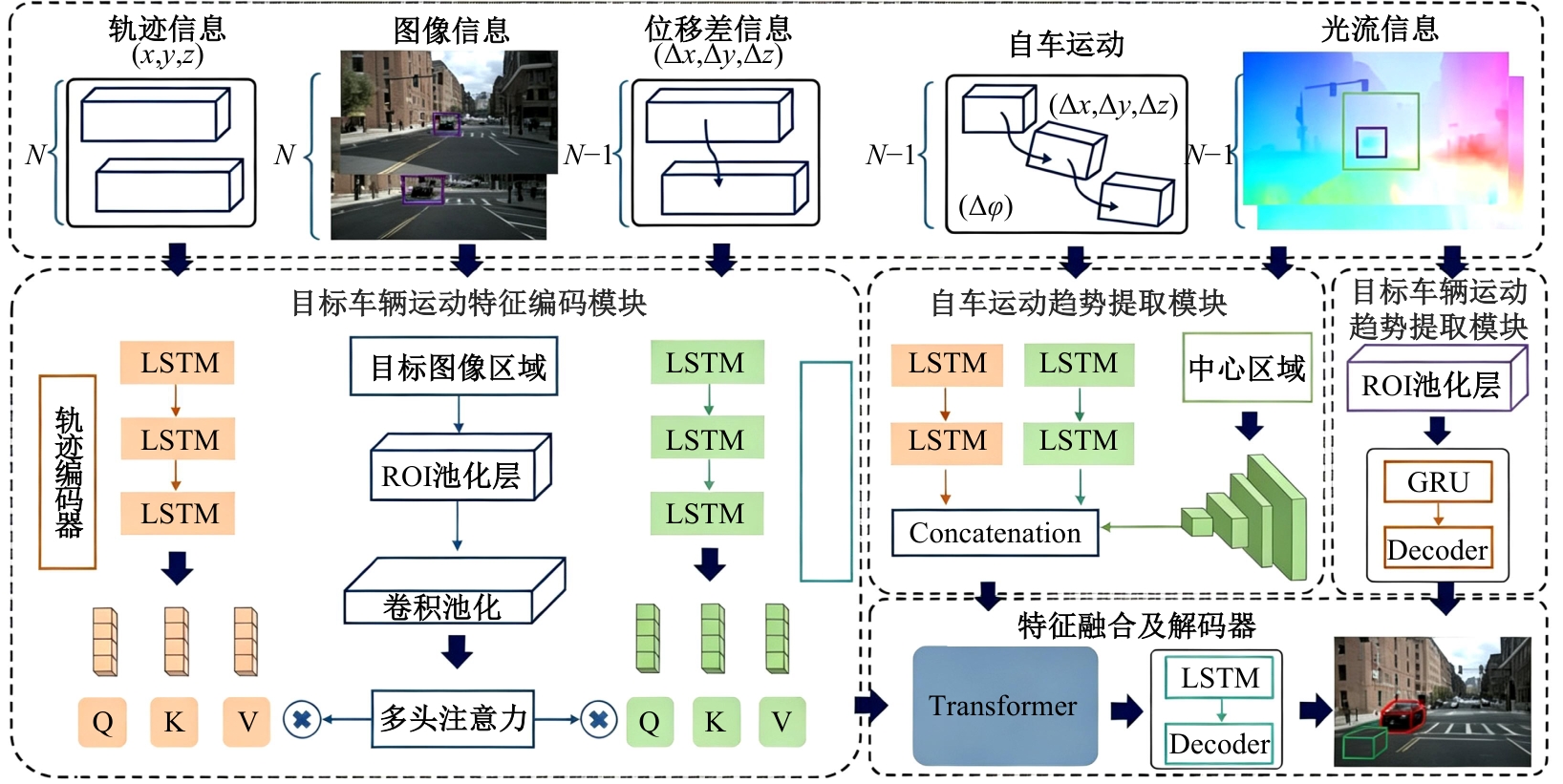
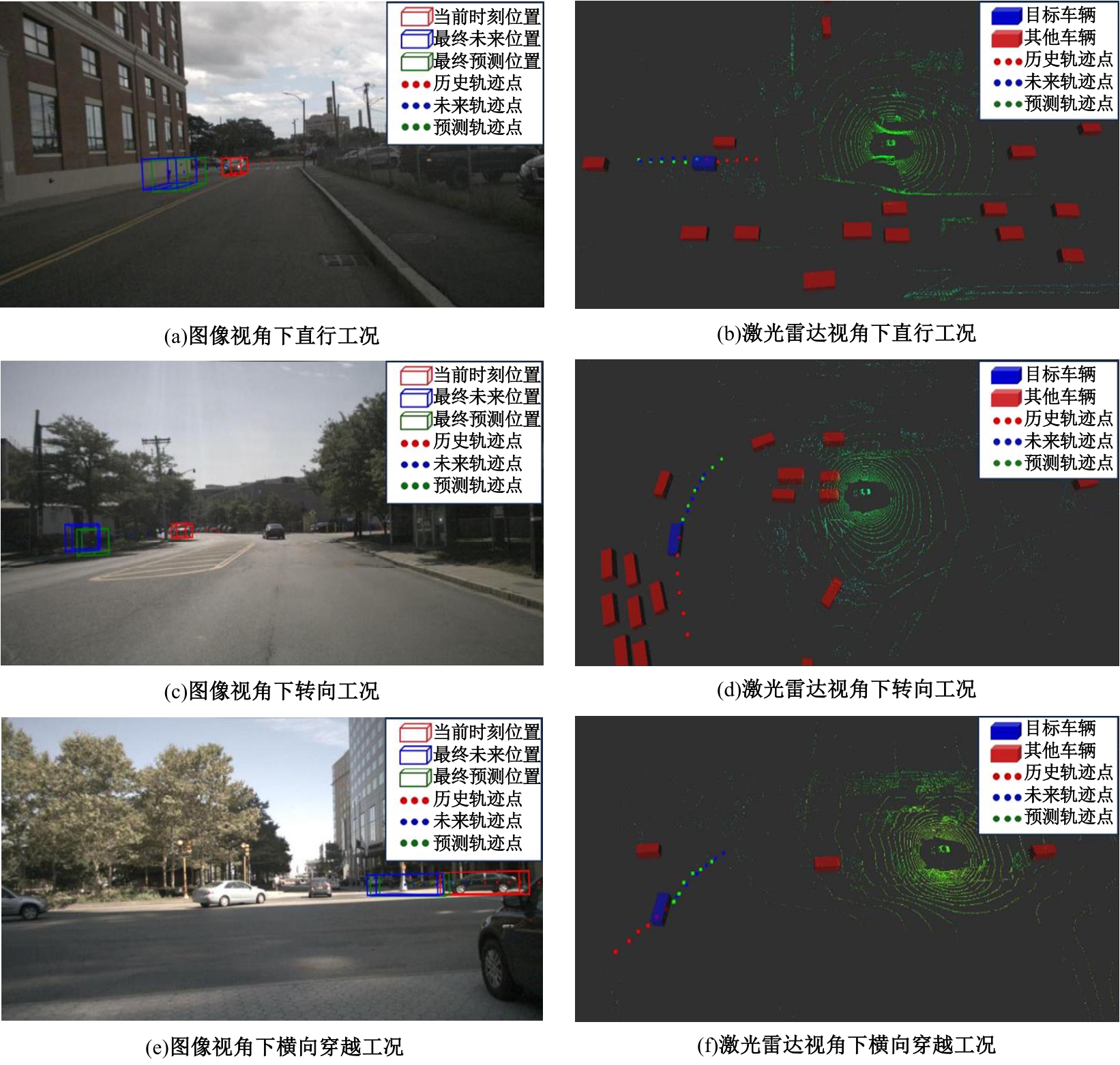
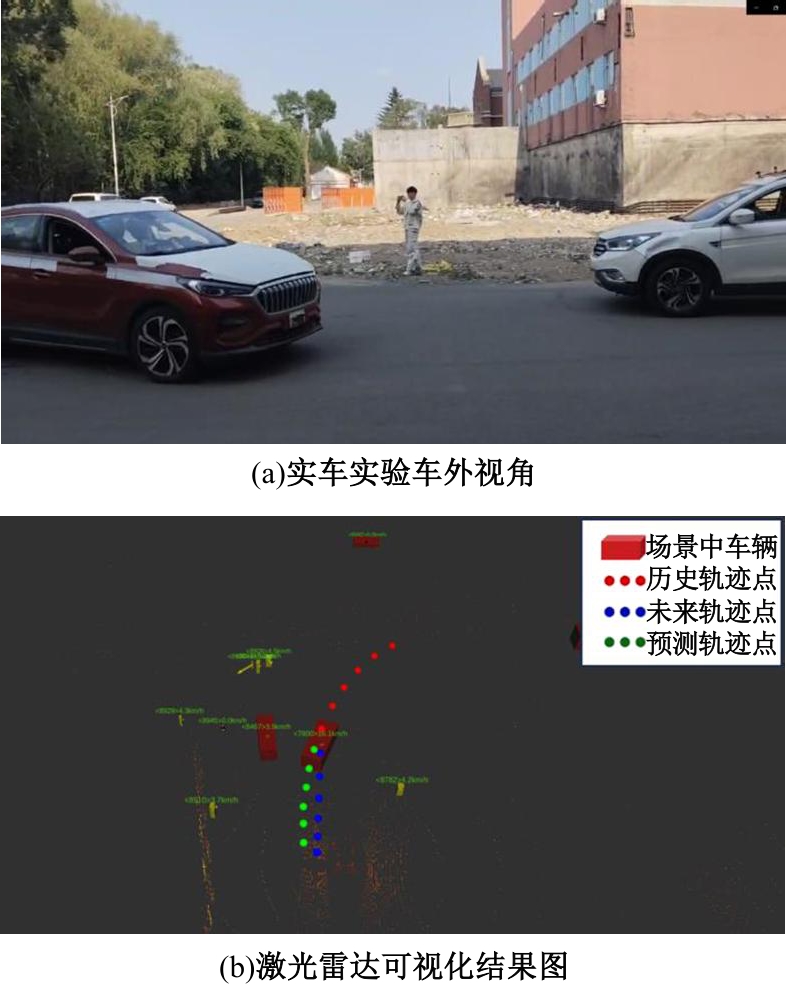
为实现自动驾驶汽车在单车智能条件下对周车未来轨迹进行准确预测的功能,提出了综合车辆感知检测框与运动状态的轨迹预测方法。通过融合车载摄像头图像、激光雷达以及自车运动信息,广泛提取目标车运动特征及自车运动趋势。首先,对目标车轨迹和位移进行编码并建立视觉特征融合的跨模态注意力机制。其次,设计自车位移差-角度差编码器,结合光流特征准确捕捉自车的运动趋势,并采用Transformer架构实现目标车运动特征与自身运动特征的深度融合。最后,将融合后的特征与目标车的光流特征输入解码器,生成目标车的预测轨迹。本文提出的轨迹预测方法在NuScenes数据集上进行了训练与测试,并且部署于东风AX7改装智能车辆进行实车实验,结果表明本文方法在预测精度和部署能力上具备优势。
中图分类号:
- U495

| [1] | 黄玲, 崔躜, 游峰, 等. 适用于多车交互场景的车辆轨迹预测模型[J]. 吉林大学学报: 工学版, 2024, 54(5): 1188-1195. |
| Huang Ling, Cui Zan, You Feng, et al. Vehicle trajectory prediction model for multi-vehicle interaction scenarios[J]. Journal of Jilin University(Engineering and Technology Edition), 2024, 54(5): 1188-1195. | |
| [2] | Xing Y, Lü C, Cao D. Personalized vehicle trajectory prediction based on joint time-series modeling for connected vehicles[J]. IEEE Transactions on Vehicular Technology, 2019, 69(2): 1341-1352. |
| [3] | 张新锋, 赵娟, 刘国华, 等. 基于图时空注意力的多车交互轨迹预测模型[J]. 汽车技术, 2025(3): 30-38. |
| Zhang Xin-feng, Zhao Juan, Liu Guo-hua, et al. Multi-vehicle interactive trajectory prediction model based on graph spatio-temporal attention[J]. Automobile Technology, 2025(3): 30-38. | |
| [4] | Malla S, Dwivedi I, Dariush B, et al. Nemo: Future object localization using noisy ego priors[C]∥IEEE 25th International Conference on Intelligent Transportation Systems(ITSC), Macau, China, 2022: 3704-3711. |
| [5] | Dasgupta K, Das A, Das S, et al. Spatio-contextual deep network-based multimodal pedestrian detection for autonomous driving[J]. IEEE Transactions on Intelligent Transportation Systems, 2022, 23(9): 15940-15950. |
| [6] | Monjurul Karim M, Qin R, Wang Y. Fusion-GRU: a deep learning model for future bounding box prediction of traffic agents in risky driving videos[J]. Transportation Research Record, 2024, 2678(9): 699-709. |
| [7] | Gu J, Hu C, Zhang T, et al. Vip3D: end-to-end visual trajectory prediction via 3D agent queries[C]∥Proceedings of the IEEE/CVF Conference on Computer Vision and Pattern Recognition, Vancouver, Canada, 2023: 5496-5506. |
| [8] | 周亦威, 劳逸男, 赵靖, 等. 考虑多类型交通参与者的图遍历多模态车辆轨迹预测[J]. 公路交通科技, 2025, 42(3): 1-10. |
| Zhou Yi-wei, Lao Yi-nan, Zhao Jing, et al. Graph-traversal based multimodal vehicle trajectory prediction considering multiple types of traffic participants[J]. Journal of Highway and Transportation Research and Development, 2025, 42(3): 1-10. | |
| [9] | Hu Y, Yang J, Chen L, et al. Planning-oriented autonomous driving[C]∥Proceedings of the IEEE/CVF Conference on Computer Vision and Pattern Recognition, Vancouver, Canada,2023: 17853-17862. |
| [10] | Liang Ming, Yang Bin, Zeng Wen-yuan, et al. Pnpnet: end-to-end perception and prediction with tracking in the loop[C]∥Proceedings of the IEEE/CVF Conference on Computer Vision and Pattern Recognition, Online,2020:11553-11562. |
| [11] | Cheng H, Liu M, Chen L, et al. Gatraj: a graph-and attention-based multi-agent trajectory prediction model[J]. ISPRS Journal of Photogrammetry and Remote Sensing, 2023, 205: 163-175. |
| [12] | Ren Y, Lan Z, Liu L, et al. EMSIN: enhanced multistream interaction network for vehicle trajectory prediction[J]. IEEE Transactions on Fuzzy Systems, 2024, 33(1): 54-68. |
| [13] | 袁静, 夏英. 基于时空图注意力卷积神经网络车辆轨迹预测[J]. 计算机科学, 2024, 51(12): 157-165. |
| Yuan Jing, Xia Ying. Vehicle trajectory prediction based on spatio-temporal graph attention convolutional neural network[J]. Computer Science, 2024, 51(12): 157-165. | |
| [14] | Schmidt J, Jordan J, Gritschneder F, et al. Crat-pred: Vehicle trajectory prediction with crystal graph convolutional neural networks and multi-head self-attention[C]∥International Conference on Robotics and Automation(ICRA), Philadelphia, USA, 2022: 7799-7805. |
| [15] | 陈文强, 王东丹, 朱文英, 等. 基于时空图注意力网络的车辆多模态轨迹预测模型[J]. 浙江大学学报:工学版, 2025, 59(3): 443-450. |
| Chen Wen-qiang, Wang Dong-dan, Zhu Wen-ying, et al. Multimodal vehicle trajectory prediction model based on spatio-temporal graph attention network[J]. Journal of Zhejiang University(Engineering Science), 2025, 59(3): 443-450. | |
| [16] | Sun Z, Wang Z, Halilaj L, et al. Semanticformer: holistic and semantic traffic scene representation for trajectory prediction using knowledge graphs[J]. IEEE Robotics and Automation Letters, 2024,9(9): 7381-7388. |
| [17] | Li L, Wang X, Yang D, et al. Real-time heterogeneous road-agents trajectory prediction using hierarchical convolutional networks and multi-task learning[J]. IEEE Transactions on Intelligent Vehicles, 2023, 9(2): 4055-4069. |
| [18] | 周亦威, 夏莫, 朱冰. 城市道路场景下考虑多类交通参与者的多模态车辆轨迹预测方法研究[J]. 汽车工程, 2024, 46(3): 396-406. |
| Zhou Yi-wei, Xia Mo, Zhu Bing. Research on multimodal vehicle trajectory prediction method considering multiple types of traffic participants in urban road scenarios[J]. Automotive Engineering, 2024, 46(3): 396-406. | |
| [19] | Teed Z, Deng J. Raft: Recurrent all-pairs field transforms for optical flow[C]∥The 16th European Conference on Computer Vision(ECCV), Glasgow, UK, 2020: 402-419. |
| [20] | Caesar H, Bankiti V, Lang A H, et al. nuscenes: A multimodal dataset for autonomous driving[C]∥Proceedings of the IEEE/CVF Conference on Computer Vision and Pattern Recognition, Online, 2020: 11621-11631. |
| [21] | Mohamed A, Qian K, Elhoseiny M, et al. Social-stgcnn: a social spatio-temporal graph convolutional neural network for human trajectory prediction[C]∥Proceedings of the IEEE/CVF Conference on Computer Vision and Pattern Recognition, Online, 2020: 14424-14432. |
| [22] | Lu Y, Wang W, Hu X, et al. Vehicle trajectory prediction in connected environments via heterogeneous context-aware graph convolutional networks[J]. IEEE Transactions on Intelligent Transportation Systems, 2022, 24(8): 8452-8464. |
| [23] | Yuan Y, Weng X, Ou Y, et al. Agentformer: Agent-aware transformers for socio-temporal multi-agent forecasting[C]∥Proceedings of the IEEE/CVF International Conference on Computer Vision, Montreal, Canada, 2021: 9813-9823. |
| [24] | Wang J, Guo J, Feng M, et al. Trajectory grid diffusion for multimodal trajectory prediction in autonomous vehicles[J]. IEEE Transactions on Intelligent Vehicles, 2024: 3495037. |
| [1] | 江晟,路启,夏淼磊,王稼禹. 基于特征融合注意力的RGB-D语义分割算法[J]. 吉林大学学报(工学版), 2026, 56(9): 2435-2443. |
| [2] | 李立,鲍宇健,杨文臣,楚庆玲,汪贵平. 路侧多源感知数据集规范化构建方法[J]. 吉林大学学报(工学版), 2025, 55(2): 529-536. |
| [3] | 程鑫,刘升贤,周经美,周洲,赵祥模. 融合密集连接和高斯距离的三维目标检测算法[J]. 吉林大学学报(工学版), 2024, 54(12): 3589-3600. |
| [4] | 吕卫,韩镓泽,褚晶辉,井佩光. 基于多模态自注意力网络的视频记忆度预测[J]. 吉林大学学报(工学版), 2023, 53(4): 1211-1219. |
| [5] | 李雪梅,王春阳,刘雪莲,谢达. 基于SESTH的线性调频连续波激光雷达信号时延估计[J]. 吉林大学学报(工学版), 2022, 52(4): 950-958. |
| [6] | 宗长富,文龙,何磊. 基于欧几里得聚类算法的三维激光雷达障碍物检测技术[J]. 吉林大学学报(工学版), 2020, 50(1): 107-113. |
| [7] | 赵宏伟,李明昭,刘静,胡黄水,王丹,臧雪柏. 基于自然性和视觉特征通道的场景分类[J]. 吉林大学学报(工学版), 2019, 49(5): 1668-1675. |
| [8] | 潘海阳, 刘顺安, 姚永明. 基于深度信息的自主空中加油技术[J]. 吉林大学学报(工学版), 2014, 44(6): 1750-1756. |
| [9] | 尚涛, 贺会超, 王昕, 宫文斌, 戴永强. 二维激光雷达实现三维成像的算法[J]. 吉林大学学报(工学版), 2012, 42(增刊1): 91-95. |
|
||