吉林大学学报(工学版) ›› 2026, Vol. 56 ›› Issue (7): 1970-1983.doi: 10.13229/j.cnki.jdxbgxb.20250002
• 交通运输工程·土木工程 • 上一篇
融合风格编码的双通道生成对抗网络步态识别
周航1( ),宋珂蔚1,徐源昊2,陈业泓1,姜江1
- 1.北京交通大学 电子信息工程学院,北京 100044
2.深圳市路桥建设集团有限公司 市政工程分公司,广东 深圳 518024
Gait recognition using dual⁃channel generative adversarial network with style encoding integration
Hang ZHOU1(),Ke-wei SONG1,Yuan-hao XU2,Ye-hong CHEN1,Jiang JIANG1
- 1.School of Electronic and Information Engineering,Beijing Jiaotong University,Beijing 100044,China
2.Municipal Engineering Branch,Shenzhen Luqiao Construction Group Co. ,Ltd. ,Shenzhen 518024,China
摘要:
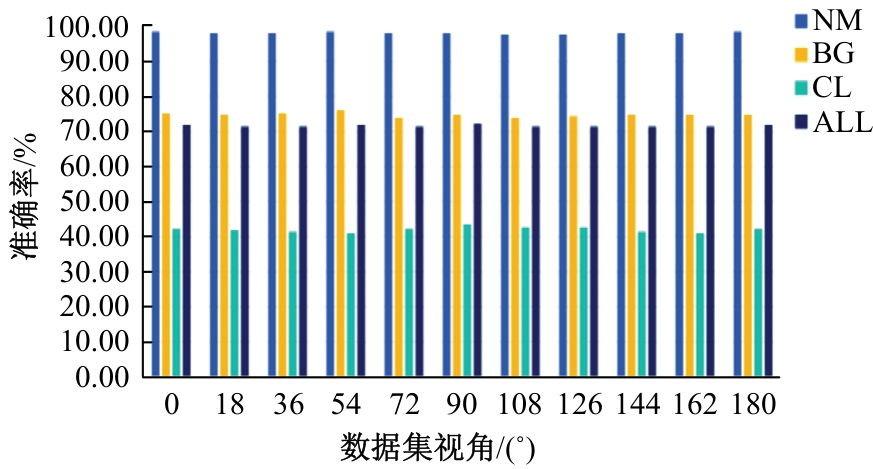
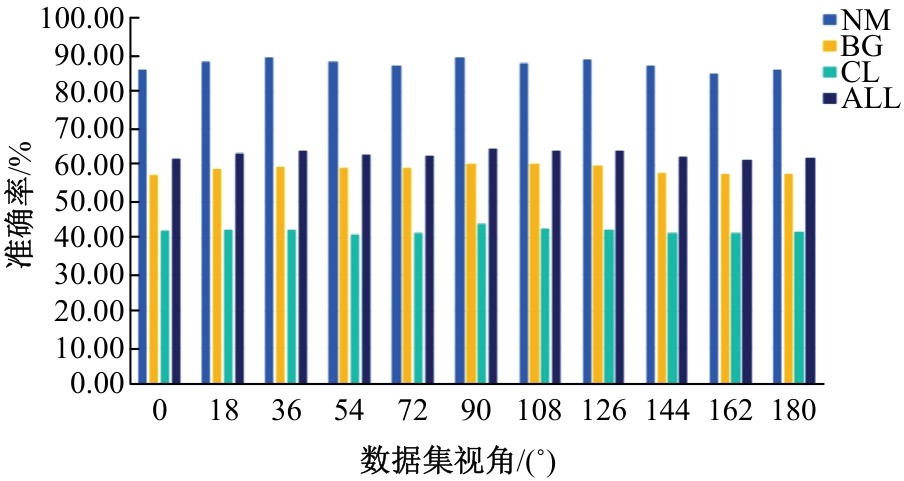
针对现有步态识别技术存在的视角适应性差、模型训练稳定性不足的问题,提出了一种融合风格编码的双通道时空卷积生成对抗网络模型。该模型通过双通道时空卷积网络分别提取步态图像中的复杂时空特征与步态特征,并引入风格编码器来减少生成图像与原图之间的语义差异,从而提升生成器的稳定性。基于CASIA-B数据集的实验结果表明,本文模型相比GaitGAN在54°、90°和126°这3个具有代表性的步态视角下,识别率分别提高了23%、28%和22%。此外,该方法在OU-MVLP大规模跨视角步态数据库中仍展现出较好的适用性,达到了89.1%的平均识别精度,有效提高了跨视角步态识别率。
中图分类号:
- TP391

| [1] | 李贻斌, 郭佳旻, 张勤.人体步态识别方法与技术[J].吉林大学学报: 工学版,2020, 50(1):1 -18. |
| Li Yi-bin, Guo Jia-min, Zhang Qin. Methods and technologies for human gait recognition[J]. Journal of Jilin University (Engineering and Technology Edition), 2020, 50(1): 1-18. | |
| [2] | Sepas-Moghaddam A, Etemad A. Deep gait recognition: a survey[J]. IEEE Transactions on Pattern Analysis and Machine Intelligence, 2023, 45(1): 264-284. |
| [3] | 段成阁, 刘康康, 李福全. 步态识别技术综述[J]. 中国人民公安大学学报: 自然科学版, 2022, 28(4):75-80. |
| Duan Cheng-ge, Liu Kang-kang, Li Fu-quan. Overview of gait recognition technology[J]. Journal of People's Public Security University of China (Natural Science Edition), 2022, 28(4): 75-80. | |
| [4] | 刘晓芳, 周航, 韩权, 等. 基于视觉的步态识别研究综述[J]. 小型微型计算机系统,2018, 39(8): 1685-1692. |
| Liu Xiao-fang, Zhou Hang, Han Quan, et al. Review of vision-based gait recognition research[J]. Mini-Micro Systems, 2018, 39(8): 1685-1692. | |
| [5] | 刘相锋, 周航. 步态识别技术及其在视频监控中的应用[J]. 电视技术,2011, 35(1): 119-121. |
| Liu Xiang-feng, Zhou Hang. Gait recognition technology and its application in video surveillance[J]. Television Technology, 2011, 35(1): 119-121. | |
| [6] | 陈福仕, 沈尧, 周池春, 等. 无监督学习步态识别综述[J].计算机科学与探索,2024,18(8): 2014-2033. |
| Chen Fu-shi, Shen Yao, Zhou Chi-chun, et al. A review of unsupervised learning for gait recognition[J]. Computer Science and Exploration, 2024, 18(8): 2014-2033. | |
| [7] | Chao H Q, Wang K, He Y W, et al. GaitSet:cross-view gait recognition through utilizing gait as a deep set[J]. IEEE Transactions on Pattern Analysis and Machine Intelligence, 44(7): 3467-3478. |
| [8] | Limcharoen P, Khamsemanan N, Nattee C. Gait recognition and re-identification based on regional LSTM for 2-second walks[J].IEEE Access, 2021, 9: 112057-112068. |
| [9] | Goodfellow I, Pougetabadie J, Mirza M, et al.Generative adversarial nets[C]∥Advances in Neural Information Processing Systems, Quebec, Canada, 2014: 2672-2680. |
| [10] | Aljazaerly M A A, Makihara Y, Muramatsu D, et al. Batch hard contrastive loss and its application to cross-view gait recognition[J]. IEEE Access, 2023, 11: 31177-31187. |
| [11] | Wang L H, Xiao P F, Zhang X L, et al. A fine-grained unsupervised domain adaptation framework for semantic segmentation of remote sensing images[J]. IEEE Journal of Selected Topics in Applied Earth Observations and Remote Sensing, 2026,16: 4109-4121. |
| [12] | Yu S, Chen H E, Reyes B G, et al. GaitGAN: invariant gait feature extraction using generative adversarial networks[C]∥2017 IEEE Conference on Computer Vision and Pattern Recognition Workshops, Honolulu, HI, USA, 2017: 532-539. |
| [13] | Yu S Q, Tan D L, Tan T N. A framework for evaluating the effect of view angle, clothing and carrying condition on gait recognition[C]∥Proc of the 18th International Conference on Pattern Recognition, Washington, USA, 2006: 441-444. |
| [14] | Xu C, Makihara Y, Liao R, et al. Applications: real-time gait-based age estimation and gender classification from a single image[C]∥Proceedings of the 2021 IEEE/CVF Winter Conference on Applications of Computer Vision, online, 2021: 3459-3469. |
| [15] | 王宇, 夏懿. 基于双通道循环一致性GAN的跨视角步态识别研究[J]. 计算机应用研究, 2022, 39(1):259-264. |
| Wang Yu, Xia Yi. Cross-view gait recognition based on dual-channel cycle-consistent GAN[J]. Computer Applications and Research, 2022, 39(1): 259-264. | |
| [16] | 张云佐, 董旭. 基于双分支时空步态特征融合的深度学习步态识别[J]. 控制与决策, 2024,39(4): 1403-1408. |
| Zhang Yun-zhuo, Dong Xu. Gait recognition based on dual-branch spatiotemporal feature fusion using deep learning[J]. Control and Decision, 2024, 39(4): 1403-1408. | |
| [17] | 李凯, 曹可凡, 沈皓凝. 基于步态序列的跨视角步态识别[J]. 河北大学学报: 自然科学版, 2021, 41(3):311-320. |
| Li Kai, Cao Ke-fan, Shen Hao-ning. Cross-view gait recognition based on gait sequences[J]. Journal of Hebei University (Natural Science Edition), 2021, 41(3): 311-320. | |
| [18] | 张红颖, 包雯静. 融合自注意力机制的生成对抗网络跨视角步态识别[J]. 中国图象图形学报, 2022, 27(4): 1097-1109. |
| Zhang Hong-ying, Bao Wen-jing. Cross-view gait recognition using generative adversarial networks with self-attention mechanism[J]. Journal of Image and Graphics, 2022, 27(4): 1097-1109. | |
| [19] | Shiraga K, Makihara Y, Muramatsu D, et al. GEINet: view-invariant gait recognition using a convolutional neural network[C]∥Proceedings of the 2016 International Conference on Biometrics. Halmstad: Sweden, 2016: 1-8. |
| [20] | Yu S, Liao R, An W, et al. GaitGANv2: Invariant gait feature extraction using generative adversarial networks[J]. Pattern Recognition, 2019, 87: 179-189. |
| [21] | Chen X, Luo X, Weng J, et al. Multi-view gait image generation for cross-view gait recognition[J]. IEEE Transactions on Image Processing, 2021,30: 3041-3055. |
| [22] | 陈万志, 唐浩博, 王天元. 融合轮廓增强和注意力机制的改进GaitSet步态识别方法[J]. 电子测量与仪器学报, 2024, 38(1): 203-210. |
| Chen Wan-zhi, Tang Hao-bo, Wang Tian-yuan. Improved GaitSet gait recognition method integrating contour enhancement and attention mechanism[J]. Journal of Electronic Measurement and Instrumentation, 2024, 38(1): 203-210. | |
| [23] | 汪堃, 雷一鸣, 张军平. 基于双流步态网络的跨视角步态识别[J]. 模式识别与人工智能, 2020, 33(5):383-392. |
| Wang Kun, Lei Yi-ming, Zhang Jun-ping. Cross-view gait recognition based on dual-stream gait network[J]. Pattern Recognition and Artificial Intelligence, 2020, 33(5): 383-392. |
| [1] | 刘昕晖,陈晫群,吕岩. 基于深度学习的工业故障诊断综述[J]. 吉林大学学报(工学版), 2026, 56(7): 1759-1779. |
| [2] | 林乐平,苏治,欧阳宁. 基于高效门控与目标区域关注的实时视频超分辨率[J]. 吉林大学学报(工学版), 2026, 56(3): 819-829. |
| [3] | 朴燕,康继元. RAUGAN:基于循环生成对抗网络的红外图像彩色化方法[J]. 吉林大学学报(工学版), 2025, 55(8): 2722-2731. |
| [4] | 文斌,彭顺,杨超,沈艳军,李辉. 多深度自适应融合去雾生成网络[J]. 吉林大学学报(工学版), 2025, 55(6): 2103-2113. |
| [5] | 刘广文,赵绮莹,王超,高连宇,才华,付强. 基于渐进递归的生成对抗单幅图像去雨算法[J]. 吉林大学学报(工学版), 2025, 55(4): 1363-1373. |
| [6] | 季渊,虞雅淇. 基于密集卷积生成对抗网络与关键帧的说话人脸视频生成优化算法[J]. 吉林大学学报(工学版), 2025, 55(3): 986-992. |
| [7] | 赵宏,马宇轩,宋馥荣. 基于Diff-AdvGAN的图像对抗样本生成方法[J]. 吉林大学学报(工学版), 2025, 55(12): 4052-4062. |
| [8] | 罗向龙,魏欣语,赵茂军,刘若辰. 融合对比学习和生成对抗网络的图像去雾算法[J]. 吉林大学学报(工学版), 2025, 55(10): 3296-3308. |
| [9] | 张曦,库少平. 基于生成对抗网络的人脸超分辨率重建方法[J]. 吉林大学学报(工学版), 2025, 55(1): 333-338. |
| [10] | 温晓岳,钱国敏,孔桦桦,缪月洁,王殿海. TrafficPro:一种针对城市信控路网的路段速度预测框架[J]. 吉林大学学报(工学版), 2024, 54(8): 2214-2222. |
| [11] | 赖丹晖,罗伟峰,袁旭东,邱子良. 复杂环境下多模态手势关键点特征提取算法[J]. 吉林大学学报(工学版), 2024, 54(8): 2288-2294. |
| [12] | 郭昕刚,何颖晨,程超. 抗噪声的分步式图像超分辨率重构算法[J]. 吉林大学学报(工学版), 2024, 54(7): 2063-2071. |
| [13] | 张云佐,董旭,蔡昭权. 拟合下肢几何特征的多视角步态周期检测[J]. 吉林大学学报(工学版), 2023, 53(9): 2611-2619. |
| [14] | 吕卫,韩镓泽,褚晶辉,井佩光. 基于多模态自注意力网络的视频记忆度预测[J]. 吉林大学学报(工学版), 2023, 53(4): 1211-1219. |
| [15] | 曾春艳,严康,王志锋,王正辉. 多尺度生成对抗网络下图像压缩感知重建算法[J]. 吉林大学学报(工学版), 2023, 53(10): 2923-2931. |
|
||