吉林大学学报(工学版) ›› 2026, Vol. 56 ›› Issue (7): 2006-2019.doi: 10.13229/j.cnki.jdxbgxb.20241283
• 计算机科学与技术 • 上一篇
一种二阶决策的车联网边缘计算任务动态卸载方法
巨涛( ),张文金,杨垚,火久元
- 兰州交通大学 电子与信息工程学院,兰州 730070
A second order decision-making dynamic offloading method for vehicle edge computing tasks
Tao JU(),Wen-jin ZHANG,Yao YANG,Jiu-yuan HUO
- School of Electronic and Information Engineering,Lanzhou Jiaotong University,Lanzhou 730070,China
摘要:
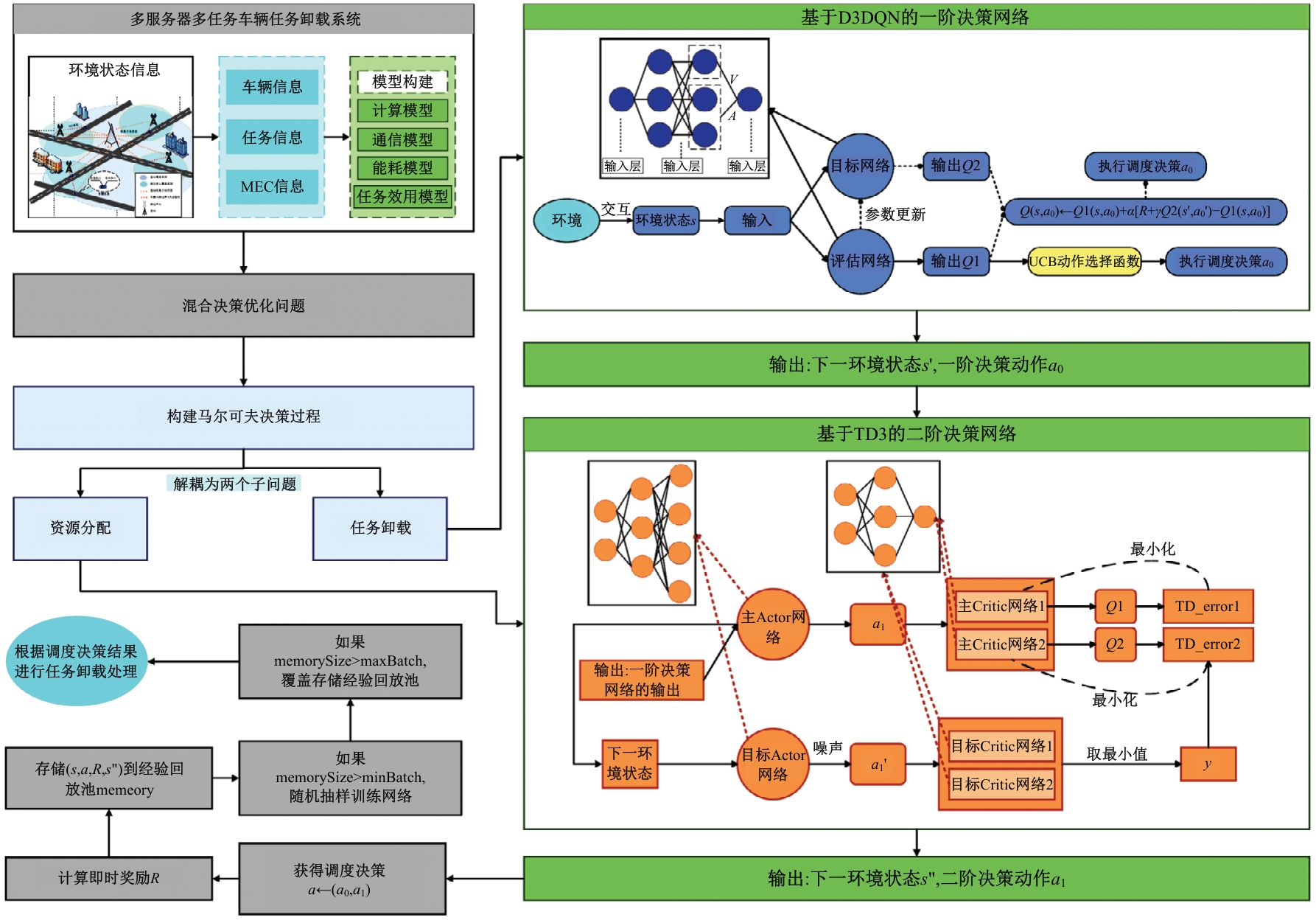
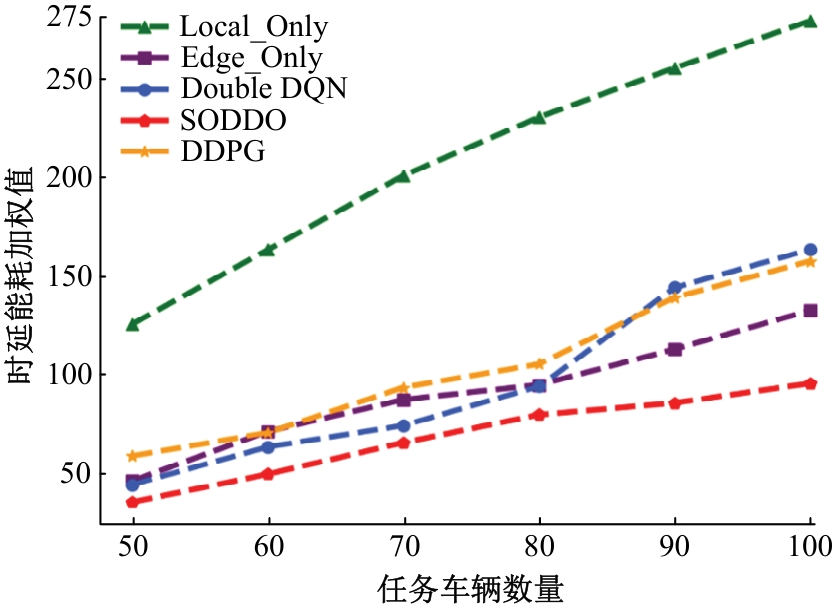
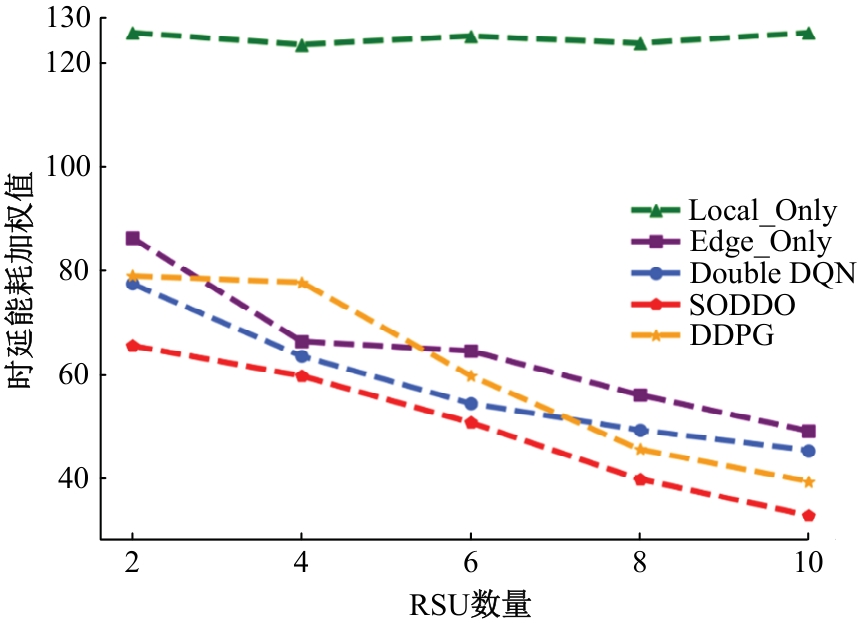
为解决车联网边缘计算中处理离散-连续混合决策问题时边缘计算系统计算性能不高的问题,基于深度强化学习提出了一种分布式的二阶决策车联网边缘计算任务动态卸载方法。通过将任务处理过程分为卸载决策和资源分配两个子问题,基于D3DQN网络和TD3网络设计了可同时处理离散和连续动作域的算法框架;同时,设计了动作空间搜索优化和动态优先级更新机制,以进一步提升对动作空间的有效搜索,提高算法性能;最终,在以上算法框架和优化机制的基础上,设计实现了二阶决策车联网边缘计算任务动态卸载算法。该算法可有效解决车联网边缘计算场景中的离散-连续混合决策问题,实现边缘计算系统资源的有效利用,保证车辆能根据当前网络状态和任务大小,以最小的时延和能耗完成计算任务卸载。仿真结果表明,与基准卸载方法相比,本文方法具有更快的收敛性和更低的时延能耗,可以较好地利用边缘系统计算资源为车载边缘任务请求提供计算服务,进一步提升用户服务质量。
中图分类号:
- TP311

| [1] | Sharma S, Kaushik B. A survey on internet of vehicles: applications, security issues & solutions[J]. Vehicular Communications, 2019, 20:100182. |
| [2] | 况博裕, 李雨泽, 顾芳铭,等. 车联网安全研究综述: 威胁、对策与未来展望[J]. 计算机研究与发展, 2023, 60(10): 2304-2321. |
| Kuang Bo-yu, Li Yu-ze, Gu Fang-ming, et al. Review of internet of vehicle security research: threats, countermeasures, and future prospects[J]. Journal of Computer Research and Development, 2023, 60(10): 2304-2321. | |
| [3] | Boban M, Kousaridas A, Manolakis K, et al. Connected roads of the future: use cases, requirements, and design considerations for vehicle-to-everything communications[J]. IEEE Vehicular Technology Magazine, 2018, 13(3): 110-123. |
| [4] | Yang D G, Jiang K, Zhao D, et al. Intelligent and connected vehicles: current status and future perspectives[J]. Science China Technological Sciences, 2018, 61: 1446-1471. |
| [5] | Zhang W Y, Zhang Z J, chao H C. Cooperative fog computing for dealing with big data in the internet of vehicles: architecture and hierarchical resource management[J]. IEEE Communications Magazine, 2017, 55(12): 60-67. |
| [6] | Jaehwan L, Woongsoo N. A survey on vehicular edge computing architectures[C]∥2022 13th International Conference on Information and Communication Technology Convergence(ICTC), Jeju, Island, Korea, 2022: 2198-2200. |
| [7] | Mao Y Y, You C S, Zhang J, et al. A survey on mobile edge computing: the communication perspective[J]. IEEE Communications Surveys & Tutorials, 2017, 19(4): 2322-2358. |
| [8] | Tang M, Wong V W S. Deep reinforcement learning for task offloading in mobile edge computing systems[J]. IEEE Transactions on Mobile Computing, 2022, 21(6): 1985-1997. |
| [9] | Zhao N, Liang Y C, Niyato D, et al. Deep reinforcement Learning for user association and resource allocation in heterogeneous cellular networks[J]. IEEE Transactions on Wireless Communications, 2019, 18(11): 5141-5152. |
| [10] | Dai Y Y, Xu D, Zhang K, et al. Deep reinforcement learning for edge computing and resource allocation in 5G beyond[C]∥2019 IEEE 19th International Conference on Communication Technology, Xi'an, China, 2019: 866-870. |
| [11] | Raeisi-varzaneh M, Dakkak O, Habbal A, et al. Resource scheduling in edge computing: architecture, taxonomy, open issues and future research directions[J]. IEEE Access, 2023, 11: 25329-25350. |
| [12] | Feng J, Yu F R, Pei Q Q, et al. Joint optimization of radio and computational resources allocation in blockchain-enabled mobile edge computing systems[J]. IEEE Transactions on Wireless Communications, 2020, 19(6): 4321-4334. |
| [13] | 李智勇, 王琦, 陈一凡, 等. 车辆边缘计算环境下任务卸载研究综述[J]. 计算机学报, 2021, 44(5): 963-982. |
| Li Zhi-yong, Wang Qi, Chen Yi-fan, et al. A survey on task offloading research in vehicular edge computing[J]. Chinese Journal of Computers, 2021, 44(5): 963-982. | |
| [14] | 许斌, 赵云凯, 朱剑鸣, 等. 移动边缘计算不确定性任务持续卸载及资源分配方法[J]. 软件学报, 2023, 35(3): 1466-1484. |
| Xu Bin, Zhao Yun-kai, Zhu Jian-ming, et al. Continuous offloading and resource allocation method of uncertain tasks in mobile edge computing[J]. Journal of Software, 2023, 35(3): 1466-1484. | |
| [15] | Liu G Z, Dai F, Huang B, et al. A collaborative computation and dependency-aware task offloading method for vehicular edge computing: a reinforcement learning approach[J]. Journal of Cloud Computing, 2022, 11(1): 1-15. |
| [16] | 孙彦景, 余政达, 陈瑞瑞, 等. 车联网中基于深度强化学习的高可靠资源分配算法[J]. 重庆邮电大学学报: 自然科学版, 2023, 35(4): 706-714. |
| Sun Yan-jing, Yu Zheng-da, Chen Rui-rui, et al. Deep reinforcement learning based high reliability resource allocation algorithm for internet of vehicles[J]. Journal of Chongqing University of Posts and Telecommunications(Natural Science Edition), 2023, 35(4): 706-714. | |
| [17] | Hao H, Ding W, Zhang W. Time-continuous computing offloading algorithm with user fairness guarantee[J]. Journal of Network and Computer Applications, 2024, 223: 103826. |
| [18] | Yan J, Bi S Z, Zhang Y J A. Offloading and resource allocation with general task graph in mobile edge computing: a deep reinforcement learning approach[J]. IEEE Transactions on Wireless Communications, 2020, 19(8): 5404-5419. |
| [19] | Zhao J H, Li Q P, Gong Y, et al. Computation offloading and resource allocation for cloud assisted mobile edge computing in vehicular networks[J]. IEEE Transactions on Vehicular Technology, 2019, 68(8): 7944-7956. |
| [20] | Han H, Wu D G, Zhou F H, et al. Dynamic task offloading in MEC-enabled IoT networks: a hybrid DDPG-D3QN approach[C]∥2021 IEEE Global Communications Conference(GLOBECOM). Madrid, Spain, 2021: 1-6. |
| [21] | Guan T, Yao Y S, Chao Y, et al. Energy-efficient computing offloading policy for MEC-assisted power sensor network: a D3QN approach[C]∥2023 International Conference on Cyber-Physical Social Intelligence(ICCSI), Xi'an, China, 2023: 180-185. |
| [22] | Wang Z Y, Schaul T, Hessel M, et al. Dueling Network Architectures for Deep reinforcement learning[C]∥JMLR.org. Proceedings of the 33rd International Conference on International Conference on Machine Learning-Volume 48, New York, NY, USA, 2016: 1995-2003. |
| [23] | Hasselt H V, Guez A, Silver D. Deep reinforcement learning with double Q-learning[C]∥AAAI'16. Proceeding of the Thirtieth AAAI Conference on Artificial Intelligence, Phoenix, Arizona, 2016: 2094-2100. |
| [24] | 巨涛, 王志强, 刘帅, 等. D3DQN-CAA: 一种基于DRL的自适应边缘计算任务调度方法[J].湖南大学学报: 自然科学版, 2024, 51(6): 73-85. |
| Ju Tao, Wang Zhi-qiang, Liu Shuai, et al. D3DQN-CAA:a DRL-based adaptive edge computing task scheduling method[J]. Journal of Hunan University(Natural Sciences), 2024, 51(6): 73-85. | |
| [25] | 张红霞, 吕智豪, 席诗语, 等. 面向绿色计算的车辆协同任务卸载方法[J]. 电子与信息学报, 2024, 48(1): 175-183. |
| Zhang Hong-Xia, Lv Zhi-hao, Xi Shi-yu, et al. A method for offloading vehicle collaborative tasks for green computing[J]. Journal of Electronics & Information Technology, 2024, 48(1): 175-183. | |
| [26] | Kiran B R, Sobh I, Talpaert V, et al. Deep reinforcement learning for autonomous driving: A survey[J]. IEEE Transactions on Intelligent Transportation Systems, 2022, 23(6): 4909-4926. |
| [27] | Zhou D R, Li L H, Gu Q Q. Neural contextual bandits with ucb-based exploration[C]∥International Conference on Machine Learning. 2020: 11492-11502. |
| [28] | Zhong J W, Chen X, Jiao L B. A fair energy-efficient offloading scheme for heterogeneous fog-enabled IoT using D3QN[C]∥2023 25th International Conference on Communication Software and Networks(ICCSN), IEEE, 2023: 47-52. |
| [29] | Min M H, Xiao L, Chen Y, et.al. Learning-based computation offloading for IoT devices with energy harvesting[J]. IEEE Transactions on Vehicular Technology, 2019, 68(2): 1930-1941. |
| [30] | Geng L W, Zhao H B, Wang J Y, et al. Deep-reinforcement-learning-based distributed computation offloading in vehicular edge computing networks[J]. IEEE Internet of Things Journal, 2023, 10(14): 12416-12433. |
| [31] | 郭晓东, 郝思达, 王丽芳. 基于深度强化学习的车辆边缘计算任务卸载方法[J]. 计算机应用技术, 2023, 40(9): 2803-2807, 2814. |
| Guo Xiao-dong, Hao Si-da, Wang Li-fang. Task offloading method based on deep reinforcement learning for vehicular edge computing[J]. Application Research of Computers, 2023, 40(9): 2803-2807, 2814. | |
| [32] | 邝祝芳, 陈清林, 李林峰, 等. 基于深度强化学习的多用户边缘计算任务卸载调度与资源分配算法[J]. 计算机学报, 2022, 45(4): 812-824. |
| Kuang Zhu-fang, Chen Qing-li, Li Li-feng, et al. Multi-user edge computing task offloading scheduling and resource allocation based on deep reinforcement learning[J]. Chinese Journal of Computers, 2022, 45(4): 812-824. | |
| [33] | 许小龙, 方子介, 齐连永, 等. 车联网边缘计算环境下基于深度强化学习的分布式服务卸载方法[J]. 计算机学报, 2021, 44(12): 2382-2405. |
| Xu Xiao-long, Fang Zi-jie, Qi Lian-yong, et al. A deep reinforcement learning-based distributed service offloading method for edge computing empowered internet of vehicles[J]. Chinese Journal of Computers, 2021, 44(12): 2382-2405. |
| [1] | 田成军,颜禹,崔仁伟,张晋通. 基于深度强化学习的机械臂自主抓取算法[J]. 吉林大学学报(工学版), 2026, 56(3): 662-669. |
| [2] | 朱科,邢志明,康翔宇. 机械手多任务均衡策略[J]. 吉林大学学报(工学版), 2025, 55(8): 2782-2790. |
| [3] | 李新春,孙鹤源,许驰. 基于深度Q网络算法的空天地边缘计算网络资源分配方法[J]. 吉林大学学报(工学版), 2025, 55(7): 2418-2424. |
| [4] | 王健,贾晨威. 面向智能网联车辆的轨迹预测模型[J]. 吉林大学学报(工学版), 2025, 55(6): 1963-1972. |
| [5] | 申自浩,高永生,王辉,刘沛骞,刘琨. 面向车联网隐私保护的深度确定性策略梯度缓存方法[J]. 吉林大学学报(工学版), 2025, 55(5): 1638-1647. |
| [6] | 戴银飞,周秀贞,范子尧,刘镕源,刘志远,王绍强,杜伟. 车载网络中基于密钥驱动信任机制的身份认证协议[J]. 吉林大学学报(工学版), 2025, 55(5): 1788-1797. |
| [7] | 戴银飞,周秀贞,刘玉宝,刘志远. 基于CAN总线数据的车载网络入侵检测系统[J]. 吉林大学学报(工学版), 2025, 55(3): 857-865. |
| [8] | 赵庶旭,孙治朝,王小龙. 移动边缘计算场景中的动态身份认证协议[J]. 吉林大学学报(工学版), 2025, 55(3): 1050-1060. |
| [9] | 曾耀平,夏玉婷,陈世森,刘月强,江伟伟. 多无人机辅助通信的节能卸载策略[J]. 吉林大学学报(工学版), 2025, 55(12): 4083-4092. |
| [10] | 胡伟超,杨镇铭,于鹏程,陈艳艳,马社强. 基于深度强化学习的自动驾驶车辆与行人交互建模[J]. 吉林大学学报(工学版), 2025, 55(10): 3180-3188. |
| [11] | 黄汉英,李鹏飞. 边缘服务器计算资源分配方法与仿真实验[J]. 吉林大学学报(工学版), 2025, 55(1): 316-324. |
| [12] | 朱广贺,朱智强,袁逸萍. 连续生产流水线深度强化学习优化调度算法[J]. 吉林大学学报(工学版), 2024, 54(7): 2086-2092. |
| [13] | 高敬鹏,王国轩,高路. 基于异步合作更新的LSTM-MADDPG多智能体协同决策算法[J]. 吉林大学学报(工学版), 2024, 54(3): 797-806. |
| [14] | 朱思峰,蔡江昊,柴争义,孙恩林. 车联网边缘场景下基于免疫算法的计算卸载优化[J]. 吉林大学学报(工学版), 2024, 54(1): 221-231. |
| [15] | 张健,李青扬,李丹,姜夏,雷艳红,季亚平. 基于深度强化学习的自动驾驶车辆专用道汇入引导[J]. 吉林大学学报(工学版), 2023, 53(9): 2508-2518. |
|
||