吉林大学学报(工学版) ›› 2026, Vol. 56 ›› Issue (8): 2137-2149.doi: 10.13229/j.cnki.jdxbgxb.20250034
• 交通运输工程·土木工程 • 上一篇
考虑混动车NO x 排放工况影响的交叉口信号配时优化模型
陈兴辉1( ),刘皓冰1,2(),胡兴华3
- 1.同济大学 道路与交通工程教育部重点实验室,上海 201804
2.上海创智学院,上海 200231
3.重庆交通大学 交通运输学院,重庆 400074
Intersection signal timing optimization model considering influence of hybrid vehicles NO x emission conditions
Xing-hui CHEN1(),Hao-bing LIU1,2(),Xing-hua HU3
- 1.The Key Laboratory of Road and Traffic Engineering,Ministry of Education,Tongji University,Shanghai 201804,China
2.Shanghai Innovation Institute,Shanghai 200231,China
3.College of Traffic & Transportation,Chongqing Jiaotong University,Chongqing 400074,China
摘要:
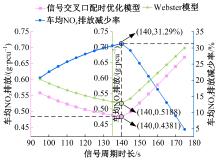
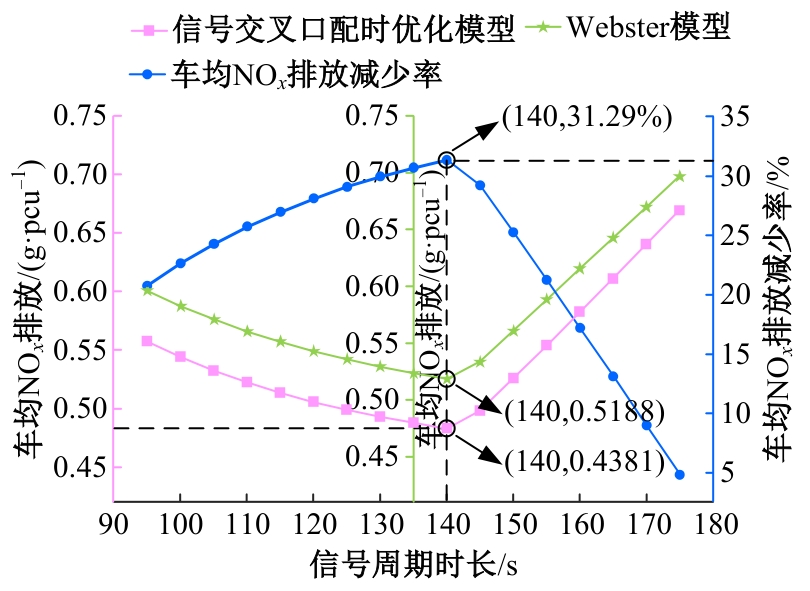
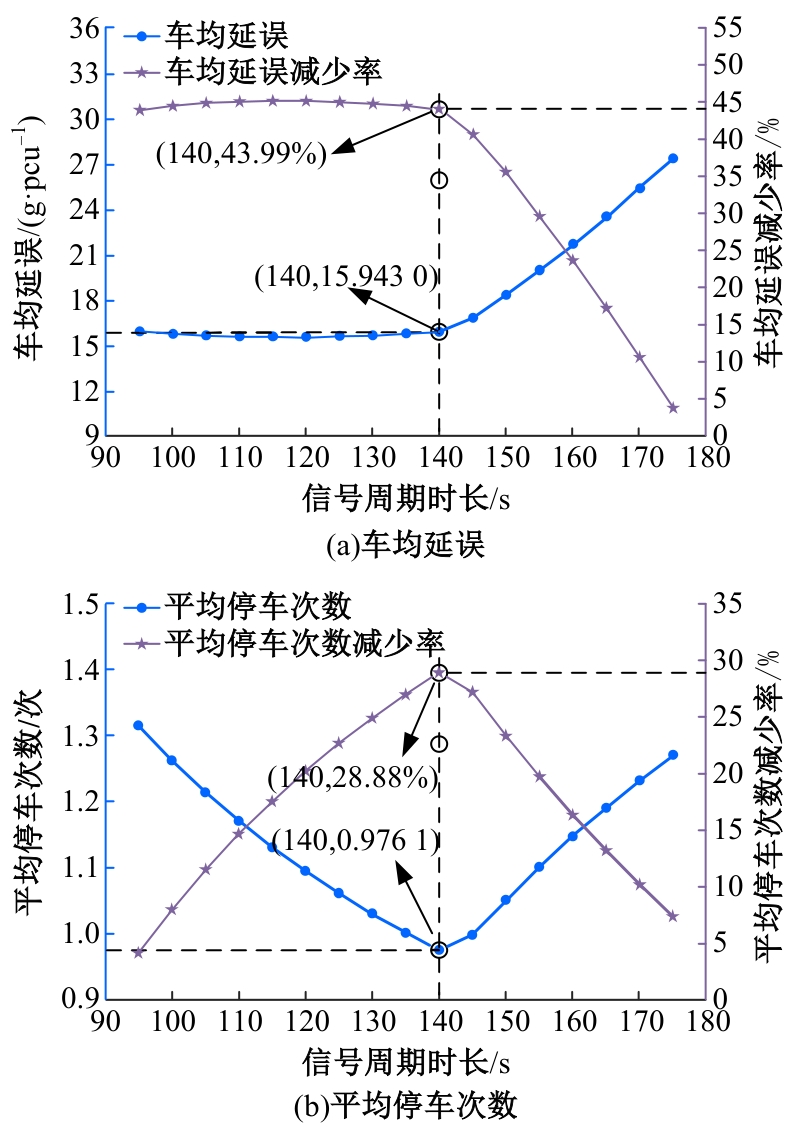
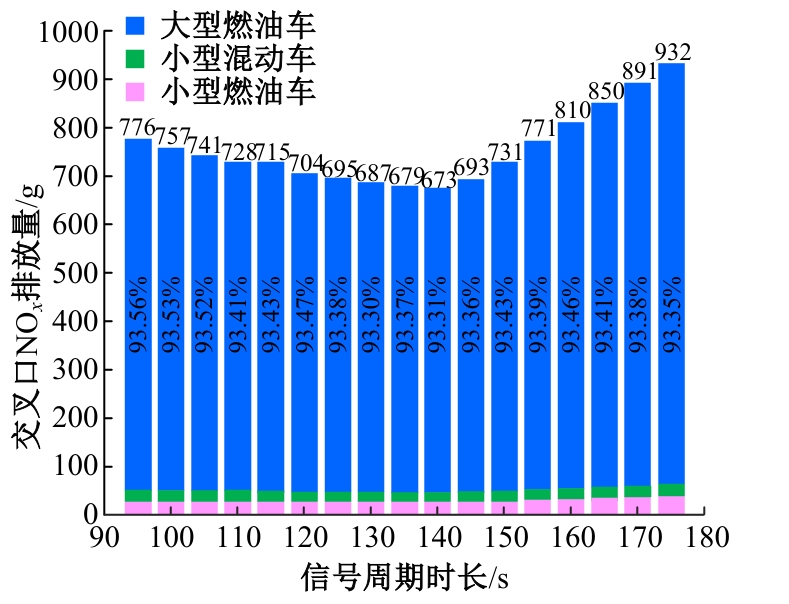
基于机动车比功率(VSP)模型,重点考虑了插电式混合动力车型特性,分别针对其电量消耗和电量维持两种模式提出NO x 排放因子的计算方法。以交叉口范围内车均NO x 排放最小为优化目标,以车均延误、平均停车次数等为约束条件,建立以燃油车与混动车构成的混合交通环境下交叉口信号配时优化模型。分析结果表明,本文模型优化后的车均NO x 排放减少率达到31.29%,同时车均延误以及平均停车次数与车均NO x 排放呈同向变化趋势,其减少率分别为43.99%和28.88%,优于仅考虑交通流量条件的Webster模型。最后,通过参数敏感性分析发现,不同交通量水平、左转车辆比例以及混动车渗透率对车均NO x 排放的影响较为显著。本文提出的平衡环境效益和通行效率的交叉口信号配时优化方法为城市交通管理和政策制定提供了有效依据。
中图分类号:
- U491

| [1] | Hu X, Chen X, Guo J, et al. Optimization model for bus priority control considering carbon emissions under non-bus lane conditions[J]. Journal of Cleaner Production, 2023, 402: No.136747. |
| [2] | Akcelik R. Traffic Signals: Capacity and Timing Analysis[M]. Melbourne: Australian Road Research Board, 1981. |
| [3] | Liu H, Gayah V V, Levin M W. A max pressure algorithm for traffic signals considering pedestrian queues[J]. Transportation Research Part C: Emerging Technologies, 2024, 169: No.104865. |
| [4] | Fan J, Baumann M, Jokhio S, et al. Evaluating the impact of signal control on emissions at intersections[C]∥Proceedings of KES-STS International Symposium,Singapore,2022: 104-111. |
| [5] | Harrington W. A Behavioral Analysis of EPA's Mobile Emission Factor Model[M]. Washington DC: Federal Highway Administration, 1998. |
| [6] | Barth M, Malcolm C, Younglove T, et al. Recent validation efforts for a comprehensive modal emissions model[J]. Transportation Research Record, 2001, 1750(1): 13-23. |
| [7] | U.S. EPA. Draft motor vehicle emission simulator (MOVES) 2009: software design reference manual[R]. Washington DC: Environmental Protection Agency, 2009. |
| [8] | 姜壁刚, 何超, 王艳艳,等. 道路坡度对轻型柴油车二氧化碳排放的影响[J]. 公路交通科技, 2025, 42(2): 207-214. |
| Jiang Bi-gang, He Chao, Wang Yan-yan, et al. Influence of road gradient on CO₂ emission from light-duty diesel vehicles[J]. Journal of Highway and Transportation Research and Development, 2025, 42(2): 207-214. | |
| [9] | 吉喆, 王鑫, 尹航,等. 考虑实际路况下排气温度的重型柴油车NO x 排放模型[J]. 华南理工大学学报:自然科学版, 2024, 52(2): 136-144. |
| Ji Zhe, Wang Xin, Yin Hang, et al. NO x emission model of heavy-duty diesel vehicles considering exhaust temperature under real-world driving conditions[J]. Journal of South China University of Technology(Natural Science Edition), 2024, 52(2): 136-144. | |
| [10] | Xu J, Tu R, Ahmed U, et al. An eco-score system incorporating driving behavior, vehicle characteristics, and traffic conditions[J]. Transportation Research Part D: Transport and Environment, 2021, 95: No.102866. |
| [11] | 杨楠, 肖军. 序列二次规划算法下城市智能交通运行节能优化控制[J]. 吉林大学学报:工学版, 2024, 54(8): 2223-2228. |
| Yang Nan, Xiao Jun. Energy saving optimization control of urban intelligent transportation under sequential quadratic programming algorithm[J]. Journal of Jilin University(Engineering and Technology Edition), 2024, 54(8): 2223-2228. | |
| [12] | Chen J, Wang K, Yu H, et al. A novel VSP-based CO2 emission model for ICEs and HEVs based on internally observable variables: engine operating speeds[J]. Energy, 2024, 313: No.133892. |
| [13] | 彭飞, 宋国华, 尹航,等. 面向实际交通状态的混合动力汽车能耗和CO2排放模型[J]. 交通运输系统工程与信息, 2022, 22(6): 316-326. |
| Peng Fei, Song Guo-hua, Yin Hang, et al. Energy consumption and CO2 emission model for hybrid vehicles in real traffic conditions[J]. Journal of Transportation Systems Engineering and Information Technology, 2022, 22(6): 316-326. | |
| [14] | Frey H, Unal A, Chen J. Methodology for developing modal emission rates for EPA's multi-scale motor vehicle & equipment emission system[R]. Washington DC: Environmental Protection Agency, 2022. |
| [15] | 张硕, 曹自强, 张春梅,等. 插电式混合动力汽车全生命周期评价及情景模拟[J]. 环境科学, 2025,46(6): No. 202405052. |
| Zhang Shuo, Cao Zi-qiang, Zhang Chun-mei, et al. Life cycle assessment and scenario simulation of plug-in hybrid electric vehicles[J]. Environmental Science, 2025, 46(6): No. 202405052. | |
| [16] | 曾小华, 王星琦, 宋大凤,等. 考虑电池寿命的插电式混合动力汽车能量管理优化[J]. 浙江大学学报:工学版, 2019, 53(11): 2206-2214. |
| Zeng Xiao-hua, Wang Xing-qi, Song Da-feng, et al. Battery-health conscious energy management optimization in plug-in hybrid electric vehicles[J]. Journal of Zhejiang University(Engineering Science), 2019, 53(11): 2206-2214. | |
| [17] | Hu J, Frey H C, Sandhu G S, et al. Method for modeling driving cycles, fuel use, and emissions for over snow vehicles[J]. Environmental Science & Technology, 2014, 48(14): 8258-8265. |
| [18] | Fernandes P, Ferreira E, Macedo E, et al. Unraveling roundabout dynamics: Analysis of driving behavior, vehicle performance, and exhaust emissions[J]. Transportation Research Part D: Transport and Environment, 2024, 133: No.104308. |
| [19] | 赵慧雄, 陈艳艳, 张斌,等. 考虑交通和环境效益的公交优先信号配时研究[J]. 公路交通科技, 2024, 41(2): 212-222. |
| Zhao Hui-xiong, Chen Yan-yan, Zhang Bin, et al. Study on transit signal priority timing considering traffic and environmental benefit[J]. Journal of Highway and Transportation Research and Development, 2024, 41(2): 212-222. | |
| [20] | Niroumand R, Tajalli M, Hajibabai L, et al. Joint optimization of vehicle-group trajectory and signal timing: Introducing the white phase for mixed-autonomy traffic stream[J]. Transportation Research Part C: Emerging Technologies, 2020, 116:No.102659. |
| [1] | 周遊,洪伟,解方喜,刘宇,宫洵,李小平. 气门控制策略对无节气门发动机性能的影响[J]. 吉林大学学报(工学版), 2024, 54(1): 55-65. |
|
||