吉林大学学报(工学版) ›› 2026, Vol. 56 ›› Issue (9): 2502-2514.doi: 10.13229/j.cnki.jdxbgxb.20250276
• 通信与控制工程 • 上一篇
考虑主动尾翼气动性能的车辆稳定性优化控制
王德军1( ),韩超楠1,章寿清1,李英2(),赵婧2
- 1.吉林大学 通信工程学院,长春 130022
2.中国第一汽车股份有限公司,长春 130022
Vehicle stability optimization control considering active rear wing aerodynamic performance
De-jun WANG1(),Chao-nan HAN1,Shou-qing ZHANG1,Ying LI2(),Jing ZHAO2
- 1.College of Communication Engineering,Jilin University,Changchun 130022,China
2.China FAW Group Corporation,Changchun 130022,China
摘要:
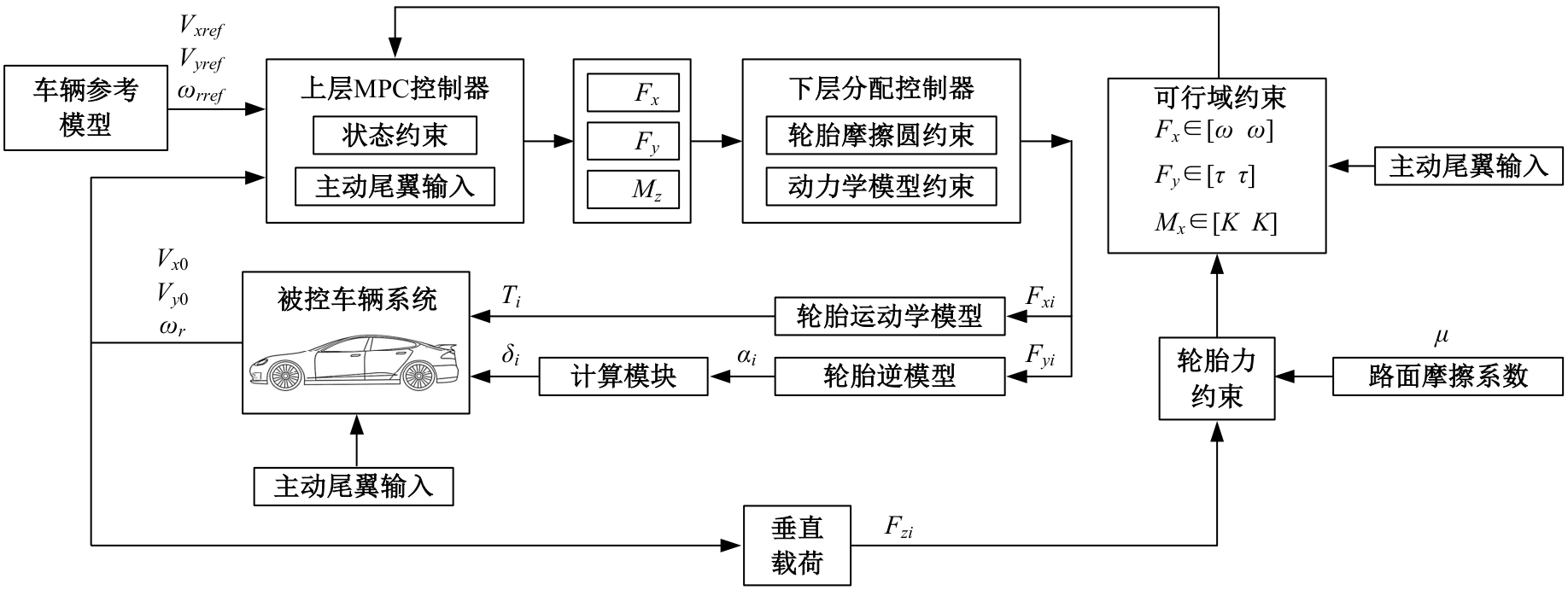
为解决高速行驶或低附着路面下车辆轮胎与地面之间附着力趋于饱和而行车驱动能力不足的问题,提出了一种考虑主动尾翼作用的驱动可行域建立以及带主动尾翼的车辆稳定性控制方法。首先,从主动尾翼的气动性能分析出发,解析主动尾翼带来的整车气动升力与气动阻力,并将其分解至车辆动力学模型中;其次,在融合主动尾翼的车辆模型基础上,以轮胎摩擦圆为约束,推导考虑主动尾翼的驱动可行域建立;最后,以所得驱动可行域作为输入约束,基于非线性模型预测控制方法,设计考虑主动尾翼作用的车辆稳定性控制器。借助CarSim和Simulink联合仿真平台,在不同工况下进行了物理仿真实验。结果表明,主动尾翼能够改善车辆轮胎垂直载荷的分布,扩大车辆行驶驱动可行域的范围,且能够在精确完成轨迹跟踪的同时,提升车辆的稳定性与安全性。
中图分类号:
- TP273

| [1] | Changoski V, Gjurkov I, Jordanoska V. Improving vehicle dynamics employing individual and coordinated sliding mode control in vehicle stability, active front wheel steering and active rear wheel steering systems in co-simulation environment[J]. IOP Conference Series: Materials Science and Engineering, 2022, 1271(5): 012026. |
| [2] | Ji W F, Jin H L, Yan B L, et al. An integrated control framework for torque vectoring and active suspension system[J]. Chinese Journal of Mechanical Engineering, 2024, 37(1): 75-86. |
| [3] | Wang W C, Li G, Liu S W. Research on trajectory tracking control of a semi-trailer train based on differential braking[J]. World Electric Vehicle Journal, 2024, 15(1): 30-45. |
| [4] | Hu J, Zhang K F, Zhang P, et al. Direct yaw moment control for distributed drive electric vehicles based on hierarchical optimization control framework[J]. Mathematics, 2024, 12(11): 1715-1721. |
| [5] | Komp D, Kumar S, Hajek M, et al. Effect of active camber morphing on rotor performance and control loads[J]. Aerospace Science & Technology, 2021, 108(3): 106311. |
| [6] | Hyundong H, Youngil K, Eunhyek J, et al. An integrated control of differential braking, front/rear traction, and active roll moment for limit handling performance[J]. IEEE Transactions on Vehicular Technology, 2016, 65(6): 4288-4300. |
| [7] | Wei C Y, Han L T. Study on modeling and control for a novel active suspension[J]. International Journal for Automotive Technology, 2024, 25(3): 11-18. |
| [8] | 严扬, 刘志国, 高华云. 汽车造型设计概论[M]. 清华大学出版社, 2005. |
| [9] | Diba F, Barari A, Esmailzadeh E. Handling and safety enhancement of race cars using active aerodynamic systems[J]. Vehicle System Dynamics, 2014, 52(9): 1171-1190. |
| [10] | 邓召文, 易强, 高伟. 基于LQR的断开式可调尾翼系统高速操纵稳定性研究[J]. 制造业自动化, 2023, 45(4): 151-158. |
| Deng Zhao-wen, Yi Qiang, Gao Wei. Study on high-speed handling stability of split adjustable rear wing system based on LQR[J]. Manufacturing Automation, 2023, 45(4): 151-158. | |
| [11] | 查云飞, 石小山, 吴昊, 等.基于主动倾斜式尾翼的车辆气动特性研究[J]. 汽车工程, 2023, 45(3): 489-500. |
| Yun-fei Cha, Shi Xiao-shan, Wu Hao, et al. Study of vehicle aerodynamics characteristic Based on active tilting rear wing[J]. Automotive Engineering, 2023, 45(3): 489-500. | |
| [12] | Hammad M, Qureshi K, He Y. Safety and lateral dynamics improvement of a race car using active rear wing control [J]. SAE Technical Papers, 2019(1): 148-156. |
| [13] | Kissai M. Fundamentals on vehicle and tire modelling[J]. Vehicle Dynamics: Fundamentals and Ultimate Trends, 2022, 12(6): 1-59. |
| [14] | 余志生. 汽车理论[M]. 6版. 北京: 机械工业出版社, 2018. |
| [15] | Arash H A, Stefano M. Numerical analysis of the influence of an actively controlled spoiler on the handling of a sports car[J]. Journal of Vibration & Control,2018,24(22): 5437-5448. |
| [16] | Wang D J, Gu T B, Zhang K R. Fault tolerant control of 4-wheel independent drive vehicle subject to actuator faults based on feasible region[J]. IEEE Transactions on Vehicular Technology, 2024, 73(2): 1652-1666. |
| [17] | Wang D J, Qu Z, Ding J N. Tire force distribution method with the constraints of executable drive space consideration[J]. IEEE Transactions on Vehicular Technology, 2018, 67(12): 11427-11439. |
| [18] | 陈虹. 模型预测控制[M]. 北京: 科学出版社, 2013. |
| [19] | 程晶晶. 考虑输入受限的车辆稳定鲁棒控制研究[D]. 长春: 吉林大学通信工程学院, 2022. |
| Cheng Jing-jing. Research on vehicle robust stability control considering input constraints[D]. Chang Chun: College of Communication Engineering, Jilin University, 2022. |
| [1] | 李文博,谢华城,于树友,林宝君,陈虹. 基于分布式模型预测的商用车队列避障控制[J]. 吉林大学学报(工学版), 2026, 56(1): 247-256. |
| [2] | 王菲,陆恒辉,卢荡. 基于UniTire轮胎模型的车辆稳定性控制[J]. 吉林大学学报(工学版), 2025, 55(9): 2864-2873. |
| [3] | 王旭. 四足机器人运动及稳定控制关键技术综述[J]. 吉林大学学报(工学版), 2025, 55(5): 1483-1496. |
| [4] | 张涛,林黄达,余中军. 混合动力车辆换挡的实时滚动优化控制方法[J]. 吉林大学学报(工学版), 2025, 55(4): 1215-1224. |
| [5] | 宫洵,任航,张华霖,汪介瑜,胡云峰,孙耀. 冬季网联纯电动汽车热泵空调生态制热控制方法[J]. 吉林大学学报(工学版), 2025, 55(3): 820-828. |
| [6] | 李寿涛,杨路,屈如意,孙鹏鹏,于丁力. 基于模型预测控制的滑移率控制方法[J]. 吉林大学学报(工学版), 2024, 54(9): 2687-2696. |
| [7] | 赵靖华,张雨彤,曹派,王忠恕,李小平,孙亚南,解方喜. 压缩天然气发动机增程式电动汽车能量管理优化[J]. 吉林大学学报(工学版), 2024, 54(3): 600-609. |
| [8] | 李文航,倪涛,赵丁选,邓英杰,师小波. 基于模型预测反馈技术的救援车辆液压悬挂系统控制方法[J]. 吉林大学学报(工学版), 2024, 54(3): 610-619. |
| [9] | 江和耀,王永海,吴幼冬,王萍. 四轮毂驱动电动车辆横向稳定与侧倾预防协同控制策略[J]. 吉林大学学报(工学版), 2024, 54(2): 540-549. |
| [10] | 刘果,熊坚,杨秀建,何扬帆. 基于曲率增广的智能车辆轨迹跟踪控制[J]. 吉林大学学报(工学版), 2024, 54(12): 3717-3728. |
| [11] | 刘刚,范群,杨旭,任宏斌. 无人驾驶汽车变速换道轨迹跟踪动态控制[J]. 吉林大学学报(工学版), 2024, 54(12): 3729-3739. |
| [12] | 宋秀兰,柴伟豪,何德峰,应颂翔. DoS攻击下网联车队安全协同自适应预测巡航控制[J]. 吉林大学学报(工学版), 2024, 54(11): 3406-3416. |
| [13] | 蒋渊德,欧阳铭,赵祥模,秦孔建,郑兵兵. 车辆纵侧向辅助驾驶集成优化控制策略[J]. 吉林大学学报(工学版), 2024, 54(10): 2741-2753. |
| [14] | 王德军,张凯然,徐鹏,顾添骠,于文雅. 基于车辆执行驱动能力的复杂路况速度规划及控制[J]. 吉林大学学报(工学版), 2023, 53(3): 643-652. |
| [15] | 谢波,高榕,许富强,田彦涛. 低附着路况条件下人车共享转向系统稳定控制[J]. 吉林大学学报(工学版), 2023, 53(3): 713-725. |
|
||