吉林大学学报(工学版) ›› 2026, Vol. 56 ›› Issue (7): 2020-2025.doi: 10.13229/j.cnki.jdxbgxb.20241303
• 计算机科学与技术 • 上一篇
基于神经面元融合溅射学习的实时真实场景重建算法
邬鹏坤1( ),吴星辰2()
- 1.沈阳航空航天大学 设计艺术学院,沈阳 110136
2.季华实验室,广东 佛山 528200
Real-time scene reconstruction algorithm based on neural voxel fusion splatting learning
Peng-kun WU1(),Xing-chen WU2()
- 1.College of Design and Art,Shenyang Aerospace University Shenyang,Shenyang 110136,China
2.JiHua Laboratory,Foshan 528200,China
摘要:
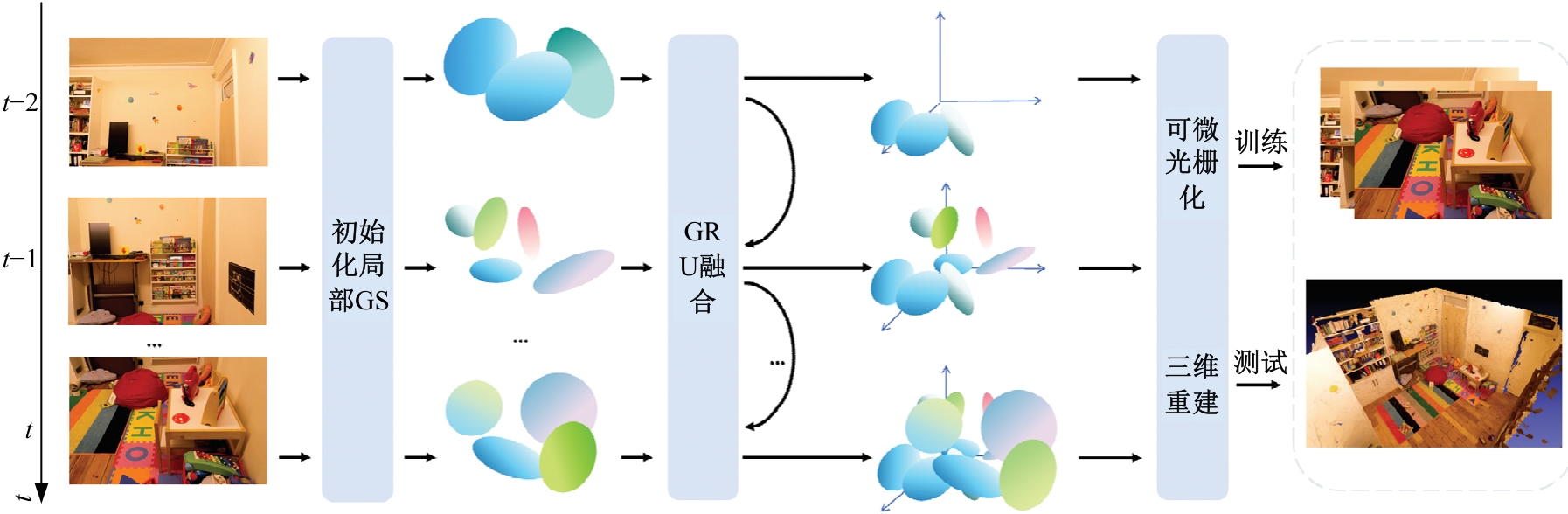
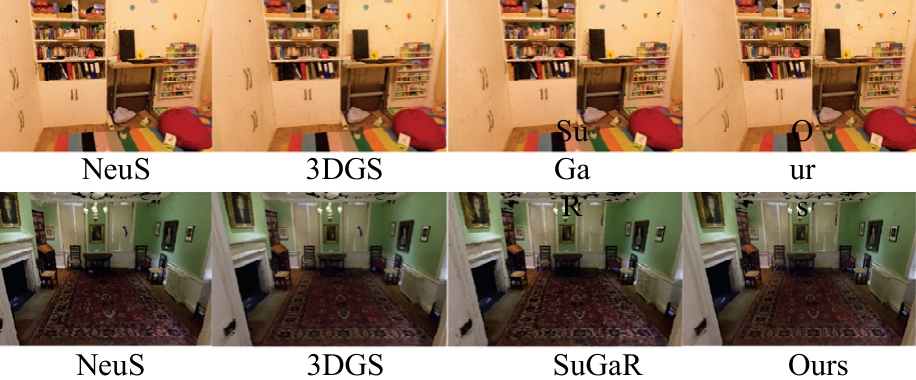
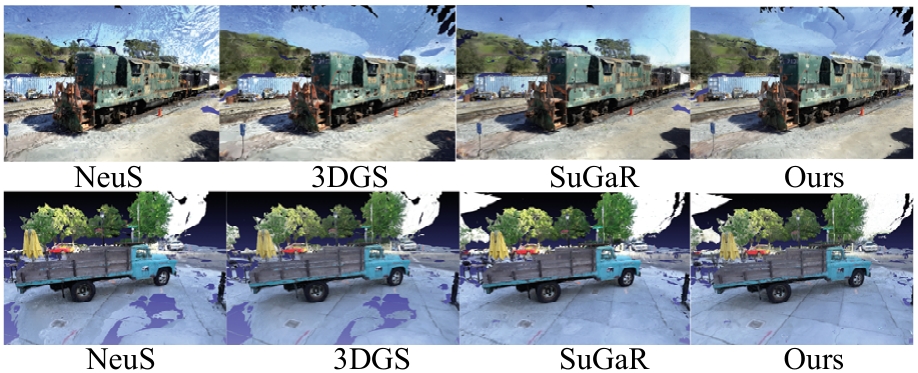
基于一组二维图像对三维场景进行重建的过程中,现有算法难以建模不同时间图片间的关联关系,导致产生较差的大型环境渲染结果,针对该问题,提出一种用于实时真实场景重建的神经面元融合溅射算法。该算法从流式输入数据中逐步构建和更新场景模型,包括基于2D高斯基元的神经面元表示和基于门控循环单元(GRU)的融合机制。首先,通过将高斯面元溅射集成到渲染管道中并采用显式光线溅射交点,实现了透视校正渲染,从而增强了跨多个视点的深度一致性和几何保真度;然后,为了进一步提高重建表面的质量,该方法结合了深度拉取和法线一致性正则化,从而促进了更平滑的表面重建并有助于提取高质量的网格;最后,在DeepBlending和Tanks&Temples两个大型室内/室外场景重建数据集对算法性能进行测试。实验结果表明:该算法在定量和定性评估方面均优于现有算法。
中图分类号:
- TP391.4

| [1] | Cheng J, Zhang L Y, Chen Q H, et al. A review of visual SLAM methods for autonomous driving vehicles[J]. Engineering Applications of Artificial Intelligence, 2022, 114: 104992. |
| [2] | Kazerouni I A, Fitzgerald L, Dooly G, et al. A survey of state-of-the-art on visual SLAM[J]. Expert Systems with Applications, 2022, 205: 117734. |
| [3] | Lee T J, Kim C H, Cho D D. A monocular vision sensor-based efficient SLAM method for indoor service robots[J]. IEEE Transactions on Industrial Electronics, 2018, 66(1): 318-328. |
| [4] | Wei Y, Liu S H, Rao Y M, et al. Nerfingmvs: Guided optimization of neural radiance fields for indoor multi-view stereo[C]∥Proceedings of the IEEE/CVF International Conference on Computer Vision, 2021: 5610-5619. |
| [5] | Chen Z, Wang C, Guo Y C, et al. Structnerf: Neural radiance fields for indoor scenes with structural hints[J]. IEEE Transactions on Pattern Analysis and Machine Intelligence, 2023, 45(12): 15694-15705. |
| [6] | Liu J L, Nie Q, Liu Y, et al. Nerf-loc: Visual localization with conditional neural radiance field[C]∥IEEE International Conference on Robotics and Automation(ICRA), London, United Kingdom, 2023: 9385-9392. |
| [7] | Kerbl B, Kopanas G, Leimkühler T, et al. 3D gaussian splatting for real-time radiance field rendering[J]. ACM Trans. Graph., 2023, 42(4): 139:1-14. |
| [8] | Stier N, Ranjan A, Colburn A, et al. Finerecon: Depth-aware feed-forward network for detailed 3d reconstruction[C]∥Proceedings of the IEEE/CVF International Conference on Computer Vision, Paris, France, 2023: 18377-18386. |
| [9] | Wei W F, Wang J, Xie X, et al. Real-time dense visual slam with neural factor representation[J]. Electronics, 2024, 13(16): 3332. |
| [11] | Tretschk E, Kairanda N, Br M, et al. State of the art in dense monocular non‐rigid 3D reconstruction[J]. Computer Graphics Forum, 2023, 42(2): 485-520. |
| [12] | Hedman P, Philip J, Price T, et al. Deep blending for free-viewpoint image-based rendering[J]. ACM Transactions on Graphics, 2018, 37(6): 1-15. |
| [13] | Knapitsch A, Park J, Zhou Q Y, et al. Tanks and temples: benchmarking large-scale scene reconstruction[J]. ACM Transactions on Graphics, 2017, 36(4): 1-13. |
| Guédon A, Lepetit V. Sugar: Surface-aligned gaussian splatting for efficient 3d mesh reconstruction and high-quality mesh rendering[C]∥Proceedings of the IEEE/CVF Conference on Computer Vision and Pattern Recognition, Seattle, WA, USA, 2024: 5354-5363. | |
| [14] | Wang P, Liu L, Liu Y, et al. Neus: learning neural implicit surfaces by volume rendering for multi-view reconstruction[J]. arXiv preprint arXiv:, 2021. |
| [15] | Zhang R, Isola P, Efros A A, et al. The unreasonable effectiveness of deep features as a perceptual metric[C]∥Proceedings of the IEEE conference on computer vision and pattern recognition, Salt Lake City, UT, USA, 2018: 586-595. |
| [1] | 侯越,张鑫,武月. 基于时空动态约束图反馈的交通流预测[J]. 吉林大学学报(工学版), 2026, 56(1): 183-198. |
| [2] | 田婧,马社强,宋现敏,赵丹,陈发城. 稀疏数据下的交通状态估计自适应卷积网络[J]. 吉林大学学报(工学版), 2025, 55(8): 2579-2587. |
| [3] | 肖红,刘显德. 基于混合智能的学习状态实时采集与动态分析方法[J]. 吉林大学学报(工学版), 2025, 55(7): 2402-2408. |
| [4] | 李家宝,王成军,苏文杭. 基于自适应参数化非极大值抑制的二维人体姿态估计算法[J]. 吉林大学学报(工学版), 2025, 55(7): 2425-2433. |
| [5] | 冯志刚,王首起,于明月. 基于变分模态提取及轻量级网络的滚动轴承故障诊断[J]. 吉林大学学报(工学版), 2025, 55(6): 1883-1891. |
| [6] | 杜睿山,王紫珊. 基于时空注意力的多视角人脸表情识别算法[J]. 吉林大学学报(工学版), 2025, 55(6): 2097-2102. |
| [7] | 才华,朱瑞昆,付强,王伟刚,马智勇,孙俊喜. 基于隐式关键点互联的人体姿态估计矫正器算法[J]. 吉林大学学报(工学版), 2025, 55(3): 1061-1071. |
| [8] | 罗维薇,刘长龙,雷琴. 基于预处理层增强和注意力机制的空域图像隐写分析[J]. 吉林大学学报(工学版), 2025, 55(12): 4024-4033. |
| [9] | 周求湛,牟岩,武慧南,陈霄,汪锋,李琛,张雯,刘萍萍,王聪. 基于RBVS和CBCNN的风机叶片故障检测和分类方法[J]. 吉林大学学报(工学版), 2025, 55(10): 3119-3130. |
| [10] | 关欣,周子健,李锵. 基于图结构引导和位置信息强化的人体姿态估计[J]. 吉林大学学报(工学版), 2025, 55(10): 3283-3295. |
| [11] | 王威,孙钰洁,王新. 频率和空间特征融合的轻量级多尺度遥感图像场景分类网络[J]. 吉林大学学报(工学版), 2025, 55(10): 3361-3371. |
| [12] | 汪豪,赵彬,刘国华. 基于时间和运动增强的视频动作识别[J]. 吉林大学学报(工学版), 2025, 55(1): 339-346. |
| [13] | 胡宏宇,张争光,曲优,蔡沐雨,高菲,高镇海. 基于双分支和可变形卷积网络的驾驶员行为识别方法[J]. 吉林大学学报(工学版), 2025, 55(1): 93-104. |
| [14] | 特木尔朝鲁朝鲁,张亚萍. 基于卷积神经网络的无线传感器网络链路异常检测算法[J]. 吉林大学学报(工学版), 2024, 54(8): 2295-2300. |
| [15] | 赵宏伟,武鸿,马克,李海. 基于知识蒸馏的图像分类框架[J]. 吉林大学学报(工学版), 2024, 54(8): 2307-2312. |
|
||