Journal of Jilin University(Engineering and Technology Edition) ›› 2026, Vol. 56 ›› Issue (7): 1780-1786.doi: 10.13229/j.cnki.jdxbgxb.20241290
Effect of negative⁃pressure design on aerodynamic drag of DrivAer car model
Ming LI1,2,3( ),Shang-yi ZHAO2,Hai-jun XU2,Qing GAO3,Xin CHEN3,Guo-feng QIN1
- 1.Engineering Research Center for Intelligent Agriculture & Forestry Equipment Technology of Guangxi Universities,Guangxi Normal University,Guilin 541006,China
2.Postdoctoral and External Expert Workstation,Guangxi Automobile Group Co. ,Ltd. ,Liuzhou 545027,China
3.State Key Laboratory of Automobile Simulation and Control,Jilin University,Changchun 130022,China
CLC Number:
- U461.1

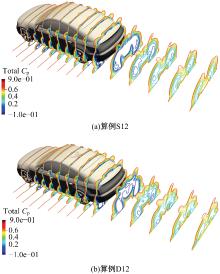
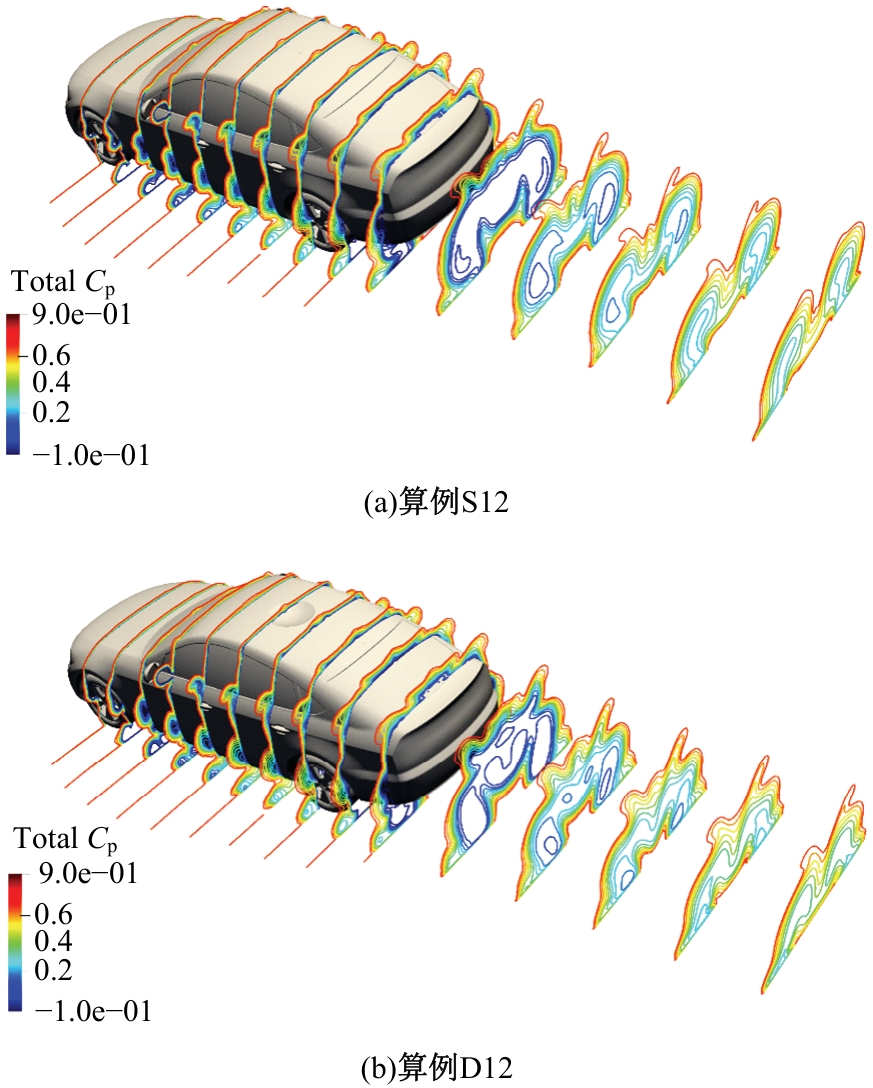
| [1] | Heft A I, Indinger T, Adams N A. Experimental and numerical investigation of the DrivAer model[C]∥ASME 2012 Fluids Engineering Division Summer Meeting, New York, USA, 2012: 41-51. |
| [2] | Qin P, Ricci A, Blocken B. CFD simulation of aerodynamic forces on the DrivAer car model: impact of computational parameters[J]. Journal of Wind Engineering and Industrial Aerodynamics, 2024, 248: No.105711. |
| [3] | Rüttgers M, Park J, You D. Large-eddy simulation of turbulent flow over the DrivAer fastback vehicle model[J]. Journal of Wind Engineering and Industrial Aerodynamics, 2019, 186: 123-138. |
| [4] | Liu J, Zhang Z, Wang Y, et al. Experimental study on the three-dimensional wake structure of the DrivAer standard model[J]. Journal of Visualization, 2021, 24(3): 443-460. |
| [5] | Wittmeier F, Kuthada T. Open grille DrivAer model-first results[J]. SAE International Journal of Passenger Cars—Mechanical Systems, 2015, 8(1): 252-260. |
| [6] | John M, Buga S D, Monti I, et al. Experimental and numerical study of the DrivAer model aerodynamics[C]∥SAE Technical Paper, 2018-01-0741. |
| [7] | Hupertz B, Chalupa K, Krueger L, et al. On the aerodynamics of the notchback open cooling DrivAer: a detailed investigation of wind tunnel data for improved correlation and reference[C]∥SAE Technical Paper, 2021-01-0958. |
| [8] | 张英朝, 杜冠茂, 田思, 等. 35°Ahmed模型气动射流减阻主动控制[J]. 吉林大学学报: 工学版, 2019,49(2): 351-358. |
| Zhang Ying-chao, Du Guan-mao, Tian Si, et al. Active flow control of 35°Ahmed model to reduce aerodynamic drag with steady jet[J]. Journal of Jilin University (Engineering and Technology Edition),2019, 49(2): 351-358. | |
| [9] | Cho J, Park J, Yee K, et al. Comparison of various drag reduction devices and their aerodynamic effects on the DrivAer model[J]. SAE International Journal of Passenger Cars—Mechanical Systems, 2018, 11(3): 225-238. |
| [10] | He P, Mader C A, Martins J R R A, et al. An aerodynamic design optimization framework using a discrete adjoint approach with OpenFOAM[J]. Computers & Fluids, 2018, 168: 285-303. |
| [11] | Grandemange M, Cadot O, Courbois A, et al. A study of wake effects on the drag of Ahmed׳s squareback model at the industrial scale[J]. Journal of Wind Engineering and Industrial Aerodynamics, 2015, 145: 282-291. |
| [12] | 胡兴军, 郭鹏, 惠政, 等. 多孔介质对厢式货车气动特性的影响[J]. 吉林大学学报: 工学版, 2019,49(2):345-350. |
| Hu Xing-jun, Guo Peng, Hui Zheng, et al. Effect of porous media on the aerodynamic characteristics of van-body truck[J]. Journal of Jilin University (Engineering and Technology Edition),2019, 49(2): 345-350. | |
| [13] | Wang Y, Wu C, Tan G, et al. Reduction in the aerodynamic drag around a generic vehicle by using a non-smooth surface[J]. Journal of Automobile Engineering, 2017, 231(1): 130-144. |
| [14] | Ballerstein N, Horst P. Manipulation of the aerodynamic behavior of the DrivAer model using dimple patterns[J]. Journal of Wind Engineering and Industrial Aerodynamics, 2023, 233: No.105216. |
| [15] | 杨易,郑萌,黄剑锋,等.基于非光滑表面与涡流干扰的车身气动减阻方法[J].中国机械工程, 2016, 27(7): 982-988. |
| Yang Yi, Zheng Meng, Huang Jian-feng, et al. Aerodynamic drag reduction method of vehicle body based on non-smooth surface and vortex interference[J]. China Mechanical Engineering, 2016, 27(7): 982-988. | |
| [16] | Strangfeld C, Wieser D, Schmidt H J, et al. Experimental study of baseline flow characteristics for the realistic car model DrivAer[C]∥SAE Technical Paper, 2013-01-1251. |
| [1] | Hong-qian ZHAO,Hai-yan LI,Cheng-ming ZHANG,Shi-hai CUI,Li-juan HE,Wen-le LYU. Development and application of pedestrian human body model representing anthropometric characteristics of 50th percentile Chinese male for intelligent safety [J]. Journal of Jilin University(Engineering and Technology Edition), 2026, 56(3): 779-792. |
| [2] | Yao FU,Chun-shui ZHAN,Ke LIU. Nonlinear path tracking control for intelligent vehicles considering communication delays [J]. Journal of Jilin University(Engineering and Technology Edition), 2026, 56(3): 851-859. |
| [3] | Jun LI,Fei-fan YANG,Sheng GONG,Ke-yu ZHOU. Lightweight pavement anomaly detection algorithm based on vision [J]. Journal of Jilin University(Engineering and Technology Edition), 2026, 56(2): 488-496. |
| [4] | Zhen-hai GAO,Ming-xi BAO,Rui ZHAO,Ming-hong TANG,Fei GAO. Multimodal trajectory prediction based on target anchor-driven [J]. Journal of Jilin University(Engineering and Technology Edition), 2026, 56(1): 21-30. |
| [5] | Xiang-wen ZHANG,Zi-hao WANG. Electro-hydraulic coordinated control strategy for braking mode switching process of electric vehicles [J]. Journal of Jilin University(Engineering and Technology Edition), 2026, 56(1): 31-43. |
| [6] | Wei LAN,Zheng ZHOU,Guan-yu WANG,Wei WANG,Miao-miao ZHANG. Intelligent fitting method for vehicle design based on machine learning [J]. Journal of Jilin University(Engineering and Technology Edition), 2025, 55(9): 2858-2863. |
| [7] | Bing ZHU,Peng-xiang MENG,Bin LIU,Jia-yi HAN,Jian ZHAO,Zhi-cheng CHEN,Dong-jian SONG,Xiao-wen TAO. Virtual lane lines fitting method based on traffic environment information [J]. Journal of Jilin University(Engineering and Technology Edition), 2025, 55(9): 2935-2945. |
| [8] | Shou-tao LI,Xiang-yi JIA,Jun ZHU,Hong-yan GUO,Ding-li YU. Uncontrolled intersections decision⁃making method for intelligent driving vehicles based on Level⁃K [J]. Journal of Jilin University(Engineering and Technology Edition), 2025, 55(9): 3069-3078. |
| [9] | Jin-wu GAO,Shao-long SUN,Shun-yao WANG,Bing-zhao GAO. Speed fluctuation suppression strategy of range extender based on motor torque compensation [J]. Journal of Jilin University(Engineering and Technology Edition), 2025, 55(8): 2475-2486. |
| [10] | Gui-shen YU,Xin CHEN,Yue TANG,Chun-hui ZHAO,Ai-jia NIU,Hui CHAI,Jing-xin NA. Effect of laser surface treatment on the shear strength of aluminum-aluminum bonding joints [J]. Journal of Jilin University(Engineering and Technology Edition), 2025, 55(8): 2555-2569. |
| [11] | Jun-wu ZHAO,Ting QU,Yun-feng HU. Trajectory planning for intelligent vehicles based on adaptive sampling [J]. Journal of Jilin University(Engineering and Technology Edition), 2025, 55(8): 2802-2816. |
| [12] | Mei-xia JIA,Jian-jun HU,Feng XIAO. Multi⁃physics simulation method of vehicle motor under varying working conditions based on multi⁃software combination [J]. Journal of Jilin University(Engineering and Technology Edition), 2025, 55(6): 1862-1872. |
| [13] | Chun XIAO,Zi-chun YI,Bing-yin ZHOU,Shao-rui ZHANG. Fuzzy energy management strategy of fuel cell electric vehicle based on improved pigeon⁃inspired optimization [J]. Journal of Jilin University(Engineering and Technology Edition), 2025, 55(6): 1873-1882. |
| [14] | Xue-wei SONG,Ze-ping YU,Yang XIAO,De-ping WANG,Quan YUAN,Xin-zhuo LI,Jia-wen ZHENG. Research progress on the performance changes of lithium⁃ion batteries after aging [J]. Journal of Jilin University(Engineering and Technology Edition), 2025, 55(6): 1817-1833. |
| [15] | Wei-dong LI,Cao-yuan MA,Hao SHI,Heng CAO. An automatic driving decision control algorithm based on hierarchical reinforcement learning [J]. Journal of Jilin University(Engineering and Technology Edition), 2025, 55(5): 1798-1805. |
|
||