吉林大学学报(医学版) ›› 2026, Vol. 52 ›› Issue (5): 1467-1473.doi: 10.13481/j.1671-587X.20260528

• 方法学 • 上一篇    

胆囊结石模型猪内镜下经自然腔道保胆取石手术安全性和隧道入路可行性评价

戴新羽,魏丽娟()   

  1. 吉林大学第二医院胃肠内科及消化内镜中心,吉林 长春 130041
  • 收稿日期:2025-11-17 接受日期:2026-01-11 出版日期:2026-09-28 发布日期:2026-10-15
  • 通讯作者: 魏丽娟 E-mail:m15526852362@163.com
  • 作者简介:戴新羽(1994-),女,吉林省白山市人,主治医师,医学硕士,主要从事胃肠道疾病和消化内镜微创诊断及治疗方面的研究。
  • 基金资助:
    吉林省科技厅科技发展计划项目(20210203191SF)

Evaluation of safety of transgastric natural orifice transluminal endoscopic gallbladder-preserving cholelithotomy and feasibility of tunnel approach in pig model with gallstones

Xinyu DAI,Lijuan WEI()   

  1. Department of Gastroenterology and Digestive Endoscopy Center,Second Hospital,Jilin University,Changchun,130041,China
  • Received:2025-11-17 Accepted:2026-01-11 Online:2026-09-28 Published:2026-10-15
  • Contact: Lijuan WEI E-mail:m15526852362@163.com

摘要:

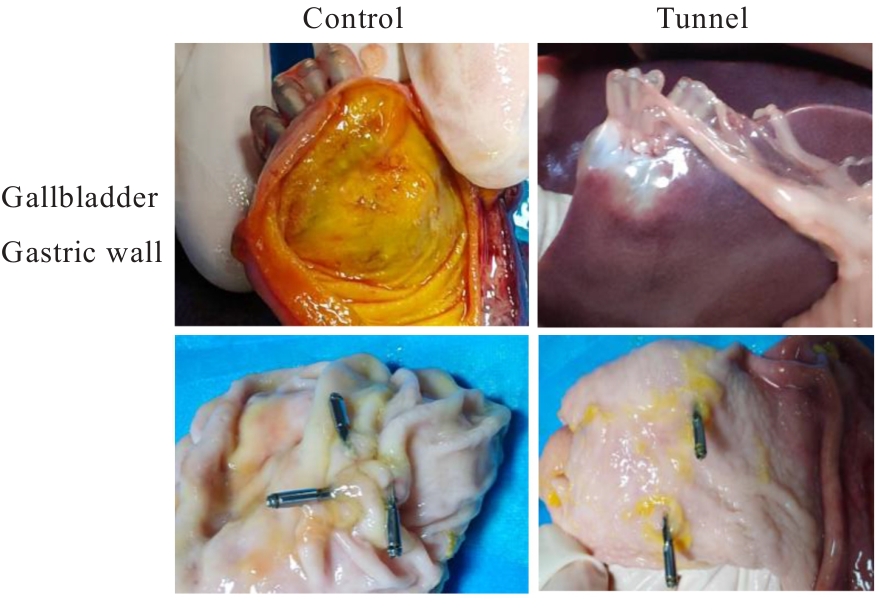
目的 探讨经自然腔道内镜手术(NOTES)实施保胆取石术的安全性及经胃隧道入路的可行性。 方法 选用6只体质量为(18±2)kg的小型猪,通过喂饲法建立胆囊结石模型,建模成功后采用随机数字表法随机分为隧道组(经黏膜下隧道入路)和对照组(胃壁逐层切开入路),每组3只。2组小型猪均经胃窦前壁切口进入腹腔,行胆囊切开取石,再以金属夹闭合胆囊及胃壁切口。记录2组小型猪的手术时间、出血量和并发症发生情况,并于术后1个月解剖观察切口愈合情况。于术前30 min、术后24 h、术后72 h和术后1个月分别检测2组小型猪血清中白细胞(WBC)计数及C反应蛋白(CRP)水平以及肝功能指标总胆红素(TBIL)水平和丙氨酸氨基转移酶(ALT)及天冬氨酸氨基转移酶(AST)活性。 结果 6只小型猪均顺利完成手术,67%(4/6)的模型猪成功形成1~3枚直径约为1~8 mm的胆囊结石。与对照组比较,隧道组小型猪胃壁切开时间明显增加(P<0.05)。与对照组比较,隧道组小型猪胃壁切口出血量更少,但差异无统计学意义(P>0.05)。与对照组比较,隧道组小型猪术中胃壁夹闭时间明显缩短(P<0.05),金属夹使用数量明显减少(P<0.05)。2组小型猪术后无严重并发症,术后1个月行解剖显示切口愈合良好。实验室指标检测,与术前30 min比较,术后24 h小型猪血清中WBC计数和CRP水平均明显升高(P<0.01),术后72 h小型猪血清中WBC计数恢复至正常水平,CRP水平仍明显升高(P<0.01)。与术前比较,术后各时间点小型猪TBIL水平和ALT及AST活性差异均无统计学意义(P>0.05)。 结论 经胃NOTES保胆取石术安全可行,隧道入路在减少出血及胃壁切口闭合方面具有优势。

关键词: 胆囊结石, 保胆取石术, 经自然腔道内镜手术, 隧道技术, 疾病模型

Abstract:

Objective To investigate the safety of gallbladder-preserving cholelithotomy via natural orifice transluminal endoscopic surgery (NOTES) and the feasibility of the transgastric tunnel approach. Methods Six miniature pigs weighing 18±2 kg were selected, and gallstone models were established by feeding method. The miniature pigs with successful modeling were randomly divided into tunnel group (submucosal tunnel approach) and control group (layered gastric wall incision approach) using a random number table method, with 3 miniature pigs in each group. Both groups of miniature pigs entered the abdominal cavity through an incision in the anterior wall of the gastric antrum, underwent cholecystotomy and stone removal, and then the gallbladder and gastric wall incisions were closed with metal clips. The surgical time, blood loss, and occurrence of complications in the two groups of miniature pigs were recorded. Incision healing was observed by anatomical dissection at 1 month postoperatively. White blood cell (WBC) count, C-reactive protein (CRP) level, and total bilirubin (TBIL) level, and alanine aminotransferase (ALT) and aspartate aminotransferase (AST) activities in the serum of the miniature pigs were detected at 30 min before surgery, 24 and 72 h postoperatively, and 1 month postoperatively. Results All 6 miniature pigs successfully completed the surgery. Gallstones (1-3 stones with diameters of approximately 1-8 mm) were successfully formed in 67% (4/6) of the model miniature pigs. Compared with control group, the gastric wall incision time in tunnel group was significantly increased (P<0.05). Compared with control group, the blood loss from gastric wall incision was less in tunnel group, but no statistically significant difference was observed (P>0.05). Compared with control group, the time required for gastric wall closure was significantly decreased in tunnel group (P<0.05), and the number of metal clips used was significantly decreased (P<0.05). No serious complications occurred in the miniature pigs in two groups postoperatively, and anatomical dissection at 1 month postoperatively showed good incision healing. For laboratory indicators, compared with those at preoperative 30 min, the WBC count and CRP level in the serum of the miniature pigs were significantly increased at 24 h postoperatively (P<0.01). At 72 h postoperatively, the WBC count in the serum of the miniature pigs returned to normal, while the CRP level remained significantly increased (P<0.01). Compared with those at preoperative 30 min, no statistically significant differences were observed in TBIL levels or ALT and AST activities of the miniature pigs at any postoperative time point (P>0.05). Conclusion Transgastric NOTES gallbladder-preserving cholelithotomy is safe and feasible. The tunnel approach shows advantages in reducing bleeding and facilitating gastric wall incision closure.

Key words: Gallstone, Gallbladder-preserving cholelithotomy, Natural orifice transluminal endoscopic surgery, Tunnel technique, Disease model

中图分类号: 

  • R657.4