吉林大学学报(医学版) ›› 2026, Vol. 52 ›› Issue (3): 730-737.doi: 10.13481/j.1671-587X.20260315

• 基础研究 • 上一篇    下一篇

人参三醇皂苷对D-半乳糖诱导小鼠骨骼肌衰老的改善作用及其机制

贾贺强1,潘路,王振江2,逯家宇3,王丹1,刘立峰2,董营1(),于春艳1,4()   

  1. 1.北华大学基础医学院病理学教研室,吉林 吉林 132013
    2.北华大学基础医学院解剖学教研室,吉林 吉林 132013
    3.北华大学附属医院麻醉科,吉林 吉林 132013
    4.吉林医药学院基础医学院病理学教研室,吉林 吉林 132013
  • 收稿日期:2025-09-26 接受日期:2025-11-10 出版日期:2026-05-28 发布日期:2026-06-08
  • 通讯作者: 董营,于春艳 E-mail:dongying@beihua.edu.cn;gchunyanyu@163.com
  • 作者简介:贾贺强(1997-),男,山西省忻州市人,在读硕士研究生,主要从事衰老生理学方面的研究。
  • 基金资助:
    吉林省科技厅科技发展计划项目(20230203073SF);吉林省科技厅科技发展计划项目(YDZJ202301ZYTS112);吉林省科技厅科技发展计划项目(20210101022JC);吉林省教育厅科学技术研究项目(JJKH20230079KJ);北华大学校级大学生创新创业训练计划项目(2025年);北华大学研究生创新计划项目(研创合字〔2024〕022)

Improving effect of Panaxatriol saponins on D-galactose-induced skeletal muscle aging of mice and its mechanism

Heqiang JIA1,Lu PAN,Zhenjiang WANG2,Jiayu LU3,Dan WANG1,Lifeng LIU2,Ying DONG1(),Chunyan YU1,4()   

  1. 1.Department of Pathology,School of Basic Medical Sciences,Beihua University,Jilin 132013,China
    2.Department of Human Anatomy,School of Basic Medical Sciences,Beihua University,Jilin 132013,China
    3.Department of Anesthesiology,Affiliated Hospital,Beihua University,Jilin 132013,China
    4.Department of Pathology,School of Basic Medicine Sciences,Jilin Medical University,Jilin 132013,China
  • Received:2025-09-26 Accepted:2025-11-10 Online:2026-05-28 Published:2026-06-08
  • Contact: Ying DONG,Chunyan YU E-mail:dongying@beihua.edu.cn;gchunyanyu@163.com

摘要:

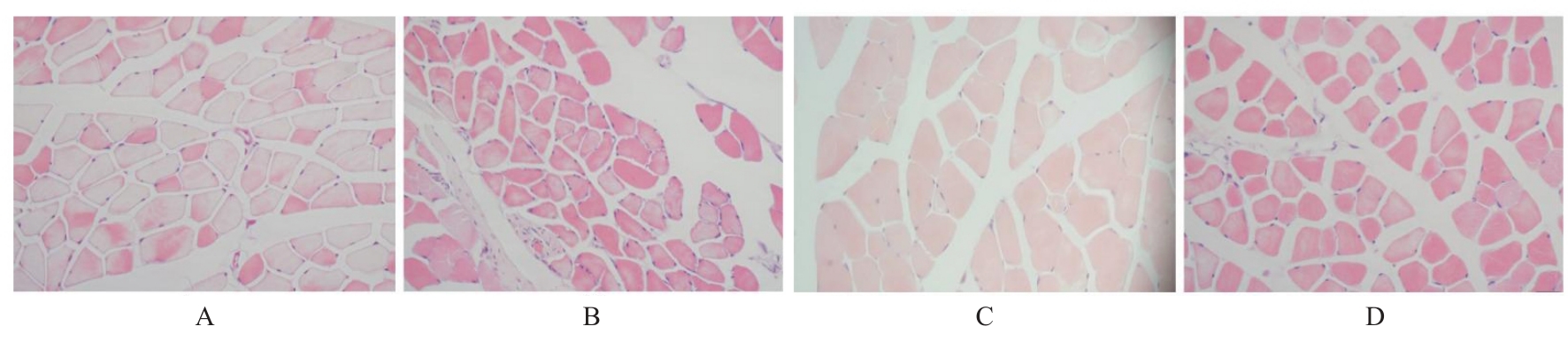
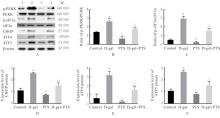
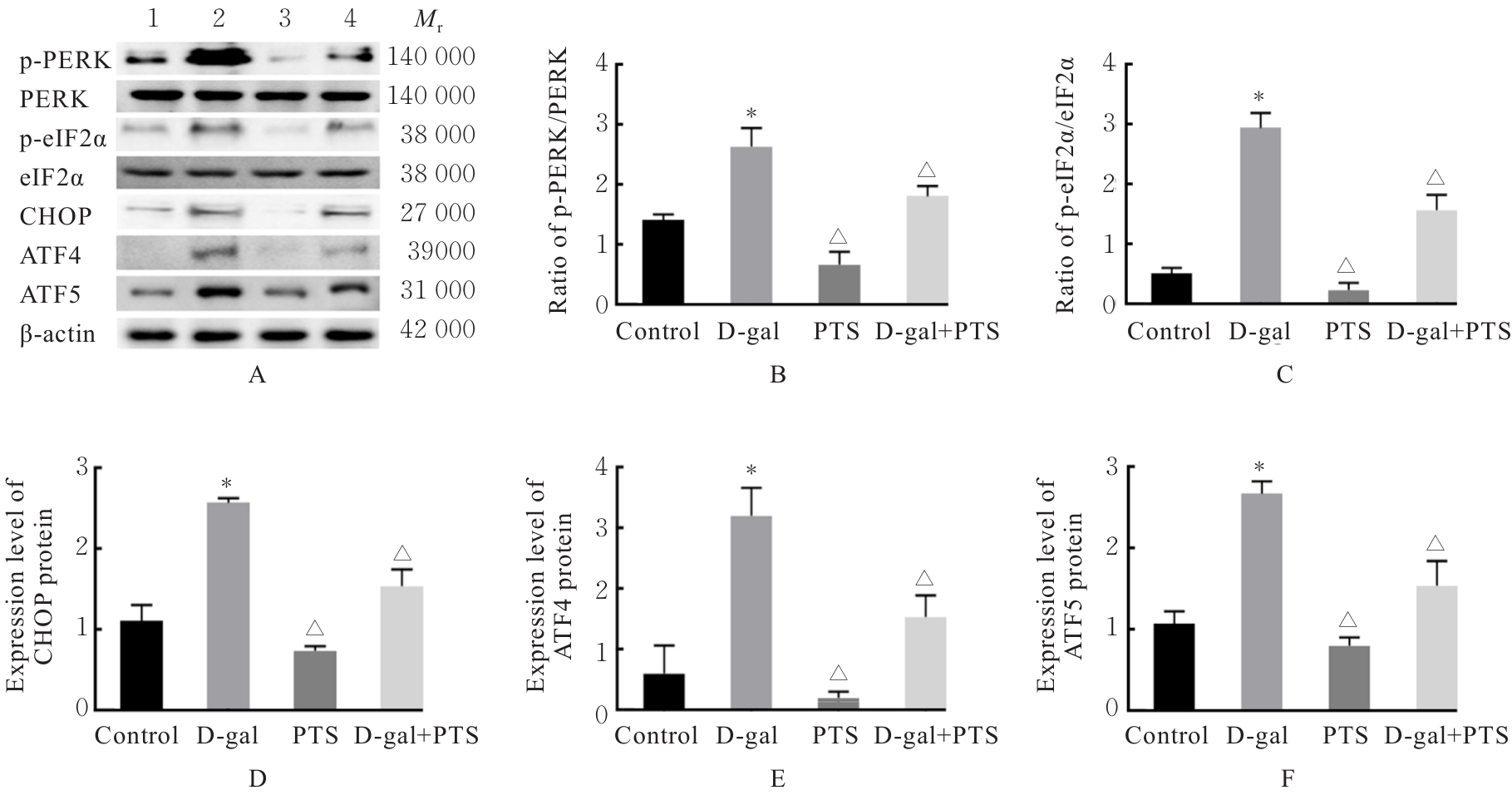
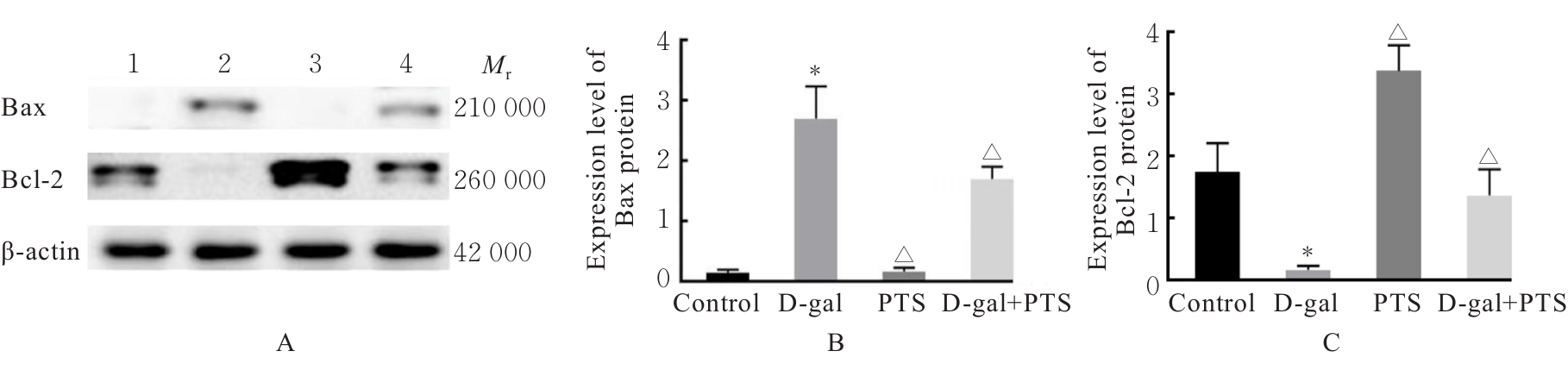
目的 探讨人参三醇皂苷(PTS)对D-半乳糖(D-gal)诱导小鼠骨骼肌衰老的作用,并阐明其可能的分子机制。 方法 将72只C57BL/6J雄性小鼠随机分为对照组、D-gal组、PTS组和D-gal+PTS组,构建D-半乳糖构建骨骼肌衰老模型,再给予PTS。观察各组小鼠一般情况,测量小鼠股直肌质量并计算肌肉质量指数(SI),采用HE染色观察各组小鼠骨骼肌组织病理形态表现,Western blotting法检测各组小鼠骨骼肌中真核翻译起始因子2α(eIF2α)/激活转录因子4(ATF4)信号通路内质网(ER)应激相关蛋白表达水平。 结果 与对照组比较,D-gal组小鼠皮肤毛发稀疏、质地较差,行为异常、活动减少;与D-gal组比较,D-gal+PTS组小鼠毛发状态明显改善,行为状态改善,更为活跃。与对照组比较,D-gal组小鼠体质量、左股直肌和右股直肌SI均明显降低(P<0.01);与D-gal组比较,D-gal+PTS组小鼠体质量、左股直肌和右股直肌SI明显升高(P<0.01)。HE染色,与对照组比较,D-gal组小鼠股直肌横截面可见破碎的肌纤维,肌细胞核内移,细胞间隙明显增宽,呈肌肉减少的形态学改变;PTS组小鼠上述组织未出现明显差异。与D-gal组比较,D-gal+PTS组小鼠肌细胞形态规则,细胞间隙不增宽,无肌细胞核内移,肌肉形态明显改善。Western blotting法,与对照组比较,D-gal组小鼠骨骼肌组织中磷酸化蛋白激酶RNA样内质网激酶(p-PERK)/PERK比值、C/EBP同源蛋白(CHOP)和ATF4和激活转录因子5(ATF5)蛋白表达水平及磷酸化eIF2α(p-eIF2α)/eIF2α比值均明显升高(P<0.01);与D-gal组比较,PTS组和D-gal+PTS组小鼠骨骼肌组织中p-PERK/PERK p-eIF2α/eIF2α比值和ATF4及ATF5蛋白表达水平均明显降低(P<0.01)。与对照组比较,D-gal组小鼠骨骼肌组织中B细胞淋巴瘤2(Bcl-2)相关X蛋白(Bax)蛋白表达水平明显升高(P<0.01),Bcl-2蛋白表达水平明显降低(P<0.01);与D-gal组比较,PTS组和D-gal+PTS组小鼠骨骼肌组织中Bax蛋白表达水平明显降低(P<0.01),PTS组和D-gal+PTS组小鼠骨骼肌组织中Bcl-2蛋白表达水平明显升高(P<0.01)。 结论 PTS可改善D-gal诱导小鼠骨骼肌衰老,并下调eIF2α/ATF4信号通路蛋白表达,其作用机制可能与eIF2α/ATF4信号通路和Bax与Bcl-2的分子机制有关。

关键词: 骨骼肌衰老, 人参三醇皂苷, D-半乳糖, 内质网应激, 蛋白激酶RNA样内质网激酶

Abstract:

Objective To discuss the effect of Panaxatriol saponins (PTS) on D-galactose (D-gal)- induced skeletal muscle aging of mice, and to clarify its possible molecular mechanism. Methods Seventy-two male C57BL/6J mice were randomly divided into control group, D-gal group, PTS group, and D-gal+PTS group. A D-gal-induced skeletal muscle aging model was established, and then PTS was administered; the general condition of the mice in various groups was observed; the weight of rectus femoris muscle of mice was measured and the sarcopenia index (SI) was calculated; HE staining was used to observe the pathomorphology of skeletal muscle tissue of the mice in various groups; Western blotting method was used to detect the expression levels of endoplasmic reticulum(ER) stress-related proteins in the eukaryotic translation initiation factor 2α (eIF2α)/activating transcription factor 4 (ATF4) signaling pathway in skeletal muscle tissue of the mice in various groups. Results The observation of general condition showed that compared with control group, the mice in D-gal group had sparse and poor quality hair, abnormal behavior, and decreased activity; compared with D-gal group, the mice in D-gal+PTS group showed significantly improved hair condition, improved behavioral state, and were more active. The measurement results showed that compared with control group, the body mass, left rectus femoris SI, and right rectus femoris SI of the mice in D-gal group were significantly decreased (P<0.01); compared with D-gal group, the body mass, left rectus femoris SI, and right rectus femoris SI of the mice in D-gal+PTS group were significantly increased (P<0.01). The HE staining results showed that compared with control group, the cross-section of rectus femoris muscle of the mice in D-gal group showed broken muscle fibers, nuclear internalization of myocytes, and significantly widened intercellular space were observed, showing the morphological changes of sarcopenia; no significant differences were observed in the above tissues of the mice in PTS group; compared with D-gal group, the myocytes of the mice in D-gal+PTS group had regular morphology, no widening of intercellular space, no nuclear internalization, and the muscle morphology was significantly improved. The Western blotting method results showed that compared with control group, the ratio of phosphorylated PERK (p-PERK) to PERK (p-PERK/PERK ratio), the expression levels of C/EBP homologous protein (CHOP) and ATF4 and activating transcription factor 5 (ATF5) proteins, and the ratio of phosphorylated eIF2α (p-eIF2α) to eIF2α (p-eIF2α/eIF2α ratio) in skeletal muscle tissue of the mice in D-gal group were significantly increased (P<0.01); compared with D-gal group, the p-PERK/PERK ratio, p-eIF2α/eIF2α ratio, and the expression levels of ATF4 and ATF5 proteins in PTS group and D-gal+PTS group were significantly decreased (P<0.01). The Western blotting method results also showed that compared with control group, the expression level of B-cell lymphoma 2 (Bcl-2)-associated X protein (Bax) in skeletal muscle tissue of the mice in D-gal group was significantly increased (P<0.01), and the expression level of Bcl-2 protein was significantly decreased (P<0.01); compared with D-gal group, the expression levels of Bax protein in skeletal muscle tissue of the mice in PTS group and D-gal+PTS group were significantly decreased (P<0.01), and the expression levels of Bcl-2 protein in skeletal muscle tissue of the mice in PTS group and D-gal+pts group were significantly increased (P<0.01). Conclusion PTS can ameliorate D-gal-induced skeletal muscle aging of the mice and down-regulate the expression of proteins in the eIF2α/ATF4 signal pathway; its mechanism may be related to eIF2α/ATF4 signal pathway and molecular mechaism of Bax and Bcl-2.

Key words: Skeletal muscle aging, Panaxatriol saponins, D-galactose, Endoplasmic reticulum stress, Protein kinase RNA-like endoplasic reticulum

中图分类号: 

  • R739.5