Journal of Jilin University(Medicine Edition) ›› 2026, Vol. 52 ›› Issue (5): 1273-1281.doi: 10.13481/j.1671-587X.20260509
• Research in basic medicine • Previous Articles
Effects of Panax notoginseng saponins on biological behaviors of gastric cancer cells and Keap1-Nrf2 signaling pathway
Dongyu XIANG( ),Guiyu CHEN,Yue XIANG
- Department of Chinese Materia Medica,Shandong College of Traditional Chinese Medicine,Yantai 264199,China
-
Received:2025-12-17Accepted:2026-02-06Online:2026-09-28Published:2026-10-15 -
Contact:Dongyu XIANG E-mail:xiangdongyu1106@163.com

CLC Number:
- R285.5
Cite this article
Dongyu XIANG,Guiyu CHEN,Yue XIANG. Effects of Panax notoginseng saponins on biological behaviors of gastric cancer cells and Keap1-Nrf2 signaling pathway[J].Journal of Jilin University(Medicine Edition), 2026, 52(5): 1273-1281.
share this article
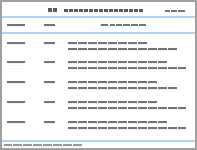
Tab.1
Cell activities in various groups detected by MTT assay"
| Cell line | Group | Cell viability | F | P | |
|---|---|---|---|---|---|
| (t/h) 24 | 48 | ||||
| GES-1 | Control | 99.58±2.73 | 100.31±2.88 | 1.083 | 0.379 |
| 5 μmol·L-1 PNS | 101.84±3.12 | 95.76±3.04 | |||
| 10 μmol·L-1 PNS | 107.36±3.78 | 92.68±2.83 | |||
| 20 μmol·L-1 PNS | 109.62±4.21 | 91.92±3.18 | |||
| AGS | Control | 99.82±2.61 | 100.47±2.79 | 12.468 | <0.001 |
| 5 μmol·L-1 PNS | 97.91±2.94 | 81.68±3.56* | |||
| 10 μmol·L-1 PNS | 84.63±3.69* | 67.94±3.87* | |||
| 20 μmol·L-1 PNS | 64.77±4.08* | 41.63±3.36* | |||
| HGC27 | Control | 99.91±2.53 | 100.38±2.66 | 14.021 | <0.001 |
| 5 μmol·L-1 PNS | 91.76±3.19* | 79.61±3.48* | |||
| 10 μmol·L-1 PNS | 81.58±3.55* | 63.72±3.82* | |||
| 20 μmol·L-1 PNS | 65.87±3.98* | 37.88±3.29* | |||
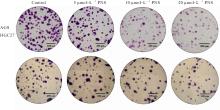
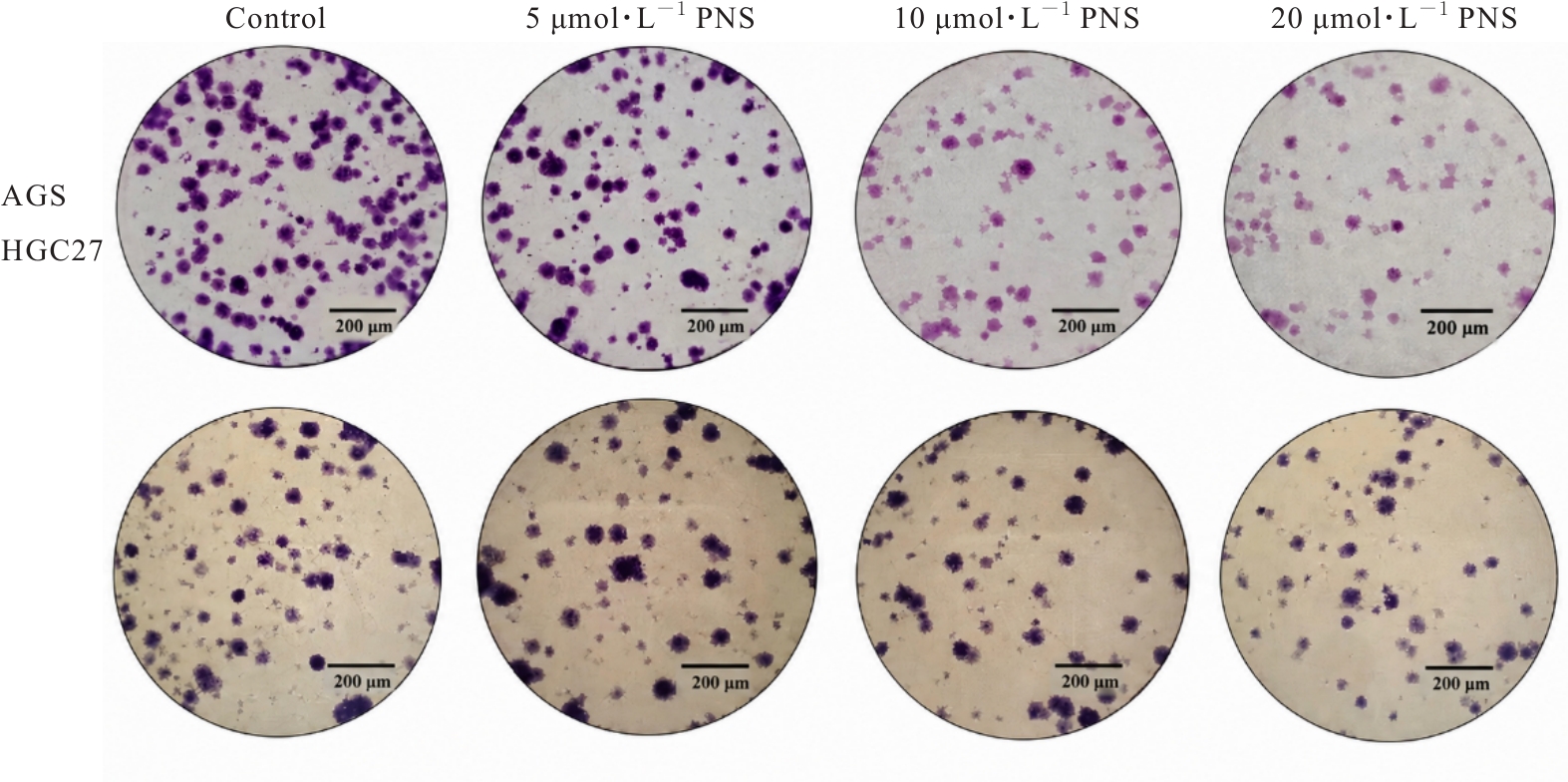
Fig. 1
Cell colony formation in various groups (Crystal violet)"
Tab.2
Numbers of colony formation of cells, migration cells and invasion cells in various groups"
| Group | AGS | HGC27 | ||||
|---|---|---|---|---|---|---|
| Number of colony formation | Number of migration cells | Number of invasion cells | Number of colony formation | Number of migration cells | Number of invasion cells | |
| Control | 172.40±10.85 | 42.30±3.85 | 43.50±3.96 | 131.60±9.42 | 43.10±3.92 | 44.20±4.01 |
| 5 μmol·L-1 PNS | 142.10±9.76* | 34.20±3.01* | 32.60±2.88* | 105.80±8.31* | 34.60±3.08* | 31.80±2.74* |
| 10 μmol·L-1 PNS | 96.30±8.14* | 20.10±2.14* | 15.30±1.92* | 78.90±6.87* | 19.40±2.05* | 16.10±1.87* |
| 20 μmol·L-1 PNS | 68.70±7.02* | 12.40±1.63* | 9.80±1.41* | 52.40±5.96* | 13.10±1.58* | 11.40±1.53* |
| F | 58.926 | 96.284 | 121.639 | 64.381 | 102.517 | 118.402 |
| P | <0.001 | <0.001 | <0.001 | <0.001 | <0.001 | <0.001 |
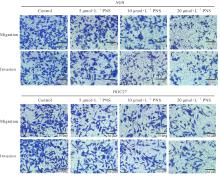
Fig. 2
Migration and invasion of cells in various groups (Crystal violet)"
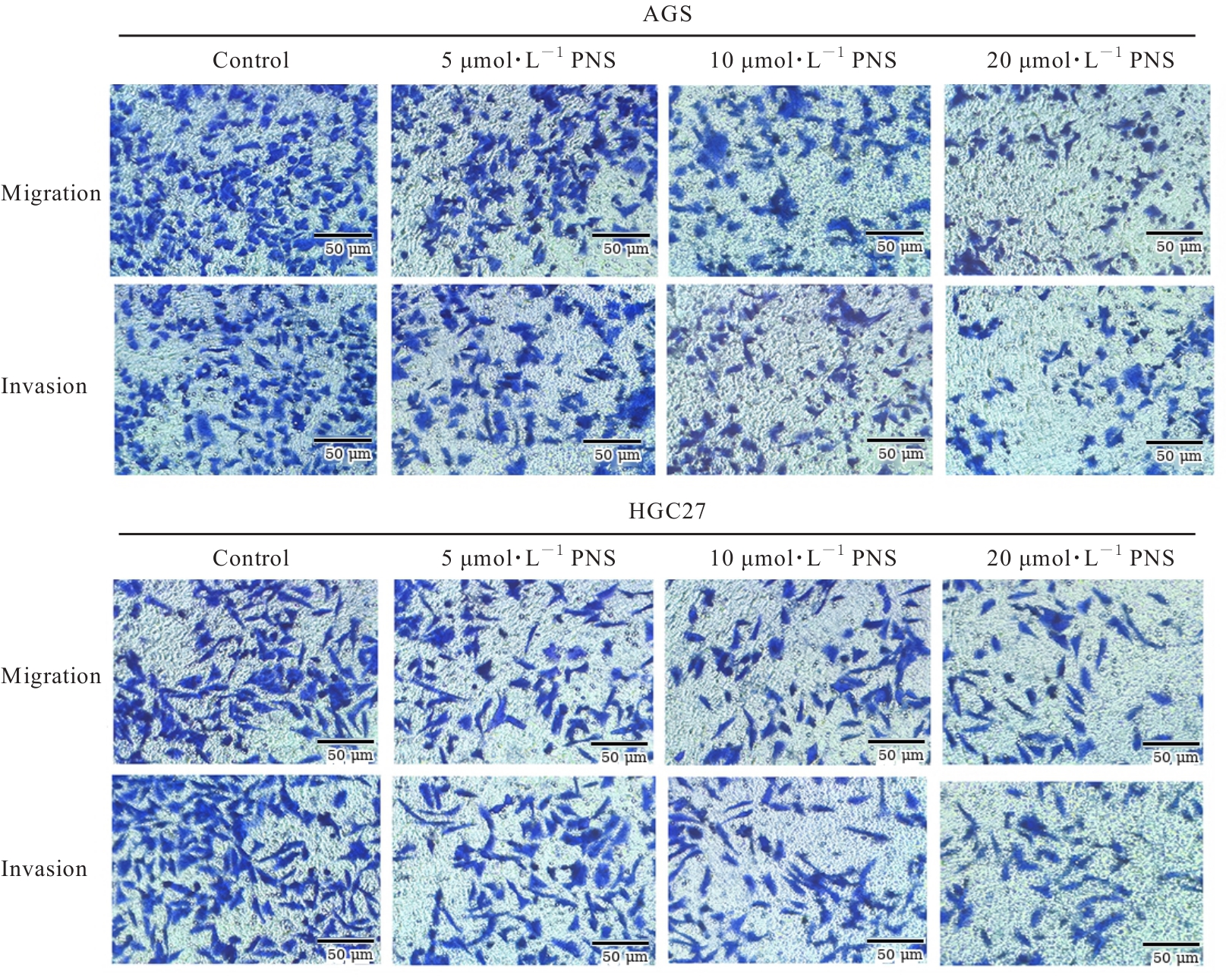
Fig. 3
Apoptosis of cells in various groups"
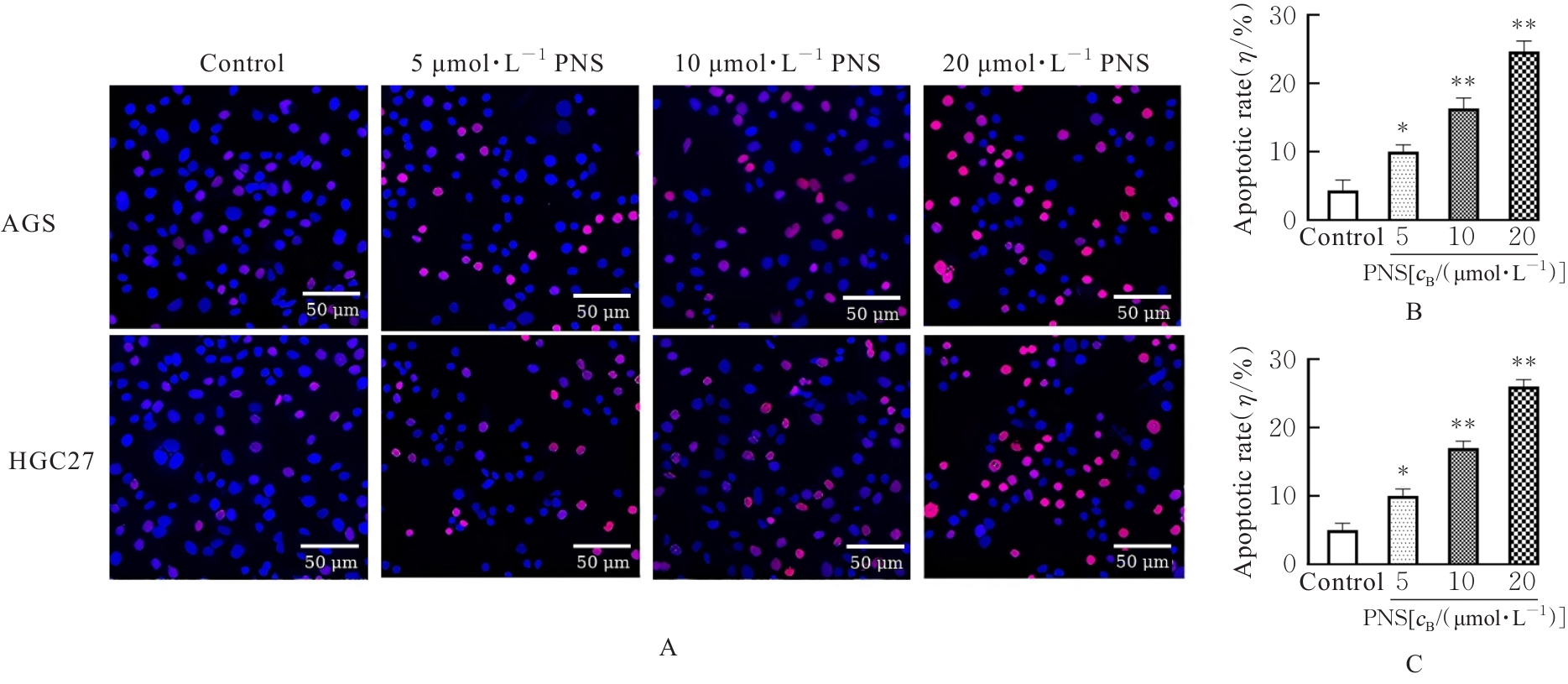
Fig. 4
Expressions of ROS in cells in various groups detected by DCFH-DA fluorescence probe assay"
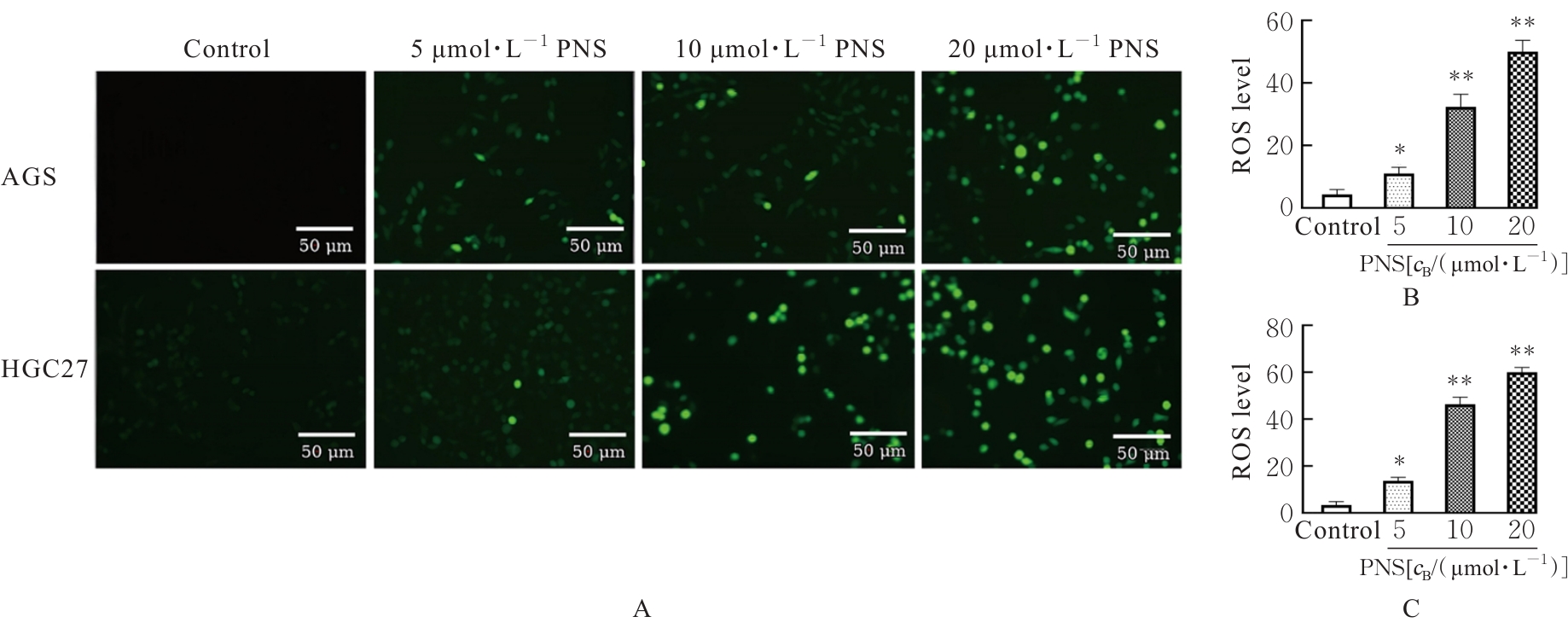
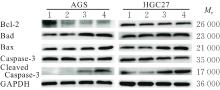
Fig. 5
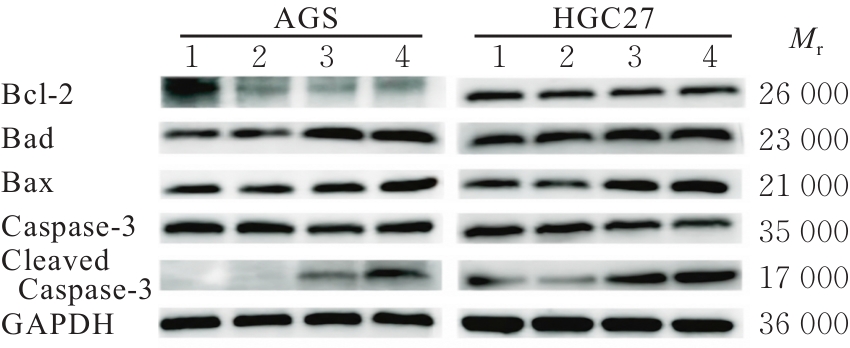
Electrophoregram of expressions of apoptosis-related proteins in cells in various groups"
Tab.3
Expression levels of apoptosis-related proteins in cells in various groups"
| Group | AGS | HGC27 | ||||||||
|---|---|---|---|---|---|---|---|---|---|---|
| Bcl-2 | Bad | Bax | Caspase-3 | Cleaved Caspase-3 | Bcl-2 | Bad | Bax | Caspase-3 | Cleaved Caspase-3 | |
| Control | 1.00±0.07 | 1.00±0.08 | 1.00±0.07 | 1.00±0.06 | 1.00±0.08 | 1.00±0.06 | 1.00±0.07 | 1.00±0.07 | 1.00±0.06 | 1.00±0.07 |
| 5 μmol·L-1 PNS | 0.55±0.05* | 1.25±0.09* | 1.15±0.08* | 1.05±0.07 | 1.15±0.09* | 0.80±0.06* | 1.20±0.09* | 1.15±0.08* | 1.03±0.06 | 1.10±0.08* |
| 10 μmol·L-1 PNS | 0.48±0.04* | 1.60±0.12* | 1.50±0.11* | 1.02±0.06 | 1.60±0.12* | 0.75±0.05* | 1.55±0.11* | 1.60±0.12* | 1.00±0.06 | 1.65±0.12* |
| 20 μmol·L-1 PNS | 0.42±0.04* | 1.75±0.13* | 1.80±0.14* | 1.08±0.07 | 2.10±0.15* | 0.70±0.05* | 1.80±0.13* | 1.75±0.13* | 1.05±0.07 | 1.95±0.14* |
| F | 132.418 | 88.264 | 104.596 | 1.214 | 146.372 | 96.537 | 91.173 | 112.483 | 0.982 | 139.824 |
| P | <0.001 | <0.001 | <0.001 | 0.342 | <0.001 | <0.001 | <0.001 | <0.001 | 0.415 | <0.001 |
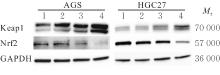
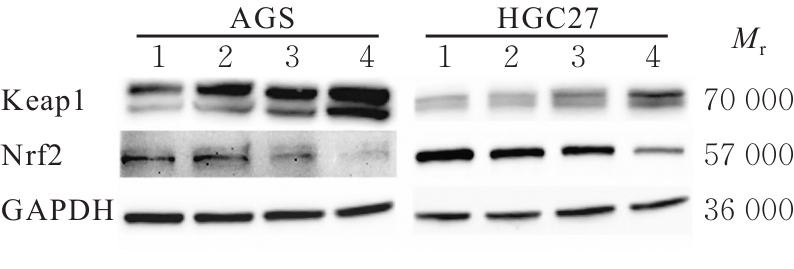
Fig. 6
Electrophoregram of expressions of Keap1 and Nrf2 proteins in cells in various groups"
Tab.4
Expression levels of Keap1 and Nrf2 proteins in cells in various groups"
| Group | AGS | HGC27 | ||
|---|---|---|---|---|
| Keap1 | Nrf2 | Keap1 | Nrf2 | |
| Control | 1.00±0.08 | 1.00±0.07 | 1.00±0.07 | 1.00±0.06 |
| 5 μmol·L-1 PNS | 2.05±0.16* | 0.90±0.07* | 1.25±0.10* | 0.82±0.06* |
| 10 μmol·L-1 PNS | 2.65±0.21* | 0.60±0.05* | 1.60±0.12* | 0.60±0.05* |
| 20 μmol·L-1 PNS | 3.00±0.24* | 0.50±0.04* | 2.10±0.16* | 0.30±0.03* |
| F | 128.437 | 96.214 | 112.583 | 104.762 |
| P | <0.001 | <0.001 | <0.001 | <0.001 |
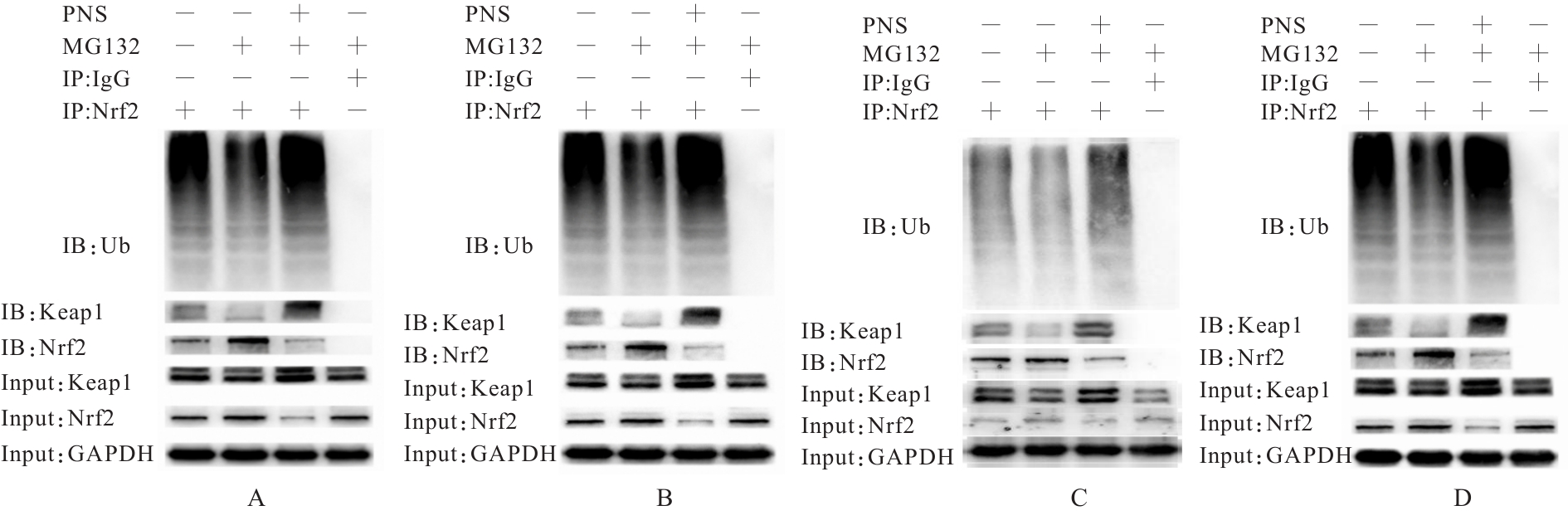
Fig. 7
Keap1-Nrf2 interaction and Nrf2 ubiquitination in cells after PNS treatment in various groups"
| [1] | LIN J L, LIN J X, LIN G T, et al. Global incidence and mortality trends of gastric cancer and predicted mortality of gastric cancer by 2035[J]. BMC Public Health, 2024, 24(1): 1763. |
| [2] | LI G Z, DOHERTY G M, WANG J P. Surgical management of gastric cancer: a review[J]. JAMA Surg, 2022, 157(5): 446-454. |
| [3] | ZHANG S X, LIU W, AI B, et al. Current advances and outlook in gastric cancer chemoresistance: a review[J]. Recent Pat Anticancer Drug Discov, 2022, 17(1): 26-41. |
| [4] | 张晴晴, 刘南阳, 吴 迪, 等. 基于数据挖掘和网络药理学探讨中药治疗胃癌前病变的分子生物学机制[J]. 浙江大学学报(医学版), 2022, 51(5): 573. |
| [5] | 康 博, 惠鹏宇, 郭高英, 等. 三七总皂苷联合顺铂对胃癌大鼠肾损伤的改善作用及机制分析[J]. 现代生物医学进展, 2023, 23(11): 2030-2034. |
| [6] | 谭东明, 谢 奇, 丁 旭, 等. 三七总皂苷通过JAK2/STAT3通路调控巨噬细胞极化抑制小鼠黑色素瘤B16-F10细胞的活力[J]. 中国肿瘤生物治疗杂志, 2024, 31(11): 1109-1115. |
| [7] | HUANG C, LI G, YAN X X, et al. Molecular mechanisms of Panax japonicus var. major against gastric cancer: metabolite analysis, signaling pathways, and protein targets[J]. Pharmaceuticals, 2025, 18(6): 823. |
| [8] | SAHOO B M, BANIK B K, BORAH P, et al. Reactive oxygen species (ROS): key components in cancer therapies[J]. Anticancer Agents Med Chem, 2022, 22(2): 215-222. |
| [9] | SUZUKI T, TAKAHASHI J, YAMAMOTO M. Molecular basis of the KEAP1-NRF2 signaling pathway[J]. Mol Cells, 2023, 46(3): 133-141. |
| [10] | BOUABDALLAH S, AL-MAKTOUM A, AMIN A. Steroidal saponins: naturally occurring compounds as inhibitors of the hallmarks of cancer[J]. Cancers, 2023, 15(15): 3900. |
| [11] | ABDALLA Y O ALI, SUBRAMANIAM B, NYAMATHULLA S, et al. Natural products for cancer therapy: a review of their mechanism of actions and toxicity in the past decade[J]. J Trop Med, 2022, 2022(1): 5794350. |
| [12] | MAJNOONI M B, FAKHRI S, GHANADIAN S M, et al. Inhibiting angiogenesis by anti-cancer saponins: from phytochemistry to cellular signaling pathways[J]. Metabolites, 2023, 13(3): 323. |
| [13] | IKSEN, WITAYATEERAPORN W, HARDIANTI B, et al. Comprehensive review of Bcl-2 family proteins in cancer apoptosis: Therapeutic strategies and promising updates of natural bioactive compounds and small molecules[J]. Phytother Res, 2024, 38(5): 2249-2275. |
| [14] | ZHAO Y X, YE X C, XIONG Z F, et al. Cancer metabolism: the role of ROS in DNA damage and induction of apoptosis in cancer cells[J]. Metabolites, 2023, 13(7): 796. |
| [15] | VERZA F A, SILVA G C DA, NISHIMURA F G. The impact of oxidative stress and the NRF2-KEAP1-ARE signaling pathway on anticancer drug resistance[J]. Oncol Res, 2025, 33(8): 1819-1834. |
| [16] | TOSSETTA G, FANTONE S, MONTANARI E, et al. Role of NRF2 in ovarian cancer[J]. Antioxidants, 2022, 11(4): 663. |
| [17] | HAYES J D, DAYALAN NAIDU S, DINKOVA-KOSTOVA A T. Regulating Nrf2 activity: ubiquitin ligases and signaling molecules in redox homeostasis[J]. Trends Biochem Sci, 2025, 50(3): 179-205. |
| [18] | XIAO J L, LIU H Y, SUN C C, et al. Regulation of Keap1-Nrf2 signaling in health and diseases[J]. Mol Biol Rep, 2024, 51(1): 809. |
| [19] | 陈秀霞, 池洪树, 许斌福, 等. 三七总皂苷对大黄鱼抗变形假单胞菌感染能力的影响[J]. 大连海洋大学学报, 2023, 38(3): 380-387. |
| [1] | Yawen HU,Changhui FU,Yanmei YANG,Xianwei MENG,Pengli LI,Hongqi LIU,Na ZHANG,Bin GU. Promotive effect of osteogenic differentiation of mouse jaw bone marrow mesenchymal stem cells by CeO₂-loaded dendritic mesoporous silica nanoparticles and its mechanism [J]. Journal of Jilin University(Medicine Edition), 2026, 52(5): 1195-1205. |
| [2] | Yang BAI,Tingting XIONG,Yanling LI,Zhongji HU,Xiao LAN,Yuan CHEN,Xiaoping HUANG,Huang DING,Changqing DENG. Inhibitory effect of combination of Astragaloside Ⅳ, Panax notoginseng saponins, and borneol on inflammatory injury after cerebral ischemia/reperfusion in rats and its mechanism [J]. Journal of Jilin University(Medicine Edition), 2026, 52(5): 1234-1243. |
| [3] | Yu ZHANG,Shuguang LI,Mingfu CAO,Di HUANG. Promotion effect of TXNDC9 gene knockdown on apoptosis and autophagy of colorectal cancer cells and its influence in xenograft tumor in nude mice [J]. Journal of Jilin University(Medicine Edition), 2026, 52(5): 1263-1272. |
| [4] | Hui KE,Lizheng YAN,Yu ZHANG,Jilong MAO,Yufei YAO. Regulation effect of resveratrol on ovarian granulosa cell function in females and mechanism of SIRT1 in regulation process [J]. Journal of Jilin University(Medicine Edition), 2026, 52(4): 1043-1050. |
| [5] | Xin LIU,Yuqing LIU,Hui LI. Research progress in effect of chronic periodontitis on occurrence and development of metabolic fatty liver disease [J]. Journal of Jilin University(Medicine Edition), 2026, 52(4): 1187-1194. |
| [6] | Xiaowei HUANG,Pengyu ZHENG,Xin LI,Chuanbin HONG,Mengmeng LI,Guangfu LYU,Yan XU,Zhe LIN,Jiaming XU. Promotion effect of velvet antler polypeptide on myocardial injury in diabetic cardiomyopathy mice by regulating Keap1/Nrf2/HO-1 signaling pathway [J]. Journal of Jilin University(Medicine Edition), 2026, 52(4): 942-952. |
| [7] | Junqi LI,Jiayun JIANG,Zhongfu ZUO,Hongdan YU. Bioinformatics analysis and in vitro and in vivo experimental verification on protective effect of salidroside on retinal ganglion cells in diabetic rats [J]. Journal of Jilin University(Medicine Edition), 2026, 52(4): 963-976. |
| [8] | Yunxia MA,Dan LIU,Ying ZHANG,Shifeng MA. Protective effect of triptolide on hippocampal neuron injury in neonatal rats with hypoxic-ischemic encephalopathy by regulating PTEN/PI3K/AKT signaling pathway [J]. Journal of Jilin University(Medicine Edition), 2026, 52(4): 977-986. |
| [9] | Junjie TAN,Jie ZHAO,Shenyi LIU,Huayang DENG,Yideng ZHAO,Tuo ZHU,Hailan ZHAN,Lihua RUAN. Effect of silencing XBP1 on recovery of neurological function in rats with spinal cord injury by regulating Nrf2-mediated ferroptosis [J]. Journal of Jilin University(Medicine Edition), 2026, 52(3): 641-650. |
| [10] | Yang LI,Shiyang LI,Hongmei ZHANG,Qianqian LIU,Yubing CHEN. Effect of NGFR gene expression differences on promotion of apoptosis of squamous cell carcinoma and adenocarcinoma cells by PD-1 inhibitor-activated T lymphocytes [J]. Journal of Jilin University(Medicine Edition), 2026, 52(3): 680-693. |
| [11] | Lingyu WANG,Ruili LI,Yu ZHANG,Meitong GUO,Yalong LIANG,Xu HAN,Xiaowei HUANG,Yang ZHANG,Xiuhua YU. Improvement effect of Renshen Jianzhi Tablets on learning and memory ability in cognitive impairment model rats and its protective effect on hippocampal neurons and its mechanism [J]. Journal of Jilin University(Medicine Edition), 2026, 52(3): 719-729. |
| [12] | Qiaotong REN,Weihua WU,Xingxiang WANG,Shichao WANG,Yipeng CHENG,Chun LI. Effect of interleukin-17 recepter B gene silencing on proliferation, invasion and apoptosis of lung adenocarcinoma A549 cells and its mechanism [J]. Journal of Jilin University(Medicine Edition), 2026, 52(3): 738-745. |
| [13] | Qiuping SU,Lei XING,Wei ZHANG,Shan JIANG,Yangyang ZHAO,Fangfang CHEN. Research progress in anti-tumor mechanism of berberine and application of its novel nano-delivery system in tumor therapy [J]. Journal of Jilin University(Medicine Edition), 2026, 52(3): 863-871. |
| [14] | Zheng TANG,Wei LIU,Hongmin HU,Qi LAI,Yan SHI,Shengquan LIU,Jun YANG,Chun CHU. Improvement effect of Qishen Yiqi dropping pills on myocardium injury in rats induced by sorafenib and its mechanism [J]. Journal of Jilin University(Medicine Edition), 2026, 52(2): 308-317. |
| [15] | Ning MA,Shuang LIU,Chengyao WANG,Jiajun LU,Linyu CHEN,Ziyi WANG,Weiqin ZHAO,Weitong WANG,Pengcheng CHE,Hong SUN. Improvement effect of topical application of exosome loaded hydrogel DCC on peritoneal adhesion in mice and its mechanism [J]. Journal of Jilin University(Medicine Edition), 2026, 52(2): 318-329. |
|
||