吉林大学学报(工学版) ›› 2026, Vol. 56 ›› Issue (3): 793-801.doi: 10.13229/j.cnki.jdxbgxb.20240809
• 计算机科学与技术 • 上一篇
基于敏感度分析的后训练式对话摘要混合精度量化
刘宇鹏( ),张禹豪,孟鑫
- 哈尔滨理工大学 计算机科学与技术学院,哈尔滨 150080
Mixed-precision quantization of post-trained conversation summarization based on sensitivity analysis
Yu-peng LIU(),Yu-hao ZHANG,Xin MENG
- School of Computer Science and Technology,Harbin University of Science and Technology,Harbin 150080,China
摘要:
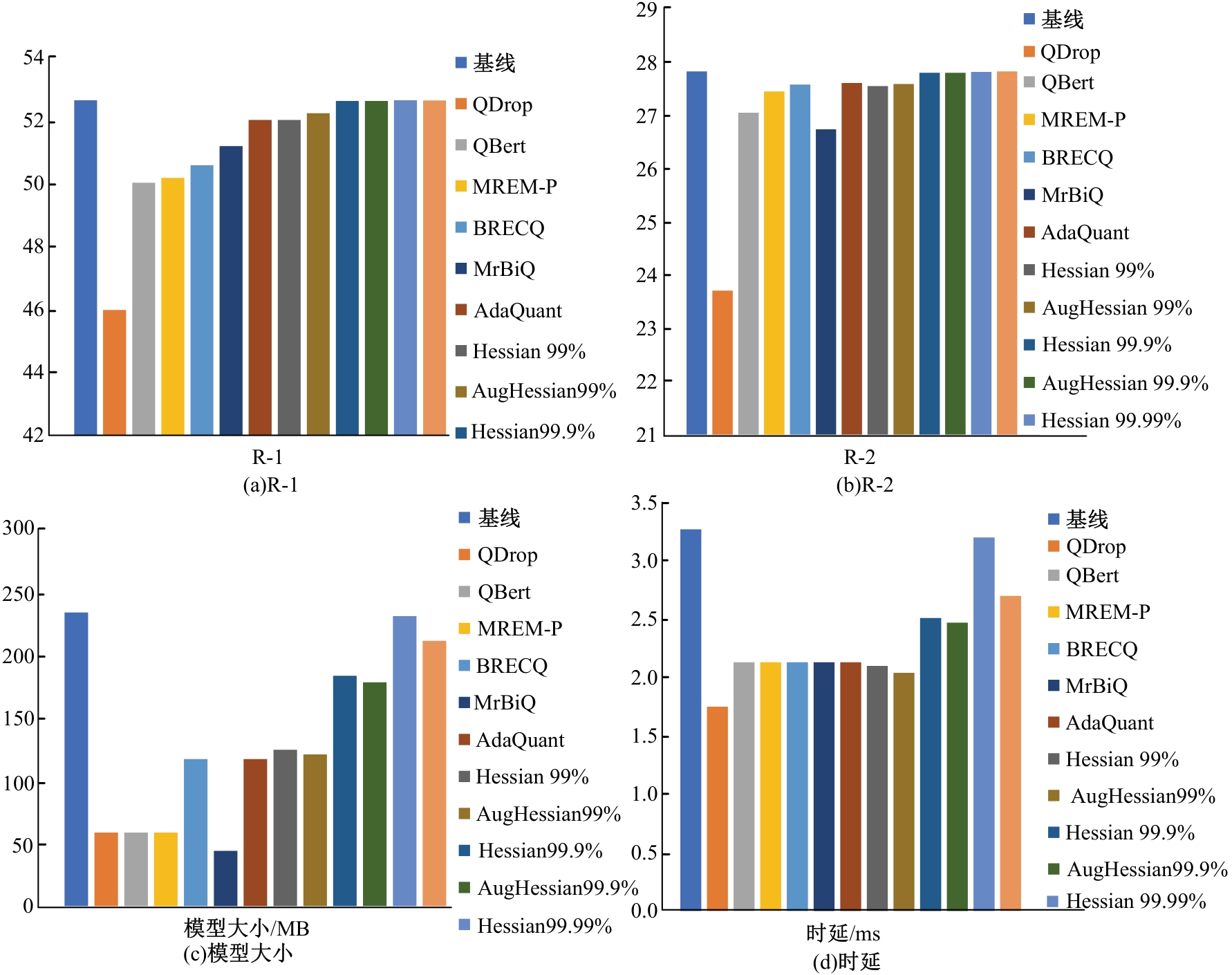
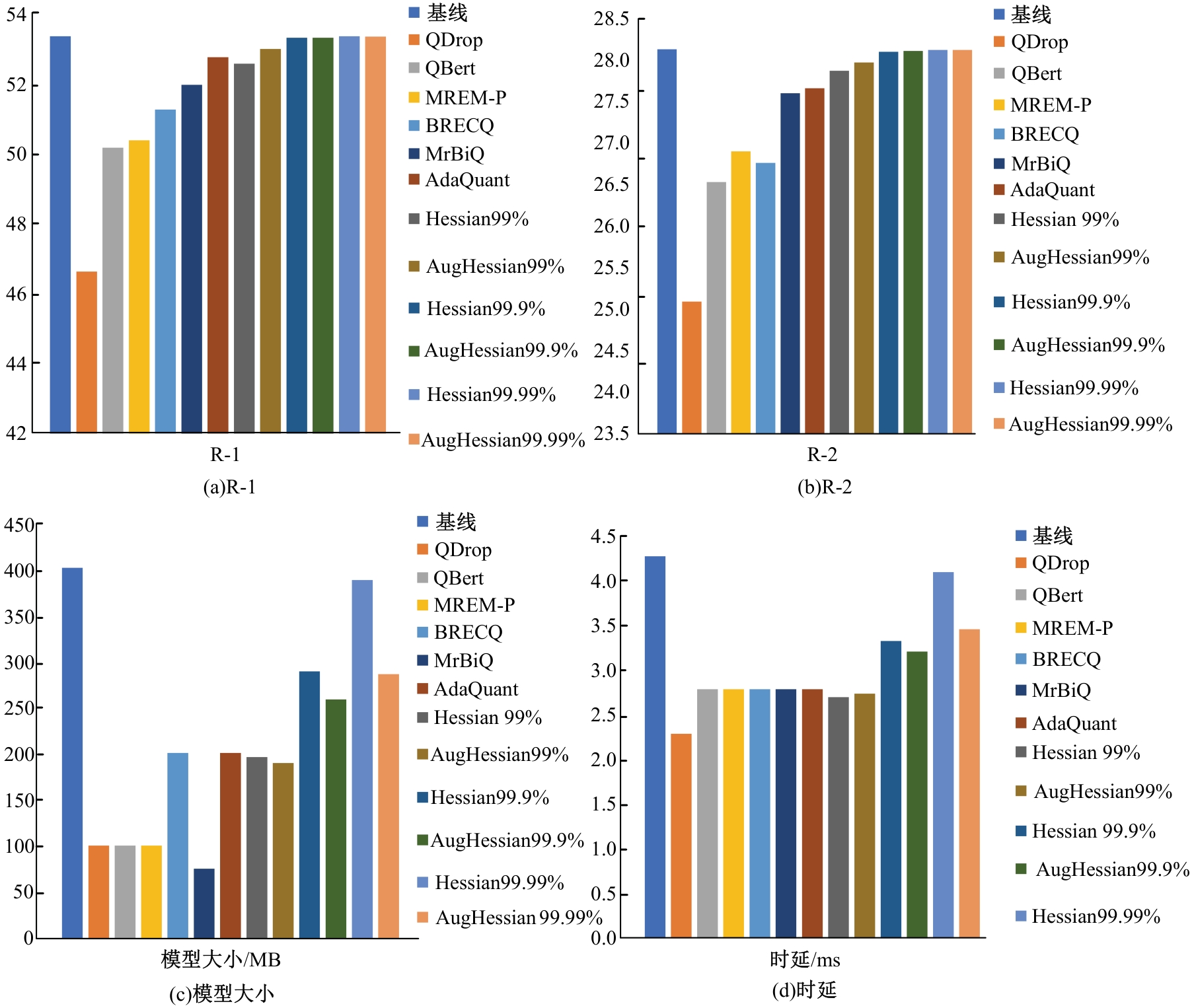
本文提出了一种后训练对话摘要模型上层级混合精度整数量化方法,采用较为精确的基于增广Hessian矩阵方法评估层敏感度,考虑层间相关性的同时可以有效保留层内信息。由于对话摘要模型激活中存在大量离群值,直接对其量化会导致模型精度大幅下降。对此,本文又提出了一种先平滑,后混合精度量化的方法。首先使用平滑因子将激活离群值平移到权重,再根据权重和激活根据敏感度评估得分进行混合精度量化。该方法可以将模型由16 bit或32bit浮点数量化为4~16 bit混合精度,将模型存储需求降低,同时加快推理速度。在基准数据集SAMSum上,与经典基线系统比较取得了标志性性能提高,几乎和不量化模型性能持平。
中图分类号:
- TP312



| [1] | Dettmers T, Lewis M, Belkada Y, et al. GPT3. int8 (): 8-bit matrix multiplication for transformers at scale[J]. Advances in Neural Information Processing Systems,2022,35: 30318-30332. |
| [2] | Zafrir O, Boudoukh G, Izsak P, et al. Q8BERT: Quantized 8bit bert[C]∥Proceedings of the Fifth Workshop on Energy Efficient Machine Learning and Cognitive Computing-NeurIPS Edition, Vancouver, Canada, 2019: 36-39. |
| [3] | Bai H L, Hou L, Shang L F, et al. Towards efficient post-training quantization of pre-trained language models[J]. Advances in Neural Information Processing Systems, 2022, 35: 1405-1418. |
| [4] | Li Y H, Gong R H, Tan X, et al. BRECQ: pushing the limit of post-training quantization by block reconstruction[C]∥International Conference on Learning Representations, Vienna, Austria, 2021, 2: 1-17. |
| [5] | Wang K, Liu Z, Lin Y, et al. HAQ: hardware-aware automated quantization with mixed precision[C]∥Proceedings of the IEEE/CVF Conference on Computer Vision and Pattern Recognition, Long Beach, USA, 2019: 8612-8620. |
| [6] | Schaefer C J S, Joshi S, Li S,et al. Edge inference with fully differentiable quantized mixed precision neural networks[C]∥Proceedings of the IEEE/CVF Winter Conference on Applications of Computer Vision, Waikoloa, USA, 2024: 8460-8469. |
| [7] | Park E, Yoo S. PROFIT: a novel training method for sub-4-bit mobilenet models[C]∥Proceedings of the Computer Vision-ECCV 2020: 16th European Conference, Glasgow, UK, 2020: 430-446. |
| [8] | Yao Z W, Dong Z, Zheng Z C, et al. HAWQ-V3: dyadic neural network quantization[C]∥Proceedings of the International Conference on Machine Learning, Shenzhen, China, 2021: 11875-11886. |
| [9] | Nahshan Y, Chmiel B, Baskin C, et al. Loss aware post-training quantization[J]. Machine Learning, 2021, 110(11-12): 3245-3262. |
| [10] | Nagel M, Amjad R A, Van B M, et al. Up or down? Adaptive rounding for post-training quantization[C]∥Proceedings of the International Conference on Machine Learning, Vienna, Austria, 2020: 7197-7206. |
| [11] | Yao Z W, Aminabadi R Y, Zhang M J, et al. ZeroQuant: efficient and affordable post-training quantization for large-scale transformers[J]. Advances in Neural Information Processing Systems, 2022, 35: 27168-27183. |
| [12] | Cai Y, Yao Z, Dong Z, et al. Zeroq: a novel zero shot quantization framework[C]∥Proceedings of the IEEE/CVF Conference on Computer Vision and Pattern Recognition, Seattle, USA, 2020: 13169-13178. |
| [13] | Hubara I, Nahshan Y, Hanani Y, et al. Accurate post training quantization with small calibration sets[C]∥Proceedings of the International Conference on Machine Learning, Online, 2021: 4466-4475. |
| [14] | Frantar E, Alistarh D. Optimal brain compression: a framework for accurate post-training quantization and pruning[J]. Advances in Neural Information Processing Systems, 2022, 35: 4475-4488. |
| [15] | Demidovskij A, Smirnov E.Effective post-training quantization of neural networks for inference on low power neural accelerator[C]∥International Joint Conference on Neural Networks, Glasgow, UK, 2020: 1-7. |
| [16] | Zandonati B, Pol A A, Pierini M, et al. Fit: a metric for model sensitivity[C]∥Proceedings of ICLR, Addis Ababa, Ethiopia, 2022: 1-20. |
| [17] | Zheng D, Liu Y, Li L. Leveraging inter-layer dependency for post-training quantization[J]. Advances in Neural Information Processing Systems, 2022, 35: 6666-6679. |
| [18] | Wei X Y, Zhang Y C, Zhang X G, et al. Outlier suppression: pushing the limit of low-bit transformer language models[J]. Advances in Neural Information Processing Systems, 2022, 35: 17402-17414. |
| [19] | Bondarenko Y, Nagel M, Blankevoort T. Understanding and overcoming the challenges of efficient transformer quantization[C]∥Proceedings of the Conference on Empirical Methods in Natural Language Processing, Punta Cana, Dominican Republic, 2021: 7947-7969. |
| [20] | Zeng A, Liu X, Du Z, et al. GLM-130B: an open bilingual pre-trained model[C]∥Proceedings of ICLR, Kigali, Rwanda, 2023: 1-56. |
| [21] | Wu H, Judd P, Zhang X, et al. Integer quantization for deep learning inference: principles and empirical evaluation[J/OL].[2024-07-06]. arXiv Preprint arXiv:. |
| [22] | Fabbri A, Rahman F, Rizvi I, et al. ConvoSumm: conversation summarization benchmark and improved abstractive summarization with argument mining[C]∥Proceedings of the 59th Annual Meeting of the Association for Computational Linguistics and the 11th International Joint Conference on Natural Language Processing, Bangkok, Thailand, 2021: 6866-6880. |
| [23] | Lewis M, Liu Y, Goyal N, et al. BART: denoising sequence-to-sequence pre-training for natural language generation, translation, and comprehension[C]∥Proceedings of the 58th Annual Meeting of the Association for Computational Linguistic, Florence, Italy, 2019: 7871-7880. |
| [24] | Liu Y P, Zhang Y H, Liu G. A conversation summary generation method for medical consultations[P]. China Patent: ZL115964475A, 2023-04-14. |
| [25] | Shen S, Dong Z, Ye J Y, et al. Q-BERT: hessian based ultra low precision quantization of bert[C]∥Proceedings of the AAAI Conference on Artificial Intelligence, New York, USA, 2020: 8815-8821. |
| [26] | Wei X Y, Gong R H, Li Y H, et al. QDrop: randomly dropping quantization for extremely low-bit post-training quantization[C]∥Proceedings of ICLR, Online, 2022: 1-19. |
| [27] | Jeon Y, Lee C, Cho E, et al. Mr. BIQ: post-training non-uniform quantization based on minimizing the reconstruction error[C]∥Proceedings of the IEEE/CVF Conference on Computer Vision and Pattern Recognition, New Orleans, USA, 2022: 12319-12328. |
| [28] | Goo C W, Chen Y N. Abstractive dialogue summarization with sentence-gated modeling optimized by dialogue acts[C]∥Proceedings of the IEEE Spoken Language Technology Workshop, Athens, Greece, 2018: 735-742. |
| [1] | 杨果林,杨一凡,徐浩栋,罗桂军,肖洪波. 曲线盾构隧道施工期地表位移计算方法及影响因素分析[J]. 吉林大学学报(工学版), 2024, 54(7): 1997-2008. |
| [2] | 章子玲,胡雄,亓寅,王微,陶志强,刘志峰. 基于向量投影响应面的数控机床几何误差分配方法[J]. 吉林大学学报(工学版), 2022, 52(2): 384-391. |
| [3] | 陈东辉, 吕建华, 龙刚, 张宇晨, 常志勇. 基于ADAMS的半悬挂式农业机组静侧翻稳定性[J]. 吉林大学学报(工学版), 2018, 48(4): 1176-1183. |
| [4] | 孙晓颖, 扈泽正, 杨锦鹏. 基于分层贝叶斯网络的车辆发动机系统电磁脉冲敏感度评估[J]. 吉林大学学报(工学版), 2018, 48(4): 1254-1264. |
| [5] | 孙晓颖, 王震, 杨锦鹏, 扈泽正, 陈建. 基于贝叶斯网络的电子节气门电磁敏感度评估[J]. 吉林大学学报(工学版), 2018, 48(1): 281-289. |
| [6] | 高印寒, 安占扬, 王举贤, 王天皓, 刘长英, 张俊东. 等效线束法在汽车线束时域辐射敏感度分析中的应用[J]. 吉林大学学报(工学版), 2015, 45(3): 946-952. |
| [7] | 蔡朝晖, 张健沛, 杨静. 基于贝叶斯网络的路网位置匿名区域估计[J]. 吉林大学学报(工学版), 2014, 44(2): 454-458. |
| [8] | 周伟, 赵胜川. 基于Mixed Logit模型的路线选择行为量化分析[J]. 吉林大学学报(工学版), 2013, 43(02): 304-309. |
| [9] | 高印寒,马喜来,陈如娜. 基于模糊推理的汽车电磁兼容预测技术[J]. 吉林大学学报(工学版), 2006, 36(03): 399-0403. |
|
||