吉林大学学报(工学版) ›› 2026, Vol. 56 ›› Issue (7): 1904-1914.doi: 10.13229/j.cnki.jdxbgxb.20241361
• 交通运输工程·土木工程 • 上一篇
基于纵向间距和亮度差的隧道群驾驶舒适度
孟云伟1( ),李智鹏1,张引2,全振宇1,杨光清3,陈芳3,赖思静4,乔俊5
- 1.重庆交通大学 智能综合立体交通重庆市重点实验室,重庆 400074
2.重庆交通大学 土木工程学院,重庆 400074
3.招商局重庆交通科研设计院有限公司 道路工程研究院,重庆 400067
4.招商局公路信息技术(重庆)有限公司,重庆 400067
5.中铁第四勘察设计院集团有限公司,武汉 430063
Driving comfort in tunnel groups based on longitudinal spacing and brightness difference
Yun-wei MENG1(),Zhi-peng LI1,Yin ZHANG2,Zhen-yu QUAN1,Guang-qing YANG3,Fang CHEN3,Si-jing LAI4,Jun QIAO5
- 1.Chongqing Key Laboratory of Intelligent Integrated and Multidimensional Transportation System,Chongqing Jiaotong University,Chongqing 400074,China
2.College of Civil Engineering,Chongqing Jiaotong University,Chongqing 400074,China
3.Institute of Road Engineering,China Merchants Chongqing Communications Technology Research & Design Institution Co. Ltd. ,Chongqing 400067,China
4.China Merchants Roadway Information Technology (Chongqing) Co. Ltd. ,Chongqing 400067,China
5.China Railway Siyuan Survey and Design Group Co. Ltd. ,Wuhan 430063,China
摘要:
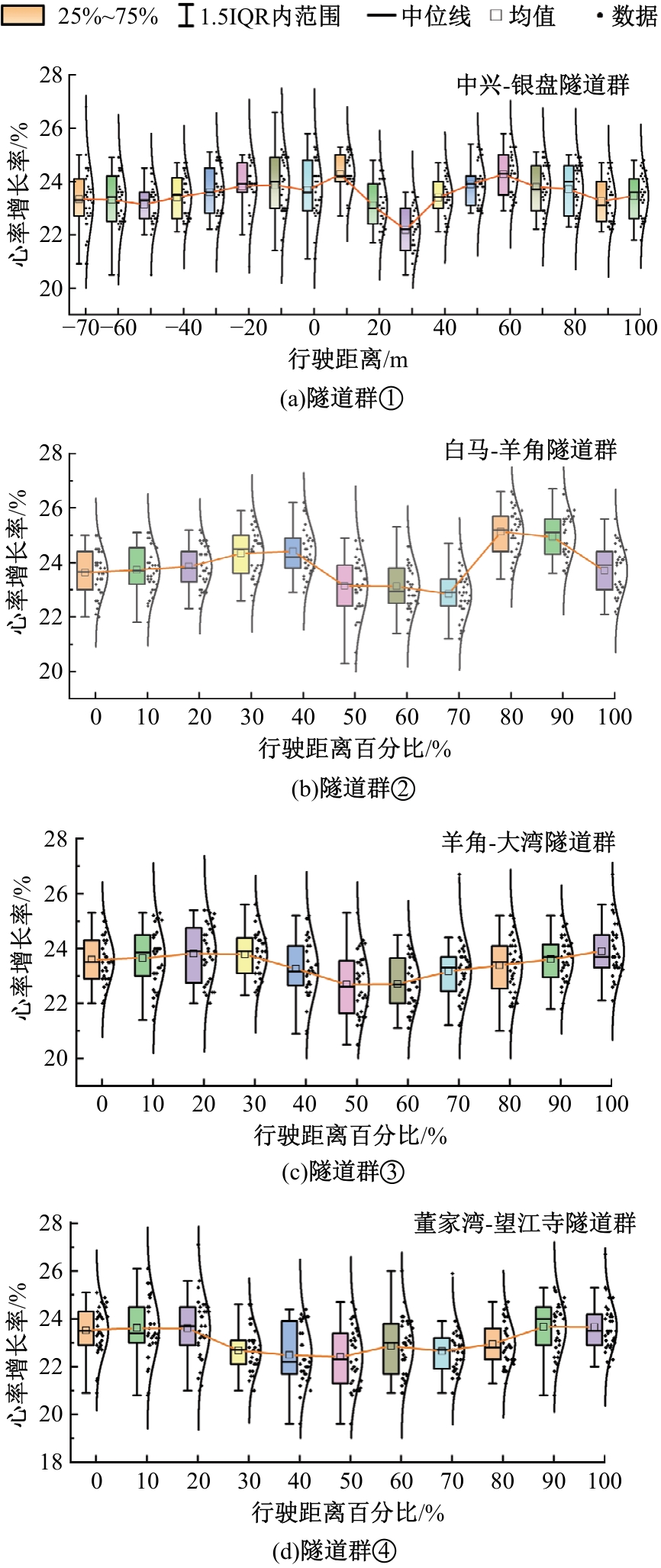
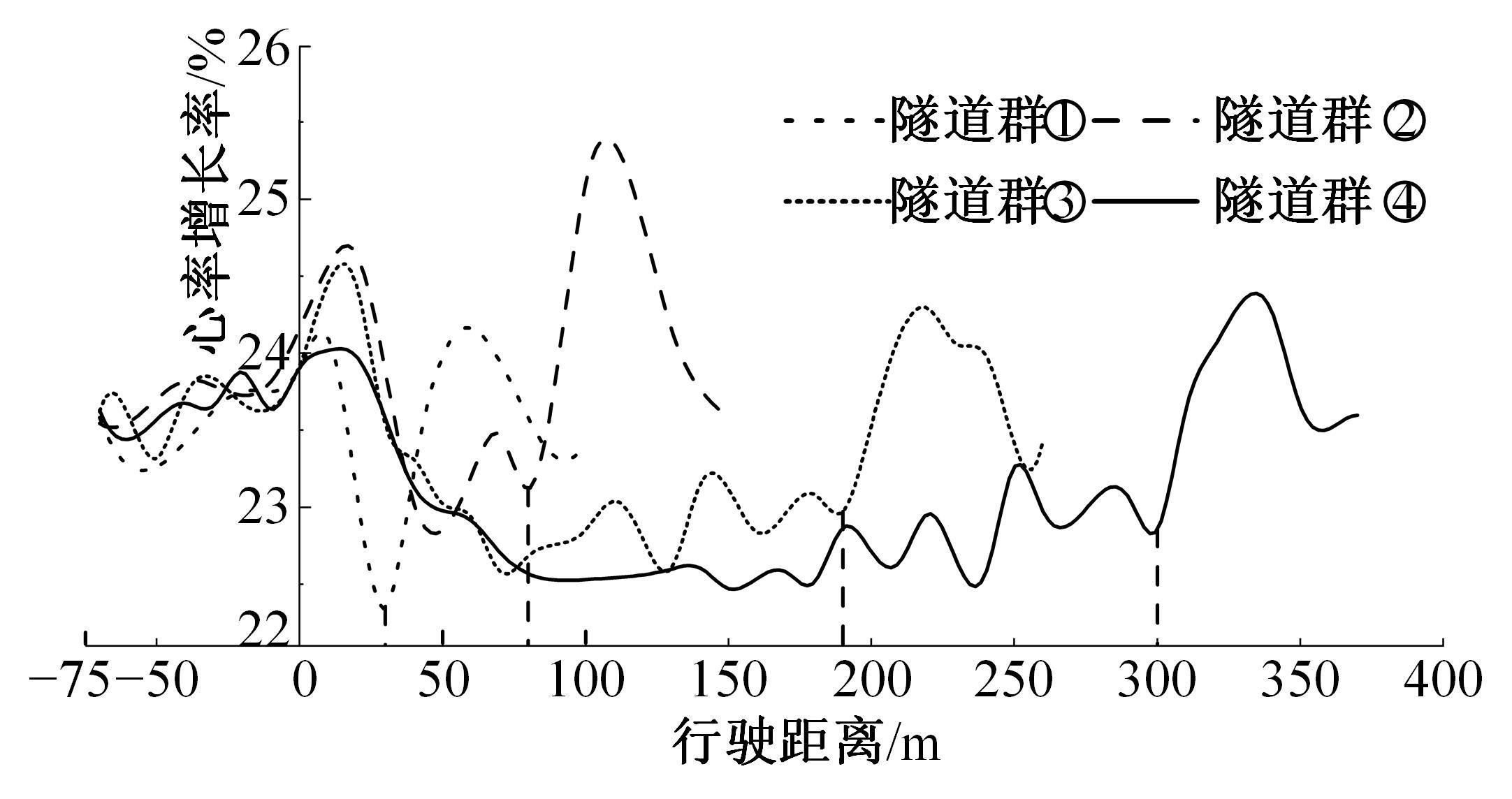
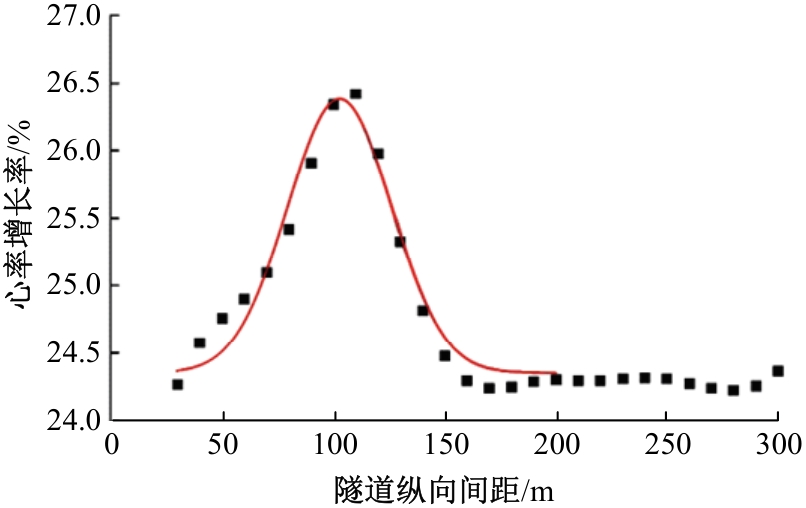
为探究高速公路隧道群路段驾驶舒适度的变化规律,通过实车试验采集了隧道群路段的长度范围、各区域亮度值和驾驶人的实时心率。分析了不同纵向间距、环境亮度差与心率增长率的关系,并基于隧道群纵向间距对下游隧道路段心率增长率的影响机理,提出了隧道群心理效应的概念。利用心率增长率表征驾驶舒适度,构建了环境亮度差与纵向间距耦合作用下的驾驶舒适度模型,探究了隧道群心理效应的产生机理。研究发现,随着纵向间距的增加,驾驶人心率增长率呈先增长再下降的趋势,且较长的纵向间距会加剧下游隧道的驾驶负荷、降低舒适度;驾驶人心率增长率随着环境亮度差的增大而增加。隧道群的纵向间距与亮度差的耦合作用显著影响驾驶舒适度,环境亮度差越大,相应的发生隧道群心理效应的纵向间距范围越大。
中图分类号:
- U458.1

| [1] | 吕能超, 王玉刚, 周颖, 等. 道路交通安全分析与评价方法综述[J]. 中国公路学报, 2023, 36(4): 183-201. |
| Neng-chao Lyu, Wang Yu-gang, Zhou Ying, et al. Review of road traffic safety analysis and evaluation methods[J]. China Journal of Highway and Transport, 2023, 36(4): 183-201. | |
| [2] | Wan L, Yan Y, Zhang C, et al. Characteristics and identification of risky driving behaviors in expressway tunnels based on behavior spectrum[J]. International Journal of Transportation Science and Technology, 2024, 16: 5-17. |
| [3] | 潘福全, 泮海涛, 王铮, 等. 照度与纵坡耦合作用下海底隧道出入口段驾驶人视觉特征分析与建模[J]. 交通运输系统工程与信息, 2021, 21(1): 142-148. |
| Pan Fu-quan, Pan Han-tao, Wang Zheng, et al. Analysis and modeling of drivers' visual characteristics at entrance and exit of undersea tunnel with coupling of illuminance and longitudinal slope[J]. Journal of Transportation Systems Engineering and Information Technology, 2021, 21(1): 142-148. | |
| [4] | 朱彤, 吴玲, 胡月琦, 等. 基于因子模型的高速公路特长隧道驾驶人心理负荷特性研究[J]. 中国公路学报, 2018, 31(11): 165-175. |
| Zhu Tong, Wu Ling, Hu Yue-qi, et al. Research on characteristics of drivers' mental workload in extra-long expressway tunnels based on the factor model[J]. China Journal of Highway and Transport, 2018, 31(11): 165-175. | |
| [5] | Yang Y Z, Du Z G, Alonso F, et al. Why frequent traffic accidents at highway tunnel exit?—An experimental analysis of the slack effect[J]. Tunnelling and Underground Space Technology, 2024, 152: No.105927. |
| [6] | 孟云伟, 全振宇, 王子骁, 等. 亮度和速度协同下公路隧道口路段驾驶舒适度研究[J]. 交通运输系统工程与信息, 2024, 24(4): 116-126. |
| Meng Yun-wei, Quan Zhen-yu, Wang Zi-xiao, et al. Driving comfort on highway tunnel portal sections based on coordination of luminance and speed[J]. Journal of Transportation Systems Engineering and Information Technology, 2024, 24(4): 116-126. | |
| [7] | Jiao F T, Du Z G, Chen G J, et al. Entrance zone length of extra-long undersea tunnels based on vision adaptation[J]. Tunnelling and Underground Space Technology, 2021, 113: No.103970. |
| [8] | Pervez A, Lee J, Huang H L. Exploring factors affecting the injury severity of freeway tunnel crashes: a random parameters approach with heterogeneity in means and variances[J]. Accident Analysis & Prevention, 2022, 178: No.106835. |
| [9] | 张姝玮, 郭忠印, 杨轸, 等. 驾驶行为多重分形特征在驾驶疲劳检测中的应用[J]. 吉林大学学报: 工学版, 2021, 51(2): 557-564. |
| Zhang Shu-wei, Guo Zhong-yin, Yang Zhen, et al. Application of multi-fractal features of driving performance in driver fatigue detection[J]. Journal of Jilin University (Engineering and Technology Edition), 2021, 51(2): 557-564. | |
| [10] | Chen S F, Lin Y, Zhao H T. Effects of flicker with various brightness contrasts on visual fatigue in road lighting using fixed low-mounting-height luminaires[J]. Tunnelling and Underground Space Technology, 2023, 136: No.105091. |
| [11] | 崔洪军, 王玉帛, 朱敏清, 等. 隧道群明暗转换对暗反应时间的影响[J]. 交通运输工程学报, 2021, 21(2): 200-208. |
| Cui Hong-jun, Wang Yu-bo, Zhu Min-qing, et al. Influence of tunnel group light-dark conversion on dark reaction time[J]. Journal of Traffic and Transportation Engineering, 2021, 21(2): 200-208. | |
| [12] | 王首硕, 杜志刚, 冯守中, 等. 高速公路隧道入口区域视线诱导系统有效性研究[J]. 交通运输工程学报, 2021, 21(2): 267-277. |
| Wang Shou-shuo, Du Zhi-gang, Feng Shou-zhong, et al. Research on effectiveness of visual guiding system in entrance zone of freeway tunnel[J]. Journal of Traffic and Transportation Engineering, 2021, 21(2): 267-277. | |
| [13] | Prithila A, Behnam B, Zunayed M, et al. Multimodal brain-computer interface for in-vehicle driver cognitive load measurement: dataset and baselines[J]. IEEE Transactions on Intelligent Transportation Systems, 2024, 25(6): 5949-5964. |
| [14] | Zheng H R, Du Z G, Jia C F, et al. Evaluating the effectiveness of rhythmic visual guidance technology for mitigating driving risks in highway tunnel groups: a simulation study[J]. Accident Analysis & Prevention, 2025, 212: No.107940. |
| [15] | Liang B, Wong Y D, He S Y, et al. Dynamic traffic safety risk assessment in road tunnel entrance zone based on drivers' psychophysiological perception states: methodology and case-study insights[J]. Tunnelling and Underground Space Technology, 2024, 147: No.105677. |
| [16] | 叶飞, 苏恩杰, 梁晓明, 等. 公路隧道景观设计现状和思考[J]. 中国公路学报, 2022, 35(1): 23-37. |
| Ye Fei, Su En-jie, Liang Xiao-ming, et al. Review and thinking on landscape design of highway tunnel[J]. China Journal of Highway and Transport, 2022, 35(1): 23-37. | |
| [17] | Lyu N, Wang Y, Wu C, et al. Using naturalistic driving data to identify driving style based on longitudinal driving operation conditions[J]. Journal of Intelligent and Connected Vehicles, 2022, 5(1): 17-35. |
| [18] | 徐进, 陈正欢, 廖祺硕, 等. 基于心电数据的高速公路高密度互通立交驾驶负荷[J]. 吉林大学学报: 工学版, 2024, 54(10): 2807-2818. |
| Xu Jin, Chen Zheng-huan, Liao Qi-shuo, et al. Mental workload of drivers at high-density interchanges of freeways based on ECG data[J]. Journal of Jilin University(Engineering and Technology Edition), 2024, 54(10): 2807-2818. | |
| [19] | 方守恩, 邬洪波, 廖军洪, 等. 山区高速公路隧道群路段安全评价[J]. 同济大学学报: 自然科学版, 2013, 41(5): 693-699. |
| Fang Shou-en, Wu Hong-bo, Liao Jun-hong, et al. Safety evaluation of freeway tunnel groups in mountainous areas[J]. Journal of Tongji University(Natural science), 2013, 41(5): 693-699. | |
| [20] | 段萌萌, 唐伯明, 胡旭辉, 等. 高隧道比路段隧道出入口驾驶员视觉负荷研究[J]. 交通运输系统工程与信息, 2018, 18(3): 113-119. |
| Duan Meng-meng, Tang Bo-ming, Hu Xu-hui, et al. Driver's visual load at tunnel entrance and exit of sections with high ratio of tunnels[J]. Journal of Transportation Systems Engineering and Information Technology, 2018, 18(3): 113-119. | |
| [21] | 蔡晓禹, 雷财林, 彭博, 等. 基于驾驶行为和信息熵的道路交通安全风险预估[J]. 中国公路学报, 2020, 33(6): 190-201. |
| Cai Xiao-yu, Lei Cai-lin, Peng Bo, et al. Estimation of road traffic safety risk based on driving behavior and information entropy[J]. China Journal of Highway and Transport, 2020, 33(6): 190-201. |
| [1] | 冯天军,郝延铭,李飞燕,高赫遥,刘一贤,刘楠,李金凤. 考虑驾驶风格的网联自动驾驶车辆集聚换道模型[J]. 吉林大学学报(工学版), 2026, 56(7): 1834-1844. |
| [2] | 张玉召,丁欣茹,侯长啸,陈虎林. 交通运输网络韧性研究现状及展望[J]. 吉林大学学报(工学版), 2026, 56(3): 585-602. |
| [3] | 慈玉生,黄轶康. 基于文献计量的交叉口车路协同研究综述[J]. 吉林大学学报(工学版), 2026, 56(2): 313-332. |
| [4] | 张文会,叶梅茹,席聪,宋子文. 混合交通流环境下车辆编队与碳排放特性[J]. 吉林大学学报(工学版), 2026, 56(2): 416-430. |
| [5] | 潘义勇,曹天宇,刘宇. 随机交通网络约束最可靠路径乘子交替方向法[J]. 吉林大学学报(工学版), 2026, 56(2): 455-463. |
| [6] | 孙宇,李世武,郭梦竹,金桐彤,宋会军,刘德志,高雯. 多模态数据在驾驶疲劳监测中的有效性分析[J]. 吉林大学学报(工学版), 2026, 56(2): 473-479. |
| [7] | 李坤宸,袁伟,王畅,张会明,穆雨薇. 基于驾驶风险和驾驶能力的人机控制权分配[J]. 吉林大学学报(工学版), 2026, 56(2): 575-584. |
| [8] | 马壮林,毕宇明,周备,邓亚娟,兆雪. 公交换乘优惠政策下居民换乘意向的异质性分析[J]. 吉林大学学报(工学版), 2026, 56(1): 158-169. |
| [9] | 王琳虹,刘宇阳,刘子昱,鹿应佳,张宇恒,黄桂树. 基于YOLOv5的轻量化桥梁缺陷识别[J]. 吉林大学学报(工学版), 2025, 55(9): 2958-2968. |
| [10] | 曲昭伟,王铭阳,王喆,宋现敏,张云翔,黄镜尘. 基于自动驾驶模块化车辆主辅功能分配的公交自适应调度方法[J]. 吉林大学学报(工学版), 2025, 55(9): 2946-2957. |
| [11] | 张云翔,宋现敏,谢渝,湛天舒. 基于用户满意度的停车预约服务智能体行为仿真[J]. 吉林大学学报(工学版), 2025, 55(9): 2978-2984. |
| [12] | 穆长儒,徐亮,程国柱. 基于能量合理分配的外包U型钢-混凝土组合护栏防撞性能[J]. 吉林大学学报(工学版), 2025, 55(8): 2669-2680. |
| [13] | 柴树山,周志强,李海涛,徐炅旸. 基于图时空模式学习网络的路网实时交通事件自动检测方法[J]. 吉林大学学报(工学版), 2025, 55(7): 2145-2161. |
| [14] | 李艳波,汪静远,陈圆媛,程绍峰,吕浩楠,陈俊硕. 面向高速公路服务区自洽能源系统的RAMS评价方法[J]. 吉林大学学报(工学版), 2025, 55(7): 2243-2250. |
| [15] | 戢晓峰,邓若凡,乔新,关昊天. 建成环境对共享单车时间集聚模式的非线性影响[J]. 吉林大学学报(工学版), 2025, 55(7): 2233-2242. |
|
||