吉林大学学报(工学版) ›› 2026, Vol. 56 ›› Issue (8): 2106-2115.doi: 10.13229/j.cnki.jdxbgxb.20250061
• 交通运输工程·土木工程 • 上一篇
轨迹数据驱动的出租车出行特征分析与时空分布建模
王君悦( ),董春娇(),王菁,王明智
- 北京交通大学 综合交通运输大数据应用技术交通运输行业重点实验室,北京 100044
Trajectory data⁃driven taxi travel characteristics analysis and spatial⁃temporal distribution modeling
Jun-yue WANG(),Chun-jiao DONG(),Jing WANG,Ming-zhi WANG
- Key Laboratory of Transport Industry of Big Data Application Technologies for Comprehensive Transport,Beijing Jiaotong University,Beijing 100044,China
摘要:
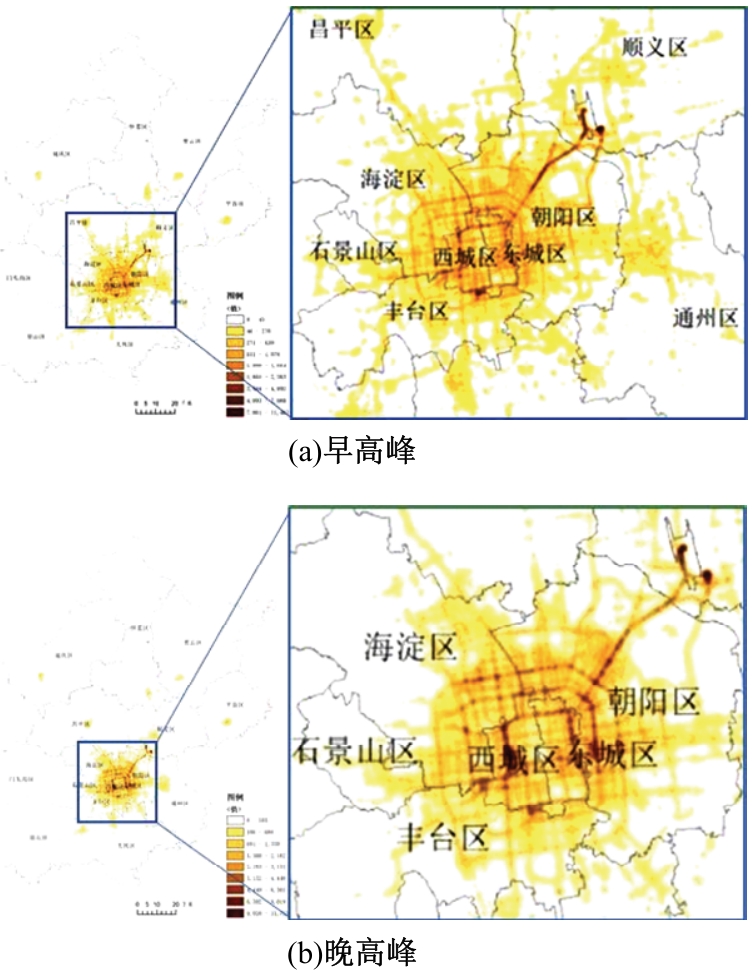
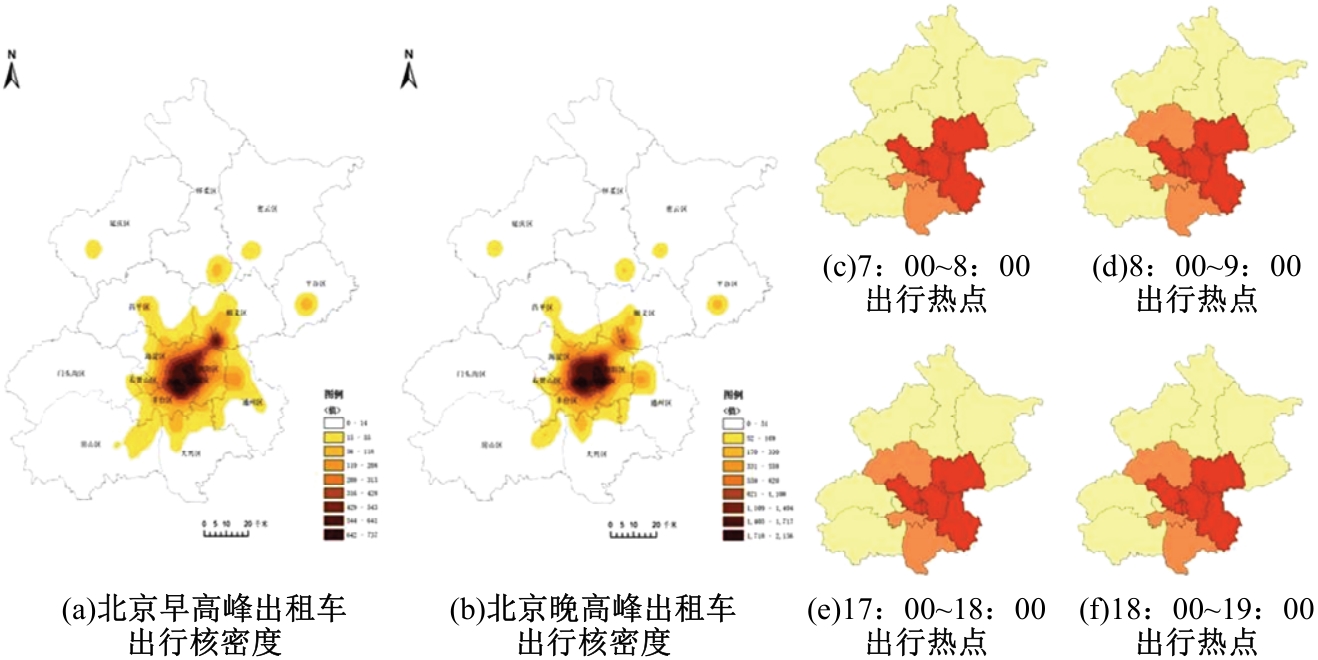
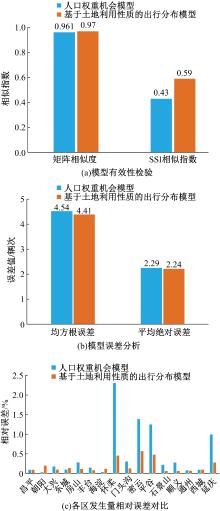
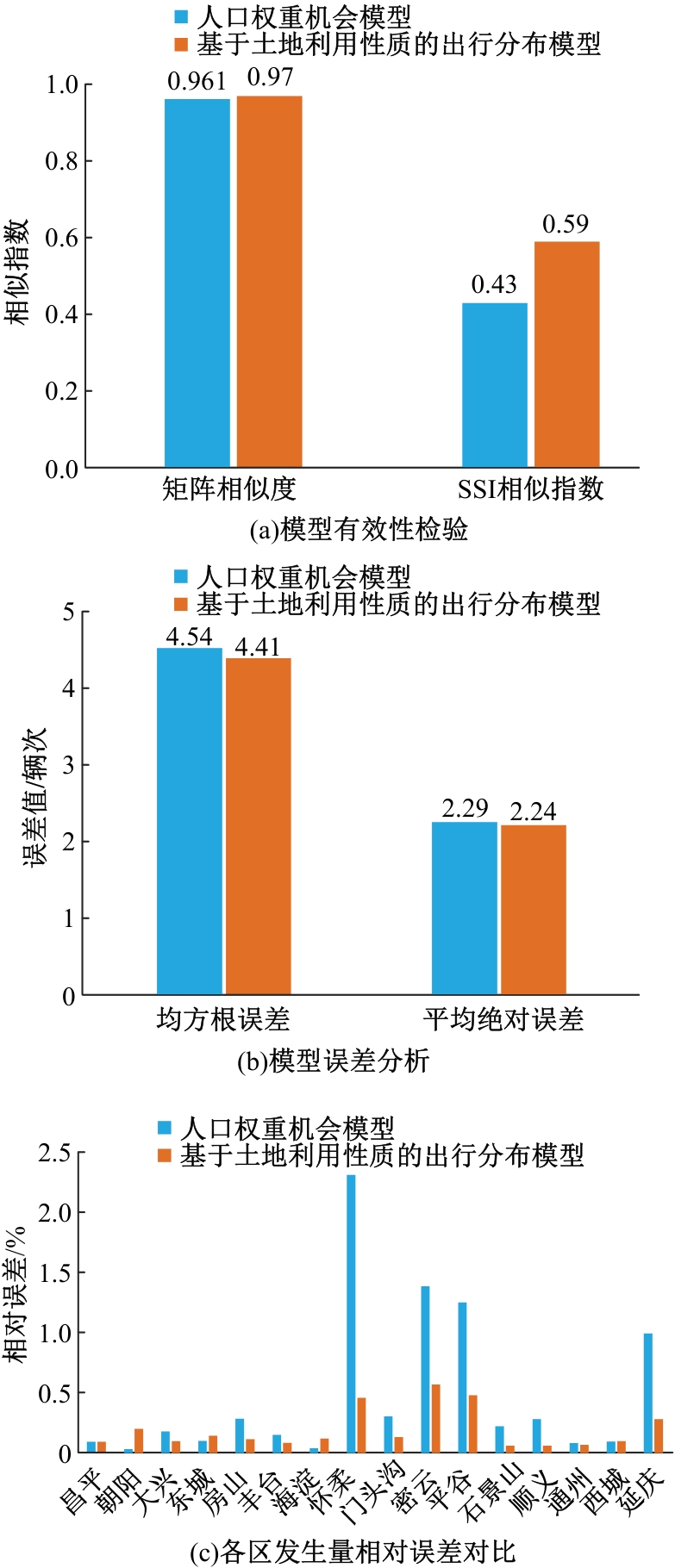
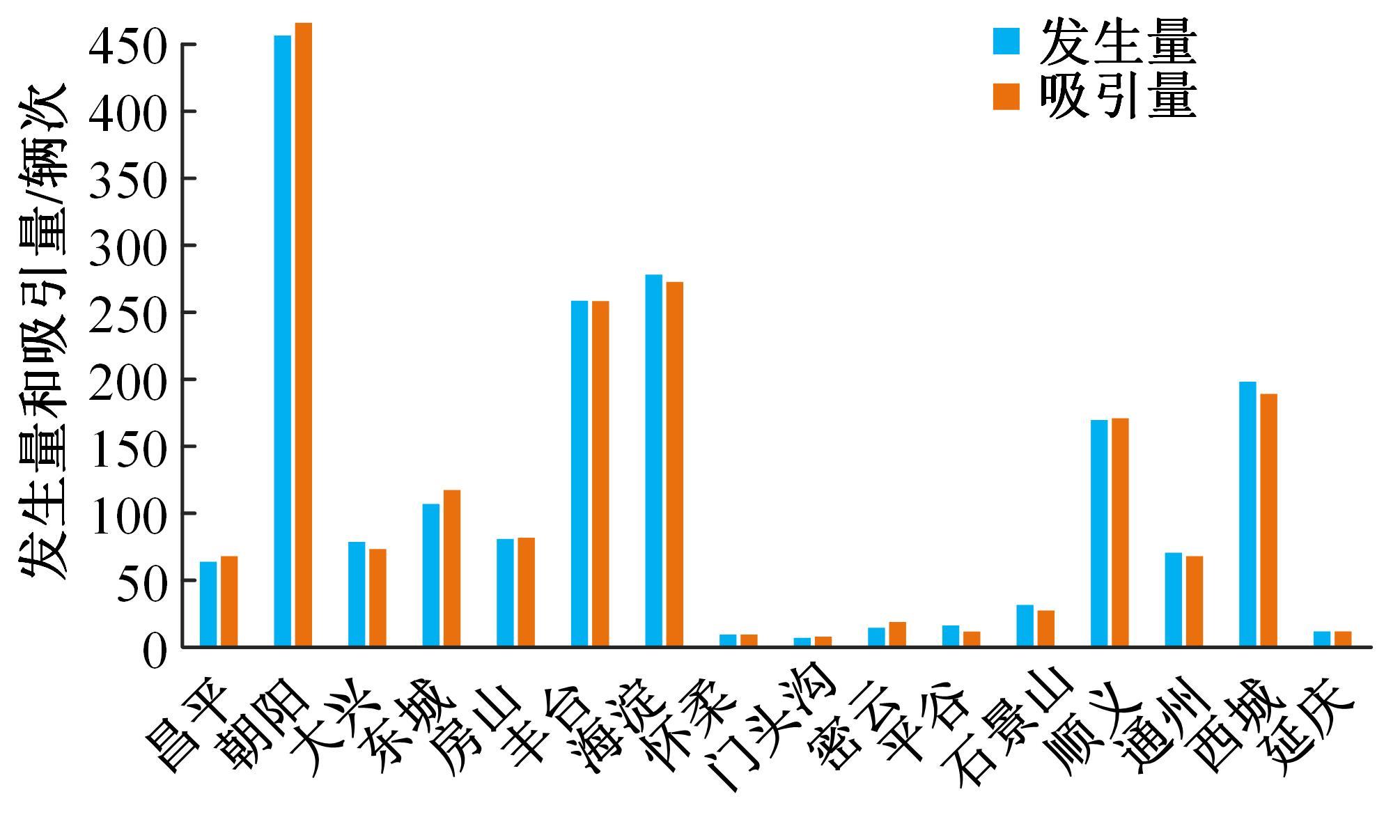
基于北京市出租车全球定位系统(GPS)轨迹数据,结合ArcGIS地图匹配功能,选定合适阈值构建了出租车出行信息数据库。首先,构建了出租车出行网络,结合核密度和热点分析方法,分析了出行轨迹空间分布特征和时序特征,揭示了出租车出行密度在早、晚高峰的变化趋势。然后,考虑土地利用性质对出租车出行分布的影响,建立了基于土地利用性质的双约束人口权重机会模型。结果表明,本文模型提高了出租车跨区出行的预测精度,均方根误差由4.54辆次降为4.41辆次,预测结果与真实数据的相似度由0.961提高为0.970,发生量平均相对误差由0.48%降为0.19%。
中图分类号:
- U491

| [1] | 马健霄, 赵飞燕, 尹超英, 等. 建成环境和出租车需求对网约车出行需求影响的时空间分异模式[J]. 交通运输系统工程与信息, 2023, 23(5): 136-145. |
| Ma Jian-xiao, Zhao Fei-yan, Yin Chao-ying, et al. Spatial-temporal heterogeneity effects of built environ-ment and taxi demand on ride-hailing demand[J]. Journal of Transportation Systems Engineering and Information Technology, 2023, 23(5): 136-145. | |
| [2] | Jiang B, Yin J, Zhao S. Characterizing the human mobility pattern in a large street network[J]. Physical Review E: Statistical, Nonlinear, and Soft Matter Physics, 2009, 80(2): No.021136. |
| [3] | Bazzani A, Giorgini B, Rambaldi S, et al. Stati-stical laws in urban mobility from micro-scopic GPS data in the area of Florence[J]. Journal of Statistical Mechanics: Theory and Experiment, 2010, 2010(5): No.P05001. |
| [4] | Liang X, Zheng X, Lv W, et al. The scaling of human mobility by taxis is exponential[J]. Physica A: Statistical Mechanics and its Applications, 2012, 391(5): 2135-2144. |
| [5] | Simini F, González M C, Maritan A, et al. A universal model for mobility and migration patterns[J]. Nature, 2012, 484(7392): 96-100. |
| [6] | Riccardo G, Armando B, Sandro R. Towards a statistical physics of human mobility[J]. International Journal of Modern Physics C, 2012, 23(9): No.1250061. |
| [7] | Peng C, Jin X, Wong K, et al. Collective human mobility pattern from taxi trips in urban area[J]. PLoS One, 2012, 7(4): No.e34487. |
| [8] | Ren Y, Ercsey-Ravasz M, Wang P, et al. Predicting commuter flows in spatial networks using a radiation model based on temporal ranges[J]. Nature Communications, 2014, 5(1): No.5347. |
| [9] | Zhao Z, Yang Z, Zhang Z, et al. Emergence of sca ling in human-interest dynamics[J]. Scientific Reports, 2013, 3(1): No.3472. |
| [10] | Yan X, Wang W, Gao Z, et al. Universal model of individual and population mobility on diverse spatial scales[J]. Nature Communications, 2017, 8(1): No.1639. |
| [11] | Liu E, Yan X. A universal opportunity model for human mobility[J]. Scientific Reports, 2020, 10(1): 4657. |
| [12] | 陶思然, 叶霞飞. 引入旅游偏好的城际客运出行分布预测模型[J]. 交通运输系统工程与信息, 2021, 21(4): 140-147. |
| Tao Si-ran, Ye Xia-fei. A forecasting model of intercity trip distribution with tourism preference[J]. Journal of Transportation Systems Engineering and Information Technology, 2021, 21(4): 140-147. | |
| [13] | 陈启香, 吕斌, 陈喜群, 等. 空间异质性建成环境对出租车与地铁竞合关系的影响[J]. 交通运输系统工程与信息, 2022, 22(3): 25-35. |
| Chen Qi-xiang, Lv Bin, Chen Xi-qun, et al. Impacts of built environment on competition and cooperation relationship between taxi and subway considering spatial heterogeneity[J]. Journal of Transportation Systems Engineering and Information Technology, 2022, 22(3): 25-35. | |
| [14] | 邢雪, 王菲, 李佳楠. 结合载客热点和POI的出租车停车位划定方法[J]. 吉林大学学报: 信息科学版, 2024, 42(1): 93-99. |
| Xing Xue, Wang Fei, Li Jia-nan. Cab fixed parking area delineation method combining passenger hotspot and POI data[J]. Journal of Jilin University (Infor- mation Science Edition), 2024, 42(1): 93-99. | |
| [15] | Xiao Z, Wu L, Jiang H, et al. Exploring intercity mobility in urban agglomeration: Evidence from private car trajectory data[J]. IEEE Transactions on Computational Social Systems, 2024, 11(2): 2940-2954. |
| [16] | Deng J, Cui Y, Chen X, et al. Who are on the road? a study on vehicle usage characteristics based on one-week vehicle trajectory data[J]. International Journal of Digital Earth, 2023, 16(1): 1962-1984. |
| [17] | 闫小勇. 超越引力定律: 空间交互和出行分布预测理论与方法[M]. 北京: 科学出版社, 2019. |
| [1] | 王艳丽,王晨曦,赵欣然,吴兵. 考虑多维属性的混合路网路径选择行为预测[J]. 吉林大学学报(工学版), 2026, 56(8): 2067-2076. |
| [2] | 刘铭,陈思危,王俊杰,梁雨萱,于晓东. 基于模块化A*寻优算法的地铁货车快递联运系统[J]. 吉林大学学报(工学版), 2026, 56(7): 1937-1949. |
| [3] | 程国柱,吕岩峰,冯天军. 地铁站周边常规公交换乘站点布局多目标优化模型[J]. 吉林大学学报(工学版), 2026, 56(3): 711-724. |
| [4] | 谢坤,董宏辉,卢玲玉,耿庆桥,李鹏辉,董春娇. 基于CFSFDP-BP的车辆出行群体分类及识别方法[J]. 吉林大学学报(工学版), 2026, 56(3): 725-733. |
| [5] | 赖元文,陈艳生,王书易,张宇龙,朱新运. 考虑公交与地铁换乘需求的公交时刻表优化[J]. 吉林大学学报(工学版), 2025, 55(6): 2030-2037. |
| [6] | 周成栋,宋菲,赵小梅,姚俊杰. 基于多模式双动态演化的拥堵收费模型[J]. 吉林大学学报(工学版), 2025, 55(4): 1319-1327. |
| [7] | 孙峣,姚宝珍,白子建. 基于随机森林模型的交通拥堵疏导效果评估[J]. 吉林大学学报(工学版), 2025, 55(2): 512-519. |
| [8] | 马书红,张俊杰,陈西芳,廖国美. 利用出租车时序数据识别城市功能区[J]. 吉林大学学报(工学版), 2025, 55(2): 603-613. |
| [9] | 年光跃,潘海啸,孙健. 城市建成环境与道路交通运行关系[J]. 吉林大学学报(工学版), 2025, 55(1): 141-149. |
| [10] | 董春娇,陆育霄,马社强,李鹏辉. 考虑等待忍耐时间的电动自行车违规行为研判[J]. 吉林大学学报(工学版), 2024, 54(9): 2540-2546. |
| [11] | 马书红,廖国美,黄岩,张俊杰. 建成环境对交通小区地铁通勤客流的异质性影响[J]. 吉林大学学报(工学版), 2024, 54(7): 1913-1922. |
| [12] | 熊志华,董黛悦,董春娇,郑炎,解超. 考虑个人偏好的观赛人群组合决策选择行为[J]. 吉林大学学报(工学版), 2024, 54(4): 979-986. |
| [13] | 吴娇蓉,林清凯,邓泳淇. 基于公交线路运行稳定性的潜在公交专用道需求识别方法[J]. 吉林大学学报(工学版), 2024, 54(3): 692-699. |
| [14] | 庄焱,董春娇,米雪玉,张小雨,王菁. 基于随机参数Logit的中小城市居民出行方式选择建模[J]. 吉林大学学报(工学版), 2024, 54(2): 461-468. |
| [15] | 张文会,伊静. 考虑通行能力和排队延误的公交停靠系统优化[J]. 吉林大学学报(工学版), 2024, 54(1): 146-154. |
|
||