吉林大学学报(工学版) ›› 2026, Vol. 56 ›› Issue (9): 2329-2339.doi: 10.13229/j.cnki.jdxbgxb.20250105
• 交通运输工程·土木工程 • 上一篇
不同天气下快速路交织区交通冲突机理
周备1( ),周千喜1,马壮林1(),蔡凌霄2,路熙3
- 1.长安大学 运输工程学院,西安 710064
2.贵州省发展和改革委员会 贵州省民营经济和区域经济发展中心,贵阳 550081
3.交通运输部 科学研究院,北京 100029
Mechanisms of traffic conflicts in expressway weaving areas under different weather condition
Bei ZHOU1(),Qian-xi ZHOU1,Zhuang-lin MA1(),Ling-xiao CAI2,Xi LU3
- 1.School of Transportation Engineering,Chang'an University,Xi'an 710064,China
2.Guizhou Provincial Private Economy and Regional Economy Development Center,Guizhou Provincial Development and Reform Commission,Guiyang 550081,China
3.China Academy of Transportation Science,Ministry of Transport,Beijing 100029,China
摘要:
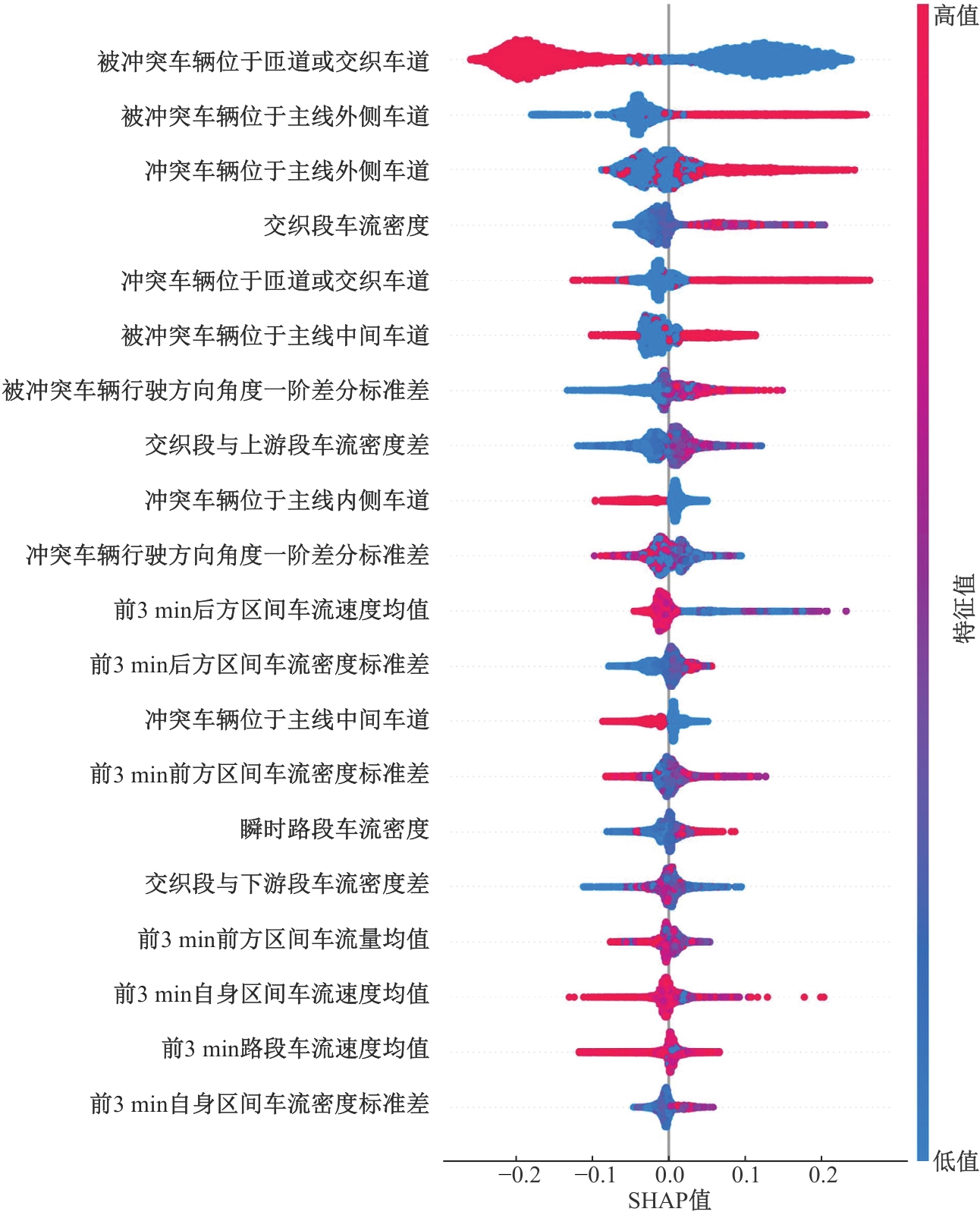
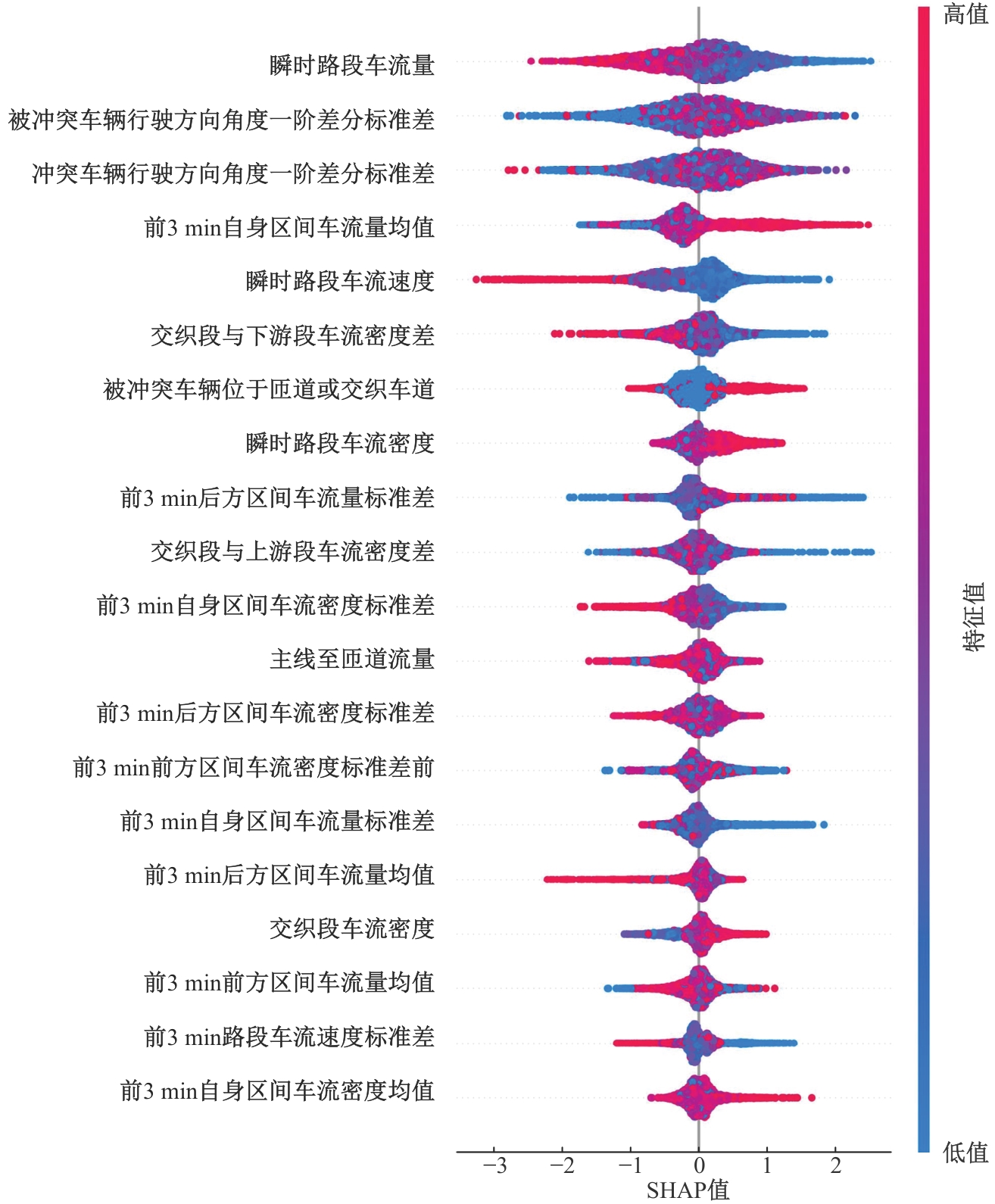
针对不同天气条件下城市快速路交织区交通冲突机理进行研究,提出了一种基于车辆边框信息的交通冲突识别算法,采用超阈值极值理论确定不同天气条件下的严重冲突阈值,并结合机器学习模型和可解释性分析方法,系统探讨了天气对交通冲突特征的影响。通过高精度轨迹数据,解决了传统冲突指标提取方法精度不足、阈值选取主观性强以及天气因素影响研究缺失的问题。研究结果表明,晴天与雨天的严重冲突阈值分别为1.75 s和1.85 s,雨天严重冲突比例(39.1%)显著高于晴天(9.7%)。通过可解释性分析发现:①天气条件显著调节交通冲突影响因素;②晴天时,车辆空间位置(尤其是被冲突车辆是否位于匝道或交织车道)是影响冲突严重程度的主导因素;③雨天时,影响因素的作用强度显著增大,且交通流特征成为主导因素。本文研究成果可为交织区的差异化管理和安全防控提供理论依据。
中图分类号:
- U491.3

| [1] | 曹倩, 李志慧, 陶鹏飞, 等. 考虑风险异质特性的路网交通事故风险评估方法[J]. 吉林大学学报: 工学版, 2023, 53(10): 2817-2825. |
| Cao Qian, Li Zhi-hui, Tao Peng-fei, et al. Traffic accident risk assessment method for road network consider risk heterogeneity[J]. Journal of Jilin University (Engineering and Technology Edition), 2023, 53(10): 2817-2825. | |
| [2] | Wang L, Abdel-Aty M, Shi Q, et al. Real-time crash prediction for expressway weaving segments[J]. Transportation Research Part C: Emerging Technologies, 2015, 61: 1-10. |
| [3] | 穆松成. 基于交通冲突极值统计的事故预测模型研究[D]. 威海: 哈尔滨工业大学汽车工程学院, 2022. |
| Mu Song-cheng. Research on crash prediction model based on extreme statistics of traffic conflicts[D]. Weihai: School of Automotive Engineering, Harbin Institute of Technology, 2022. | |
| [4] | 姜雪. 城市快速路交织区交通冲突机理研究[D]. 大连: 大连交通大学交通工程学院, 2021. |
| Jiang Xue. Study on traffic conflict mechanism in urban expressway weaving areas[D]. Dalian: School of Traffic Engineering, Dalian Jiaotong University,2021. | |
| [5] | Yuan R, Abdel-Aty M, Xiang Q. A study on diversion behavior in weaving segments: individualized traffic conflict prediction and causal mechanism analysis[J]. Accident Analysis & Prevention, 2024, 205: No.107681. |
| [6] | 李佳硕, 郑展骥, 顾欣, 等. 考虑快速路交织区驾驶人强行变道行为的交通冲突机理分析[J]. 交通信息与安全, 2023, 41(3): 1-11. |
| Li Jia-shuo, Zheng Zhang-ji, Gu Xin, et al. An analysis of the mechanism of traffic conflicts considering risky lane-changing behavior in weaving sections of expressways[J]. Journal of Transport Information and Safety, 2023, 41(3): 1-11. | |
| [7] | 马菲. 基于轨迹数据的快速路交织区交通风险评估[D]. 济南: 山东大学齐鲁交通学院, 2024. |
| Ma Fei. Risk assessment of expressway weaving sections based on trajectory data[D]. Jinan: School of Qilu Transportation, Shandong University, 2024. | |
| [8] | 卢启慧. 基于交通冲突预测模型的城市快速路交织区安全评价方法研究[D]. 南京: 东南大学交通学院, 2024. |
| Lu Qi-hui. Research on safety evaluation method of urban expressway weaving areas based on traffic conflict prediction model[D]. Nanjing: School of Transportation, Southeast University, 2024. | |
| [9] | Onelcin P, Alver Y. A new lane change index for lane change conflicts at weaving segments[J]. Traffic Injury Prevention, 2023, 24(7): 559-566. |
| [10] | Xia Y, Qin Y, Li X, et al. Risk identification and conflict prediction from videos based on TTC-ML of a multi-lane weaving area[J]. Sustainability, 2022, 14: No.4620. |
| [11] | 赵涛, 张宁, 王小超, 等. 基于图神经网络轨迹预测的合流区交通冲突预测方法[J]. 山东大学学报: 工学版, 2024, 54(2): 36-46. |
| Zhao Tao, Zhang Ning, Wang Xiao-chao, et al. A traffic conflict prediction method for merging areas based on trajectory prediction with graph neural network[J]. Journal of Shandong University (Engineering Science), 2024, 54(2): 36-46. | |
| [12] | Zheng O, Abdel-Aty M, Yue L, et al. CitySim: a drone-based vehicle trajectory dataset for safety oriented research and digital twins[J]. Transportation Research Record, 2023, 2678(4): 606-621. |
| [13] | 史道济. 实用极值统计方法[M]. 天津: 天津科学技术出版社, 2006. |
| [14] | Lundberg S M, Lee S I. A unified approach to interpreting model predictions[C]∥Proceedings of the 31st International Conference on Neural Information Processing Systems, CA, USA, 2017: 4768-4777. |
| [15] | 温惠英, 何梓琦, 李秋灵, 等. 高速公路货车换道冲突预测及其影响因素分析[J]. 吉林大学学报: 工学版, 2024, 54(10): 2827-2836. |
| Wen Hui-ying, He Zi-qi, Li Qiu-ling, et al. Traffic conflict prediction and influencing factors analysis of truck lane change on expressway[J]. Journal of Jilin University (Engineering and Technology Edition), 2024, 54(10): 2827-2836. |
| [1] | 王艳丽,王晨曦,赵欣然,吴兵. 考虑多维属性的混合路网路径选择行为预测[J]. 吉林大学学报(工学版), 2026, 56(8): 2067-2076. |
| [2] | 刘康琳,张泽宇,蒋婧雯,宫洵,陈垚. 基于分布鲁棒优化的无人机配送设施选址分配问题[J]. 吉林大学学报(工学版), 2026, 56(2): 464-472. |
| [3] | 张毅,陈莎雯,陈艳,范翔宇,王思祺,吴欢,焦鹏飞. 高速公路机电设备动态运维评价及预测性维护[J]. 吉林大学学报(工学版), 2026, 56(1): 170-182. |
| [4] | 孙峣,白东轩,姚宝珍,白子建. 基于渗流理论的港城交通网络特征分析[J]. 吉林大学学报(工学版), 2026, 56(1): 199-208. |
| [5] | 贾洪飞,庄博,罗清玉,刘玲,黄秋阳. 积水条件下城市路网性能恢复决策优化[J]. 吉林大学学报(工学版), 2025, 55(9): 2969-2977. |
| [6] | 王东,李宇暄,吴欢,宗芳. 基于随机森林的智能网联汽车开放测试道路评级算法[J]. 吉林大学学报(工学版), 2025, 55(9): 2998-3006. |
| [7] | 徐慧智,郝东升,徐小婷,蒋时森. 基于深度学习的高速公路小目标检测算法[J]. 吉林大学学报(工学版), 2025, 55(6): 2003-2014. |
| [8] | 何庆龄,裴玉龙,侯琳,刘静,潘胜. 混合策略改进WOA-BiLSTM的快速路出口匝道车速预测[J]. 吉林大学学报(工学版), 2025, 55(6): 2038-2049. |
| [9] | 吴文静,邓淳淳,贾洪飞,孙舒航. 内涝影响下路网畅通可靠度评估及关键路段识别[J]. 吉林大学学报(工学版), 2025, 55(4): 1250-1257. |
| [10] | 岳昊,常笑,刘建业,曲秋莳. 引入车辆窗的定制公交线路优化[J]. 吉林大学学报(工学版), 2025, 55(4): 1266-1274. |
| [11] | 孟祥海,王国锐,张明扬,田毕江. 基于选择集成的山区高速事故预测模型[J]. 吉林大学学报(工学版), 2025, 55(4): 1298-1306. |
| [12] | 高天洋,胡大伟,姜瑞森,吴雪,刘慧甜. 基于模块化车辆的区域灵活接驳公交线路优化[J]. 吉林大学学报(工学版), 2025, 55(2): 537-545. |
| [13] | 李昱燃,汪飞,朱才华,韩飞,李岩. 污染天气居民通勤模式选择影响因素的链式效用[J]. 吉林大学学报(工学版), 2025, 55(2): 577-590. |
| [14] | 马书红,张俊杰,陈西芳,廖国美. 利用出租车时序数据识别城市功能区[J]. 吉林大学学报(工学版), 2025, 55(2): 603-613. |
| [15] | 曲大义,戴守晨,陈意成,崔善柠,杨宇翔. 基于轨迹数据的车辆博弈切出及汇入行为建模[J]. 吉林大学学报(工学版), 2025, 55(10): 3208-3220. |
|
||