吉林大学学报(工学版) ›› 2026, Vol. 56 ›› Issue (9): 2444-2455.doi: 10.13229/j.cnki.jdxbgxb.20250237
• 计算机科学与技术 • 上一篇
基于改进型DQN的无人机覆盖路径规划算法
王兴旺1( ),罗锦宽2,张紫洋2,迟玉璞2,蒋金佑2,于美铭3()
- 1.吉林大学 计算机科学与技术学院,长春 130012
2.吉林大学 软件学院,长春 130012
3.吉林大学 公共计算机教学与研究中心,长春 130012
Algorithm of coverage path planning for unmanned aerial vehicle based on improved DQN
Xing-wang WANG1(),Jin-kuan LUO2,Zi-yang ZHANG2,Yu-pu CHI2,Jin-you JIANG2,Mei-ming YU3()
- 1.College of Computer Science and Technology,Jilin University,Changchun 130012,China
2.College of Software,Jilin University,Changchun 130012,China
3.Public Computer Education and Research Center,Jilin University,Changchun 130012,China
摘要:
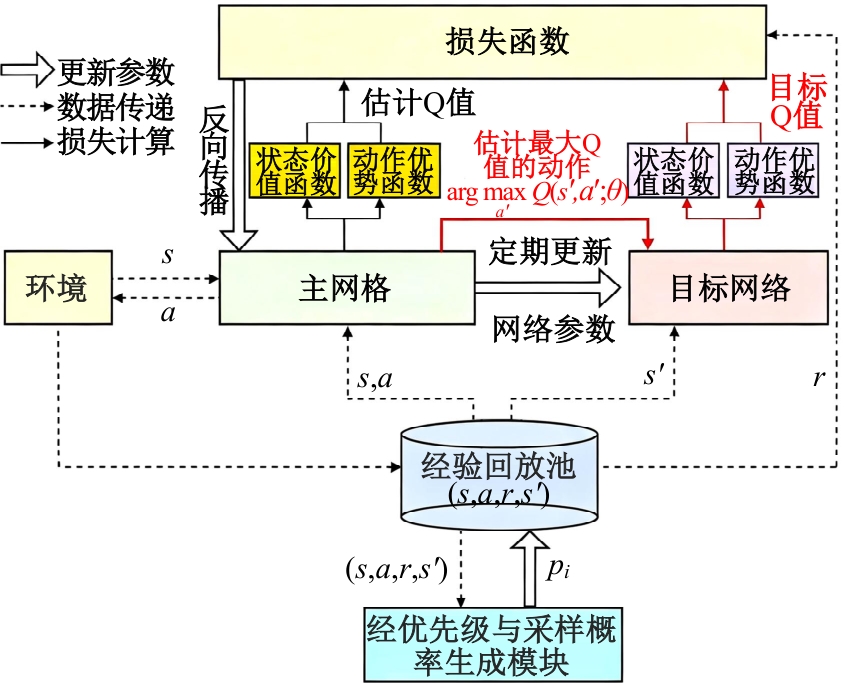
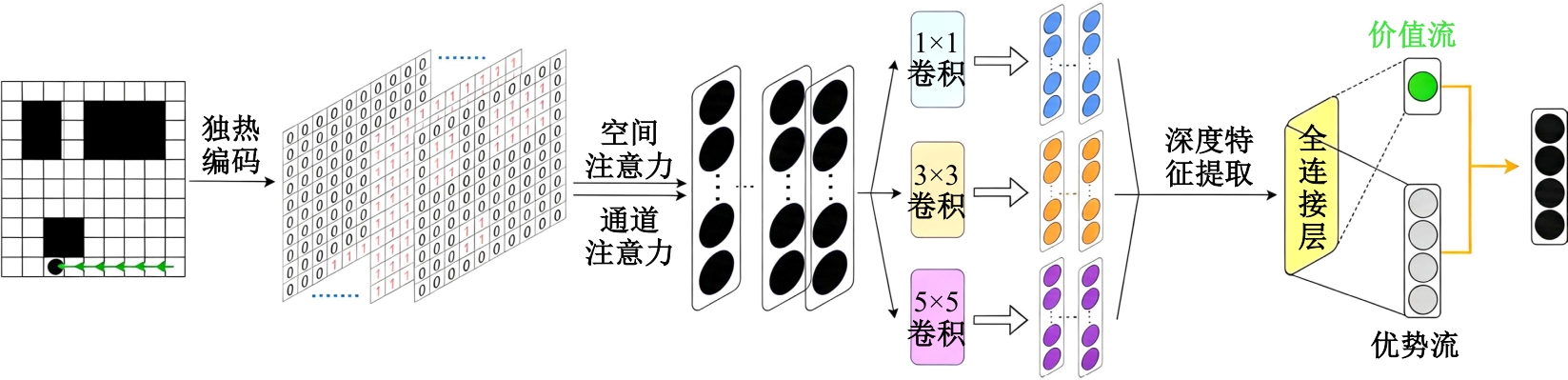
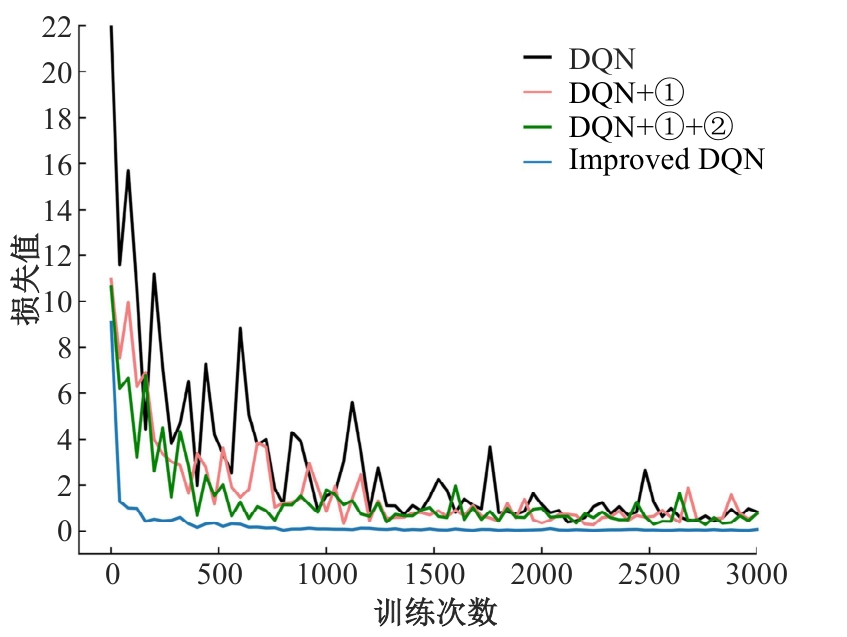
针对无人机覆盖路径规划中传统Deep Q-network(DQN)存在的覆盖率低、路径冗余度高、收敛速度慢等问题,提出了一种基于多机制融合的改进型DQN模型。首先,将无人机的工作空间建模为二维栅格地图,进行预处理并设计奖励函数。其次,基于传统DQN,逐步融合Double DQN、Dueling network和Priority experience replay三种机制,运用独热编码等技术搭建多尺度卷积神经网络,构建了改进型DQN模型。最后,设计可视化仿真实验,并以栅格覆盖率等评价指标进行消融实验。实验结果表明:改进型DQN模型在覆盖路径规划任务中表现出色,其性能优于传统DQN等模型。相较于传统DQN,其栅格覆盖率提升了8.28%,栅格重复率、路径长度、碰撞障碍物次数、超出边界次数分别降低了28.44%、45.14%、77.31%、90.14%,且网络收敛速度显著加快。
中图分类号:
- TP391

| [1] | Buchelt A, Adrowitzer A, Kieseberg P, et al. Exploring artificial intelligence for applications of drones in forest ecology and management[J]. Forest Ecology and Management, 2024, 551: No.121530. |
| [2] | Bakirci M. Smart city air quality management through leveraging drones for precision monitoring[J]. Sustainable Cities and Society, 2024, 106: No.105390. |
| [3] | Ibrahim Z T, He J. Slam technology on disaster response[J]. World Journal of Engineering and Technology, 2024, 12(3): 695-714. |
| [4] | Xing B, Wang X, Yang L, et al. An algorithm of complete coverage path planning for unmanned surface vehicle based on reinforcement learning[J]. Journal of Marine Science and Engineering, 2023, 11(3): No.645. |
| [5] | Kim J. Autonomous robot vacuum system composed of a cleaner robot and a dust storage robot[J]. Journal of the Franklin Institute, 2024, 361(11): No.106938. |
| [6] | Wan S, Chen Z, Dong J. An efficiency-based interactive dynamic technique with interval-valued hesitant fuzzy constraint cone for rescue route planning[J]. Expert Systems with Applications, 2023, 231: No.120648. |
| [7] | Dijkstra E W. A note on two problems in connexion with graphs[J]. Numerische Mathematik, 1959, 1(1): 269-271. |
| [8] | Hart P E, Nilsson N J, Raphael B. A formal basis for the heuristic determination of minimum cost paths[J]. IEEE transactions on Systems Science and Cybernetics, 1968, 4(2): 100-107. |
| [9] | Xu R, Xia Y, Chen P. A Multi-Objective Particle Swarm Optimization Algorithm for Drone Path Planning in Forest Firefighting[C]∥The 11th International Conference on Electrical and Electronics Engineering(ICEEE), Marmaris,Turkiye,2024:523-527. |
| [10] | 唐颂, 吴建源. 基于改进遗传算法的协同航迹规划方法[J]. 电光与控制, 2024, 31(7): 8-12, 26. |
| Tang Song, Wu Jian-yuan. A Cooperative Trajectory Planning Method Based on Improved Genetic Algorithm[J]. Electronics Optics & Control, 2024, 31(7): 8-12, 26. | |
| [11] | Luo J, Shun H, Hao Y. A path planning method for comprehensive area coverage utilizing neuron activity[C]∥The 5th International Conference on Robotics, Intelligent Control and Artificial Intelligence(RICAI),Hangzhou,China, 2023: 379-383. |
| [12] | 屈博琛. 基于深度学习自动微分的无人机路径规划[J]. 自动化与仪表, 2025, 40(2): 66-72. |
| Qu Bo-chen. Drone path planning based on deep learning with automatic differentiation[J]. Automation & Instrumentation, 2025, 40(2): 66-72. | |
| [13] | Mnih V, Kavukcuoglu K, Silver D, et al. Playing atari with deep reinforcement learning[J/OL].[2025-02-16]. . |
| [14] | van Hasselt H, Guez A, Silver D. Deep reinforcement learning with double Q-learning[C]∥Proceedings of the Thirtieth AAAI Conference on Artificial Intelligence, Phoenix, Arizona, 2016, 30(1): 2094-2100. |
| [15] | Wang Z, Schaul T, Hessel M, et al. Dueling network architectures for deep reinforcement learning[C]∥International Conference on Machine Learning, New York, USA, 2016: 1995-2003. |
| [16] | Schaul T, Quan J, Antonoglou I, et al. Prioritized experience replay[J/OL]. [2025-01-22]. . |
| [17] | Watkins C J C H. Learning from delayed rewards[D]. Cambridge: King's College, University of Cambridge,1989. |
| [18] | Jaderberg M, Simonyan K, Zisserman A. Spatial transformer networks[J]. Advances in Neural Information Processing Systems, 2015, 28: 2017-2025. |
| [19] | Hu J, Shen L, Sun G. Squeeze-and-excitation networks[C]∥Proceedings of the IEEE Conference on Computer Vision and Pattern Recognition, Salt Lake City, USA, 2018:7132-7141. |
| [20] | Brockman G, Cheung V, Pettersson L, et al. Openai gym[J/OL].[2025-01-26]. . |
| [1] | 巨涛,张文金,杨垚,火久元. 一种二阶决策的车联网边缘计算任务动态卸载方法[J]. 吉林大学学报(工学版), 2026, 56(7): 2006-2019. |
| [2] | 张楠,张和茂,章涛,张艳军. 智能机器人自适应巡检路径栅格地图邻域搜索算法[J]. 吉林大学学报(工学版), 2026, 56(7): 2026-2033. |
| [3] | 田成军,颜禹,崔仁伟,张晋通. 基于深度强化学习的机械臂自主抓取算法[J]. 吉林大学学报(工学版), 2026, 56(3): 662-669. |
| [4] | 刘康琳,张泽宇,蒋婧雯,宫洵,陈垚. 基于分布鲁棒优化的无人机配送设施选址分配问题[J]. 吉林大学学报(工学版), 2026, 56(2): 464-472. |
| [5] | 王琳虹,刘宇阳,刘子昱,鹿应佳,张宇恒,黄桂树. 基于YOLOv5的轻量化桥梁缺陷识别[J]. 吉林大学学报(工学版), 2025, 55(9): 2958-2968. |
| [6] | 艾青林,刘元宵,杨佳豪. 基于MFF-STDC网络的室外复杂环境小目标语义分割方法[J]. 吉林大学学报(工学版), 2025, 55(8): 2681-2692. |
| [7] | 张宇飞,王丽敏,赵建平,贾智尧,李明洋. 基于中心选择大逃杀优化算法的机器人逆运动学求解[J]. 吉林大学学报(工学版), 2025, 55(8): 2703-2710. |
| [8] | 朴燕,康继元. RAUGAN:基于循环生成对抗网络的红外图像彩色化方法[J]. 吉林大学学报(工学版), 2025, 55(8): 2722-2731. |
| [9] | 朱科,邢志明,康翔宇. 机械手多任务均衡策略[J]. 吉林大学学报(工学版), 2025, 55(8): 2782-2790. |
| [10] | 车翔玖,李良. 融合全局与局部细粒度特征的图相似度度量算法[J]. 吉林大学学报(工学版), 2025, 55(7): 2365-2371. |
| [11] | 李文辉,杨晨. 基于对比学习文本感知的小样本遥感图像分类[J]. 吉林大学学报(工学版), 2025, 55(7): 2393-2401. |
| [12] | 庄珊娜,王君帅,白晶,杜京瑾,王正友. 基于三维卷积与自注意力机制的视频行人重识别[J]. 吉林大学学报(工学版), 2025, 55(7): 2409-2417. |
| [13] | 刘琼昕,王甜甜,王亚男. 非支配排序粒子群遗传算法解决车辆位置路由问题[J]. 吉林大学学报(工学版), 2025, 55(7): 2464-2474. |
| [14] | 王健,贾晨威. 面向智能网联车辆的轨迹预测模型[J]. 吉林大学学报(工学版), 2025, 55(6): 1963-1972. |
| [15] | 车翔玖,孙雨鹏. 基于相似度随机游走聚合的图节点分类算法[J]. 吉林大学学报(工学版), 2025, 55(6): 2069-2075. |
|
||