吉林大学学报(工学版) ›› 2026, Vol. 56 ›› Issue (10): 2566-2577.doi: 10.13229/j.cnki.jdxbgxb.20250433
• 交通运输工程·土木工程 • 上一篇
低能见度条件下高速公路异构交通流建模及仿真
程国柱1( ),刘强1,方丽庄2,尤志栋2,顾爽1()
- 1.东北林业大学 土木与交通学院,哈尔滨 150040
2.公安部交通管理科学研究所,江苏 无锡 214151
Modeling and simulation of heterogeneous traffic flow on freeway under low visibility conditions
Guo-zhu CHENG1(),Qiang LIU1,Li-zhuang FANG2,Zhi-dong YOU2,Shuang GU1()
- 1.School of Civil Engineering and Transportation,Northeast Forestry University,Harbin 150040,China
2.Transportation Management Research Institute of the Ministry of Public Security,Wuxi 214151,China
摘要:
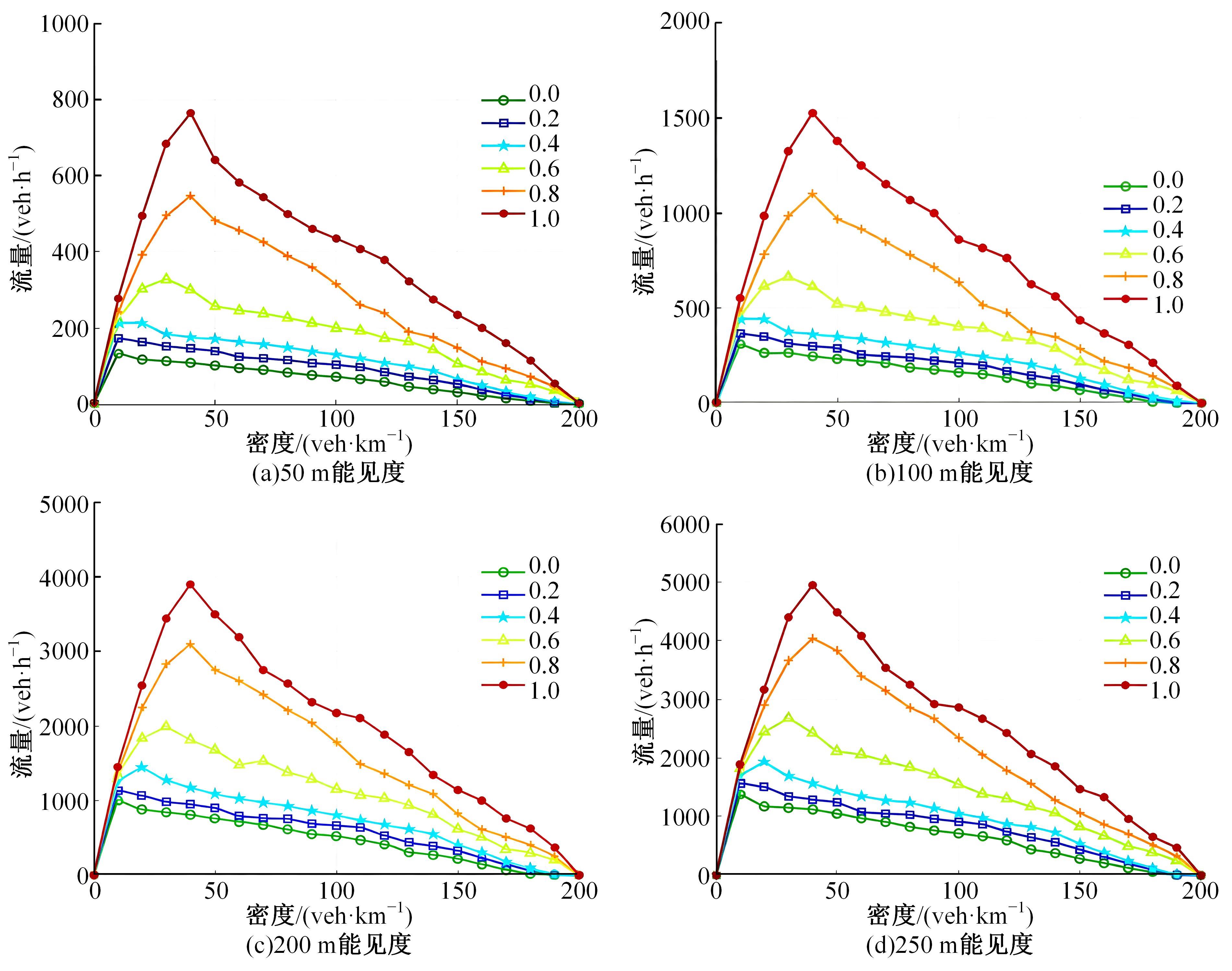
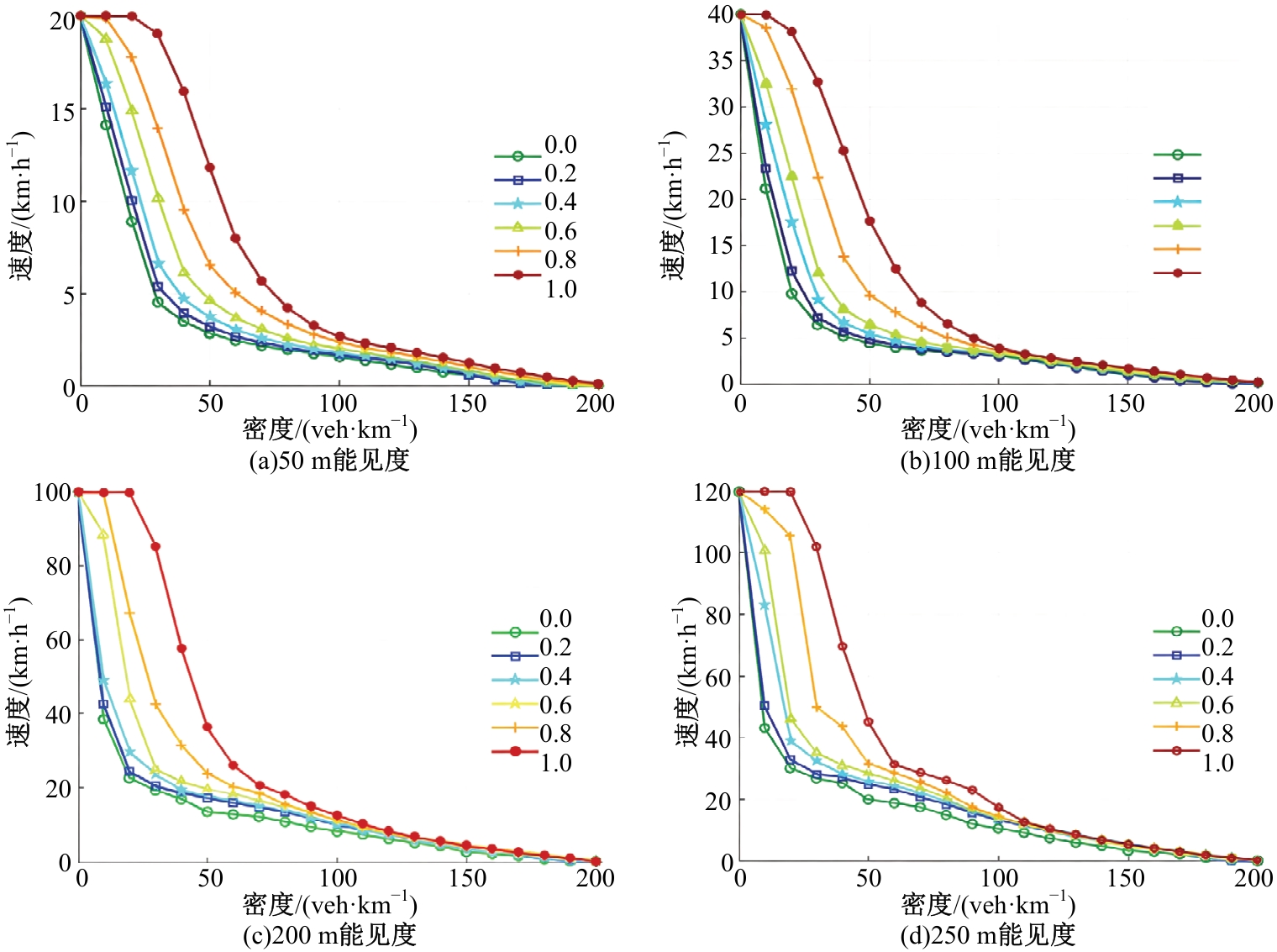
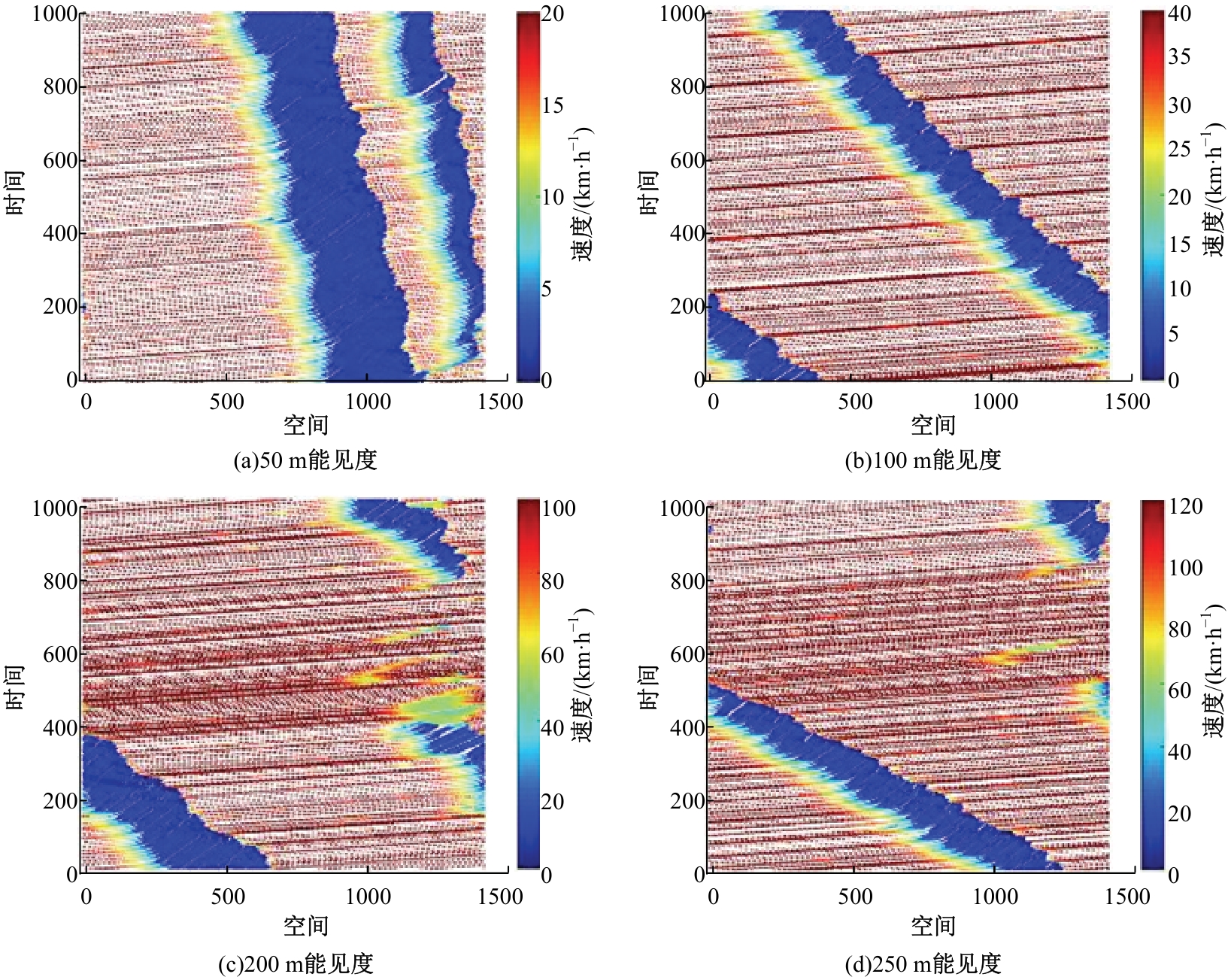
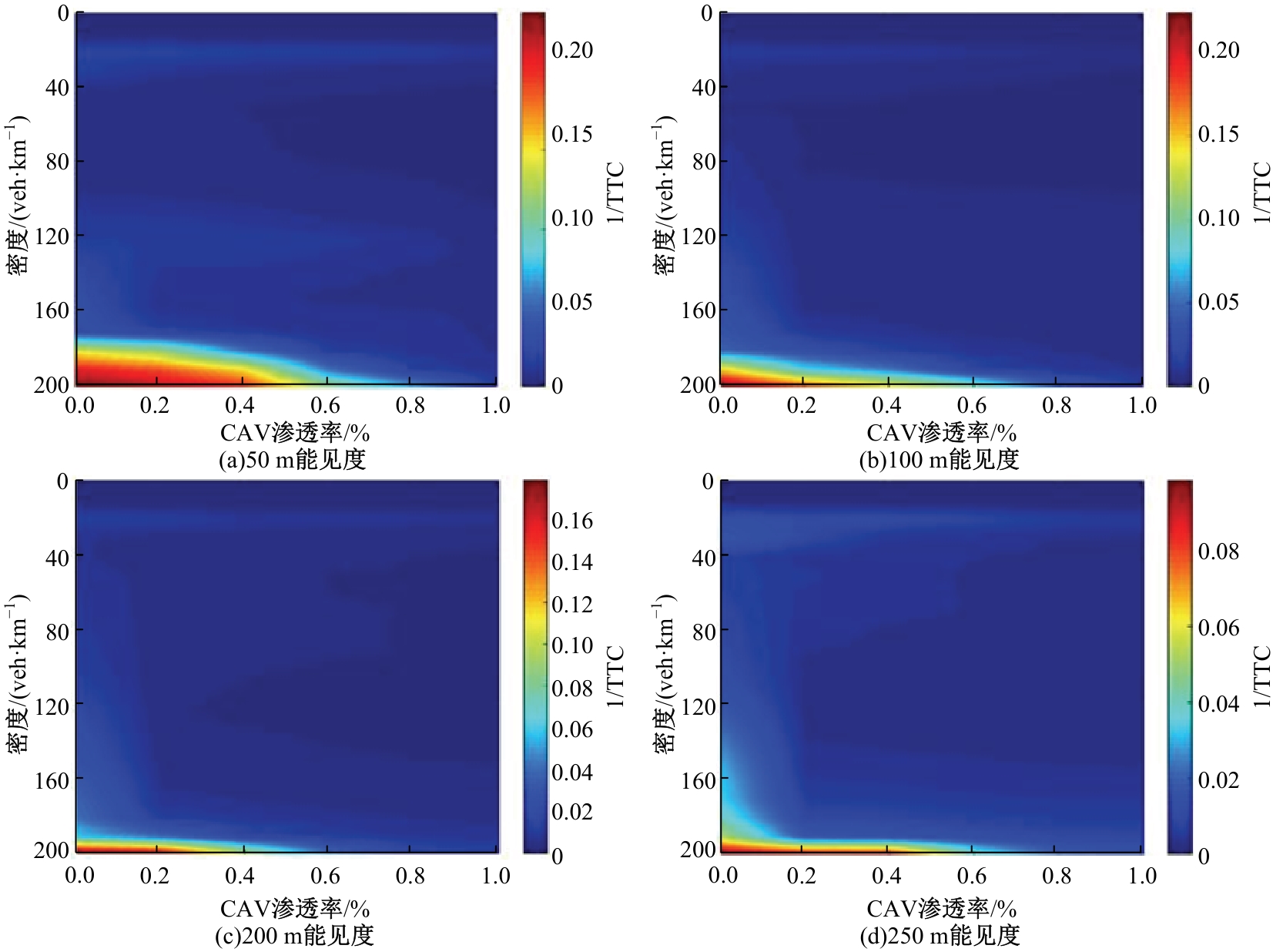
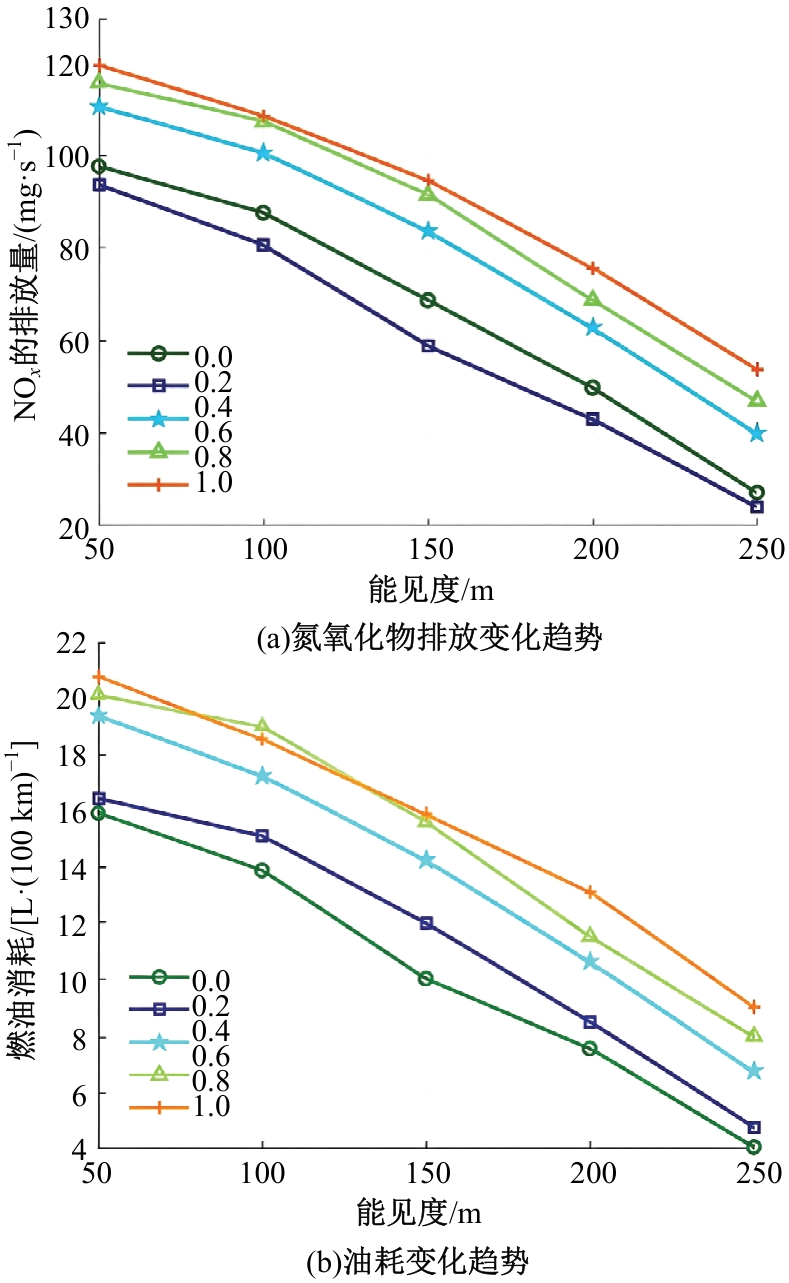
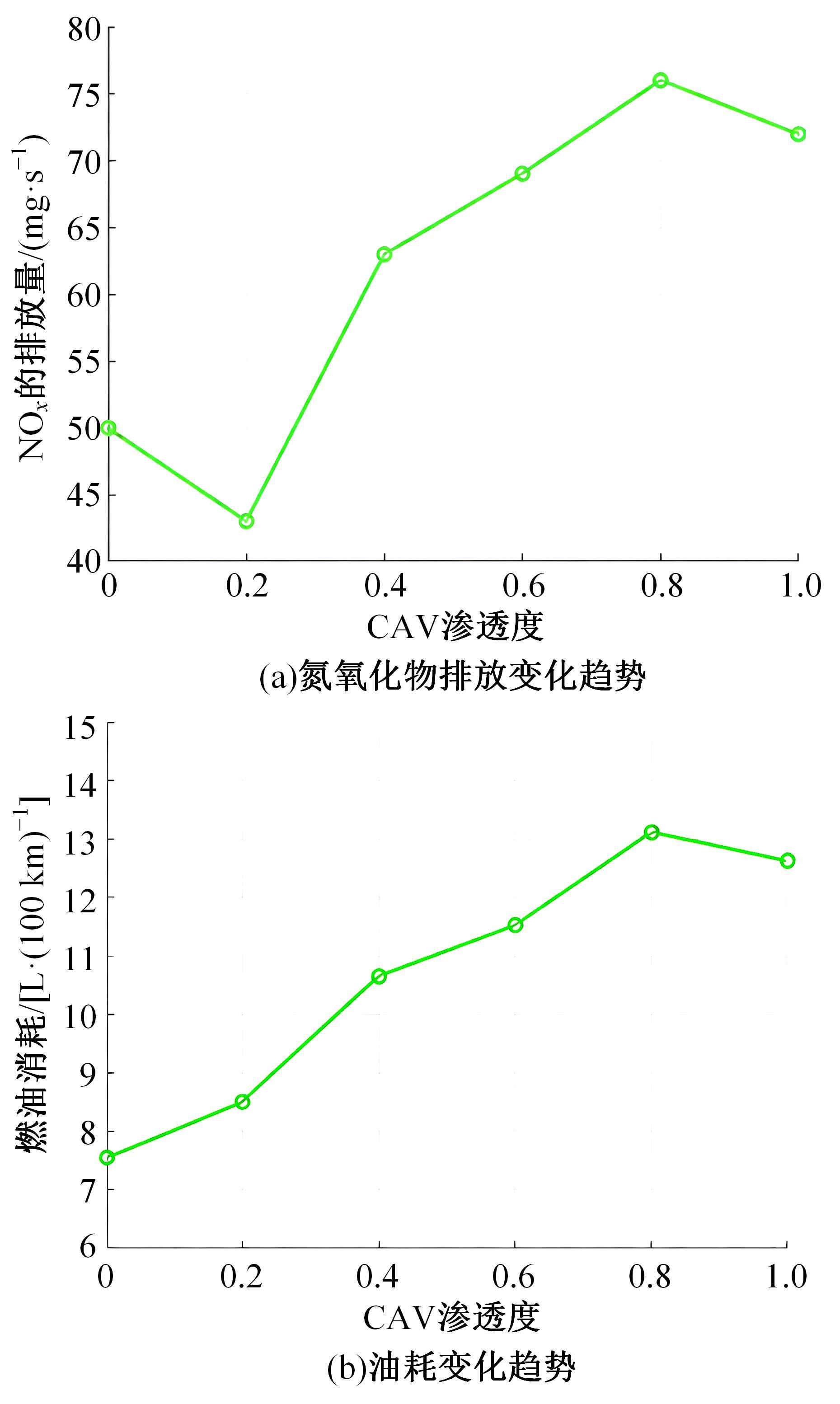
考虑到低能见度对人工驾驶车辆(HDV)的安全距离、加速度、视距及换道行为的影响,基于元胞自动机构建了HDV跟驰模型,采用Path实验室开发的跟驰模型刻画网联自动驾驶车辆(CAV)跟驰行为;构建了考虑能见度、驾驶风格等因素的HDV换道模型,根据前方车辆类型和换道条件刻画CAV的换道决策,开展低能见度条件下高速公路异构交通流仿真研究,基于仿真结果评估不同能见度及CAV渗透率下的通行能力、拥堵率、冲突严重程度、平均油耗及排放量。结果表明:随着能见度和CAV渗透率的增大,通行能力和平均车速均显著提高;相较于Nasch模型,本文构建的低能见度条件下高速公路异构交通流跟驰和换道模型在安全性方面提升约23.1%,平均油耗和氮氧化物排放分别降低了3.42%和1.5%。本文研究成果可丰富高速公路交通流理论,为研究异构交通环境下的相关交通问题提供基础模型。
中图分类号:
- U495

| [1] | Xu C, Wang W, Liu P. Identifying crash-prone traffic conditions under different weather on freeways[J]. Journal of Safety Research, 2013, 46: 135-144. |
| [2] | Peng Y, Abdel-Aty M, Shi Q, et al. Assessing the impact of reduced visibility on traffic crash risk using microscopic data and surrogate safety measures[J]. Transportation Research Part C: Emerging Technologies, 2017, 74: 295-305. |
| [3] | Hjelkrem A O, Ryeng O E. Chosen risk level during car-following in adverse weather conditions[J]. Accident Analysis and Prevention, 2016, 95: 227-235. |
| [4] | Li J, Yu C, Shen Z, et al. A survey on urban traffic control under mixed traffic environment with connected automated vehicles[J]. Transportation Research Part C: Emerging Technologies, 2023, 154: 104258. |
| [5] | Yang S, Shladover S E, Lu X Y, et al. A Bayesian regression analysis of truck drivers' use of cooperative adaptive cruise control(CACC) for platooning on California highways[J]. Journal of Intelligent Transportation Systems, 2023, 27(1): 80-91. |
| [6] | Cui S, Cao F, Yu B, et al. Modeling heterogeneous traffic mixing regular, connected, and connected-autonomous vehicles under connected environment[J]. IEEE Transactions on Intelligent Transportation Systems, 2021, 23(7): 8579-8594. |
| [7] | 秦严严, 王昊, 王炜, 等. 混有CACC车辆和ACC车辆的异质交通流基本图模型[J]. 中国公路学报, 2017, 30(10): 127-136. |
| Qin Yan-yan, Wang Hao, Wang Wei, et al. Stability analysis and fundamental diagram of heterogeneous traffic flow mixed with cooperative adaptive cruise control vehicles[J]. China Journal of Highway and Transport, 2017, 30(10): 127-136. | |
| [8] | 姚志洪, 金玉婷, 王思琛, 等. 混入智能网联汽车的交通流稳定性与安全性分析[J]. 中国安全科学学报, 2021, 31(10): 136-143. |
| Yao Zhi-hong, Jin Yu-ting, Wang Si-chen, et al. Stability and safety analysis on traffic flow mixed with ICV[J]. China Safety Science Journal, 2021, 31(10): 136-143. | |
| [9] | 蒋阳升, 王思琛, 高宽, 等. 混入智能网联车队的混合交通流元胞自动机模型[J]. 系统仿真学报, 2022, 34(5): 1025-1032. |
| Jiang Yang-sheng, Wang Si-chen, Gao Kuan, et al. Cellular automata model of mixed traffic flow composed of intelligent connected vehicles' platoon[J]. Journal of System Simulation, 2022, 34(5): 1025-1032. | |
| [10] | Yao H, Li X. Lane-change-aware connected automated vehicle trajectory optimization at a signalized intersection with multi-lane roads[J]. Transportation Research Part C: Emerging Technologies, 2021, 129: 103182. |
| [11] | 蒋锐, 郭忠印, 李振楠. 恶劣天气条件下车辆换车道的安全模型[J]. 同济大学学报: 自然科学版, 2011, 39(4): 529-533. |
| Jiang Rui, Guo Zhong-yin, Li Zhen-nan. Lane-changing safety model for deteriorative weather[J]. Journal of Tongji University(Natural Science), 2011, 39(4): 529-533. | |
| [12] | Tan J, Gong L, Qin X. An extended car-following model considering the low visibility in fog on a highway with slopes[J]. International Journal of Modern Physics C: Computational Physics & Physical Computation, 2019, 30(11): 1950090. |
| [13] | Jiang R, Wu Q, Zhu Z. Full velocity difference model for a car-following theory[J]. Physical Review E, 2001, 64(1): 017101. |
| [14] | 程国柱, 李金禹, 陈永胜, 等. 高速公路异构交通流HDV建模及其特征[J]. 长安大学学报: 自然科学版, 2024, 44(4): 97-107. |
| Cheng Guo-zhu, Li Jin-yu, Chen Yong-sheng, et al. Modeling of human-driven vehicles and characteristics of heterogeneous traffic flow for freeway[J] Journal of Chang' an University(Natural Science Edition), 2024, 44(4): 97-107. | |
| [15] | Das A, Ahmed M M, Ghasemzadeh A. Using trajectory-level SHRP2 naturalistic driving data for investigating driver lane-keeping ability in fog: an association rules mining approach[J]. Accident Analysis & Prevention, 2019, 129: 250-262. |
| [16] | 秦严严, 王昊, 王炜, 等. 不同CACC渗透率条件下的混合交通流稳定性分析[J]. 交通运输系统工程与信息, 2017, 17(4): 63-69, 104. |
| Qin Yan-yan, Wang Hao, Wang Wei, et al. Mixed traffic flow string stability analysis for different CACC penetration ranges[J]. Journal of Transportation Systems Engineering and Information Technology, 2017, 17(4): 63-69, 104. | |
| [17] | 张建旭, 胡帅. 混有CACC和ACC车辆的连续型元胞自动机交通流模型[J]. 科学技术与工程, 2022, 22(15): 6340-6346. |
| Zhang Jian-xu, Hu Shuai. Continuous cellular automata model of traffic flow mixed with cooperative adaptive cruise control vehicles and adaptive cruise control vehicles[J]. Science Technology and Engineering, 2022, 22(15): 6340-6346. | |
| [18] | Shladover S E, Nowakowski C, Lu X Y, et al. Cooperative adaptive cruise control: definitions and operating concepts[J]. Journal of the Transportation Research Board, 2016, 2489: 145-152. |
| [19] | 杨崇辉,郑玲,左益芳,等.基于高速公路场景的换道驾驶行为研究[J].重庆大学学报, 2024, 47(11):37-50. |
| Yang Chong-hui, Zheng Ling, Zuo Yi-fang, et al. Highway lane-changing behavior: a data-driven analysis of driver intentions[J]. Journal of Chongqing University, 2024, 47(11): 37-50. | |
| [20] | Zhang Z. Collision simulation of trucks and pedestrians based on Pc-Crash in the blind area of truck driving[J]. Proceedings of SPIE, 2021, 30(11): 1950090. |
| [21] | 冯付勇,魏超,吕彦直,等.基于GCN和QP的智能车辆换道决策规划[J].北京理工大学学报, 2024, 44(8):820-827. |
| Feng Fu-yong, Wei Chao, Yan-zhi Lü, et al. Lane change decision making and planning of intelligent vehicles based on GCN and QP[J]. Transactions of Beijing Institute of Technology, 2024, 44(8): 820-827. | |
| [22] | Li C, Zhao X, Xie D, et al. Exploring the impact mechanism of communicating information on the perturbation propagation[J]. Transportmetrica A: Transport Science, 2024, 20(1): 1-34. |
| [23] | Yao Z, Hu R, Wang Y, et al. Stability analysis and the fundamental diagram for mixed connected automated and human-driven vehicles[J]. Physica A: Statistical Mechanics and its Applications, 2019, 533:121931. |
| [24] | 黄岩, 李海军, 闫学东, 等. 雾天网联车辆跟驰模型构建及行为影响分析[J]. 交通运输系统工程与信息, 2024, 24(4): 41-49. |
| Huang Yan, Li Hai-jun, Yan Xue-dong, et al. Car-following model and behavior analysis of connected vehicles in fog weather conditions[J]. Journal of Transportation Systems Engineering and Information Technology, 2024, 24(4): 41-49. | |
| [25] | Ahn K, Rakha H, Trani A, et al. Estimating vehicle fuel consumption and emissions based on instantaneous speed and acceleration levels[J]. Journal of transportation engineering, 2002, 128(2): 182-190. |
| [26] | 高坤, 涂辉招, 时恒, 等. 雾霾天气低能见度对不同跟驰状态驾驶行为的影响[J]. 吉林大学学报: 工学版, 2017, 47(6): 1716-1727. |
| Gao Kun, Tu Hui-zhao, Shi Heng, et al. Effect of low visibility in haze weather condition on longitudinal driving behavior in different car-following stages[J]. Journal of Jilin University(Engineering and Technology Edition), 2017, 47(6): 1716-1727. |
| [1] | 周备,周千喜,马壮林,蔡凌霄,路熙. 不同天气下快速路交织区交通冲突机理[J]. 吉林大学学报(工学版), 2026, 56(9): 2329-2339. |
| [2] | 吴文静,贾子曦,贾洪飞,杨旭,卢国范. 低碳导向的网约车合乘意愿及激励策略[J]. 吉林大学学报(工学版), 2026, 56(9): 2350-2360. |
| [3] | 王艳丽,王晨曦,赵欣然,吴兵. 考虑多维属性的混合路网路径选择行为预测[J]. 吉林大学学报(工学版), 2026, 56(8): 2067-2076. |
| [4] | 张惠玲,王靖帆,曹一铄,敖谷昌. 基于效益-费用的高速公路货车差异化收费双层优化建模[J]. 吉林大学学报(工学版), 2026, 56(7): 1958-1969. |
| [5] | 赵红星,刘书英,聂江龙,梁瑞艳,何瑞春. 考虑弯道条件的同质与异质交通流稳定性分析[J]. 吉林大学学报(工学版), 2026, 56(2): 393-406. |
| [6] | 张航,熊宇豪,吕能超. 基于停车视距的高速公路下坡段货车制动可靠性[J]. 吉林大学学报(工学版), 2026, 56(2): 383-392. |
| [7] | 刘康琳,张泽宇,蒋婧雯,宫洵,陈垚. 基于分布鲁棒优化的无人机配送设施选址分配问题[J]. 吉林大学学报(工学版), 2026, 56(2): 464-472. |
| [8] | 张毅,陈莎雯,陈艳,范翔宇,王思祺,吴欢,焦鹏飞. 高速公路机电设备动态运维评价及预测性维护[J]. 吉林大学学报(工学版), 2026, 56(1): 170-182. |
| [9] | 孙峣,白东轩,姚宝珍,白子建. 基于渗流理论的港城交通网络特征分析[J]. 吉林大学学报(工学版), 2026, 56(1): 199-208. |
| [10] | 贾洪飞,庄博,罗清玉,刘玲,黄秋阳. 积水条件下城市路网性能恢复决策优化[J]. 吉林大学学报(工学版), 2025, 55(9): 2969-2977. |
| [11] | 王东,李宇暄,吴欢,宗芳. 基于随机森林的智能网联汽车开放测试道路评级算法[J]. 吉林大学学报(工学版), 2025, 55(9): 2998-3006. |
| [12] | 于征磊,张超磊,陈立新,胡平,徐涛,郭滨恺. 高速公路声屏障板仿生结构设计及声学力学性能[J]. 吉林大学学报(工学版), 2025, 55(9): 3079-3088. |
| [13] | 张航,孙煜,马宝林,牛世豪,王星月,吕能超. 高速公路双车道出口辅助车道长度可靠性设计[J]. 吉林大学学报(工学版), 2025, 55(8): 2611-2618. |
| [14] | 葛洪成,郭忠印,宋灿灿,王世伟. 半地下枢纽互通匝道隧道出口与二次分流点间安全距离[J]. 吉林大学学报(工学版), 2025, 55(7): 2223-2232. |
| [15] | 徐慧智,郝东升,徐小婷,蒋时森. 基于深度学习的高速公路小目标检测算法[J]. 吉林大学学报(工学版), 2025, 55(6): 2003-2014. |
|
||