吉林大学学报(工学版) ›› 2026, Vol. 56 ›› Issue (9): 2350-2360.doi: 10.13229/j.cnki.jdxbgxb.20250155
• 交通运输工程·土木工程 • 上一篇
低碳导向的网约车合乘意愿及激励策略
吴文静1( ),贾子曦1,贾洪飞1(),杨旭1,卢国范2
- 1.吉林大学 交通学院,长春 130022
2.吉林省地方海事局,长春 130016
Low⁃carbon oriented carpooling willingness and incentive strategies for ride⁃hailing services
Wen-jing WU1(),Zi-xi JIA1,Hong-fei JIA1(),Xu YANG1,Guo-fan LU2
- 1.College of Transportation,Jilin University,Changchun 130022,China
2.Jilin Maritime Safety Administration,Changchun 130016,China
摘要:
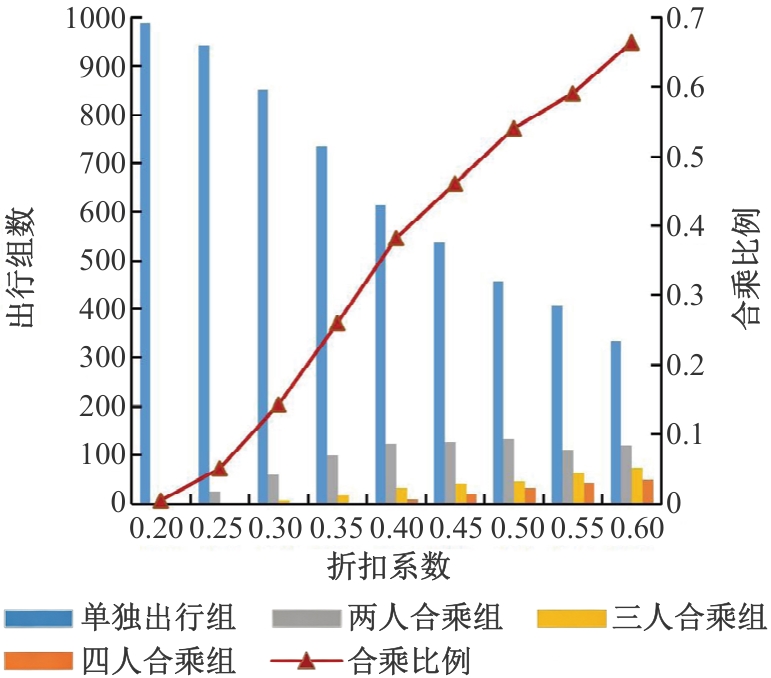
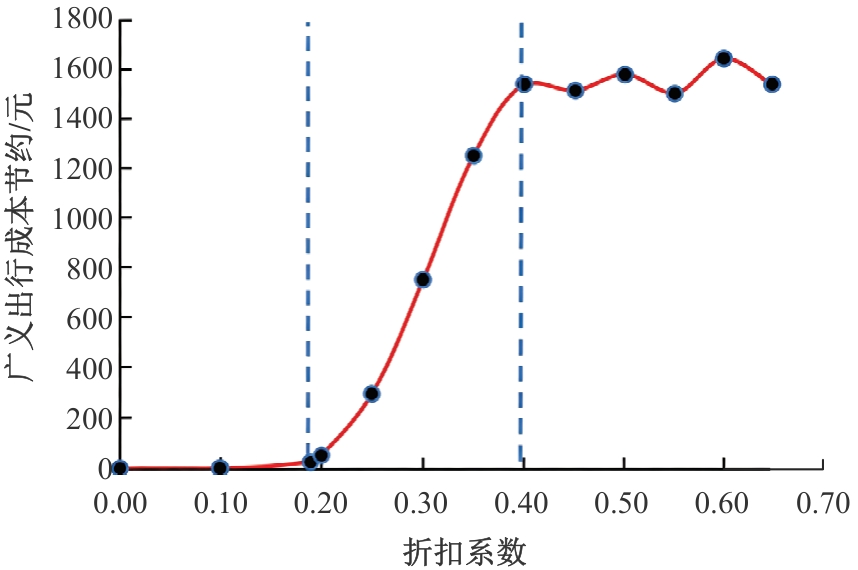
为推动城市交通方式的低碳转型,将合乘出行的碳减排收益以合乘价格折扣的形式反馈给乘客以激励网约车合乘行为,基于前景理论描述了激励策略下乘客的合乘出行意愿,以平台总利润最大化和乘客广义出行成本节约最大化为目标函数,考虑多人合乘匹配、平台利润、时间窗等约束条件,构建了激励策略下的乘客-网约车合乘匹配模型并进行模型求解。以厦门市网约车实际运营数据为例进行算例研究,从乘客、网约车平台视角分析激励策略对乘客广义出行成本、平台总利润及碳减排效果的影响过程。研究结果表明:激励策略对促进乘客由非合乘向合乘出行选择转移具有积极意义;以平台最优为目标可最大化碳减排效果,但通常会造成乘客过多地绕行;合乘价格折扣系数约在0.40时效果最佳,可最大化促成多人合乘时兼顾乘客及平台的利益。
中图分类号:
- U121

| [1] | Li W X, Wang L, Pu Z Y, et al. What determines the real-world CO2 emission reductions of ridesplitting trips?[J]. Travel Behaviour and Society, 2024, 35: No.100734. |
| [2] | 贾洪飞, 邵子函, 杨丽丽. 终点不确定条件下网约车合乘匹配模型及算法[J]. 吉林大学学报: 工学版, 2022, 52(3): 564-571. |
| Jia Hong-fei, Shao Zi-han, Yang Li-li. Ride⁃sharing matching model and algorithm of online car⁃hailing under condition of uncertain destination[J]. Journal of Jilin University(Engineering and Technology Edition), 2022, 52(3): 564-571. | |
| [3] | Xiao L L, Liu T L, Huang H J. On the morning commute problem with carpooling behavior under parking space constraint[J]. Transportation Research Part B: Methodological, 2016, 91: 383-407. |
| [4] | 北京市交通委员会. 北京市交通委员会 北京市生态环境局关于印发《北京MaaS2.0工作方案》的通知[EB/OL]. [2025-01-15]. . |
| [5] | 北京市生态环境局. 北京市生态环境局关于滴滴北京低碳出行合乘项目设计文件的公示[EB/OL]. [2025-01-15]. . |
| [6] | Rey-Merchan M, Fernandez V, Lopez-Arquillos A, et al. Carpooling for sustainable commuting: a review[C]∥Universidad de Malaga, Guimaraes, Portugal, 2022: 144-146. |
| [7] | Hu S, Dessouky M M, Uhan N A, et al. Cost-sharing mechanism design for ride-sharing[J]. Transportation Research Part B: Methodological, 2021, 150: 410-434. |
| [8] | 李兴华, 冯飞宇, 成诚, 等. 网约拼车服务选择偏好分析及建模[J]. 吉林大学学报: 工学版, 2022, 52(3): 578-584. |
| Li Xing-hua, Feng Fei-yu, Cheng Cheng, et al. Choice preference analysis and modeling of ridesplitting service[J]. Journal of Jilin University(Engineering and Technology Edition), 2022, 52(3): 578-584. | |
| [9] | 李振东, 郭敏. 考虑出行者低碳偏好的网约车平台定价策略[J]. 中北大学学报: 自然科学版, 2023, 44(1): 8-15. |
| Li Zhen-dong, Guo Min. Pricing strategies of ride-hailing platforms considering travelers' low-carbon preferences[J]. Journal of North University of China(Natural Science Edition), 2023, 44(1): 8-15. | |
| [10] | 李振东. 考虑平台补贴的网约车平台定价研究[D]. 太原: 中北大学经济与管理学院, 2023. |
| Li Zhen-dong. Research on pricing of online car-hailing platform considering platform subsidy[D]. Taiyuan: School of Economics and Management of North University of China, 2023. | |
| [11] | Shen B, Cao B, Zhao Y, et al. Roo: Route planning algorithm for ride sharing systems on large-scale road networks[C]∥2019 IEEE International Conference on Big Data and Smart Computing, Kyoto, Japan, 2019: 1-8. |
| [12] | 陈林. 基于心理账户论的交通决策行为建模分析[D]. 成都: 西南交通大学交通运输与物流学院, 2017. |
| Chen Lin. Modeling analysis the travel choice behavior based on mental accounting[D]. Chengdu:School of Transportation and Logistics, Southwest Jiaotong University, 2017. | |
| [13] | Tversky A, Kahneman D. Advances in prospect theory: cumulative representation of uncertainty[J]. Journal of Risk and Uncertainty, 1992, 5(4): 297-323. |
| [14] | Cheng J H, Wang Z, Zhou H Y, et al. DM-SLAM: a feature-based SLAM system for rigid dynamic scenes[J]. ISPRS International Journal of Geo-Information, 2020, 9(4): No.202. |
| [15] | Chen J Q, Peng D P, Liu Z W. A sustainable model for forecasting carbon emission trading prices[J]. Sustainability, 2024, 16(19): No. 8324. |
| [16] | 郭麦菊, 厉行, 雷莹, 等. 时间的价值:基于共享出行平台的实证研究[J]. 营销科学学报, 2021, 1(2): 39-59. |
| Guo Mai-ju, Li Xing, Lei Ying, et al. The value of time: an empirical study on a ride-sharing platform[J]. Journal of Marketing Science, 2021, 1(2): 39-59. |
| [1] | 周备,周千喜,马壮林,蔡凌霄,路熙. 不同天气下快速路交织区交通冲突机理[J]. 吉林大学学报(工学版), 2026, 56(9): 2329-2339. |
| [2] | 王艳丽,王晨曦,赵欣然,吴兵. 考虑多维属性的混合路网路径选择行为预测[J]. 吉林大学学报(工学版), 2026, 56(8): 2067-2076. |
| [3] | 刘康琳,张泽宇,蒋婧雯,宫洵,陈垚. 基于分布鲁棒优化的无人机配送设施选址分配问题[J]. 吉林大学学报(工学版), 2026, 56(2): 464-472. |
| [4] | 张毅,陈莎雯,陈艳,范翔宇,王思祺,吴欢,焦鹏飞. 高速公路机电设备动态运维评价及预测性维护[J]. 吉林大学学报(工学版), 2026, 56(1): 170-182. |
| [5] | 孙峣,白东轩,姚宝珍,白子建. 基于渗流理论的港城交通网络特征分析[J]. 吉林大学学报(工学版), 2026, 56(1): 199-208. |
| [6] | 贾洪飞,庄博,罗清玉,刘玲,黄秋阳. 积水条件下城市路网性能恢复决策优化[J]. 吉林大学学报(工学版), 2025, 55(9): 2969-2977. |
| [7] | 王东,李宇暄,吴欢,宗芳. 基于随机森林的智能网联汽车开放测试道路评级算法[J]. 吉林大学学报(工学版), 2025, 55(9): 2998-3006. |
| [8] | 徐慧智,郝东升,徐小婷,蒋时森. 基于深度学习的高速公路小目标检测算法[J]. 吉林大学学报(工学版), 2025, 55(6): 2003-2014. |
| [9] | 何庆龄,裴玉龙,侯琳,刘静,潘胜. 混合策略改进WOA-BiLSTM的快速路出口匝道车速预测[J]. 吉林大学学报(工学版), 2025, 55(6): 2038-2049. |
| [10] | 吴文静,邓淳淳,贾洪飞,孙舒航. 内涝影响下路网畅通可靠度评估及关键路段识别[J]. 吉林大学学报(工学版), 2025, 55(4): 1250-1257. |
| [11] | 岳昊,常笑,刘建业,曲秋莳. 引入车辆窗的定制公交线路优化[J]. 吉林大学学报(工学版), 2025, 55(4): 1266-1274. |
| [12] | 孟祥海,王国锐,张明扬,田毕江. 基于选择集成的山区高速事故预测模型[J]. 吉林大学学报(工学版), 2025, 55(4): 1298-1306. |
| [13] | 高天洋,胡大伟,姜瑞森,吴雪,刘慧甜. 基于模块化车辆的区域灵活接驳公交线路优化[J]. 吉林大学学报(工学版), 2025, 55(2): 537-545. |
| [14] | 李昱燃,汪飞,朱才华,韩飞,李岩. 污染天气居民通勤模式选择影响因素的链式效用[J]. 吉林大学学报(工学版), 2025, 55(2): 577-590. |
| [15] | 马书红,张俊杰,陈西芳,廖国美. 利用出租车时序数据识别城市功能区[J]. 吉林大学学报(工学版), 2025, 55(2): 603-613. |
|
||