吉林大学学报(工学版) ›› 2026, Vol. 56 ›› Issue (10): 2597-2605.doi: 10.13229/j.cnki.jdxbgxb.20250365
• 交通运输工程·土木工程 • 上一篇
基于街景图像的建成环境对行人量非线性影响
尹超英1( ),庄韵芊1,汤文蕴1,邵春福2,王晓全3()
- 1.南京林业大学 汽车与交通工程学院,南京 210037
2.新疆大学 新疆交通基础设施绿色建养与智慧交通管控重点实验室,乌鲁木齐 830017
3.河海大学 土木与交通学院,南京 210098
Nonlinear impact of built environment on pedestrian volume based on street view imagery
Chao-ying YIN1(),Yun-qian ZHUANG1,Wen-yun TANG1,Chun-fu SHAO2,Xiao-quan WANG3()
- 1.College of Automobile and Traffic Engineering,Nanjing Forestry University,Nanjing 210037,China
2.Xinjiang Key Laboratory of Green Construction and Smart Traffic Control of Transportation Infrastructure,Urumqi 830017,China
3.College of Civil and Transportation Engineering,Hohai University,Nanjing 210098,China
摘要:
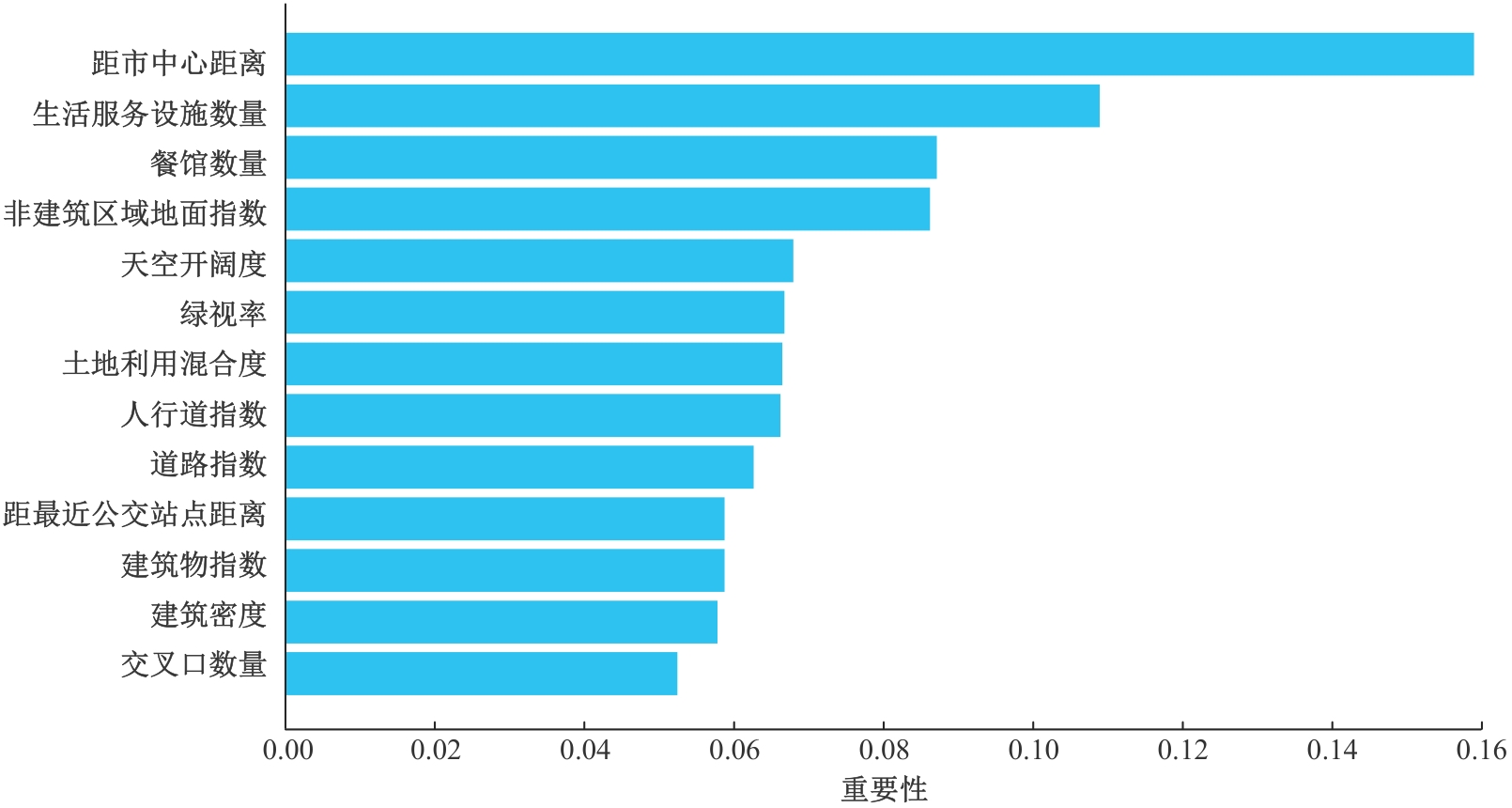
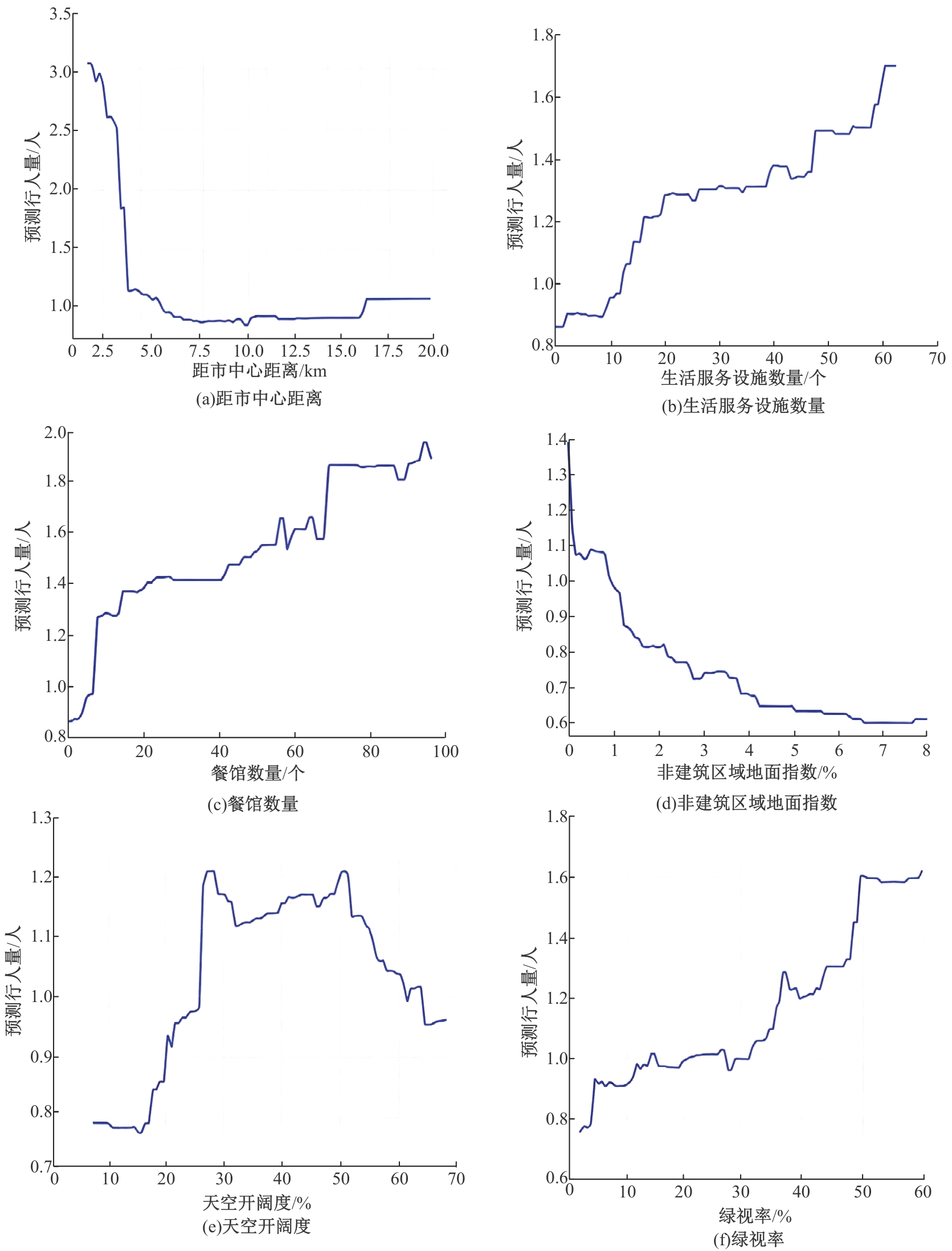
为研究建成环境与行人量之间的非线性关联,以南京市主城区街景图像数据为基础,采用深度学习模型从中提取行人量和街景特征,并结合多源数据从社区和街道两个尺度构建建成环境指标。利用极限梯度提升模型(XGBoost),探究建成环境影响行人量的关键因素,分析各因素与行人量之间的潜在非线性关系。研究结果显示:在社区建成环境因素中,距市中心距离、生活服务设施数量和餐馆数量对行人量影响较大;街道建成环境因素中,非建筑区域地面指数、天空开阔度和绿视率对行人量的影响贡献较大。此外,建成环境各变量对行人量均存在非线性效应且各变量的反馈机制不同。距市中心的距离和非建筑区域地面指数对行人量的影响呈现负反馈特征;生活服务设施数量、餐馆数量和绿视率对行人量的影响呈现正反馈特征;天空开阔度和行人量非线性关系则呈现倒“U”型分布。本文研究成果可为优化城市空间布局和完善步行友好型交通政策提供理论参考。
中图分类号:
- U495

| [1] | Zhang W, Sun B, Zegras C. Sustainable built environment and travel behavior: new perspectives, new data, and new methods[J]. Transportation Research Part D: Transport and Environment, 2021, 97: 102966. |
| [2] | 尹超英, 周建, 林丽, 等. 城市建成环境影响下通勤时间和距离联合建模研究[J]. 北京交通大学学报, 2021, 45(3): 24-29. |
| Yin Chao-ying, Zhou Jian, Lin Li, et.al. Joint modeling research of commuting time and distance considering the impacts of urban built environment[J]. Journal of Beijing Jiaotong University, 2021, 45(3): 24-29. | |
| [3] | 杜森, 钱苾宬, 王嘉鑫, 等. 健康城市视角下建成环境对步行效率影响研究——以兰州市城关核心片区为例[J]. 南方建筑, 2024(10): 49-59. |
| Du Sen, Qian Bi-cheng, Wang Jia-xin, et.al. Impact of built environment on walking efficiency from the perspective of healthy cities: a case study based on the core area of chengguan district in Lanzhou city[J]. South Architecture, 2024(10): 49-59. | |
| [4] | 刘吉祥, 肖龙珠, 周江评, 等. 建成环境与青少年步行通学的非线性关系——基于极限梯度提升模型的研究[J]. 地理科学进展, 2022, 41(2): 251-263. |
| Liu Ji-xiang, Xiao Long-zhu, Zhou Jiang-ping, et.al. Non-linear relationships between the built environment and walking to school: applying extreme gradient boosting method[J]. Progress in Geography, 2022, 41(2): 251-263. | |
| [5] | 刘智谦, 吕建军, 姚尧, 等. 基于街景图像的可解释性城市感知模型研究方法[J]. 地球信息科学学报, 2022, 24(10): 2045-2057. |
| Liu Zhi-qian, Lv Jian-jun, Yao Yao, et.al. Research method of interpretable urban perception model based on street view imagery[J]. Journal of Geo-information Science, 2022, 24(10): 2045-2057. | |
| [6] | Chen L, Lu Y, Sheng Q, et al. Estimating pedestrian volume using street view images: a large-scale validation test[J]. Computers, Environment and Urban Systems, 2020, 81: 101481. |
| [7] | Yin L, Cheng Q, Wang Z, et al. ‘Big data’ for pedestrian volume: exploring the use of Google street view images for pedestrian counts[J]. Applied Geography, 2015, 63: 337-345. |
| [8] | Zeng Q, Wu H, Zhou L, et al. Toward pedestrian-friendly cities: nonlinear and interaction effects of building density on pedestrian volume[J]. Journal of Transport Geography, 2024, 119: 103954. |
| [9] | Liu D, Lu Y, Yang L. Exploring non-linear effects of environmental factors on the volume of pedestrians of different ages using street view images and computer vision technology[J]. Travel Behaviour and Society, 2024, 36: 100814. |
| [10] | Jiang Y, Chen L, Grekousis G, et al. Spatial disparity of individual and collective walking behaviors: a new theoretical framework[J]. Transportation Research Part D: Transport and Environment, 2021, 101: 103096. |
| [11] | Yin L. Street level urban design qualities for walkability: Combining 2D and 3D GIS measures[J]. Computers, Environment and Urban Systems, 2017, 64: 288-296. |
| [12] | Chen L, Lu Y, Ye Y, et al. Examining the association between the built environment and pedestrian volume using street view images[J]. Cities, 2022, 127: 103734. |
| [13] | Cheng L, Shi K, de Vos J, et al. Examining the spatially heterogeneous effects of the built environment on walking among older adults[J]. Transport Policy, 2021, 100: 21-30. |
| [14] | 李康康, 杨东峰. 影响老年人步行效能的关键性建成环境要素识别[J]. 交通运输系统工程与信息, 2021, 21(2): 245-250. |
| Li Kang-kang, Yang Dong-feng. Identification of key building environment factors affecting walking efficiency of the elderly[J]. Journal of Transportation Systems Engineering and Information Technology, 2021, 21(2): 245-250. | |
| [15] | 黄晓燕, 曹小曙, 殷江滨, 等. 城市轨道交通和建成环境对居民步行行为的影响[J]. 地理学报, 2020, 75(6): 1256-1271. |
| Huang Xiao-yan, Cao Xiao-shu, Yin Jiang-bin . et.al . The influence of urban transit and built environment on walking[J]. Acta Geographica Sinica, 2020, 75(6): 1256-1271. | |
| [16] | Cheng L, de Vos J, Zhao P, et al. Examining non-linear built environment effects on elderly's walking: a random forest approach[J]. Transportation Research Part D: Transport and Environment, 2020, 88: 102552. |
| [17] | Wang C Y, Yeh I H, Mark Liao H Y. YOLOv9: learning what you want to learn using programmable gradient information[C]∥European Conference on Computer Vision,Milan, Italy, 2024: 1-21. |
| [18] | Ewing R, Cervero R. Travel and the built environment: a meta-analysis[J]. Journal of the American Planning Association, 2010, 76(3): 265-294. |
| [19] | Zhang Z, Qian Z, Zhong T, et al. Vectorized rooftop area data for 90 cities in China[J]. Scientific Data, 2022, 9(1): 66. |
| [20] | 吴静娴, 申华鹏, 韩印, 等. 考虑城市建成环境非线性作用的通勤时间模型[J]. 吉林大学学报: 工学版, 2022, 52(11): 2568-2573. |
| Wu Jing-xian, Shen Hua-peng, Han Yin, et.al. Residents' commuting time model under the nonlinear impact of urban built environment[J]. Journal of Jilin University(Engineering and Technology Edition), 2022, 52(11): 2568-2573. | |
| [21] | Chen L C, Zhu Y, Papandreou G, et al. Encoder-decoder with atrous separable convolution for semantic image segmentation[C]∥Proceedings of the European Conference on Computer Vision (ECCV),Munich, Germany, 2018: 801-818. |
| [22] | Chen T, Guestrin C. XGBoost: a scalable tree boosting system[J/OL].[2025-04-12].. |
| [23] | Wang R, Lu Y, Zhang J, et al. The relationship between visual enclosure for neighbourhood street walkability and elders' mental health in China: using street view images[J]. Journal of Transport & Health, 2019, 13: 90-102. |
| [1] | 张琦悦,岳昊,孟德邻,曲秋莳. 考虑拥堵空间排队和溢出的交通流用户均衡分配模型[J]. 吉林大学学报(工学版), 2026, 56(9): 2302-2316. |
| [2] | 潘义勇,杨赛赛. 自动驾驶汽车接管模式与事故严重程度关联性分析[J]. 吉林大学学报(工学版), 2026, 56(8): 2077-2083. |
| [3] | 郭瑞军,范超冉,付明迪. 基于PSO-GRU模型的车辆换道意图识别[J]. 吉林大学学报(工学版), 2026, 56(8): 2084-2094. |
| [4] | 孙轶琳,蔡余坤,贾方圆,疏阳. 不同时期建成环境对居民小汽车依赖的影响[J]. 吉林大学学报(工学版), 2026, 56(8): 2095-2105. |
| [5] | 马壮林,毕宇明,贾稳见,邓亚娟,谭晓伟. 公交换乘优惠政策下居民换乘行为机理分析[J]. 吉林大学学报(工学版), 2026, 56(8): 2116-2126. |
| [6] | 冯天军,郝延铭,李飞燕,高赫遥,刘一贤,刘楠,李金凤. 考虑驾驶风格的网联自动驾驶车辆集聚换道模型[J]. 吉林大学学报(工学版), 2026, 56(7): 1834-1844. |
| [7] | 孟云伟,李智鹏,张引,全振宇,杨光清,陈芳,赖思静,乔俊. 基于纵向间距和亮度差的隧道群驾驶舒适度[J]. 吉林大学学报(工学版), 2026, 56(7): 1904-1914. |
| [8] | 张玉召,丁欣茹,侯长啸,陈虎林. 交通运输网络韧性研究现状及展望[J]. 吉林大学学报(工学版), 2026, 56(3): 585-602. |
| [9] | 慈玉生,黄轶康. 基于文献计量的交叉口车路协同研究综述[J]. 吉林大学学报(工学版), 2026, 56(2): 313-332. |
| [10] | 张文会,叶梅茹,席聪,宋子文. 混合交通流环境下车辆编队与碳排放特性[J]. 吉林大学学报(工学版), 2026, 56(2): 416-430. |
| [11] | 潘义勇,曹天宇,刘宇. 随机交通网络约束最可靠路径乘子交替方向法[J]. 吉林大学学报(工学版), 2026, 56(2): 455-463. |
| [12] | 孙宇,李世武,郭梦竹,金桐彤,宋会军,刘德志,高雯. 多模态数据在驾驶疲劳监测中的有效性分析[J]. 吉林大学学报(工学版), 2026, 56(2): 473-479. |
| [13] | 李坤宸,袁伟,王畅,张会明,穆雨薇. 基于驾驶风险和驾驶能力的人机控制权分配[J]. 吉林大学学报(工学版), 2026, 56(2): 575-584. |
| [14] | 胡立伟,刘一辰,陈琛. 快速路短交织区车辆交互风险预测及影响因素分析[J]. 吉林大学学报(工学版), 2026, 56(10): 2578-2586. |
| [15] | 马壮林,毕宇明,周备,邓亚娟,兆雪. 公交换乘优惠政策下居民换乘意向的异质性分析[J]. 吉林大学学报(工学版), 2026, 56(1): 158-169. |
|
||