吉林大学学报(医学版) ›› 2026, Vol. 52 ›› Issue (3): 872-880.doi: 10.13481/j.1671-587X.20260330
• 综述 • 上一篇
肿瘤放射抗性形成机制及低剂量放射治疗协同新型增敏策略对肿瘤放射抗性抑制作用的研究进展
于洋1,2,叶舍予3,魏可新4,王志成2( )
)
- 1.北华大学附属医院放射科,吉林 吉林 132011
2.吉林大学公共卫生学院 国家卫健委放射生物学重点实验室 吉林 长春 130021
3.川北医学院附属医院放射科,四川 南充 637504
4.北华大学附属医院手外科,吉林 吉林 132011
-
收稿日期:2025-09-02接受日期:2025-11-10出版日期:2026-05-28发布日期:2026-06-08 -
通讯作者:王志成 E-mail:zhicheng@jlu.edu.cn -
作者简介:于 洋(1989-),女,吉林省吉林市人,在读博士研究生,主要从事临床医学影像诊断和肿瘤增敏方面的研究。 -
基金资助:吉林省科技厅科技发展计划项目(YDZJ202401200ZYTS)
Research progress in formation mechanism of tumor radioresistance and inhibitory effect of low-dose radiotherapy combination with novel sensitization strategies on tumor radioresistance
Yang YU1,2,Sheyu YE3,Kexin WEI4,Zhicheng WANG2()
- 1.Department of Radiology,Affiliated Hospital,Beihua University,Jilin 132011,China
2.NHC Key Laboratory of Radiobiology,School of Public Health,Jilin University,Changchun 130021,China
3.Depatment of Radiotogy,Affiliated Hospital,North Sichuan Medical College,Nanchong,637504,China
4.Department of Hand Surgery,Affiliated Hospital,Beihua University,Jilin 132011,China
-
Received:2025-09-02Accepted:2025-11-10Online:2026-05-28Published:2026-06-08 -
Contact:Zhicheng WANG E-mail:zhicheng@jlu.edu.cn

摘要:
低剂量放射治疗(LDRT)通常指单次剂量0.5~2.0 Gy或总剂量低于10.0 Gy的放射治疗方式,其在降低正常组织毒性的同时保留抗肿瘤效应,具有免疫调节、血管正常化和肿瘤微环境重塑等独特生物学效应。然而,肿瘤放射抗性严重制约了LDRT的临床疗效。肿瘤放射抗性的形成涉及多重机制,包括DNA损伤修复系统过度激活、细胞周期检查点失调、抗凋亡通路激活、肿瘤微环境重塑、活性氧稳态失衡和表观遗传学改变等。近年来,多种新型增敏策略被开发并用于协同LDRT抑制放射抗性,包括基于高原子序数纳米材料的放射治疗增敏、靶向谷胱甘肽系统的氧化应激调控、针对糖酵解关键酶的代谢重编程和联合免疫检查点抑制剂的免疫调控等,相关策略在LDRT中显示出特别的应用前景。本研究阐明肿瘤放射抗性形成的分子机制,重点综述了放射治疗增敏策略的应用和机制,并从剂量优化、安全性评估和技术创新3个维度分析了临床转化面临的挑战,旨在为放疗增敏策略的优化设计和临床应用提供理论依据。
中图分类号:
- R815.2
引用本文
于洋,叶舍予,魏可新,王志成. 肿瘤放射抗性形成机制及低剂量放射治疗协同新型增敏策略对肿瘤放射抗性抑制作用的研究进展[J]. 吉林大学学报(医学版), 2026, 52(3): 872-880.
Yang YU,Sheyu YE,Kexin WEI,Zhicheng WANG. Research progress in formation mechanism of tumor radioresistance and inhibitory effect of low-dose radiotherapy combination with novel sensitization strategies on tumor radioresistance[J]. Journal of Jilin University(Medicine Edition), 2026, 52(3): 872-880.
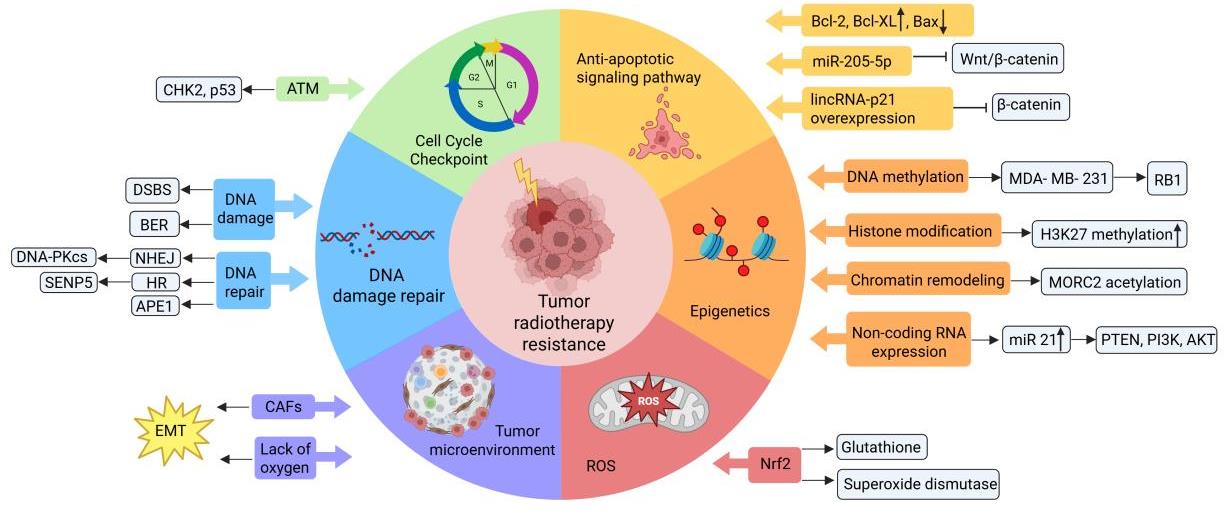
图1
肿瘤放射抗性产生的机制"
| [1] | SCHAUE D, MCBRIDE W H. Opportunities and challenges of radiotherapy for treating cancer[J]. Nat Rev Clin Oncol, 2015, 12(9): 527-540. |
| [2] | FENG Y, LI Z J, SONG L Q, et al. A ZIF-8-based dual-modal smart responsive nanoplatform for overcoming radiotherapy resistance in advanced tumors[J]. Nanoscale, 2025, 17(19): 12134-12148. |
| [3] | WANG K, TEPPER J E. Radiation therapy-associated toxicity: Etiology, management, and prevention[J]. CA Cancer J Clin, 2021, 71(5): 437-454. |
| [4] | ZHOU L Y, LIU Y X, WU Y J, et al. Low-dose radiation therapy mobilizes antitumor immunity: New findings and future perspectives[J]. Int J Cancer, 2024, 154(7): 1143-1157. |
| [5] | YIN L M, XUE J X, LI R, et al. Effect of low-dose radiation therapy on abscopal responses to hypofractionated radiation therapy and anti-PD1 in mice and patients with non-small cell lung cancer[J]. Int J Radiat Oncol Biol Phys, 2020, 108(1): 212-224. |
| [6] | 崔 羽, 杨 露, 杜 雪, 等. 低剂量放疗联合免疫治疗在恶性肿瘤综合治疗中的研究进展[J]. 癌症进展, 2022, 20(14): 1424-1427, 1433. |
| [7] | 张羲茜, 翟素娜, 李冰妍. 中枢神经细胞瘤切除程度和辅助放疗与术后肿瘤进展的关系[J]. 郑州大学学报(医学版), 2025, 60(5): 689-691. |
| [8] | GONG L Y, ZHANG Y J, LIU C C, et al. Application of radiosensitizers in cancer radiotherapy[J]. Int J Nanomedicine, 2021, 16: 1083-1102. |
| [9] | LI Q, QIAN W Y, ZHANG Y, et al. A new wave of innovations within the DNA damage response[J]. Sig Transduct Target Ther, 2023, 8(1): 338. |
| [10] | RASS E, WILLAUME S, BERTRAND P. 53BP1: keeping it under control, even at a distance from DNA damage[J]. Genes, 2022, 13(12): 2390. |
| [11] | DESHPANDE R A, MYLER L R, SONIAT M M, et al. DNA-dependent protein kinase promotes DNA end processing by MRN and CtIP[J]. Sci Adv, 2020, 6(2): eaay0922. |
| [12] | ZHANG J N, DONG M M, CAO W, et al. Disruption of DNA-PKcs-mediated cGAS retention on damaged chromatin potentiates DNA damage-inducing agent-induced anti-multiple myeloma activity[J]. Br J Cancer, 2024, 131(3): 430-443. |
| [13] | LIU T T, WANG H, CHEN Y Y, et al. SENP5 promotes homologous recombination-mediated DNA damage repair in colorectal cancer cells through H2AZ deSUMOylation[J]. J Exp Clin Cancer Res, 2023, 42(1): 234. |
| [14] | ZHOU J, WEI Z X, YANG C, et al. APE1 promotes radiation resistance against radiation-induced pyroptosis by inhibiting the STING pathway in lung adenocarcinoma[J]. Transl Oncol, 2023, 36: 101749. |
| [15] | VAKILI-SAMIANI S, KHANGHAH O J, GHOLIPOUR E, et al. Cell cycle involvement in cancer therapy; WEE1 kinase, a potential target as therapeutic strategy[J]. Mutat Res, 2022, 824: 111776. |
| [16] | ZHANG W H, LI Q L, YIN R T. Targeting WEE1 kinase in gynecological malignancies[J]. Drug Des Devel Ther, 2024, 18: 2449-2460. |
| [17] | LI C L, DENG C S, WANG S W, et al. A novel role for the ROS-ATM-Chk2 axis mediated metabolic and cell cycle reprogramming in the M1 macrophage polarization[J]. Redox Biol, 2024, 70: 103059. |
| [18] | COSENTINO K, HERTLEIN V, JENNER A, et al. The interplay between BAX and BAK tunes apoptotic pore growth to control mitochondrial-DNA-mediated inflammation[J]. Mol Cell, 2022, 82(5): 933-949. |
| [19] | PARK D, ANISUZZAMAN A S M, MAGIS A T, et al. Discovery of small molecule bak activator for lung cancer therapy[J]. Theranostics, 2021, 11(17): 8500-8516. |
| [20] | SAFA A R. Drug and apoptosis resistance in cancer stem cells: a puzzle with many pieces[J]. Cancer Drug Resist, 2022, 5(4): 850-872. |
| [21] | LOPEZ A, REYNA D E, GITEGO N, et al. Co-targeting of BAX and BCL-XL proteins broadly overcomes resistance to apoptosis in cancer[J]. Nat Commun, 2022, 13(1): 1199. |
| [22] | 张玉宇, 王利波, 赵 钦, 等. 肿瘤微环境与肿瘤细胞放射敏感性关系的研究进展[J]. 吉林大学学报(医学版), 2016, 42(5): 1038-1044. |
| [23] | LI Y, MA X, LI J, et al. LncRNA gas5 regulates granulosa cell apoptosis and viability following radiation by X-ray through sponging miR-205-5p and Wnt/β-catenin signaling pathway ingranulosa cell tumor of ovary[J]. Trop J Pharm Res, 2021, 19(12): 2491-2498. |
| [24] | CHEN L J, YUAN D F, YANG Y C, et al. LincRNA-p21 enhances the sensitivity of radiotherapy for gastric cancer by targeting the β-catenin signaling pathway[J]. J Cell Biochem, 2019, 120(4): 6178-6187. |
| [25] | DEEPAK K G K, VEMPATI R, NAGARAJU G P, et al. Tumor microenvironment: Challenges and opportunities in targeting metastasis of triple negative breast cancer[J]. Pharmacol Res, 2020, 153: 104683. |
| [26] | ZHOU S N, ZHANG M X, ZHOU C, et al. The role of epithelial-mesenchymal transition in regulating radioresistance[J]. Crit Rev Oncol Hematol, 2020, 150: 102961. |
| [27] | HUANG R X, ZHOU P K. HIF-1 signaling: a key orchestrator of cancer radioresistance[J]. Radiat Med Prot, 2020, 1(1): 7-14. |
| [28] | YI M, BAN Y Y, TAN Y X, et al. 6-Phosphofructo-2-kinase/fructose-2, 6-biphosphatase 3 and 4: a pair of valves for fine-tuning of glucose metabolism in human cancer[J]. Mol Metab, 2019, 20: 1-13. |
| [29] | YANG X G, LU Y, HANG J J, et al. Lactate-modulated immunosuppression of myeloid-derived suppressor cells contributes to the radioresistance of pancreatic cancer[J]. Cancer Immunol Res, 2020, 8(11): 1440-1451. |
| [30] | FIORI M E, DI FRANCO S, VILLANOVA L, et al. Cancer-associated fibroblasts as abettors of tumor progression at the crossroads of EMT and therapy resistance[J]. Mol Cancer, 2019, 18(1): 70. |
| [31] | GOULET C R, CHAMPAGNE A, BERNARD G, et al. Cancer-associated fibroblasts induce epithelial-mesenchymal transition of bladder cancer cells through paracrine IL-6 signalling[J]. BMC Cancer, 2019, 19(1): 137. |
| [32] | NARAYANAN D, MA S N, ÖZCELIK D. Targeting the redox landscape in cancer therapy[J]. Cancers, 2020, 12(7): 1706. |
| [33] | NAKAMURA T, SAKAMOTO K. Forkhead transcription factor FOXO subfamily is essential for reactive oxygen species-induced apoptosis[J]. Mol Cell Endocrinol, 2008, 281(1/2): 47-55. |
| [34] | PATWARDHAN R S, SHARMA D, SANDUR S K. Thioredoxin reductase: an emerging pharmacologic target for radiosensitization of cancer[J]. Transl Oncol, 2022, 17: 101341. |
| [35] | RAKOTOMALALA A, ESCANDE A, FURLAN A, et al. Hypoxia in solid tumors: how low oxygenation impacts the “six rs” of radiotherapy[J]. Front Endocrinol, 2021, 12: 742215. |
| [36] | LEE M, NAM H Y, KANG H B, et al. Epigenetic regulation of p62/SQSTM1 overcomes the radioresistance of head and neck cancer cells via autophagy-dependent senescence induction[J]. Cell Death Dis, 2021, 12(3): 250. |
| [37] | ANTWIH D A, GABBARA K M, LANCASTER W D, et al. Radiation-induced epigenetic DNA methylation modification of radiation-response pathways[J]. Epigenetics, 2013, 8(8): 839-848. |
| [38] | PARK J, LEE H J, HAN Y K, et al. Identification of DNA methylation biomarkers for evaluating cardiovascular disease risk from epigenome profiles altered by low-dose ionizing radiation[J]. Clin Epigenetics, 2024, 16(1): 19. |
| [39] | ORONSKY B, SCICINSKI J, KIM M M, et al. Turning on the radio: epigenetic inhibitors as potential radiopriming agents[J]. Biomolecules, 2016, 6(3): 32. |
| [40] | WANG Y X, HAN Y, JIN Y Z, et al. The advances in epigenetics for cancer radiotherapy[J]. Int J Mol Sci, 2022, 23(10): 5654. |
| [41] | WANG N, MA T, YU B. Targeting epigenetic regulators to overcome drug resistance in cancers[J]. Sig Transduct Target Ther, 2023, 8(1): 69. |
| [42] | JIE X H, FONG W P, ZHOU R, et al. USP9X-mediated KDM4C deubiquitination promotes lung cancer radioresistance by epigenetically inducing TGF-β2 transcription[J]. Cell Death Differ, 2021, 28(7): 2095-2111. |
| [43] | OGIWARA H, UI A, OTSUKA A, et al. Histone acetylation by CBP and p300 at double-strand break sites facilitates SWI/SNF chromatin remodeling and the recruitment of non-homologous end joining factors[J]. Oncogene, 2011, 30(18): 2135-2146. |
| [44] | LIN R K, HSU H S, CHANG J W, et al. Alteration of DNA methyltransferases contributes to 5'CpG methylation and poor prognosis in lung cancer[J]. Lung Cancer, 2007, 55(2): 205-213. |
| [45] | ZHAO H J, WU X, WANG Y H, et al. Histone variant H2AZ1 drives lung cancer progression through the RELA-HIF1A-EGFR signaling pathway[J]. Cell Commun Signal, 2024, 22(1): 453. |
| [46] | CHENG J Y, REN S F, FU H P, et al. Effective BiOBr(I)-BP nanocomposite for synergistic photothermal and radiodynamic therapy against hypoxic tumor to complement low-dose radiotherapy[J]. Colloids Surf A Physicochem Eng Aspects, 2025, 711: 136411. |
| [47] | CHEN L, ZHANG J H, XU L H, et al. Composition tunability of semiconductor radiosensitizers for low-dose X-ray induced photodynamic therapy[J]. J Nanobiotechnology, 2022, 20(1): 293. |
| [48] | ZHU S C, YAN F H, YANG L L, et al. Low-dose X-ray radiodynamic therapy solely based on gold nanoclusters for efficient treatment of deep hypoxic solid tumors combined with enhanced antitumor immune response[J]. Theranostics, 2023, 13(3): 1042-1058. |
| [49] | HU A K, ZHOU W Y, LUO X Y, et al. Impact of oxygen on DNA damage distribution in 3D genome and its correlation to oxygen enhancement ratio after high-LET irradiation[J]. Radiat Res, 2025: 41196811. |
| [50] | JIA S C, GE S F, FAN X Q, et al. Promoting reactive oxygen species generation: a key strategy in nanosensitizer-mediated radiotherapy[J]. Nanomedicine (Lond), 2021, 16(9): 759-778. |
| [51] | ZHU D M, LIU Z M, LI Y, et al. Delivery of manganese carbonyl to the tumor microenvironment using Tumor-Derived exosomes for cancer gas therapy and low dose radiotherapy[J]. Biomaterials, 2021, 274: 120894. |
| [52] | SHAO N, YANG Y Q, HU G W, et al. Synergistic enhancement of low-dose radiation therapy via cuproptosis and metabolic reprogramming for radiosensitization in in situ hepatocellular carcinoma[J]. J Nanobiotechnology, 2024, 22(1): 772. |
| [53] | ZHANG R, JIA M C, LV H Y, et al. Assembling Au8 clusters on surfaces of bifunctional nanoimmunomodulators for synergistically enhanced low dose radiotherapy of metastatic tumor[J]. J Nanobiotechnology, 2024, 22(1): 20. |
| [54] | ZHUANG W J, PAN K W, WU J, et al. Harnessing the power of traceable system C-GAP: homologous-targeting to fire up T-cell immune responses with low-dose irradiation[J]. J Nanobiotechnology, 2025, 23(1): 207. |
| [55] | KLUG F, PRAKASH H, HUBER P E, et al. Low-dose irradiation programs macrophage differentiation to an iNOS⁺/M1 phenotype that orchestrates effective T cell immunotherapy[J]. Cancer Cell, 2013, 24(5): 589-602. |
| [56] | 张羲茜, 翟素娜, 李冰妍. 中枢神经细胞瘤切除程度和辅助放疗与术后肿瘤进展的关系[J]. 郑州大学学报(医学版), 2025, 60(5): 689-691. |
| [57] | CLEARY J M, AGUIRRE A J, SHAPIRO G I, et al. Biomarker-guided development of DNA repair inhibitors[J]. Mol Cell, 2020, 78(6): 1070-1085. |
| [58] | DUKE K, PAPANIKOLAOU N. Artificial intelligence in radiation therapy: from imaging to delivery: a comprehensive review[J]. BJR Artif Intell, 2025, 2(1): ubaf012. |
| [59] | 吴晓勤, 汪珍光, 刘 辉. 人工智能结合多模态影像融合技术在肝脏外科中的应用[J]. 临床肝胆病杂志, 2025, 41(11): 2201-2206. |
| [60] | SUN L M, LIU H M, YE Y Q, et al. Smart nanoparticles for cancer therapy[J]. Sig Transduct Target Ther, 2023, 8: 418. |
| [61] | CUI R W, WU Q, WANG J, et al. Hydrogel-by-design:smart delivery system for cancer immunotherapy[J]. Front Bioeng Biotechnol, 2021, 9: 723490. |
| [1] | 刘欣,张雨阳,曾德玲,刘晓琴,张璐,李玫颖,陈洪,曹邦荣,马士淇. NSCLC患者外周血中KLRG1 + NK细胞水平检测及其临床意义[J]. 吉林大学学报(医学版), 2026, 52(3): 746-754. |
| [2] | 刘长丰,金光俊,王永刚. 原发性肾血管肉瘤伴多次腹腔出血1例报告及文献复习[J]. 吉林大学学报(医学版), 2026, 52(3): 821-827. |
| [3] | 苏秋平,邢磊,张薇,姜珊,赵洋洋,陈芳芳. 小檗碱抗肿瘤机制及其新型纳米递送系统在肿瘤治疗中应用的研究进展[J]. 吉林大学学报(医学版), 2026, 52(3): 863-871. |
| [4] | 姜东昕, 李蕴潜. 少突胶质细胞瘤临床诊断及治疗的研究进展[J]. 吉林大学学报(医学版), 2026, 52(1): 272-280. |
| [5] | 周先雷,闫子默,郭力雯,张雪梅. 基于甾醇酯与肝内导管、胆道和胆囊恶性肿瘤发生的因果关系的孟德尔随机化分析[J]. 吉林大学学报(医学版), 2025, 51(4): 1084-1093. |
| [6] | 杨佳,佟玲玲,马金姝,耿华锋. 卵巢硬化性间质瘤误诊恶性肿瘤1例报告及文献复习[J]. 吉林大学学报(医学版), 2025, 51(4): 1115-1120. |
| [7] | 于馨一,贾志芳,张宇铮,潘禹辰,张扬雨,吴燕华,曹东慧,姜晶. 2009-2016年吉林省德惠市和延吉市恶性肿瘤发病与死亡分布及其变化趋势分析[J]. 吉林大学学报(医学版), 2025, 51(3): 797-806. |
| [8] | 王璐瑶,赵晨曦,张婉泽,刘林林. 第二原发性气管腺样囊性癌1例报告及文献复习[J]. 吉林大学学报(医学版), 2025, 51(1): 215-221. |
| [9] | 李红红,于娜,史鸣昊,孙莹,李峣,沈忠军,刘晓一,赵丽艳. 新血栓风险评估模型对恶性肿瘤患者静脉血栓形成的预测价值[J]. 吉林大学学报(医学版), 2024, 50(5): 1390-1399. |
| [10] | 刘帅,商圣涛,尹腾程,薛锦儒,刘曦宇,侯奕楠,王岩. 3D打印钛合金胸骨治疗传统钛板胸骨重建术失败患者1例报告及文献复习[J]. 吉林大学学报(医学版), 2023, 49(5): 1351-1357. |
| [11] | 张德洪,郑明珠,李家秋,路中. 基于MSR1 mRNA和蛋白在泛癌组织中表达的生物信息学分析及其意义[J]. 吉林大学学报(医学版), 2023, 49(2): 425-439. |
| [12] | 汪敏,于鹏跃,王言,宋燕珂,李峣,孙莹,赵丽艳. 外周血凝血指标、血小板计数和NLR检测对恶性肿瘤患者治疗前机体凝血状态的评估价值[J]. 吉林大学学报(医学版), 2022, 48(1): 203-210. |
| [13] | 王聪, 郭秀, 迟昊, 张捷, 许溟宇, 董春玲. 简化版Wells评分、修订版Geneva评分和D-二聚体水平在恶性肿瘤并发肺血栓栓塞症诊断中的应用价值[J]. 吉林大学学报(医学版), 2021, 47(3): 707-713. |
| [14] | 许沙沙, 王玲, 靖丽娟, 张炜旸, 王博蔚. 女性盆腔恶性肿瘤患者术中及术后淋巴囊肿预防和治疗的研究进展[J]. 吉林大学学报(医学版), 2020, 46(04): 888-893. |
| [15] | 王钰聪, 徐英辉, 李宏伟, 王旭, 孙超, 郭晔, 邱实, 马克威. PD1/PD-L1免疫检查点抑制剂治疗非小细胞肺癌的研究进展[J]. 吉林大学学报(医学版), 2019, 45(04): 965-970. |
|