Journal of Jilin University(Medicine Edition) ›› 2025, Vol. 51 ›› Issue (4): 1061-1071.doi: 10.13481/j.1671-587X.20250422
• Research in clinical medicine • Previous Articles Next Articles
Clinical characteristics analysis on clinical high-risk patients with bipolar disorder
Shengmin ZHANG1,2,Xinyu MENG1,2,Yingzhen XU1,2,Jingwen SUN1,Zhikang MAO1,Shuzhe ZHOU1,Tianhang ZHOU1,Yilin YUAN1,Chenmei XIE2,Xinrui ZHAO2,Yantao MA1,Hong MA2,Xin YU1,Lili GUAN1,2( )
)
- 1.Department of Clinical Research,Sixth Hospital,Peking University,Beijing 100191,China
2.Department of Public Mental Health,Sixth Hospital,Peking University,Beijing 100191,China
-
Received:2024-12-13Accepted:2025-03-22Online:2025-07-28Published:2025-08-25 -
Contact:Lili GUAN E-mail:guanlili@bjmu.edu.cn

CLC Number:
- R749.4
Cite this article
Shengmin ZHANG,Xinyu MENG,Yingzhen XU,Jingwen SUN,Zhikang MAO,Shuzhe ZHOU,Tianhang ZHOU,Yilin YUAN,Chenmei XIE,Xinrui ZHAO,Yantao MA,Hong MA,Xin YU,Lili GUAN. Clinical characteristics analysis on clinical high-risk patients with bipolar disorder[J].Journal of Jilin University(Medicine Edition), 2025, 51(4): 1061-1071.
share this article
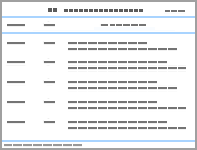
Tab.1
General informations of subjects in three groups"
| Variable | HC group(n=32) | CHR-BD group(n=43) | BD group(n=33) | F/χ2 | P |
|---|---|---|---|---|---|
| Age [year, M (P25, P75)] | 23.0 (22.3, 24.0) | 21.0 (19.0, 25.0) | 22.0 (18.5, 25.5) | - | 0.265 |
| Gender [n (%)] | 1.062 | 0.588 | |||
| Male | 10 (31.2) | 9 (20.9) | 9 (27.3) | ||
| Female | 22 (68.8) | 34 (79.1) | 24 (72.7) | ||
| Ethnicity[n (%)] | 1.487 | 0.564 | |||
| Han | 30 (93.8) | 37 (86.0) | 28 (84.8) | ||
| Others | 2 (6.2) | 6 (14.0) | 5 (15.2) | ||
| Years of education (year, x±s) | 17.0±1.8 | 14.6±3.0* | 14.8±2.8* | 8.419 | <0.001 |
| Education[n (%)] | 17.419 | 0.002 | |||
| High school | 1 (3.1) | 10 (23.3) | 9 (27.3) | ||
| College/bachelor’s degree | 14 (43.8) | 25 (58.1) | 19 (57.5) | ||
| Master’s degree or above | 17 (53.1) | 8 (18.6) | 5 (15.2) | ||
| Current occupation[n (%)] | 11.476 | 0.012 | |||
| Full-time employed | 3 (9.4) | 15 (34.8) | 8 (24.2) | ||
| On campus students | 29 (90.6) | 26 (60.5) | 21 (63.7) | ||
| Unemployed/semi-unemployed | 0 (0.0) | 2 (4.7) | 4 (12.1) | ||
| Smoking history[n (%)] | 3.109 | 0.247 | |||
| No | 31 (96.9) | 37 (86.0) | 28 (84.8) | ||
| Yes (including former smokers) | 1 (3.1) | 6 (14.0) | 5 (15.2) | ||
| Drinking history[n (%)] | 6.421 | 0.107 | |||
| Never | 18 (56.2) | 16 (37.2) | 9 (27.3) | ||
| Sometimes | 14 (43.8) | 26 (60.5) | 23 (69.7) | ||
| Always | 0 (0.0) | 1 (2.3) | 1 (3.0) | ||
| Family history of mental disorders[n (%)] | 22.544 | <0.001 | |||
| Negative | 32 (100.0) | 27 (62.8) | 19 (57.6) | ||
| Positive | 0 (0.0) | 16 (37.2) | 14 (42.4) |
Tab.2
Clinical characteristics of subjects in three groups"
| Variable | HC group(n=32) | CHR-BD group(n=43) | BD group(n=33) | F | P |
|---|---|---|---|---|---|
| Symptom | |||||
| HAMD-17 [M (P25, P75)] | 1.0 (0.0, 3.0) | 15.0 (12.0, 20.0)* | 14.0 (7.5, 20.0)* | - | <0.001 |
| YMRS [M (P25, P75)] | 0.0 (0.0, 0.0) | 6.0 (3.0, 11.0)* | 5.0 (1.0, 13.0)* | - | <0.001 |
| SDS [M (P25, P75)] | 0.3 (0.3, 0.4) | 0.7 (0.6, 0.8)* | 0.6 (0.5, 0.8)* | - | <0.001 |
| SAS [M (P25, P75)] | 29.0 (26.0, 32.5) | 56.0 (48.0, 63.0)* | 54.0 (43.5, 70.0)* | - | <0.001 |
| MDQ [M (P25, P75)] | 0.5 (0.0, 2.0) | 8.0 (6.0, 10.0)* | 9.0 (6.5, 11.0)* | - | <0.001 |
| HCL-32 [M (P25, P75)] | 6.5 (3.3, 13.0) | 22.0 (16.0, 24.0)* | 22.0 (18.5, 24.5)* | - | <0.001 |
| PQ-16 | |||||
| Positive symptoms items score [M (P25, P75)] | 1.0 (0.0, 2.0) | 6.0 (4.0, 10.0)* | 8.0 (5.0, 10.0)* | - | <0.001 |
| Pain level score [M (P25, P75)] | 0.0 (0.0, 0.8) | 7.0 (4.0, 12.0)* | 8.0 (3.0, 13.0)* | - | <0.001 |
| TEMPS-A total (x±s) | 4.8±3.4 | 21.6±6.7* | 21.6±8.6* | 75.268 | <0.001 |
| Cyclothymic [M (P25, P75)] | 1.0 (0.0, 2.0) | 9.0 (6.0, 11.0)* | 9.0 (7.0, 11.0)* | - | <0.001 |
| Depressive [M (P25, P75)] | 0.0 (0.0, 1.0) | 5.0 (4.0, 7.0)* | 5.0 (2.5, 7.0)* | - | <0.001 |
| Irritable[ [M (P25, P75)] | 0.0 (0.0, 0.0) | 3.0 (1.0, 4.0)* | 2.0 (0.0, 4.5)* | - | <0.001 |
| Hyperthymic [M (P25, P75)] | 2.0 (1.0, 3.0) | 3.0 (1.0, 5.0)* | 4.0 (2.0, 6.0)* | - | 0.010 |
| Anxious [M (P25, P75)] | 0.0 (0.0, 1.0) | 2.0 (1.0, 3.0)* | 3.0 (1.0, 3.0)* | - | <0.001 |
| Neurocognition | |||||
| C-BCt total standard T-score (x±s) | 54.5±5.9 | 54.1±7.9 | 54.3±2.6 | 0.026 | 0.975 |
| Connection test standard T-score [M (P25, P75)] | 49.0 (47.3, 50.0) | 49.0 (46.0, 50.0) | 49.0 (48.0, 50.0) | - | 0.853 |
| Symbol coding standard T-score (x±s) | 55.7±10.1 | 55.6±9.7 | 55.8±9.3 | 0.003 | 0.997 |
| Continuous operation standard T-score [M (P25, P75)] | 49.0 (48.0, 52.0) | 51.0 (49.0, 52.0) | 51.0 (48.0, 52.0) | - | 0.364 |
| Digit span standard T-score [M (P25, P75)] | 55.5 (53.0, 56.0) | 54.0 (50.0, 57.0) | 55.0 (48.0, 59.0) | - | 0.825 |
| Global functioning | |||||
| GAF current (x±s) | 92.0±4.6 | 59.9±14.7* | 67.8±12.8*△ | 68.536 | <0.001 |
| Highest in the past year [M (P25, P75)] | 92.5 (91.0, 98.0) | 87.0 (78.0, 91.0)* | 83.0 (79.0, 88.0)* | - | <0.001 |
| Lowest in the past year (x±s) | 84.3±8.7 | 47.4±15.5* | 39.9±15.2*△ | 98.304 | <0.001 |
Tab.3
Univariate logistic regression analysis on independent impact factors for diagnosis of bipolar disorder among research subjects"
| Variable | β | SE | OR (95%CI) | Wald χ2 | P |
|---|---|---|---|---|---|
| Age | 0.028 | 0.053 | 1.028(0.926-1.142) | 0.267 | 0.606 |
| Years of education | 0.022 | 0.080 | 1.022(0.874-1.196) | 0.075 | 0.785 |
| HAMD-17 | -0.047 | 0.032 | 0.954(0.896-1.016) | 2.117 | 0.146 |
| YMRS | -0.008 | 0.024 | 0.992(0.947-1.039) | 0.121 | 0.728 |
| SDS | -2.277 | 1.690 | 0.103(0.004-2.817) | 1.815 | 0.178 |
| SAS | 0.004 | 0.021 | 1.004(0.964-1.045) | 0.031 | 0.860 |
| MDQ | 0.129 | 0.080 | 1.138(0.963-1.332) | 2.612 | 0.106 |
| HCL-32 | 0.087 | 0.050 | 1.091(0.990-1.204) | 3.068 | 0.080 |
| PQ-16 positive symptoms items score | -0.056 | 0.067 | 0.946(0.829-1.079) | 0.684 | 0.408 |
| PQ-16 pain level score | 0.001 | 0.036 | 1.001(0.933-1.074) | 0.001 | 0.981 |
| TEMPS-A total | -0.001 | 0.032 | 0.999(0.939-1.063) | 0.001 | 0.972 |
| GAF current | 0.041 | 0.018 | 1.042(1.006-1.078) | 5.363 | 0.021 |
| GAF highest in the past year | 0.003 | 0.021 | 1.003(0.962-1.046) | 0.025 | 0.873 |
| GAF lowest in the past year | -0.033 | 0.017 | 0.967(0.936-1.000) | 3.934 | 0.047 |
Tab.4
Multivariate Logistic regression analysis on independent impact factors for diagnosis of bipolar disorder among research subjects"
| Variable | β | SE | OR (95%CI) | Wald χ2 | P |
|---|---|---|---|---|---|
| HAMD-17 | -0.003 | 0.057 | 0.997 (0.891-1.116) | 0.002 | 0.963 |
| SDS | -2.174 | 2.722 | 0.114 (0.001-23.586) | 0.638 | 0.424 |
| MDQ | -0.006 | 0.102 | 0.994 (0.813-1.214) | 0.004 | 0.950 |
| HCL-32 | 0.093 | 0.067 | 1.098 (0.963-1.251) | 1.959 | 0.162 |
| GAF current | 0.049 | 0.026 | 1.050 (0.998-1.106) | 3.565 | 0.059 |
| GAF lowest in the past year | -0.049 | 0.019 | 0.952 (0.917-0.988) | 6.569 | 0.010 |
Tab.5
Associations between global function levels, symptoms, and neurocognition characteristics of subjects in CHR-BD group and BD group"
| Variable | CHR-BD group (n=43) | BD group (n=33) | |||
|---|---|---|---|---|---|
| r | P | r | P | ||
| GAF-Current | |||||
| HAMD-17 | -0.501 | 0.001 | -0.843 | <0.001 | |
| YMRS | 0.262 | 0.090 | -0.141 | 0.435 | |
| SDS | -0.417 | 0.005 | -0.617 | <0.001 | |
| SAS | -0.360 | 0.018 | -0.506 | 0.003 | |
| MDQ | 0.168 | 0.282 | -0.128 | 0.477 | |
| HCL-32 | 0.079 | 0.615 | -0.360 | 0.039 | |
| PQ-16-positive symptoms items score | -0.249 | 0.107 | -0.502 | 0.003 | |
| PQ-16-pain level score | 0.279 | 0.070 | -0.367 | 0.036 | |
| TEMPS-A total | 0.114 | 0.465 | -0.479 | 0.005 | |
| C-BCT total standard T-score | 0.021 | 0.896 | -0.267 | 0.134 | |
| GAF-highest in the past year | |||||
| MDQ | -0.099 | 0.529 | 0.220 | 0.219 | |
| HCL-32 | -0.143 | 0.361 | 0.067 | 0.713 | |
| TEMPS-A Total | 0.032 | 0.839 | -0.232 | 0.194 | |
| GAF-lowest in the past year | |||||
| MDQ | 0.035 | 0.824 | -0.391 | 0.024 | |
| HCL-32 | -0.110 | 0.481 | -0.176 | 0.328 | |
| TEMPS-A total | -0.122 | 0.437 | -0.062 | 0.733 | |
| [1] | MCGRATH J J, AL-HAMZAWI A, ALONSO J, et al. Age of onset and cumulative risk of mental disorders: a cross-national analysis of population surveys from 29 countries[J]. Lancet Psychiatry, 2023, 10(9): 668-681. |
| [2] | HUANG Y Q, WANG Y, WANG H, et al. Prevalence of mental disorders in China: a cross-sectional epidemiological study[J]. Lancet Psychiatry, 2019, 6(3): 211-224. |
| [3] | KALMAN J L, OLDE LOOHUIS L M, VREEKER A, et al. Characterisation of age and polarity at onset in bipolar disorder[J]. Br J Psychiatry, 2021, 219(6): 659-669. |
| [4] | VIETA E, SALAGRE E, GRANDE I, et al. Early intervention in bipolar disorder[J]. Am J Psychiatry, 2018, 175(5): 411-426. |
| [5] | COURTIN C, MARIE-CLAIRE C, GROSS G, et al. Gene expression of circadian genes and CIART in bipolar disorder: a preliminary case-control study[J]. Prog Neuropsychopharmacol Biol Psychiatry, 2023, 122: 110691. |
| [6] | SARAF G, MOAZEN-ZADEH E, PINTO J V, et al. Early intervention for people at high risk of developing bipolar disorder: a systematic review of clinical trials[J]. Lancet Psychiatry, 2021, 8(1): 64-75. |
| [7] | CORRELL C U, PENZNER J B, LENCZ T, et al. Early identification and high-risk strategies for bipolar disorder[J]. Bipolar Disord, 2007, 9(4): 324-338. |
| [8] | MARTINI J, BRÖCKEL K L, LEOPOLD K, et al. Young people at risk for developing bipolar disorder: Two-year findings from the multicenter prospective, naturalistic Early-BipoLife study[J]. Eur Neuropsychopharmacol, 2024, 78: 43-53. |
| [9] | SALAZAR DE PABLO G, CABRAS A, PEREIRA J, et al. Predicting bipolar disorder Ⅰ/Ⅱ in individuals at clinical high-risk: Results from a systematic review[J]. J Affect Disord, 2023, 325: 778-786. |
| [10] | KERAMATIAN K, CHAKRABARTY T, SARAF G, et al. Transitioning to bipolar disorder: a systematic review of prospective high-risk studies[J]. Curr Opin Psychiatry, 2022, 35(1): 10-21. |
| [11] | MENG X Y, ZHANG S M, ZHOU S Z, et al. Putative risk biomarkers of bipolar disorder in at-risk youth[J]. Neurosci Bull, 2024, 40(10): 1557-1572. |
| [12] | BECHDOLF A, NELSON B, COTTON S M, et al. A preliminary evaluation of the validity of at-risk criteria for bipolar disorders in help-seeking adolescents and young adults[J]. J Affect Disord, 2010, 127(1-3): 316-320. |
| [13] | HAFEMAN D, AXELSON D, DEMETER C, et al. Phenomenology of bipolar disorder not otherwise specified in youth: a comparison of clinical characteristics across the spectrum of manic symptoms[J]. Bipolar Disord, 2013, 15(3): 240-252. |
| [14] | SALAZAR DE PABLO G, GUINART D, CORNBLATT B A, et al. Demographic and clinical characteristics, including subsyndromal symptoms across bipolar-spectrum disorders in adolescents[J]. J Child Adolesc Psychopharmacol, 2020, 30(4): 222-234. |
| [15] | LIN K G, SHAO R, WANG R H, et al. Inflammation, brain structure and cognition interrelations among individuals with differential risks for bipolar disorder[J]. Brain Behav Immun, 2020, 83: 192-199. |
| [16] | HOU L, LAM B Y, WONG N M L, et al. Integrity of cerebellar tracts associated with the risk of bipolar disorder[J]. Transl Psychiatry, 2022, 12(1): 335. |
| [17] | 卢玮聪, 张若曦, 徐贵云, 等. 双相障碍未患病子代前驱症状及其对整体功能的影响[J]. 中国神经精神疾病杂志, 2021, 47(7): 395-399. |
| [18] | LI X Y, LU W C, ZHANG R X, et al. Integrity of the uncinate fasciculus is associated with the onset of bipolar disorder: a 6-year followed-up study[J]. Transl Psychiatry, 2021, 11(1): 111. |
| [19] | LIU T, XU G Y, LU W C, et al. Affective temperament traits measured by TEMPS-A and their associations with cognitive functions among offspring of parents with bipolar disorder with and without subthreshold symptoms[J]. J Affect Disord, 2021, 283: 377-383. |
| [20] | CORRELL C U, OLVET D M, AUTHER A M, et al. The bipolar prodrome symptom interview and scale-prospective (BPSS-P): description and validation in a psychiatric sample and healthy controls[J]. Bipolar Disord, 2014, 16(5): 505-522. |
| [21] | MARTINI J, BRÖCKEL K L, LEOPOLD K, et al. Young people at risk for developing bipolar disorder: Two-year findings from the multicenter prospective, naturalistic Early-BipoLife study[J]. Eur Neuropsychopharmacol, 2024, 78: 43-53. |
| [22] | 司天梅, 舒 良, 党卫民, 等. 简明国际神经精神访谈中文版的临床信效度[J]. 中国心理卫生杂志, 2009, 23(7): 493-497, 503. |
| [23] | SUN J, MAO Z, ZHANG S, et al. Validation and psychometric properties of the bipolar prodrome symptom interview and scale-full prospective Chinese version to assess individuals at risk for bipolar disorder[J]. J Affect Disord, 2025, 370: 532-537. |
| [24] | Hamilton M. A Rating Scale for Depression [J]. J Neurol Neurosurg Psychiatry, 1960, 23(1): 56-62. |
| [25] | YOUNG R C, BIGGS J T, ZIEGLER V E, et al. A rating scale for mania: reliability, validity and sensitivity[J]. Br J Psychiatry, 1978, 133: 429-435. |
| [26] | 汪向东. 心理卫生评定量表手册[M]. 增订版. 北京: 中国心理卫生杂志社, 1999. |
| [27] | 杨海晨, 苑成梅, 刘铁榜, 等. 中文版心境障碍问卷的效度与信度[J]. 中华精神科杂志, 2010, 43(4): 217-220. |
| [28] | 杨海晨, 苑成梅, ANGST J, 等. 中文版32项轻躁狂症状清单效度与信度[J]. 中华行为医学与脑科学杂志, 2010(8): 760-762. |
| [29] | 苏 娜, 王 璐, 史靖宇, 等. 精神病前驱期问卷(PQ-16)评估大学生精神病风险的信效度检验[J]. 同济大学学报(医学版), 2015, 36(3): 123-127. |
| [30] | 苑成梅, 黄 佳, 李则挚, 等. 情感气质自评量表简版中文版的信效度[J]. 中国心理卫生杂志, 2014, 28(2): 151-155. |
| [31] | YE S L, XIE M J, YU X, et al. The Chinese brief cognitive test: normative data stratified by gender, age and education[J]. Front Psychiatry, 2022, 13: 933642. |
| [32] | 张明园. 精神科评定量表手册[M]. 长沙: 湖南科学技术出版社, 1993. |
| [33] | 苑成梅. 双相障碍早期识别的临床及生物学指标筛选[D]. 上海: 上海交通大学, 2010. |
| [34] | ROSA A R, REINARES M, MICHALAK E E, et al. Functional impairment and disability across mood states in bipolar disorder[J]. Value Health, 2010, 13(8): 984-988. |
| [35] | WATSON M, FILIA K, STEVENS A, et al. A systematic review and meta-analysis of global and social functioning among people at risk of bipolar disorder[J]. J Affect Disord, 2023, 321: 290-303. |
| [36] | FUSAR-POLI P, SALAZAR DE PABLO G, CORRELL C U, et al. Prevention of psychosis: advances in detection, prognosis, and intervention[J]. JAMA Psychiatry, 2020, 77(7): 755-765. |
| [37] | JUDD L L, AKISKAL H S, SCHETTLER P J, et al. Psychosocial disability in the course of bipolar Ⅰ and Ⅱ disorders: a prospective, comparative, longitudinal study[J]. Arch Gen Psychiatry, 2005, 62(12): 1322-1330. |
| [38] | BORA E, EYUBOGLU M S, CESIM E, et al. Neurocognition and social cognition in youth and young adults at ultra-high-risk for psychosis and bipolar disorder[J]. Schizophr Res, 2024, 266: 58-65. |
| [39] | GREEN M J, GIRSHKIN L, KREMERSKOTHEN K, et al. A systematic review of studies reporting data-driven cognitive subtypes across the psychosis spectrum[J]. Neuropsychol Rev, 2020, 30(4): 446-460. |
| [40] | HEMAGER N, CHRISTIANI C J, THORUP A A E, et al. Neurocognitive heterogeneity in 7-year-old children at familial high risk of schizophrenia or bipolar disorder: The Danish high risk and resilience study-VIA 7[J]. J Affect Disord, 2022, 302: 214-223. |
| [1] | Chuwen WU,Mengling PENG,Yu FU,Shanshan ZHOU. Comparison of clinical characteristics and prognostic influence factors between patients with or without hypertrophic cardiomyopathy complicated by microvascular dysfunction [J]. Journal of Jilin University(Medicine Edition), 2025, 51(6): 1630-1637. |
| [2] | Dong CHEN,Na ZHOU,Xin ZHANG,Xiaoyu TAO,Wenyan TAN,Haicheng LIN,Shibin WANG,Saisai ZHAO,Wenhui GAO,Lina JIN,Yaqin YU. Epidemiological characteristics and influencing factors of risk behaviors of patients with bipolar disorder in Guangdong Province [J]. Journal of Jilin University(Medicine Edition), 2021, 47(6): 1562-1569. |
| [3] | GU Sanwei, MA Hongshuang, ZHAO Ling, JIANG Zhenyu. Analysis on clinical characteristics of PM/DM combined with thyroid disease [J]. Journal of Jilin University Medicine Edition, 2016, 42(05): 999-1004. |
| [4] | CUI Xiao-Feng, ZHANG Hai-Shan, ZHAO Hang, LI Mo. Analysis of clinical characteristics and prognosis of young patients with rectal carcinoma [J]. J4, 2009, 35(4): 726-730. |