吉林大学学报(工学版) ›› 2026, Vol. 56 ›› Issue (2): 443-454.doi: 10.13229/j.cnki.jdxbgxb.20240841
• 交通运输工程·土木工程 • 上一篇
考虑等待时间的多层时变网络路径规划算法
于德新1( ),王胪陈1,吴新程1,2,毛建宇3,石世龙1
- 1.集美大学 航海学院,福建 厦门 361021
2.厦门海洋职业技术学院 航海学院,福建 厦门 361012
3.桂林电子科技大学 建筑与交通工程学院,广西 桂林 541214
Multi-layer time dependent network path planning algorithm considering waiting time
De-xin YU1(),Lu-chen WANG1,Xin-cheng WU1,2,Jian-yu MAO3,Shi-long SHI1
- 1.Navigation College,Jimei University,Xiamen 361021,China
2.Navigation College,Xiamen Ocean Vocational College,Xiamen 361012,China
3.School of Architecture and Transportation Engineering,Guilin University of Electronic Technology,Guilin 541004,China
摘要:
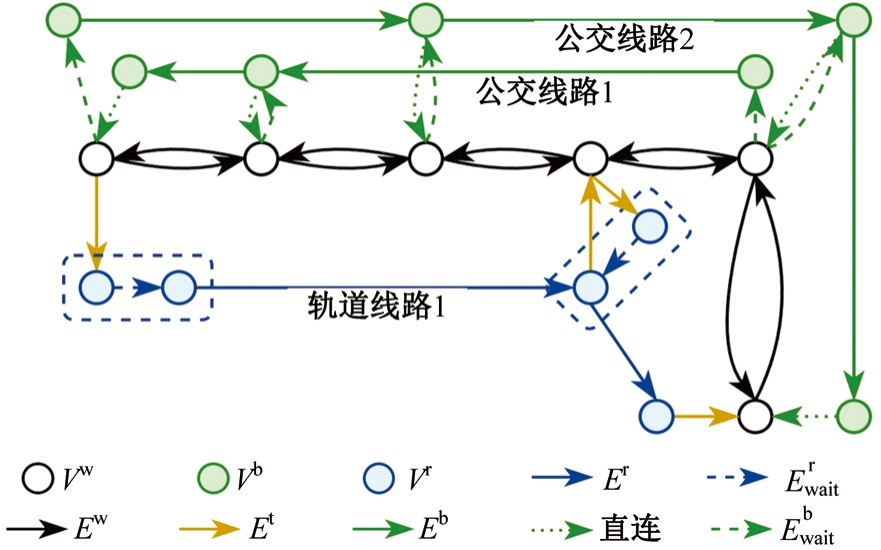
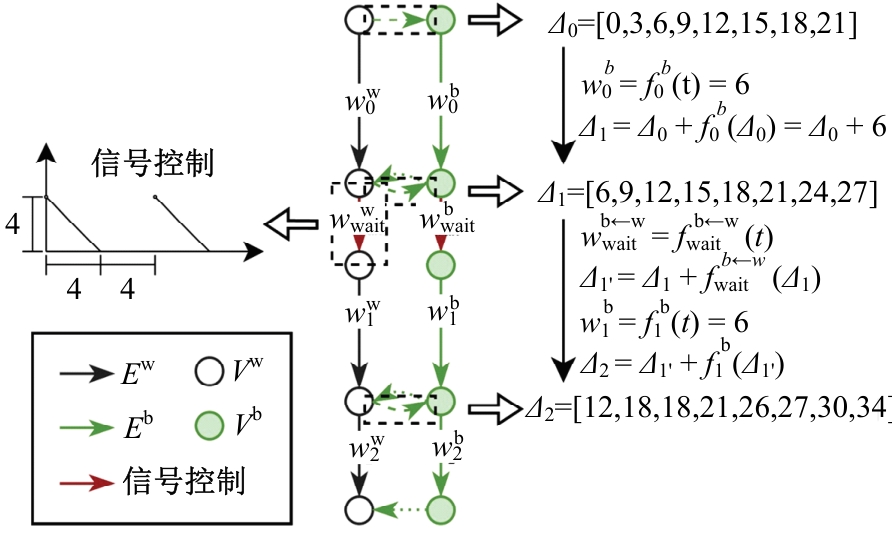
为解决经典路径规划算法的两个局限性,即较少考虑多交通方式组合换乘和缺少等待时间的建模方法,以厦门市交通网络为研究对象开展研究。构建了考虑等待时间的多层网络拓扑结构;基于FINLO的特性研究,提出了不同出行方式等待时间的时间依赖建模方法;最后,将等待时间依赖函数引入基于邻接字典的二叉堆Dijkstra算法,提出了一种考虑信号控制、车辆发车间隔的等待时间的多层网络路径规划算法。研究结果表明:本文方法能综合考虑多模式交通换乘、车辆班次和信号控制的等待时间依赖特性,弥补了现有时间依赖建模的不足,与不考虑等待时间依赖特性的路径规划算法相比,总行程时间缩短了8.4%。
中图分类号:
- U412

| [1] | 陈凤涛. 城市时变网络路径分析方法研究[D]. 南京:东南大学交通学院, 2018. |
| Chen Feng-tao. Research on the method of routing analysis of urban in time-varying networks[D]. Nanjing: School of Transportation, Southeast University, 2018. | |
| [2] | 谭国真. 时变、随机网络最优路径算法及其应用研究[D].大连:大连理工大学信息与通信工程学院, 2002. |
| Tan Guo-zhen. Studies on optimal path algorithms and its applications in time-varying and stochastic networks[D]. Dalian:School of Information and Communication Engineering, Dalian University of Technology, 2002. | |
| [3] | 王福. GIS中时变最短路径理论及算法研究[D]. 南京: 南京理工大学自动化学院, 2010. |
| Wang Fu. Research on time varying shortest path theory and algorithm in GIS[D]. Nanjing: School of Automation, Nanjing University of Science and Technology, 2010. | |
| [4] | 张晓楠, 王陆宇, 谭昕妮, 等. 时变条件下道路网的车辆路径优化[J]. 机械科学与技术, 2023, 42(11): 1919-1928. |
| Zhang Xiao-nan, Wang Lu-yu, Tan Xin-ni, et al. Time-dependent vehicle routing optimization problem under road network[J]. Mechanical Science and Technology for Aerospace Engineering, 2023, 42(11): 1919-1928. | |
| [5] | Liu C, Kou G, Zhou X, et al. Time-dependent vehicle routing problem with time windows of city logistics with a congestion avoidance approach[J]. Knowledge-Based Systems, 2020, 188: 104813. |
| [6] | 张煜璐. 考虑碳排放的时变路网多车型城市配送路径优化研究[D]. 杭州:浙江工商大学计算机与信息工程学院,2017. |
| Zhang Yu-lu. The study of urban distrivution route optimization with heterogeneous fleet and time-varying networks for carbon emissions[D].Hangzhou:School of Computer and Information Engineering, Zhejiang Gongshang University,2017. | |
| [7] | 许祎娜, 王旭仁, 苏红莉. 时变公路网络的动态路径规划算法[J]. 小型微型计算机系统, 2018, 39(6): 1291-1298. |
| Xu Yi-na, Wang Xu-ren, Su Hong-li. Dynamic path planning algorithm in time-dependent road networks[J]. Journal of Chinese Computer Systems, 2018, 39(6): 1291-1298. | |
| [8] | Cheng P, Xu C, Lebreton P, et al. TERP: time-event-dependent route planning in stochastic multimodal transportation networks with bike sharing system[J]. IEEE Internet of Things Journal,2019, 6(3): 4991-5000. |
| [9] | 何俊, 戴浩, 宋自林, 等. 时间依赖的交通网络模型及最短路径算法[J]. 解放军理工大学学报: 自然科学版, 2005(6): 541-544. |
| He Jun, Dai Hao, Song Zi-lin, et al. Time-dependent traffic networks model and shortest path algorithm[J]. Journal of PLA University of Science and Technology, 2005(6): 541-544. | |
| [10] | 魏航. 时变条件下允许等待的最短路问题[J]. 系统管理学报, 2008, 2008(1): 99-103. |
| Wei Hang. An approach for time-varying shortest path problem with waiting[J]. Journal of Systems & Management, 2008, 2008(1): 99-103. | |
| [11] | Foschini L, Hershberger J, Suri S. On the complexity of time-dependent shortest paths[C]∥Proceedings of the Twenty-second Annual ACM-SIAM Symposium on Discrete Algorithms, New Orleans, USA, 2011: 327-341. |
| [12] | Huang H, Bucher D, Kissling J, et al. Multimodal route planning with public transport and carpooling[J]. IEEE Transactions on Intelligent Transportation Systems, 2018, 20(9): 3513-3525. |
| [13] | 赵凯旋. MaaS背景下网约车接驳轨道交通的路径优化研究[D]. 武汉: 华中科技大学土木工程与力学学院, 2019. |
| Zhao Kai-xuan. Study on path optimazition of online car-hailing transfering to rail transit under MaaS background[D]. Wuhan: School of Civil Engineering and Mechanics, Huazhong University of Science and Technology, 2019. | |
| [14] | Zhang Y, Ye M, Deng L, et al. Path optimization of green multimodal transportation considering dynamic random transit time[J]. International Journal of Applied Mathematics, 2024, 54(4): 623-633. |
| [15] | 刘松. 面向随机时变网络的带班期限制的多式联运路径优化研究[D]. 重庆: 重庆交通大学交通运输学院, 2019. |
| Liu Song. Research on route optimization of multi-modal transport with timetable limit for stochastic time-dependent networks[D]. Chongqing: School of Transportation, Chongqing Jiaotong University,2019. | |
| [16] | Li L, Zhang Q, Zhang T, et al. Optimum route and transport mode selection of multimodal transport with time window under uncertain conditions[J]. Mathematics, 2023, 11(14): 11143244. |
| [17] | Kaufman D E, Smith R L. Fastest paths in time-dependent networks for intelligent vehicle-highway systems application[J]. Journal of Intelligent Transportation Systems, 1993, 1(1): 1-11. |
| [18] | 杜牧青, 鞠姿彦, 李大韦. 一种基于交叉口信号延误的超路径规划方法[J]. 西南交通大学学报, 2024, 59(6): 1378-1388. |
| Du Mu-qing, Ju Zi-yan, Li Da-wei. Hyperpath searching algorithm method based on signal delay at intersections[J]. Journal of Southwest JiaoTong University, 2024, 59(6): 1378-1388. | |
| [19] | 蒋睿. 考虑节点耗费的时变随机网络最短路径问题研究[D]. 天津: 天津理工大学计算机与通信工程学院, 2016. |
| Jiang Rui. Least travel time paths in stochastic and time-varying transportation networks considering the time consumption of nodes[D]. Tianjin:School of Computer and Communication Engineering, Tianjin University of Technology, 2016. | |
| [20] | Sun Y, Li J, Liu S X. Study on the shortest reliable path of stochastic time‐dependent transportation networks considering waiting time at signalized intersections[J]. Journal of Advanced Transportation, 2023, 2023(1): 8298068. |
| [1] | 张伏,韩伟东,鲍若飞,张亚坤,王亚飞,付三玲. 融合改进A*与DWA算法的车间移动机器人路径规划[J]. 吉林大学学报(工学版), 2025, 55(9): 3020-3031. |
| [2] | 张文会,付博,周舸,乔晓田. 城市公共汽车全生命周期碳排放测算[J]. 吉林大学学报(工学版), 2025, 55(4): 1232-1240. |
| [3] | 李振江,万利,周世睿,陶楚青,魏巍. 基于时空Transformer网络的隧道交通运行风险动态辨识方法[J]. 吉林大学学报(工学版), 2025, 55(4): 1336-1345. |
| [4] | 孙帅帅,冯春晓,张良. 基于离散采样的多模态四足机器人路径规划[J]. 吉林大学学报(工学版), 2025, 55(11): 3736-3744. |
| [5] | 李健,孙晓海,廖昌义,杨建平. 基于双起点蚁群算法的机器人路径规划方法[J]. 吉林大学学报(工学版), 2025, 55(1): 325-332. |
| [6] | 朱瑾,黄琦. 路网资源分配下自动化码头水平运输调度与路径规划[J]. 吉林大学学报(工学版), 2024, 54(8): 2245-2255. |
| [7] | 涂辉招,鹿畅,陆淼嘉,李浩. 基于避险脱离的自动驾驶路测安全影响因素[J]. 吉林大学学报(工学版), 2024, 54(7): 1935-1943. |
| [8] | 胡钊政,孙勋培,张佳楠,黄戈,柳雨婷. 基于时空图模型的车-路-图协同定位方法[J]. 吉林大学学报(工学版), 2024, 54(5): 1246-1257. |
| [9] | 孙宝凤,刘娇娇,姚天姿,任欣欣. 考虑能量消耗的纯电动物流车柔性时间窗路径规划问题[J]. 吉林大学学报(工学版), 2023, 53(4): 1047-1059. |
| [10] | 吴振宇,刘小飞,王义普. 基于DKRRT*-APF算法的无人系统轨迹规划[J]. 吉林大学学报(工学版), 2023, 53(3): 781-791. |
| [11] | 张惠臻,高正凯,李建强,王晨曦,潘玉彪,王成,王靖. 基于循环神经网络的城市轨道交通短时客流预测[J]. 吉林大学学报(工学版), 2023, 53(2): 430-438. |
| [12] | 孙宝凤,姚天姿,陈雨琦. 考虑时变交通拥堵的纯电动物流车路径规划模型[J]. 吉林大学学报(工学版), 2023, 53(2): 468-479. |
| [13] | 李津,孙雨彤,魏小忠,焦玉玲. 考虑柔性车道设置的公交优先信号设计[J]. 吉林大学学报(工学版), 2023, 53(2): 448-456. |
| [14] | 李文勇,马从若,胡清玮,刘承堃,廉冠,顾国斌,周旦. 基于站台容量限制和路段绿波控制的公交速度引导模型[J]. 吉林大学学报(工学版), 2023, 53(11): 3088-3103. |
| [15] | 杨帆,翟志强,汪圆圆,朱忠祥,杜岳峰,毛恩荣. 基于虚拟现实的拖拉机变速箱装配系统设计[J]. 吉林大学学报(工学版), 2023, 53(10): 3038-3044. |
|
||