吉林大学学报(医学版) ›› 2025, Vol. 51 ›› Issue (1): 228-237.doi: 10.13481/j.1671-587X.20250128

• 影像学 • 上一篇    

超声心动图在经心尖途径经导管主动脉瓣置换术后早期疗效评价中的应用

金朝龙1,史学功1(),张成鑫2,梁有峰3,肖洁1,盛哲1,张定欣1   

  1. 1.安徽医科大学第一附属医院心脏超声影像中心,安徽 合肥 230032
    2.安徽医科大学第一附属医院心脏大血管外科,安徽 合肥 230032
    3.安徽医科大学第一附属医院心血管内科,安徽 合肥 230032
  • 收稿日期:2024-01-21 接受日期:2024-05-14 出版日期:2025-01-28 发布日期:2025-03-06
  • 通讯作者: 史学功 E-mail:shixgay@sohu.com
  • 作者简介:金朝龙(1984-),男,安徽省淮北市人,副主任医师,在读博士研究生,主要从事心血管疾病的超声影像诊断方面的研究。
  • 基金资助:
    安徽省教育厅科学研究项目(KJ2021ZD0026)

Application of echocardiography in early efficacy evaluation after transapical transcatheter aortic valve replacement via transapical approach

Chaolong JIN1,Xuegong SHI1(),Chengxin ZHANG2,Youfeng LIANG3,Jie XIAO1,Zhe SHENG1,Dingxin ZHANG1   

  1. 1.Cardiac Ultrasound Imaging Center,First Affiliated Hospital,Anhui Medical University,Hefei 230032,China
    2.Department of Cardiac and Vascular Surgery,First Affiliated Hospital,Anhui Medical University,Hefei 230032,China
    3.Department of Cardiovascular Medicine,First Affiliated Hospital,Anhui Medical University,Hefei 230032,China
  • Received:2024-01-21 Accepted:2024-05-14 Online:2025-01-28 Published:2025-03-06
  • Contact: Xuegong SHI E-mail:shixgay@sohu.com

摘要:

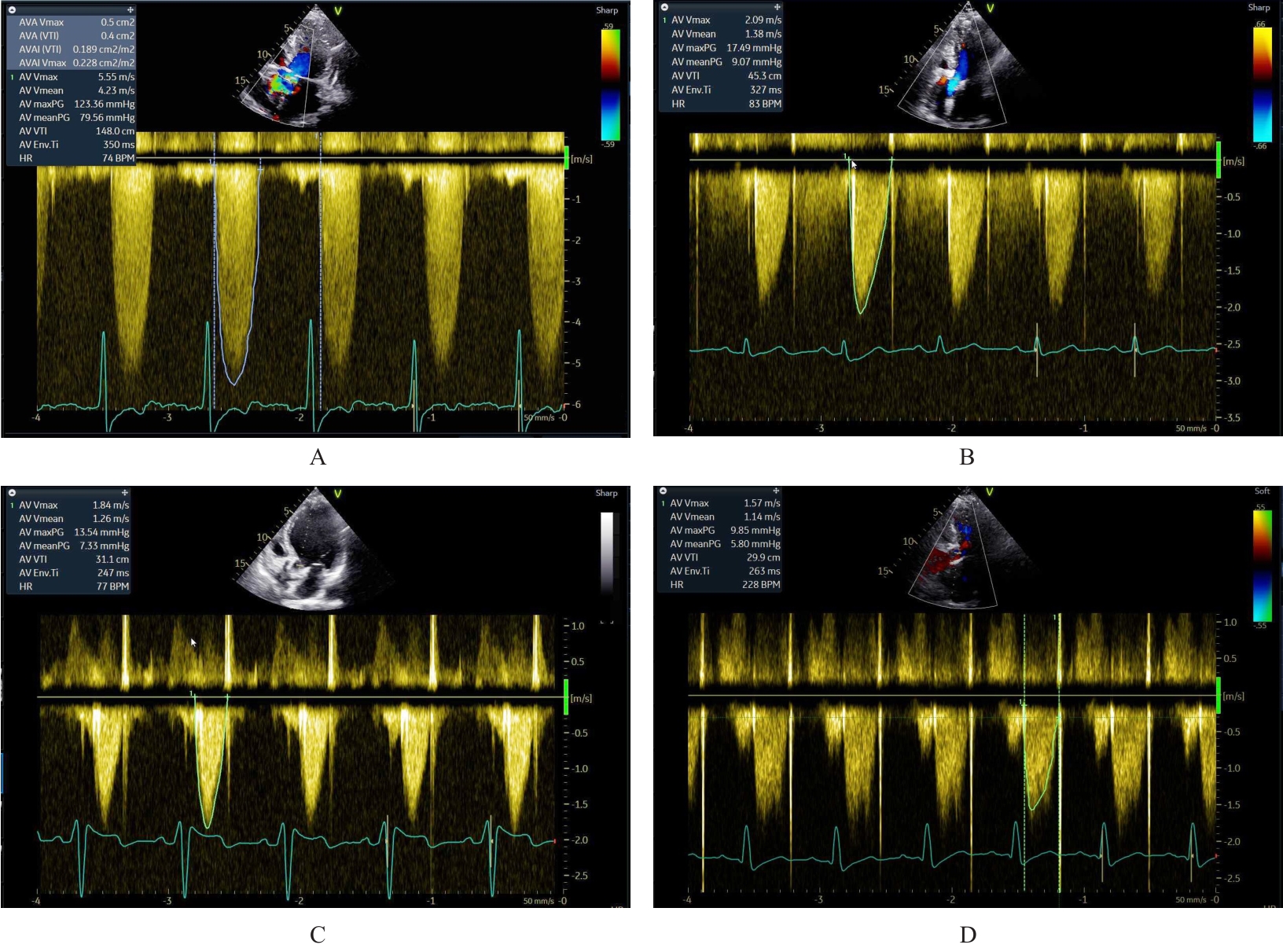
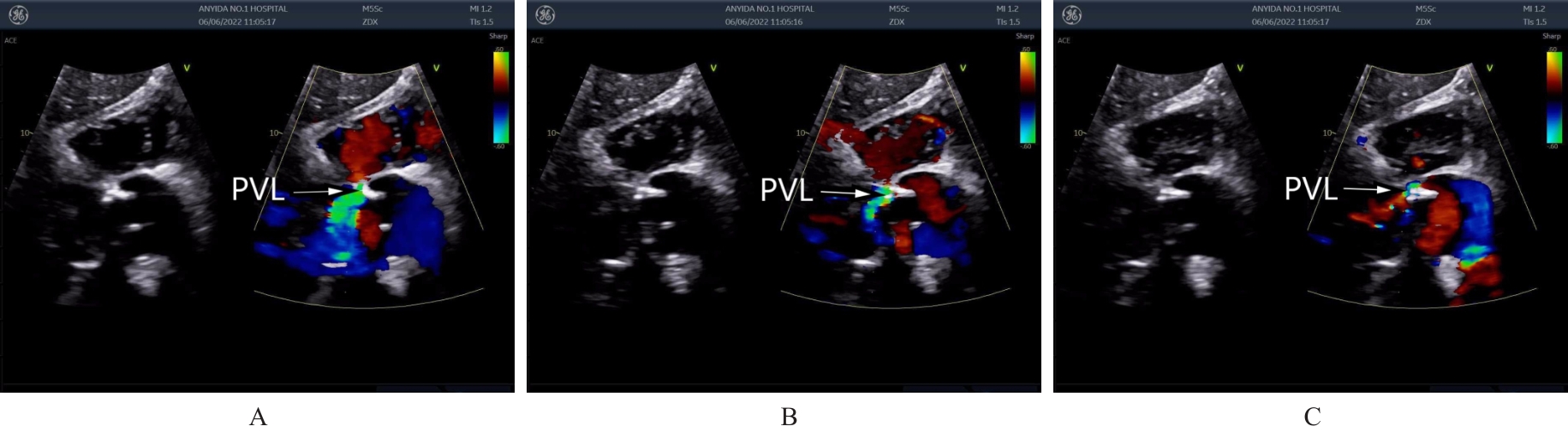
目的 探讨超声心动图在经心尖途径经导管主动脉瓣置换术(TAVR)后早期效果评价中的临床应用价值,阐明超声心动图在评估该手术疗效中的作用。 方法 回顾性分析85例行经心尖途径TAVR植入J-Valve人工瓣膜患者的临床资料,共分为单纯主动脉瓣狭窄组(AS组,n=20)、单纯主动脉瓣反流组(AR组,n=37)和主动脉瓣狭窄并发反流组(AS&AR组,n=28)。分别于术前、术后1周、术后3个月和术后6个月对各组患者进行超声心动图检查,通过测量各组患者左室舒张末期容积(LVEDV)、左室收缩末期容积(LVESV)、左室射血分数(LVEF)、左室短轴缩短率(LVFS)、室间隔厚度(IVST)、左室后壁厚度(LVPWT)、主动脉瓣峰值流速(AV Vmax)、主动脉瓣平均跨瓣压差(AV PGmean)和瓣周漏(PVL)宽度等参数评估心脏及人工瓣膜功能,并分析各组患者术后并发症发生情况。 结果 85例患者均成功植入J-Valve人工瓣膜。各组患者年龄、性别、纽约心脏病协会(NYHA)心功能分级、高血压病史、糖尿病史、高脂血症史和冠心病史等术前一般资料比较差异均无统计学意义(P>0.05),具有可比性。与术前比较,术后1周AS组和AS&AR组患者AV Vmax及AV PGmean减小(P<0.05);AR组患者各参数差异无统计学意义(P>0.05)。与术前比较,术后3个月AS组患者LVEF和LVFS增大(P<0.05),AV Vmax和AV PGmean减小(P<0.05);AR组患者LVEDV和LVESV减小(P<0.05),LVEF和LVFS增大(P<0.05);AS&AR组患者LVEDV、LVESV、AV Vmax和AV PGmean减小(P<0.05),LVEF和LVFS增大(P<0.05)。与术前比较,术后6个月3组患者LVEDV、LVESV、IVST和LVPWT减小(P<0.05),LVEF和LVFS增大(P<0.05);AS组和AS&AR组患者AV Vmax及AV PGmean减小(P<0.05);AR组患者AV PGmean减小(P<0.05)。术后并发症情况,行永久起搏器植入3例(AS组2例,AR组1例),脑卒中1例(AS组1例),PVL 13例(AS组4例,AR组5例,AS&AR组4例)。随访期间未出现死亡病例。 结论 超声心动图可准确定量评估心尖途径TAVR术后早期心脏功能变化及人工瓣膜功能状态,为评价手术效果及术后并发症提供客观依据。

关键词: 超声心动描记术, 经导管主动脉瓣置换术, 心尖途径, 主动脉瓣狭窄, 主动脉瓣反流

Abstract:

Objective To discuss the clinical application value of echocardiography in evaluating the early outcomes of transcatheter aortic valve replacement (TAVR) via the transapical approach, and to clarify the role of echocardiography in assessing the efficacy of the surgery. Methods The clinical data of 85 patients who received J-Valve prosthetic valves via the transapical TAVR were retrospectively analyzed. The patients were divided into AS group (simple aortic stenosis, n=20), AR group (simple aortic regurgitation, n=37), and AS&AR group (aortic stenosis with regurgitation, n=28). Echocardiographic examination was performed on all the patients before operation, 1 week after operation, 3 months after operation, and 6 months after operation. The parameters including left ventricular end-diastolic volume (LVEDV), left ventricular end-systolic volume (LVESV), left ventricular ejection fraction (LVEF), left ventricular fractional shortening (LVFS), interventricular septal thickness (IVST), left ventricular posterior wall thickness (LVPWT), aortic valve peak flow velocity (AV Vmax), aortic valve mean transvalvular pressure gradient (AV PGmean), and paravalvular leak (PVL) width were measured to evaluate the cardiac function and the function of the prosthetic valve; the occurrence of postoperative complications of the patients in various groups was also analyzed. Results J-Valve prosthetic valves were successfully implanted in all 85 patients. There were no significant differences in age, gender, New York Heart Association (NYHA) heart function classification, history of hypertension, history of diabetes, history of hyperlipidemia, and history of coronary artery disease among various groups befor operation(P>0.05), ensuring comparability. Compared with before operation, 1 week after operation, the AV Vmax and AV PGmean of the patients in AS group and AS&AR group were decreased (P<0.05); there were no significant differences in various parameters of the patients in AR group (P>0.05). Compared with before operation, 3 months after operation, the LVEF and LVFS of the patients in AS group were increased (P<0.05), while the AV Vmax and AV PGmean were decreased (P<0.05); the LVEDV and LVESV of the patients in AR group were decreased (P<0.05), while the LVEF and LVFS were increased (P<0.05); the LVEDV, LVESV, AV Vmax, and AV PGmean of the patients in AS&AR group were decreased (P<0.05), while the LVEF and LVFS were increased (P<0.05). Compared with before operation, LVEDV, LVESV, IVST, and LVPWT of the patients in all three groups 6 months after operation were decreased (P<0.05), while LVEF and LVFS were increased (P<0.05); the AV Vmax and AV PGmean of the patients in AS group and AS&AR group were decreased (P<0.05); the AV PGmean of the patients in AR group was decreased (P<0.05). The postoperative complications included 3 cases of permanent pacemaker implantation (2 cases in AS group, 1 case in AR group), 1 case of stroke (in AS group), and 13 cases of PVL (4 cases in AS group, 5 cases in AR group, 4 cases in AS&AR group). No deaths occurred during follow-up. Conclusion Echocardiography can accurately and quantitatively evaluate early changes in cardiac function and the functional state of prosthetic valves after transapical TAVR, providing objective evidence for evaluating surgical outcomes and postoperative complications.

Key words: Echocardiography, Transcatheter aortic valve replacement, Transapical approach, Aortic stenosis, Aortic regurgitation

中图分类号: 

  • R542.5