吉林大学学报(工学版) ›› 2026, Vol. 56 ›› Issue (8): 2095-2105.doi: 10.13229/j.cnki.jdxbgxb.20250050
• 交通运输工程·土木工程 • 上一篇
不同时期建成环境对居民小汽车依赖的影响
孙轶琳1,2( ),蔡余坤1,贾方圆1,疏阳2
- 1.浙江大学 工程师学院,杭州 310015
2.浙江大学 建筑工程学院,杭州 310058
Impact of built environment on residents′ car dependence in different periods
Yi-lin SUN1,2(),Yu-kun CAI1,Fang-yuan JIA1,Yang SHU2
- 1.Polytechnic Institute,Zhejiang University,Hangzhou 310015,China
2.College of Civil Engineering and Architecture,Zhejiang University,Hangzhou 310058,China
摘要:
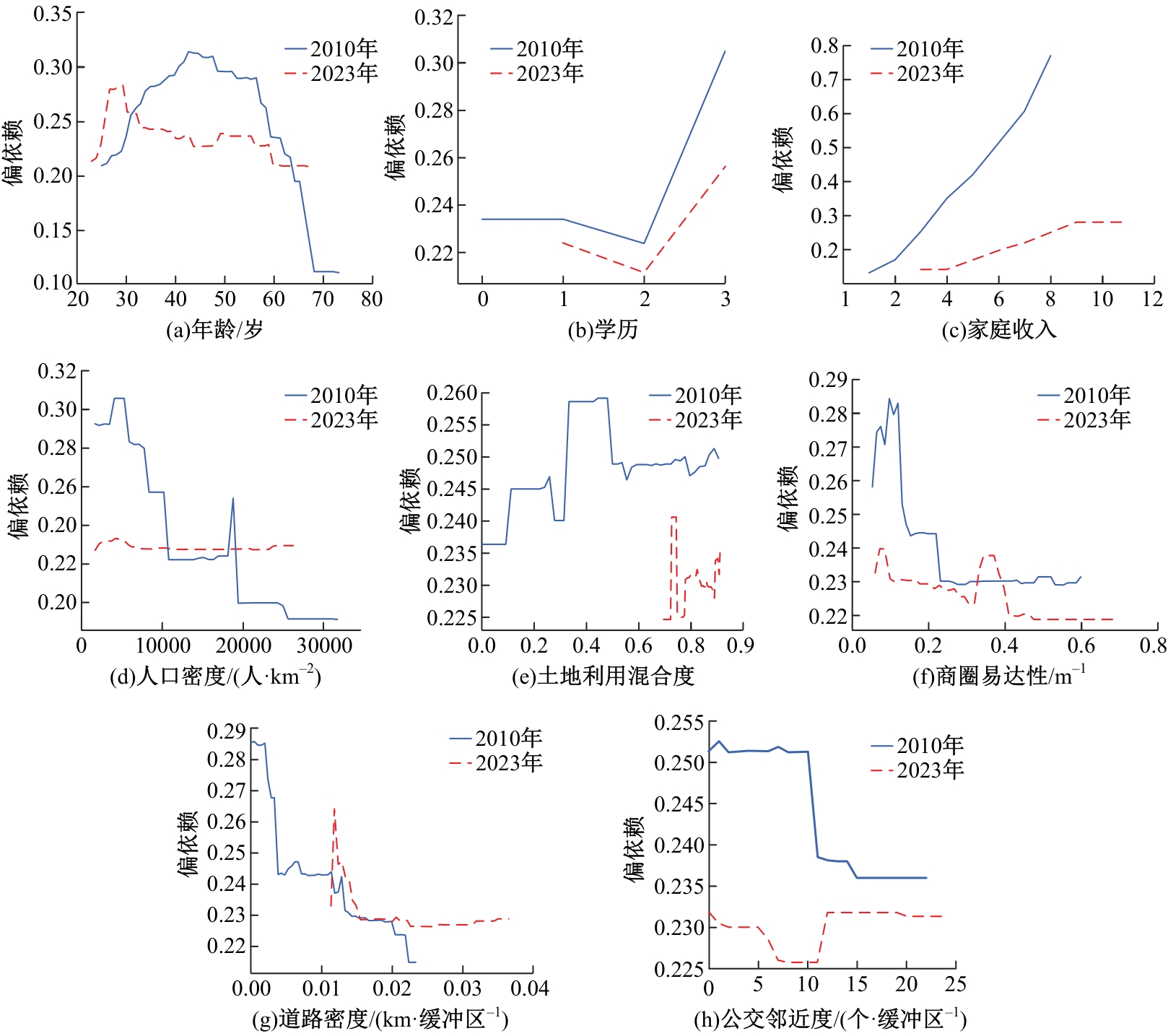
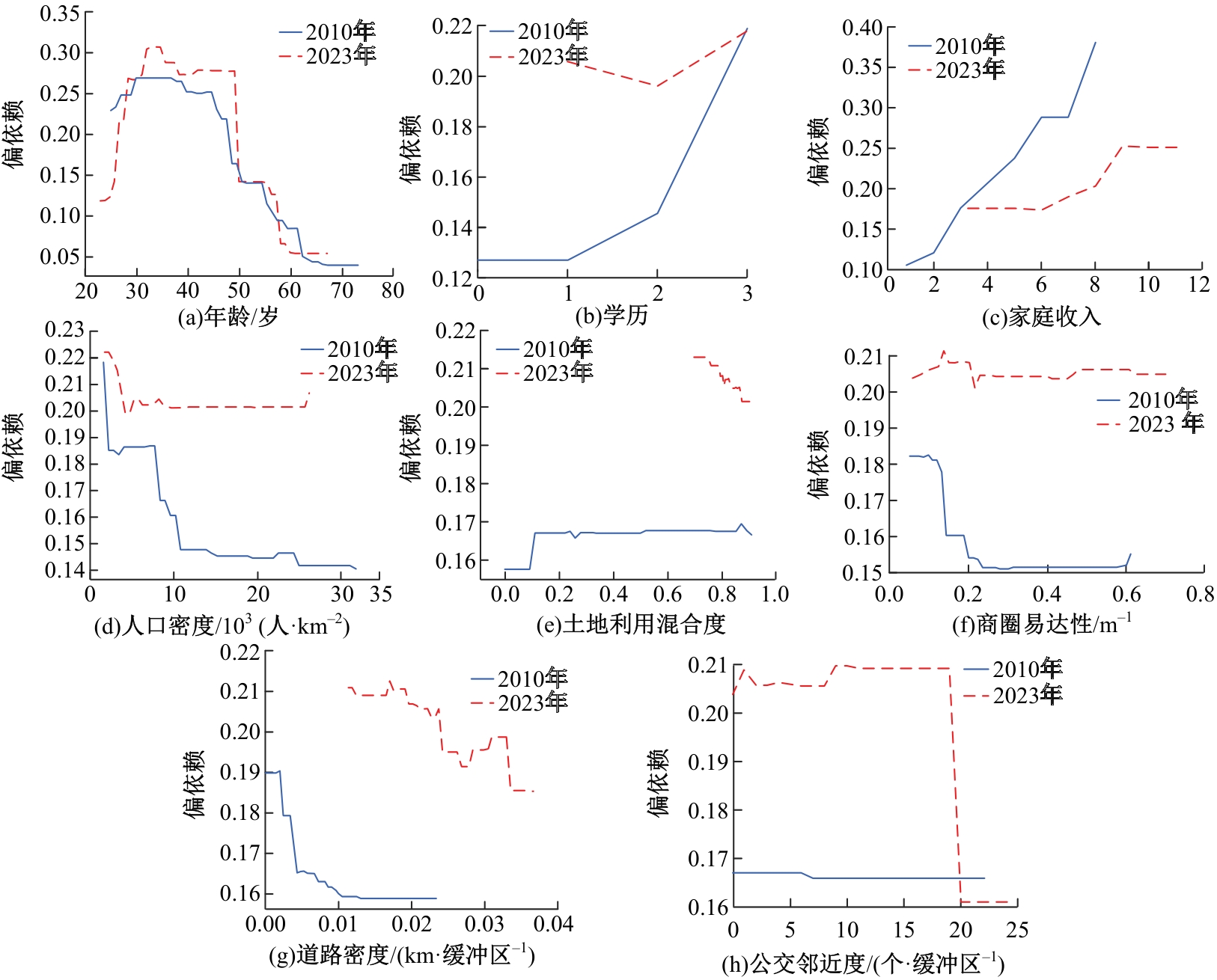
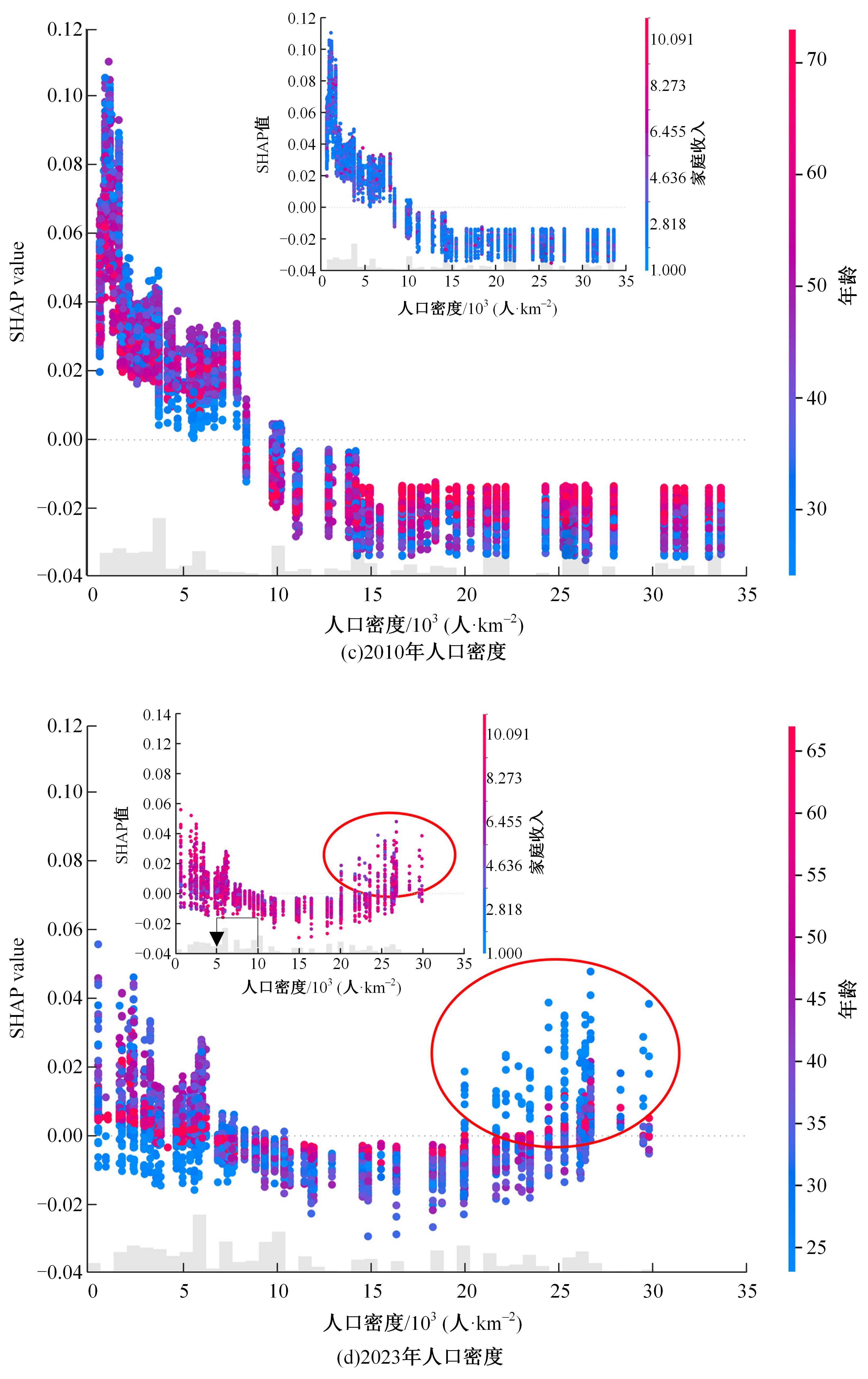
为探究不同时期建成环境对居民小汽车依赖影响的差异,基于杭州市2010年和2023年的居民出行调查数据,构建了轻量级梯度提升机模型,并结合部分依赖图和沙普利加性解释方法进行了非线性分析。结果表明:轻量级梯度提升机模型精准捕捉了建成环境与居民小汽车依赖之间的非线性关系,建成环境对居民小汽车依赖有显著影响,且在不同时期存在显著差异。相比2010年,2023年建成环境对居民小汽车依赖的影响明显减弱,且人口和道路密度因素的影响呈现阈值效应,当居住地人口密度超过2 万人/km2或道路密度超过0.04 km/缓冲区时,青年群体的小汽车出行占比反而升高,表明应准确把握阈值效应的影响,以避免建设资源浪费及过度建设带来的负向效应。
中图分类号:
- U491

| [1] | Shao Q, Zhang W, Cao X J, et al. Nonlinear and interaction effects of land use and motorcycles/E-bikes on car ownership[J]. Transportation Research Part D: Transport and Environment, 2022, 102: No.103115. |
| [2] | 袁晓瑞. 多尺度建成环境对小汽车拥有行为的影响研究[D]. 南京: 南京林业大学汽车与交通工程学院, 2023. |
| Yuan Xiao-rui. Research on the impact of multi-scale built environment on car ownership behavior[D]. Nanjing: College of Automobile and Traffic Engineering, Nanjing Forestry University, 2023. | |
| [3] | Wu L, Yuan X, Yin C, et al. Car ownership behavior model considering nonlinear impacts of multi-scale built environment characteristics[J]. Sustainability, 2023, 15(12): No.9658. |
| [4] | 尹超英, 邵春福, 黄兆国, 等. 基于梯度提升决策树的多尺度建成环境对小汽车拥有的影响[J]. 吉林大学学报: 工学版, 2022, 52(3): 572-577. |
| Yin Chao-ying, Shao Chun-fu, Huang Zhao-guo, et al. Investigating influences of multi-scale built environment on car ownership behavior based on gradient boosting decision trees[J]. Journal of Jilin University (Engineering and Technology Edition), 2022, 52(3): 572-577. | |
| [5] | Cao J, Jin T, Shou T, et al. Investigating the nonlinear relationship between car dependency and the built environment[J]. Urban Planning, 2023, 8(3): 41-55. |
| [6] | 王晓全, 邵春福, 尹超英, 等. 考虑空间不确定效应的建成环境对出行频率的影响[J]. 交通工程, 2023, 23(6): 21-26. |
| Wang Xiao-quan, Shao Chun-fu, Yin Chao-ying, et al. Exploring the impacts of built environment on travel frequency considering spatial uncertainty[J]. Journal of Transportation Engineering, 2023, 23(6): 21-26. | |
| [7] | 王晓全. 职住地建成环境影响下居民小汽车依赖行为分析与建模[D]. 北京:北京交通大学交通运输学院, 2022. |
| Wang Xiao-quan. Analysis and modelling of residents' car dependence under the impacts of residential and workplace built environment[D]. Beijing: School of Traffic and Transportation, Beijing Jiaotong University, 2022. | |
| [8] | Wang X, Shao C, Yin C, et al. Exploring the influence of built environment on car ownership and use with a spatial multilevel model: a case study of Changchun, China[J]. International Journal of Environmental Research and Public Health, 2018, 15(9): No.1868. |
| [9] | Yin C, Shao C, Wang X. Exploring the impact of built environment on car use: does living near urban rail transit matter?[J]. Transportation Letters, 2020, 12(6): 391-398. |
| [10] | Chowdhury T, Scott D M. An analysis of the built environment and auto travel in Halifax, Canada[J]. Transport Policy, 2020, 94: 23-33. |
| [11] | Wang X, Shao C, Yin C, et al. Exploring the relationships of the residential and workplace built environment with commuting mode choice: a hierarchical cross-classified structural equation model[J]. Transportation Letters, 2022, 14(3): 274-281. |
| [12] | Sun Y, Susilo Y O, Waygood E O D, et al. Detangling the impacts of age, residential locations and household lifecycle in car usage and ownership in the Osaka metropolitan area, Japan[J]. Journal of Zhejiang University—Science A, 2014, 15(7): 517-528. |
| [13] | 江捷, 吴娇蓉, 陈澍. 建成环境对居民小汽车依赖影响研究进展简介[J]. 交通与运输, 2023, 36(): 205-208. |
| Jiang Jie, Wu Jiao-rong, Chen Shu. Overview of association of the built environment with residents' car dependence[J]. Traffic & Transportation, 2023, 36(Sup.1): 205-208. | |
| [14] | 杭州市统计局. 2023年杭州统计年鉴[M]. 北京:中国统计出版社, 2023. |
| [15] | 王晓全, 邵春福, 管岭, 等. 基于机器学习模型的建成环境对小汽车拥有行为的影响[J]. 交通运输系统工程与信息, 2020, 20(4): 173-177. |
| Wang Xiao-quan, Shao Chun-fu, Guan Ling, et al. Exploring influences of built environment on car ownership based on a machine learning method[J]. Journal of Transportation Systems Engineering and Information Technology, 2020, 20(4): 173-177. | |
| [16] | 尹超英, 陆颖, 邵春福, 等. 考虑空间自相关的建成环境对通勤方式选择的影响[J]. 吉林大学学报: 工学版, 2023, 53(7): 1994-2000. |
| Yin Chao-ying, Lu Ying, Shao Chun-fu, et al. Impacts of built environment on commuting mode choice considering spatial autocorrelation[J]. Journal of Jilin University (Engineering and Technology Edition), 2023, 53(7): 1994-2000. | |
| [17] | 王振科, 白云鹏. 社区建成环境对中等收入群体机动车行驶里程的非线性影响模型[J]. 重庆理工大学学报:自然科学, 2023, 37(5): 159-168. |
| Wang Zhen-ke, Bai Yun-peng. A nonlinear impact model of community built environment on vehicle miles traveled of middle-income groups[J]. Journal of Chongqing University of Technology(Natural Science), 2023, 37(5): 159-168. | |
| [18] | 吴静娴, 唐桂孔, 李文翔. 建成环境对共享单车分时骑行量的非线性作用研究——以上海市为例[J]. 交通运输系统工程与信息, 2024, 24(1):290-298, 310. |
| Wu Jing-xian, Tang Gui-kong, Li Wen-xiang. Nonlinear effect of built environment on bike-sharing ridership at different time periods: a case study from Shanghai[J]. Journal of Transportation Systems Engineering and Information Technology,2024, 24(1):290-298, 310. | |
| [19] | Cheng L, de Vos J, Zhao P, et al. Examining non-linear built environment effects on elderly's walking: a random forest approach[J]. Transportation Research Part D: Transport and Environment, 2020, 88: No.102552. |
| [20] | Ke G, Meng Q, Finley T, et al. Lightgbm: a highly efficient gradient boosting decision tree[C]∥Advances in Neural Information Processing Systems, Long Beach, CA, USA, 2017: 3146-3154. |
| [21] | Milakis D, Cervero R, van Wee B. Stay local or go regional? Urban form effects on vehicle use at different spatial scales: a theoretical concept and its application to the San Francisco Bay Area[J]. Journal of Transport and Land Use, 2015, 8(2): 1-16. |
| [22] | Ding C, Zhou X, Cao X J, et al. Spatial and mediation analysis of the influences of residential and workplace built environments on commuting by car[J]. Transportation research part A: Policy and Practice, 2023, 171: No.103662. |
| [23] | 徐浩文, 李志学, 黄中祥. 基于城市空间均衡的居民出行方式选择[J].系统工程, 2023, 41(5): 77-83. |
| Xu Hao-wen, Li Zhi-xue, Huang Zhong-xiang. Travel mode selection of residents under urban spatial equilibrium[J]. Systems Engineering, 2023,41(5):77-83. |
| [1] | 潘义勇,杨赛赛. 自动驾驶汽车接管模式与事故严重程度关联性分析[J]. 吉林大学学报(工学版), 2026, 56(8): 2077-2083. |
| [2] | 郭瑞军,范超冉,付明迪. 基于PSO-GRU模型的车辆换道意图识别[J]. 吉林大学学报(工学版), 2026, 56(8): 2084-2094. |
| [3] | 冯天军,郝延铭,李飞燕,高赫遥,刘一贤,刘楠,李金凤. 考虑驾驶风格的网联自动驾驶车辆集聚换道模型[J]. 吉林大学学报(工学版), 2026, 56(7): 1834-1844. |
| [4] | 孟云伟,李智鹏,张引,全振宇,杨光清,陈芳,赖思静,乔俊. 基于纵向间距和亮度差的隧道群驾驶舒适度[J]. 吉林大学学报(工学版), 2026, 56(7): 1904-1914. |
| [5] | 张玉召,丁欣茹,侯长啸,陈虎林. 交通运输网络韧性研究现状及展望[J]. 吉林大学学报(工学版), 2026, 56(3): 585-602. |
| [6] | 慈玉生,黄轶康. 基于文献计量的交叉口车路协同研究综述[J]. 吉林大学学报(工学版), 2026, 56(2): 313-332. |
| [7] | 张文会,叶梅茹,席聪,宋子文. 混合交通流环境下车辆编队与碳排放特性[J]. 吉林大学学报(工学版), 2026, 56(2): 416-430. |
| [8] | 潘义勇,曹天宇,刘宇. 随机交通网络约束最可靠路径乘子交替方向法[J]. 吉林大学学报(工学版), 2026, 56(2): 455-463. |
| [9] | 孙宇,李世武,郭梦竹,金桐彤,宋会军,刘德志,高雯. 多模态数据在驾驶疲劳监测中的有效性分析[J]. 吉林大学学报(工学版), 2026, 56(2): 473-479. |
| [10] | 李坤宸,袁伟,王畅,张会明,穆雨薇. 基于驾驶风险和驾驶能力的人机控制权分配[J]. 吉林大学学报(工学版), 2026, 56(2): 575-584. |
| [11] | 马壮林,毕宇明,周备,邓亚娟,兆雪. 公交换乘优惠政策下居民换乘意向的异质性分析[J]. 吉林大学学报(工学版), 2026, 56(1): 158-169. |
| [12] | 王琳虹,刘宇阳,刘子昱,鹿应佳,张宇恒,黄桂树. 基于YOLOv5的轻量化桥梁缺陷识别[J]. 吉林大学学报(工学版), 2025, 55(9): 2958-2968. |
| [13] | 曲昭伟,王铭阳,王喆,宋现敏,张云翔,黄镜尘. 基于自动驾驶模块化车辆主辅功能分配的公交自适应调度方法[J]. 吉林大学学报(工学版), 2025, 55(9): 2946-2957. |
| [14] | 张云翔,宋现敏,谢渝,湛天舒. 基于用户满意度的停车预约服务智能体行为仿真[J]. 吉林大学学报(工学版), 2025, 55(9): 2978-2984. |
| [15] | 穆长儒,徐亮,程国柱. 基于能量合理分配的外包U型钢-混凝土组合护栏防撞性能[J]. 吉林大学学报(工学版), 2025, 55(8): 2669-2680. |
|
||