吉林大学学报(工学版) ›› 2026, Vol. 56 ›› Issue (9): 2302-2316.doi: 10.13229/j.cnki.jdxbgxb.20250287

• 交通运输工程·土木工程 • 上一篇    

考虑拥堵空间排队和溢出的交通流用户均衡分配模型

张琦悦1(),岳昊1(),孟德邻1,曲秋莳2   

  1. 1.北京交通大学 综合交通运输大数据应用技术交通运输行业重点实验室,北京 100044
    2.北京交通运输职业学院 城市轨道交通学院,北京 100096
  • 收稿日期:2025-04-03 出版日期:2026-09-01 发布日期:2026-09-07
  • 通讯作者: 岳昊 E-mail:22110279@bjtu.edu.cn;hyue@bjtu.edu.cn
  • 作者简介:张琦悦(1998-),女,博士研究生.研究方向:交通运输规划与管理.E-mail:22110279@bjtu.edu.cn
  • 基金资助:
    国家自然科学基金项目(71771013);中央高校基本科研业务费专项资金项目(2019JBM341)

Traffic user equilibrium assignment model with congestion space queuing and spillover

Qi-yue ZHANG1(),Hao YUE1(),De-lin MENG1,Qiu-shi QU2   

  1. 1.Key Laboratory of Transport Industry of Big Data Application Technologies for Comprehensive Transport,Beijing Jiaotong University,Beijing 100044,China
    2.Urban Rail Transit Department,Beijing Vocational Transportation College,Beijing 100096,China
  • Received:2025-04-03 Online:2026-09-01 Published:2026-09-07
  • Contact: Hao YUE E-mail:22110279@bjtu.edu.cn;hyue@bjtu.edu.cn

摘要:

针对传统用户均衡(UE)分配模型难以刻画拥堵空间排队和溢出现象的问题,本文考虑同时描述畅通和拥堵状态的一般道路网络,构建了一种考虑由于路段通行能力和存储容量限制导致拥堵空间排队和溢出的交通流用户均衡分配模型,并证明了模型用户均衡原理的等价性和解的唯一性。同时,引入需求折算、拥堵回溯、拥堵区域识别及不同交通状态下的需求加载等机制,构建改进FW算法对模型进行求解。最后,通过算例证明本文模型和算法有效性,简单算例计算结果的误差精度为e=1.044?5×10⁻⁵,加载流量的路径具有相同行程时间,符合用户均衡原理。结果表明:本文模型是传统畅通与完全拥堵用户均衡分配模型的集成和拓展,可以有效计算路网在不同交通状态下的均衡分配结果和最终均衡稳态,描述拥堵空间排队和溢出现象;分配结果可以体现路网达到均衡状态时全局宏观交通运行特性,识别瓶颈位置及拥堵排队区域,为路网结构优化、交通诱导、需求管理和拥堵缓解提供依据。

关键词: 交通运输系统工程, 用户均衡分配模型, 交通流分配, 拥堵空间排队, 排队溢出

Abstract:

Aiming at the problem that the traditional user equilibrium assignment model is difficult to describe the phenomenon of congestion space queuing and spillover, in order to describe the macroscopic and overall traffic operation state of the road network, portray the impact of congestion spatial queuing and spillback phenomena on the traffic assignment of road network, and provide reference ideas for traffic planning, demand management and congestion mitigation, considering the general road network with both smooth and congested state, a novel traffic user equilibrium assignment model with congestion space queuing and spillover caused by the link capacity and storage capacity constraints was constructed. The equivalence of model with user equilibrium principle and the uniqueness of solution were proved. Moreover, mechanisms such as demand conversion, congestion backtracking, congestion area identification and demand loading of different traffic conditions were introduced, the calculation method of demand flow transfer coefficient was proposed, and an improved FW algorithm was constructed to solve the model. Finally, the effectiveness of the model and the algorithm was compared and analyzed by numerical examples. The error accuracy of the calculation results of the simple numerical example is e=1.044?5×10⁻⁵, and the routes with loaded traffic volume have equal travel times, which conforms to the user equilibrium principle. The results show that the model is an integration and expansion of the traditional smooth and fully congested user equilibrium assignment model, which can effectively calculate the equilibrium assignment results and the final equilibrium steady states of the road network under different traffic conditions, and describe the phenomenon of congestion space queuing and spillover. The assignment results can reflect the macroscopic and global traffic operation characteristics when the road network reaches the equilibrium state, identify bottleneck locations and congestion queuing areas, and provide basis for road network structure optimization, traffic guidance, demand management and congestion relief.

Key words: engineering of communications and transportation system, user equilibrium assignment model, traffic assignment, congestion space queuing, queuing spillover

中图分类号: 

  • U491

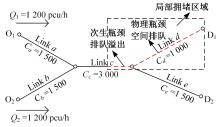
图1

拥堵空间排队和溢出示意图"

表1

变量和参数解释表"

序号类型参数含义
1路段属性Xa路段a上的需求流量,是计划分配并允许超过路段通行能力的流量,pcu/time
2xa路段a上的流入流量,是考虑路段a上游需求折算后流入路段a并允许超过路段通行能力的流量,pcu/time
3ya路段a上的流出流量,是考虑下游空间排队和溢出,进行需求折算和拥堵回溯后路段a实际流出并不超过路段通行能力的流量,pcu/time
4y1,a次生瓶颈路段a上干扰流的流出流量,是经过路段a的所有路径中,路段a下游产生拥堵空间排队并蔓延溢出至路段a的部分路径,通过路段a的部分流出流量,pcu/time
5y2,a次生瓶颈路段a上被干扰流的流出流量,是经过路段a的所有路径中,路段a下游没有产生拥堵空间排队或没有蔓延溢出至路段a,但受到其他产生拥堵空间排队并蔓延溢出至路段a的路径干扰的部分路径,通过路段a的部分流出流量,pcu/time
6ya?,krs出发地为r、目的地为s的OD间的第k条路径上,路段a紧邻的下游路段总流出流量,pcu/time
7NQa路段a下游出口处在路段a上的待排队需求车辆数,是计划分配并允许超过路段存储容量的车辆数,pcu
8NQ1,a次生瓶颈路段a下游出口处在路段a上的干扰流待排队需求车辆数,是经过路段a的所有路径中,路段a下游产生拥堵空间排队并蔓延溢出至路段a的部分路径,在路段a下游出口处产生的部分待排队车辆数,pcu
9NQ2,a次生瓶颈路段a下游出口处在路段a上的被干扰流待排队需求车辆数,是经过路段a的所有路径中,路段a下游没有产生拥堵空间排队或没有蔓延溢出至路段a,但受到其他产生拥堵空间排队并蔓延溢出至路段a的路径干扰部分路径,在路段a下游出口处产生的部分待排队需求车辆数,pcu
10NBa路段a上游入口处排队溢出的需求车辆数,是路段a待排队需求车辆数超过路段存储容量后从该路段溢出的需求车辆数,pcu
11NBa?,krs出发地为r、目的地为s的OD间的第k条路径上,路段a紧邻的下游路段入口处排队溢出总需求车辆数,pcu
12ta(Ω)路段a的交通阻抗,根据路段的畅通拥堵状态、流入/流出流量和上游入口处排队溢出车辆数计算得出,Ω为自变量xayaNQaNBa的集合,time
13t1,a(xa)路段a以流入流量为自变量的畅通状态阻抗函数,由路段通行能力Ca、自由流通过时间t0,a等组成,畅通状态下流量增大、密度增大、速度减小、通过时间增加,故阻抗函数为单调递增函数
14t2,a(ya)路段a以流出流量为自变量的拥堵状态阻抗函数,由路段通行能力Ca、自由流通过时间t0,a等组成,拥堵状态下流量增大、密度减小、速度增大、通过时间减少,故阻抗函数为单调递减函数
15Ca路段a的通行能力,是通过该路段上瓶颈的最大流量,简化为该路段固定的出口容量,pcu/time
16γa路段a的需求折算系数
17γa˙,krs出发地为r、目的地为s的OD间的第k条路径上,导致次生瓶颈路段a拥堵的下游最近物理瓶颈路段的需求折算系数
18Ka路段a的拥堵比例,是路段a上拥堵排队部分占该路段的比例
19路径属性Fkrs出发地为r、目的地为s的OD间第k条路径上的需求流量,pcu/time
20fm(r+s+)在局部畅通子网络中,起讫点分别为r+s+的第m条路径上的流量,pcu/time
21fn(r-s-)在局部拥堵子网络中,起讫点分别为r-s-的第n条路径上的流量,pcu/time
22δa,krs路段-路径相关变量,如果路段a属于从出发地r到目的地s的OD间的第k条路径,则δa,krs=1,否则δa,kr=0
23μa,krs0-1变量,如果路段a是从出发地为r到目的地为s的OD间的第k条路径上的最上游首条路段,则μa,krs=1;否则μa,krs=0
24OD属性qrs出发地r和目的地s间的OD交通需求流量,是道路网中rs间计划或预期分配的流量,pcu/time
25qr+s+在局部畅通子网络中,起讫点分别为r+s+间的交通分配流量,pcu/time
26qr-s-在局部拥堵子网络中,起讫点分别为r-s-间的交通分配流量,pcu/time
27Nrs出发地r与目的地s间的OD交通需求车辆数,是道路网中rs间计划或预期分配的遇到瓶颈时产生空间排队的车辆数,pcu
28节点N道路网中节点的集合
29R道路网中出发地的集合,R?N
30S道路网中目的地的集合,S?N
31路段、路径集合A道路网中路段的集合
32A+每次迭代过程中需求折算和拥堵回溯后,道路网中完全畅通状态的路段集合,A+?A
33A*每次迭代过程中需求折算和拥堵回溯后,道路网中xa>Ca时导致形成拥堵空间排队的完全拥堵状态的物理瓶颈路段集合,A*?A
34A-每次迭代过程中需求折算和拥堵回溯后,道路网中xaCa但由于物理瓶颈导致的拥堵空间排队进行蔓延溢出而形成的完全拥堵状态的次生瓶颈路段集合,A-?A
35A±每次迭代过程中需求折算和拥堵回溯后,道路网中xaCa但由于物理瓶颈导致的拥堵空间排队进行蔓延溢出而形成的半畅通半拥堵状态的次生瓶颈路段集合,A±?A
36Akˉrs出发地为r、目的地为s的OD间的第k条路径上的最上游首条路段集合,Akˉrs?A
37Aa?,krs出发地为r、目的地为s的OD间的第k条路径上,路段a的所有上游路段集合,其中不包括路段aAa?,k(rs)?A
38Aa˙?,krs出发地为r、目的地为s的OD间的第k条路径上,导致次生瓶颈路段a拥堵的下游最近物理瓶颈的所有上游路段集合,其中不包括该物理瓶颈,Aa˙?,krs?A
39Prs出发地r和目的地s间的所有路径集合

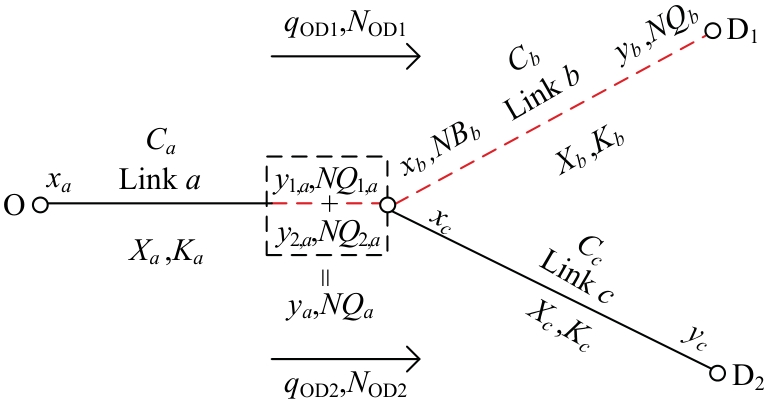
图2

变量和参数解释示意图"

图3

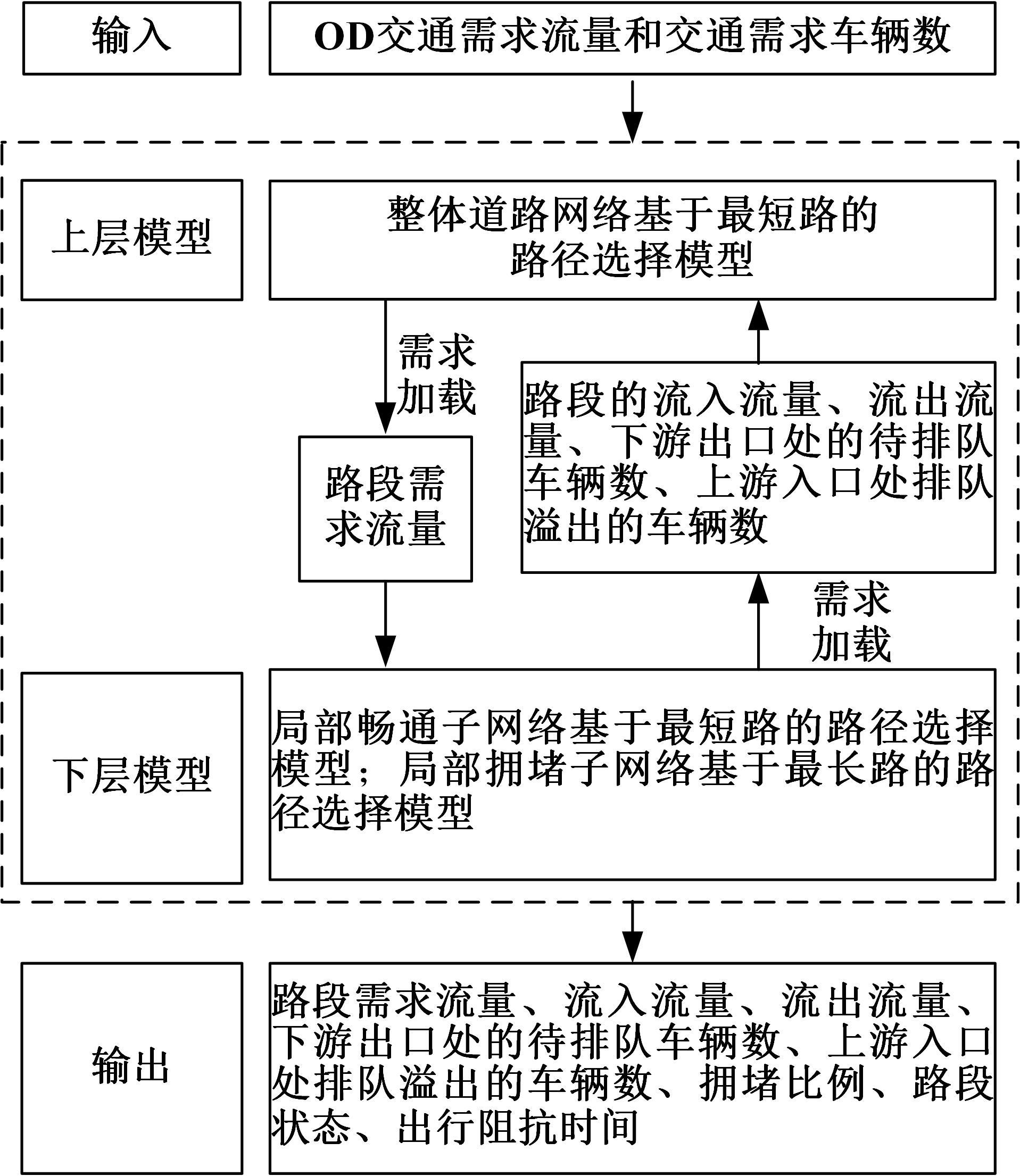
模型构建思路图"

图4

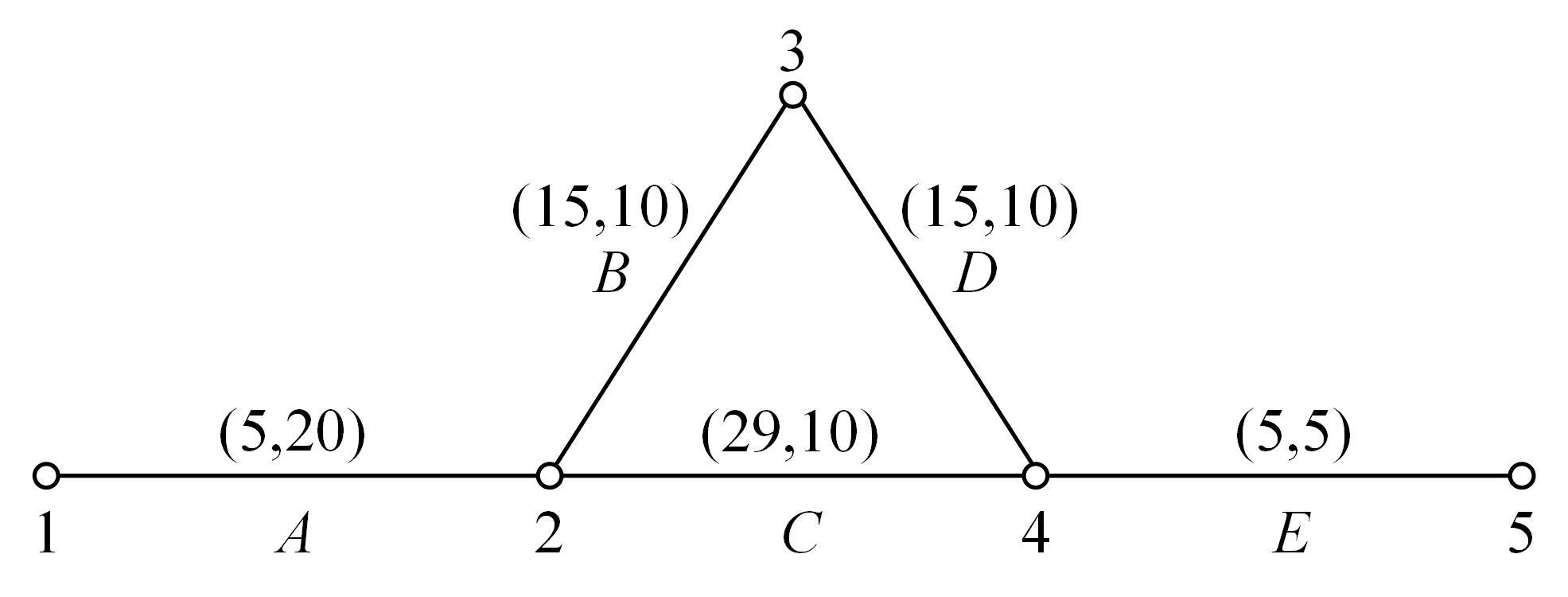
单OD对简单道路网结构示意图"

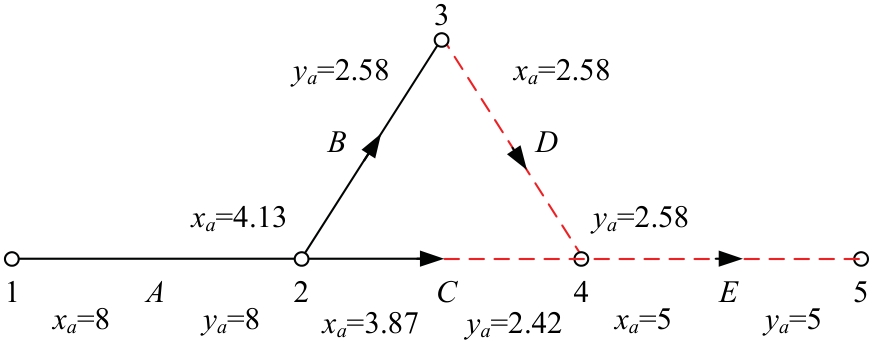
图5

简单道路网的模型分配结果图"

表2

简单道路网的模型分配结果"

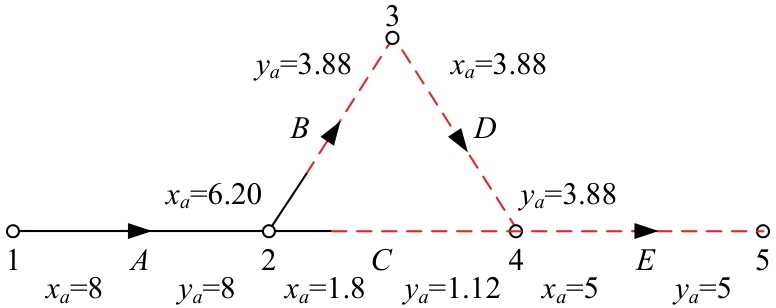
路段XaxayaKaNQaNBata
A8880005.635
B4.134.132.580.1161.18038.824
C3.873.872.420.53580.430255.128
D4.132.582.581619.5761.18216.301
E85511 2501 20010

图6

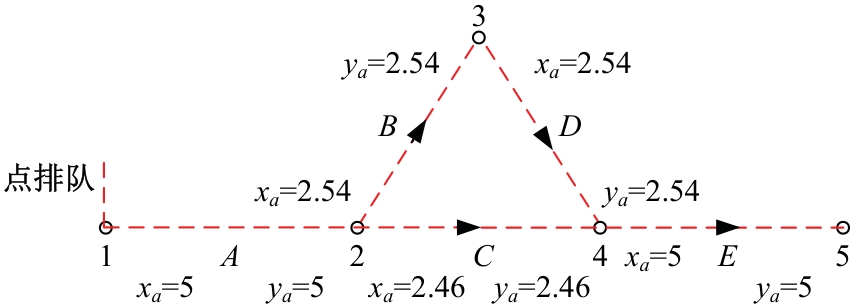
OD需求激增的简单道路网分配结果图"

图7

路段通行能力骤降的简单道路网分配结果图"

图8

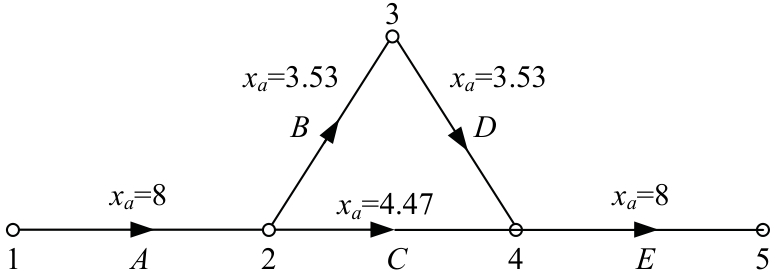
简单道路网的Beckmann模型分配结果图"

表3

单OD对简单道路网的分配结果对比"

模型算法分配结果误差算法计算时间/s
Beckmann模型4.753 1×10-62.881 6
非均衡分配算法190.095 32.028 5
本文模型1.044 5×10-53.283 0

图9

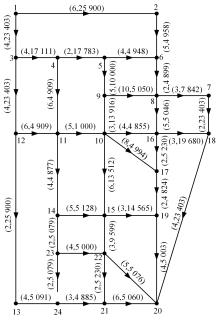
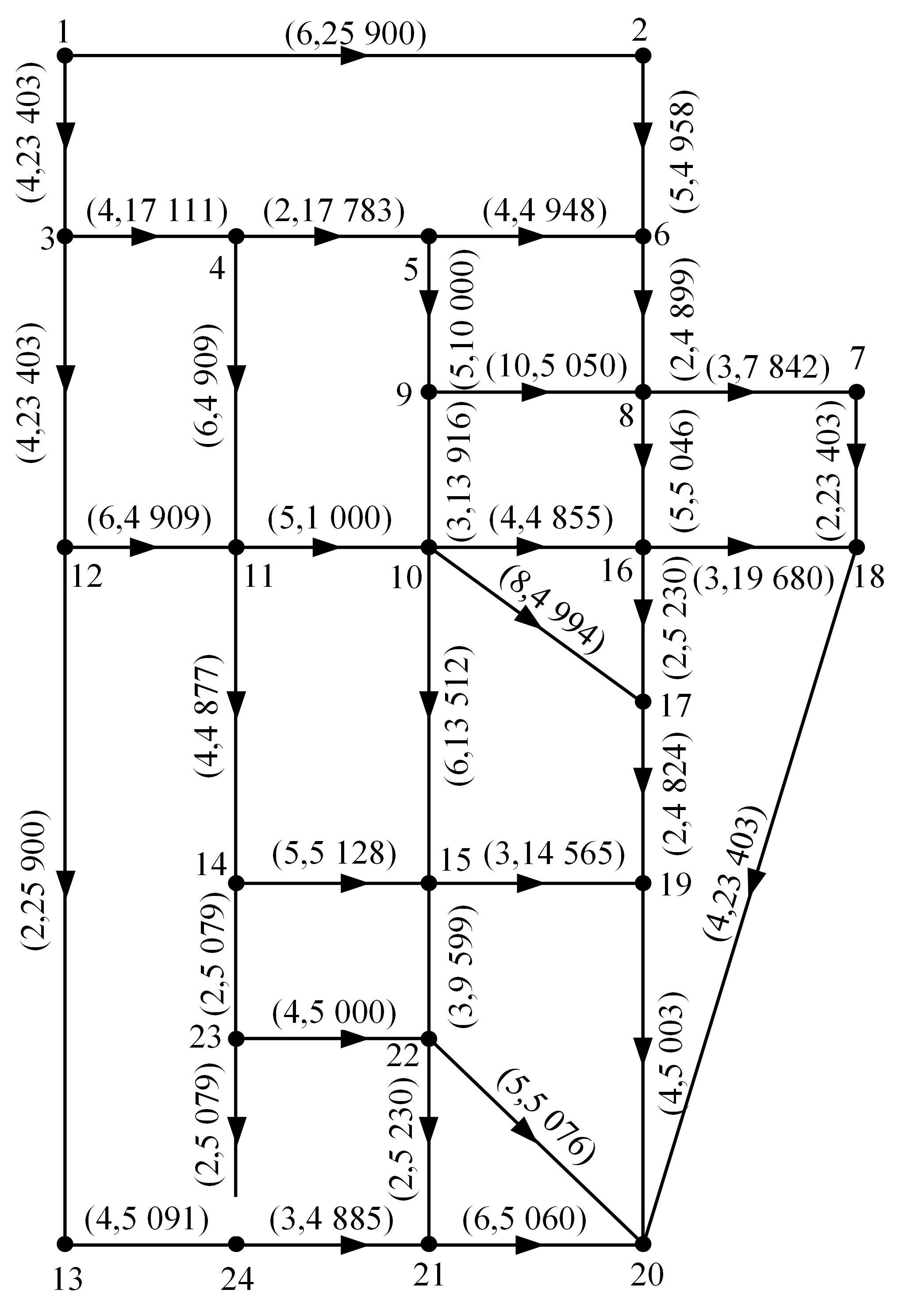
复杂道路网结构示意图"

表4

复杂道路网的OD对间交通需求"

序号起点终点qrs /(pcu·h-1序号起点终点qrs /(pcu·h-1
111350039819700
211430040820900
311550041915900
411740042917900
511930043919400
612030044920600
712110045921300
812240046922700
91233004710154 000
101241004810173 900
112172004910191 800
122191005010202 500
132201005110211 200
143131005210222 600
153141005311141 600
163151005411151 400
173171005511171 000
18322100561119400
19323100571120600
20414500581121400
214155005911221 100
224175006011231 300
23419200611124600
244203006212131 300
25421200631214700
26422400641215700
27423500651217600
28424200661219300
29515200671220400
30517200681221300
31519100691222700
32520100701223700
33521100711224500
345222007216172 800
356175007316191 300
366192007416201 600
37620300751820400
388171 400

图10

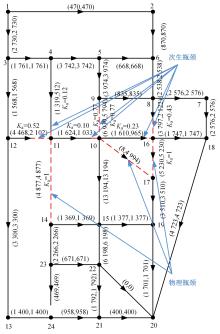
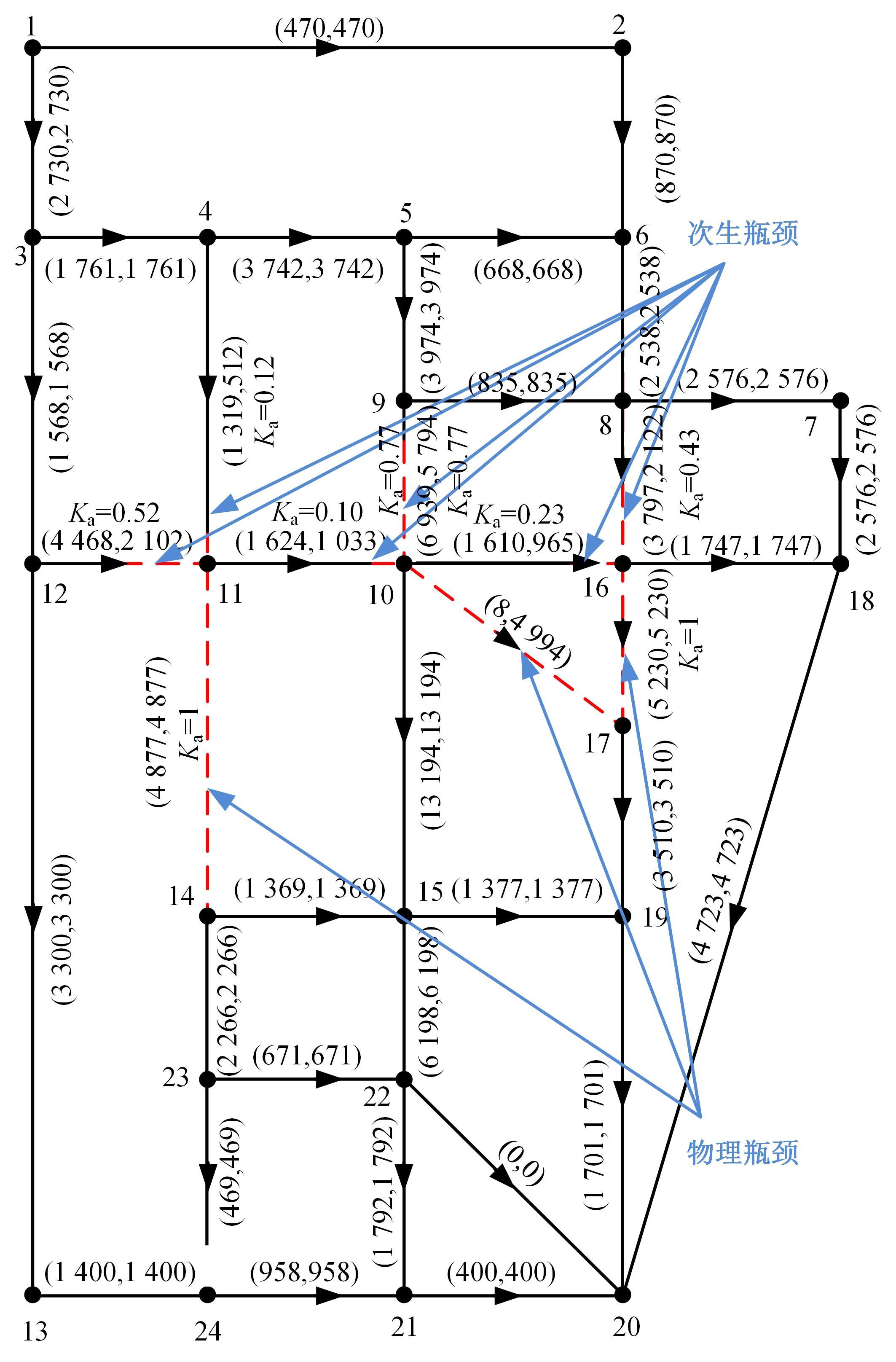
复杂道路网的模型分配结果图"

[1] Wardrop J G. Some theoretical aspects of road traffic research[J]. Proceedings of the Institute of Civil Engineers, 1952, 1(3): 325-378.
[2] Beckmann M, Mcguirec B, Winsten C B. Studies in the Economics of Transportation[M]. New Haven, Connecticut: Yale University Press, 1956.
[3] Leblance L J, Morlok E K, Pierskalla W. An efficient approach to solving the road network equilibrium traffic assignment problem[J]. Transportation Research, 1975, 9(5): 309-318.
[4] Larsson T, Patriksson M. An augmented lagrangean dual algorithm for link capacity side constrained traffic assignment problems[J]. Transportation Research Part B, 1995, 29: 433-455.
[5] Bell M G H. Stochastic user equilibrium assignment in networks with queues[J]. Transportation Research Part B, 1995, 29(2): 125-137.
[6] Smith M J. A link-based elastic demand equilibrium model with capacity constraints and queueing delays[J]. Transportation Research Part C, 2013, 29: 131-147.
[7] Smith M, Huang W, Viti F. Equilibrium in capacitated network models with queueing delays, queue-storage, blocking back and control[J]. Procedia-Social and Behavioral Sciences, 2013, 80: 860-879.
[8] Thompson W A, Payne H J. Traffic assignment on a transportation network with capacity constraints and queueing[C]∥47th National ORSA/TIMS North American Meeting, Washington DC, USA, 1975: 232-239.
[9] Smith M J. Traffic control and traffic assignment in a signal-controlled network with queueing[C]∥Proceedings of the Tenth International Symposium on Transportation and Traffic Theory, New York, USA,1987: 61-77.
[10] Bliemer M C J, Raadsen M P H, Smits E S, et al. Quasi-dynamic traffic assignment with residual point queues incorporating a first order node model[J]. Transportation Research Part B: Methodological, 2014, 68: 363-384.
[11] Lam W H K, Zhang Y. Capacity-constrained traffic assignment in network with residual queues[J]. Journal of Transportation Engineering, 2000, 126(2): 121-128.
[12] Larrain H, Suman H K, Muñoz J C. Route based equilibrium assignment in congested transit networks[J]. Transportation Research Part C: Emerging Technologies, 2021, 127: No.103125.
[13] 岳昊, 刘晓玲, 孟晓雨, 等. 拥堵道路网的静态交通流非均衡分配方法[J]. 北京交通大学学报, 2017, 41(3): 1-6.
Yue Hao, Liu Xiao-ling, Meng Xiao-yu, et al. A non-equilibrium method to solve static traffic assignment problem at the congested road network[J]. Journal of Beijing Jiaotong University, 2017, 41(3): 1-6.
[14] 岳昊, 张鹏, 刘晓玲, 等. 拥堵路网交通流均衡分配模型[J]. 哈尔滨工业大学学报, 2019, 51(9): 103-109.
Yue Hao, Zhang Peng, Liu Xiao-ling, et al. The equilibrium model for congested traffic assignment in road networks[J]. Journal of Harbin Institute of Technology, 2019, 51(9): 103-109.
[15] Bliemer M C J, Raadsen M P H. Static traffic assignment with residual queues and spillback[J]. Transportation Research Part B, 2020, 132: 303-319.
[16] 何胜学. 基于两阶段行程时间的交通流分配理论[J]. 交通运输系统工程与信息, 2018, 18(1): 139-144.
He Sheng-xue. Traffic assignment theory based on two-stage travel time[J]. Journal of Transportation Systems Engineering and Information Technology, 2018, 18(1): 139-144.
[17] 龙雪琴, 王瑞璇, 王晗. 考虑出行者不同理性程度的拥堵交通流分配方法[J]. 交通运输系统工程与信息, 2023, 23(1): 216-223.
Long Xue-qin, Wang Rui-xuan, Wang Han. Traffic flow assignment method considering travelers' different rational degree under congestions[J]. Journal of Transportation Systems Engineering and Information Technology, 2023, 23(1): 216-223.
[18] 岳昊, 任孟杰, 杨子玉, 等. 考虑拥堵空间排队与溢出的道路网静态交通流分配[J]. 中国公路学报, 2022, 35(7): 241-250.
Yue Hao, Ren Meng-jie, Yang Zi-yu, et al. Static traffic assignment on road network with spatial queuing and spillback[J]. China Journal of Highway and Transport, 2022, 35(7): 241-250.
[19] 岳昊, 张琦悦, 杨子玉, 等. 拥堵空间排队的静态交通流分配迭代加权算法[J]. 吉林大学学报: 工学版, 2024, 54(1): 136-145.
Yue Hao, Zhang Qi-yue, Yang Zi-yu, et al. Iterative weighted algorithms of static congestion traffic assignment considering spatial queuing[J]. Journal of Jilin University (Engineering and Technology Edition), 2024, 54(1): 136-145.
[1] 潘义勇,杨赛赛. 自动驾驶汽车接管模式与事故严重程度关联性分析[J]. 吉林大学学报(工学版), 2026, 56(8): 2077-2083.
[2] 郭瑞军,范超冉,付明迪. 基于PSO-GRU模型的车辆换道意图识别[J]. 吉林大学学报(工学版), 2026, 56(8): 2084-2094.
[3] 孙轶琳,蔡余坤,贾方圆,疏阳. 不同时期建成环境对居民小汽车依赖的影响[J]. 吉林大学学报(工学版), 2026, 56(8): 2095-2105.
[4] 马壮林,毕宇明,贾稳见,邓亚娟,谭晓伟. 公交换乘优惠政策下居民换乘行为机理分析[J]. 吉林大学学报(工学版), 2026, 56(8): 2116-2126.
[5] 冯天军,郝延铭,李飞燕,高赫遥,刘一贤,刘楠,李金凤. 考虑驾驶风格的网联自动驾驶车辆集聚换道模型[J]. 吉林大学学报(工学版), 2026, 56(7): 1834-1844.
[6] 孟云伟,李智鹏,张引,全振宇,杨光清,陈芳,赖思静,乔俊. 基于纵向间距和亮度差的隧道群驾驶舒适度[J]. 吉林大学学报(工学版), 2026, 56(7): 1904-1914.
[7] 张玉召,丁欣茹,侯长啸,陈虎林. 交通运输网络韧性研究现状及展望[J]. 吉林大学学报(工学版), 2026, 56(3): 585-602.
[8] 慈玉生,黄轶康. 基于文献计量的交叉口车路协同研究综述[J]. 吉林大学学报(工学版), 2026, 56(2): 313-332.
[9] 张文会,叶梅茹,席聪,宋子文. 混合交通流环境下车辆编队与碳排放特性[J]. 吉林大学学报(工学版), 2026, 56(2): 416-430.
[10] 潘义勇,曹天宇,刘宇. 随机交通网络约束最可靠路径乘子交替方向法[J]. 吉林大学学报(工学版), 2026, 56(2): 455-463.
[11] 孙宇,李世武,郭梦竹,金桐彤,宋会军,刘德志,高雯. 多模态数据在驾驶疲劳监测中的有效性分析[J]. 吉林大学学报(工学版), 2026, 56(2): 473-479.
[12] 李坤宸,袁伟,王畅,张会明,穆雨薇. 基于驾驶风险和驾驶能力的人机控制权分配[J]. 吉林大学学报(工学版), 2026, 56(2): 575-584.
[13] 马壮林,毕宇明,周备,邓亚娟,兆雪. 公交换乘优惠政策下居民换乘意向的异质性分析[J]. 吉林大学学报(工学版), 2026, 56(1): 158-169.
[14] 王琳虹,刘宇阳,刘子昱,鹿应佳,张宇恒,黄桂树. 基于YOLOv5的轻量化桥梁缺陷识别[J]. 吉林大学学报(工学版), 2025, 55(9): 2958-2968.
[15] 曲昭伟,王铭阳,王喆,宋现敏,张云翔,黄镜尘. 基于自动驾驶模块化车辆主辅功能分配的公交自适应调度方法[J]. 吉林大学学报(工学版), 2025, 55(9): 2946-2957.
Viewed
Full text


Abstract

Cited

  Shared   
  Discussed   
No Suggested Reading articles found!