Journal of Jilin University(Medicine Edition) ›› 2026, Vol. 52 ›› Issue (5): 1369-1376.doi: 10.13481/j.1671-587X.20260518
• Research in basic medicine • Previous Articles
Effects of omalizumab on proliferation and migration of airway smooth muscle cells in asthmatic mice by regulating Wnt/β-catenin signaling pathway
Shuang REN,Xiaochao GAO,Yan WANG,Yanmei LIU,Wenxia MENG( )
- Department of Allergy,First Hospital,Hebei Medical University,Shijiazhuang 050000,China
-
Received:2025-12-11Accepted:2026-02-01Online:2026-09-28Published:2026-10-15 -
Contact:Wenxia MENG E-mail:496256035@qq.com

CLC Number:
- R562.25
Cite this article
Shuang REN,Xiaochao GAO,Yan WANG,Yanmei LIU,Wenxia MENG. Effects of omalizumab on proliferation and migration of airway smooth muscle cells in asthmatic mice by regulating Wnt/β-catenin signaling pathway[J].Journal of Jilin University(Medicine Edition), 2026, 52(5): 1369-1376.
share this article
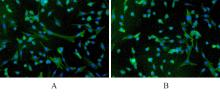
Fig.1
Expression of α-SMA in cells in two groups detected by immunofluorescence staining (×200)"
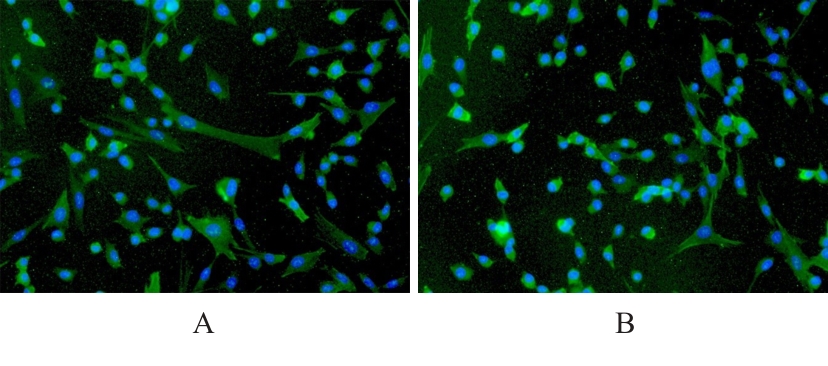
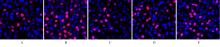
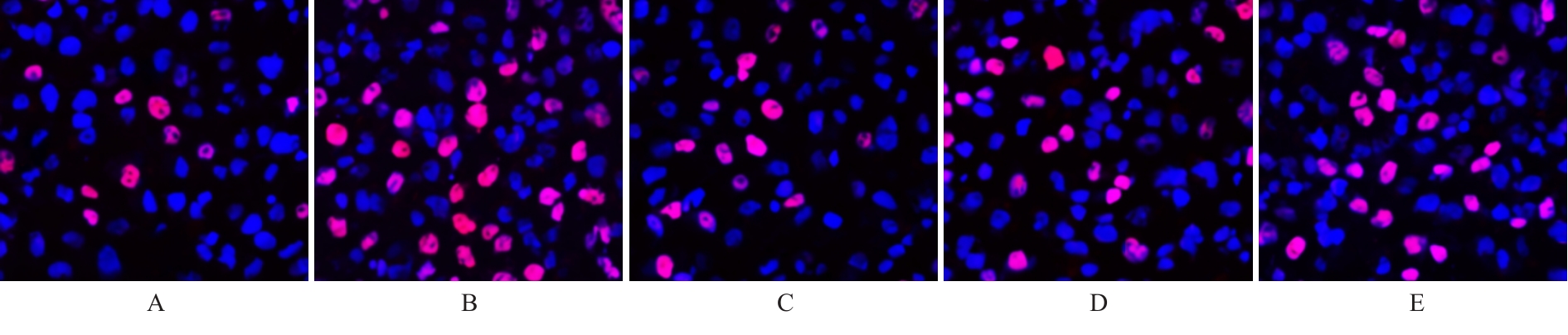
Fig. 2
EdU staining of ASMCs in various groups (×200)"
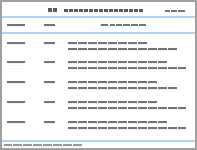
Tab.1
Percentages of Edu-positive cells and proliferation activities of ASMCs in various groups"
| Group | Percentage ofEdU-positive cell(η/%) | Proliferation activity |
|---|---|---|
| Control | 10.69±0.75 | 0.46±0.05 |
| Asthma | 28.74±1.92* | 1.27±0.16* |
| Omalizumab | 14.96±0.85△ | 0.59±0.05△ |
| iCRT3 | 16.22±0.91△ | 0.67±0.07△ |
| Omalizumab+SKL2001 | 20.89±1.73# | 0.89±0.08# |
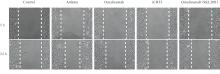
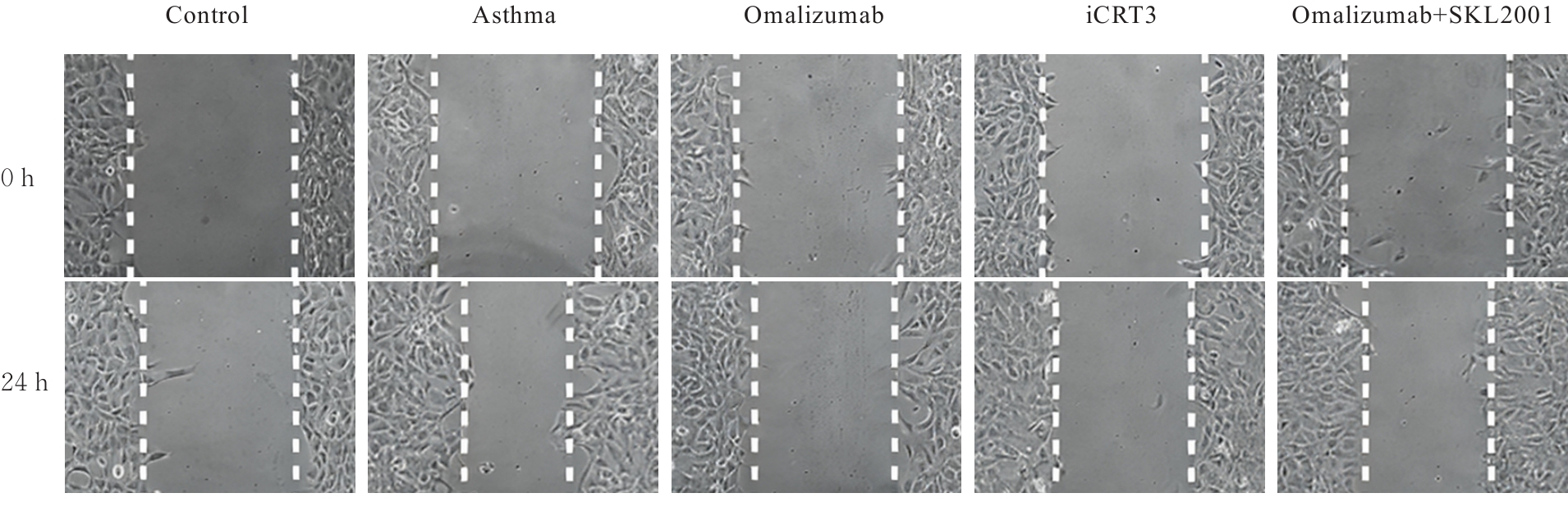
Fig. 3
Migration of ASMCs in various groups detected by scratch assay (×200)"
Tab.2
Expression levels of IL-6, IL-17, TNF-α, IL-33, and IL-13 in supernatant of ASMCs in various groups (n=6, x±s, ρB/(ng·L-1)]"
| Group | IL-6 | IL-17 | TNF-α | IL-33 | IL-13 |
|---|---|---|---|---|---|
| Control | 131.67±7.22 | 26.69±1.58 | 54.62±3.25 | 15.69±1.04 | 43.68±2.59 |
| Asthma | 276.69±15.56* | 87.72±5.16* | 165.54±10.27* | 46.78±2.63* | 89.76±5.05* |
| Omalizumab | 162.28±10.43△ | 39.83±2.25△ | 78.86±4.46△ | 26.81±1.54△ | 56.81±2.96△ |
| iCRT3 | 150.67±8.89△ | 46.69±2.58△ | 83.61±5.29△ | 28.67±1.83△ | 61.62±4.04△ |
| Omalizumab+SKL2001 | 212.36±12.26# | 60.63±4.18# | 123.37±7.75# | 37.44±2.15# | 69.22±4.05# |
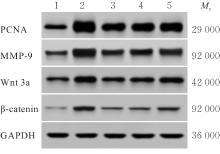
Fig. 4
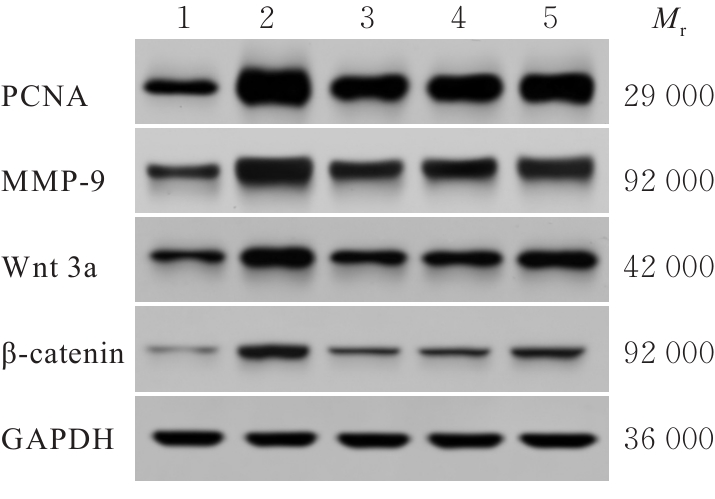
Electrophoregram of expressions of PCNA, MMP-9, Wnt 3a,and β-catenin proteins in ASMCs in various groups"
Tab.3
Expression levels of PCNA, MMP-9, Wnt 3a and β-catenin proteins in ASMCs in various groups"
| Group | PCNA | MMP-9 | Wnt 3a | β-catenin |
|---|---|---|---|---|
| Control | 1.06±0.19 | 0.71±0.09 | 0.54±0.06 | 0.15±0.02 |
| Asthma | 2.73±0.25* | 2.05±0.22* | 1.38±0.19* | 0.81±0.09* |
| Omalizumab | 1.56±0.14△ | 1.08±0.15△ | 0.69±0.07△ | 0.29±0.03△ |
| iCRT3 | 1.71±0.16△ | 1.19±0.18△ | 0.80±0.09△ | 0.35±0.04△ |
| Omalizumab+SKL2001 | 2.08±0.18# | 1.52±0.17# | 1.01±0.13# | 0.57±0.06# |
| [1] | XIAO Y L, ZHU H, LEI J H, et al. miR-182/Sestrin2 affects the function of asthmatic airway smooth muscle cells by the AMPK/mTOR pathway[J]. J Transl Intern Med, 2023, 11(3): 282-293. |
| [2] | LI W, LIU L Y, DUANQING M, et al. CLDN1 silencing suppresses the proliferation and migration of airway smooth muscle cells by modulating MMP14[J]. Autoimmunity, 2023, 56(1): 2281223. |
| [3] | GU J Y, ZHOU D F. Long non-coding RNA MEG3 knockdown represses airway smooth muscle cells proliferation and migration via sponging miR-143-3p/FGF9 in asthma[J]. J Cardiothorac Surg, 2024, 19(1): 314. |
| [4] | RAMOS-RAMÍREZ P, TLIBA O. Glucocorticoid insensitivity in asthma: the unique role for airway smooth muscle cells[J]. Int J Mol Sci, 2022, 23(16): 8966. |
| [5] | MENZELLA F, JUST J, SAUERBECK I S, et al. Omalizumab for the treatment of patients with severe allergic asthma with immunoglobulin E levels above >1500 IU/mL[J]. World Allergy Organ J, 2023, 16(6): 100787. |
| [6] | 赵艳梅, 闫 萌, 张振艳, 等. 奥马珠单抗通过miR-217/E2F3轴介导SMAD3表达水平对大鼠支气管哮喘ASMCs增殖和迁移的影响及作用机制[J]. 中国老年学杂志, 2025, 45(1): 199-205. |
| [7] | YUAN Y Y, ZHU H H, HUANG S H, et al. SFRP5 partially inhibits the proliferation and migration of airway smooth muscle cells in children with asthma by regulating the Wnt/β-catenin signaling pathway[J]. Discov Med, 2024, 36(181): 323. |
| [8] | 王 盟, 李 慧, 吕传峰. 钩藤碱固体脂质纳米粒抑制哮喘模型小鼠气道平滑肌细胞增殖的作用机制[J]. 中国药房, 2023, 34(9): 1066-1070. |
| [9] | 孟亮, 王跃飞, 陶亮, 等. miR-1471通过调控Wnt/β-catenin通路对胶质瘤细胞EMT和侵袭的影响及其机制[J].中国老年学杂志,2025,45(6):1438-1441. |
| [10] | 王晓英, 韩志梅, 李春艳. 藤黄酸抑制Wnt/β-catenin信号通路减轻牙周炎牙周膜细胞损伤及凋亡[J]. 激光生物学报, 2024, 33(6): 567-576. |
| [11] | HU L L, LI L L, YAN C, et al. Baicalin inhibits airway smooth muscle cells proliferation through the RAS signaling pathway in murine asthmatic airway remodeling model[J]. Oxid Med Cell Longev, 2023, 2023: 4144138. |
| [12] | WANG J, WANG L, TIAN X F, et al. N6-methyladenosine reader YTHDF1 regulates the proliferation and migration of airway smooth muscle cells through m6A/cyclin D1 in asthma[J]. PeerJ, 2023, 11: e14951. |
| [13] | YANG Q, MIAO Q, CHEN H, et al. Myocd regulates airway smooth muscle cell remodeling in response to chronic asthmatic injury[J]. J Pathol, 2023, 259(3): 331-341. |
| [14] | BEAUFILS F, BERGER P. Commentary: Effect of curcumin nanoparticles on proliferation and migration of mouse airway smooth muscle cells and airway inflammatory infiltration[J]. Front Pharmacol, 2024, 15: 1432397. |
| [15] | LOVEL A G, MITCHELL D M. PCNA staining of retinal cryosections to assess microglial/macrophage proliferation[J]. Methods Mol Biol, 2023, 2636: 389-400. |
| [16] | KWON M R, PARK J S, KO E J, et al. Ibulocydine inhibits migration and invasion of TNBC cells via MMP-9 regulation[J]. Int J Mol Sci, 2024, 25(11): 6123. |
| [17] | ZHOU T, CHEN X, FENG X. LncRNA DGCR5/miR-204-5p/SRSF7 axis regulates PDGF-BB-induced proliferation and migration of airway smooth muscle cells with potential role in asthma[J]. Autoimmunity, 2023, 56(1): 2193678. |
| [18] | LANG D D, LIU Z M, LI D J. Safety and tolerability of omalizumab in children with allergic (IgE-mediated) asthma: a systematic review and meta-analysis[J]. Discov Med, 2023, 35(176): 233-241. |
| [19] | 杨文平, 李 刚, 亓玉心, 等. 奥马珠单抗对支气管哮喘大鼠肺功能及气道重塑的影响及机制研究[J]. 中国现代医学杂志, 2023, 33(14): 16-21. |
| [20] | JIA X X, ZHU T T, HUANG Y, et al. Wnt/β-catenin signaling pathway regulates asthma airway remodeling by influencing the expression of c-Myc and cyclin D1 via the p38 MAPK-dependent pathway[J]. Exp Ther Med, 2019,18(5):3431-3438. |
| [21] | LIU C Y, SHI S, GAO Y, et al. microRNA-485-3p promotes the inflammatory response and extracellular matrix deposition by activating Wnt/β-catenin signaling in human airway smooth muscle cells[J]. Crit Rev Eukaryot Gene Expr, 2023, 33(4): 1-12. |
| [22] | LIU Y L, LI J N, CHEN R C, et al. Airway epithelial cells promote in vitro airway smooth muscle cell proliferation by activating the Wnt/β-catenin pathway[J]. Respir Physiol Neurobiol, 2025, 331: 104368. |
| [23] | WANG X H, ZHAO H Q, MA C H, et al. Gallic acid attenuates allergic airway inflammation via suppressed interleukin-33 and group 2 innate lymphoid cells in ovalbumin-induced asthma in mice[J]. Int Forum Allergy Rhinol, 2018, 8(11): 1284-1290. |
| [24] | SHI Z H, XU M, CHEN X D, et al. The regulatory role of SFRP5/WNT5A axis in allergic rhinitis through inhibiting JNK pathway activation and lowering mucin generation in human nasal epithelial cells[J]. Exp Mol Pathol, 2021, 118: 104591. |
| [25] | REDHU N S, SALEH A, SHAN L Y, et al. Proinflammatory and Th2 cytokines regulate the high affinity IgE receptor (FcεRⅠ) and IgE-dependant activation of human airway smooth muscle cells[J]. PLoS One, 2009, 4(7): e6153. |
| [26] | ABDULAAL W H, OMAR U M, ZEYADI M, et al. Pirfenidone ameliorates ANIT-induced cholestatic liver injury via modulation of FXR, NF-κB/TNF-α, and Wnt/GSK-3β/β-catenin signaling pathways[J]. Toxicol Appl Pharmacol, 2024, 490: 117038. |
| [27] | GÖKTUNA S I, SHOSTAK K, CHAU T L, et al. The prosurvival IKK-related kinase IKKϵ integrates LPS and IL17A signaling cascades to promote Wnt-dependent tumor development in the intestine[J]. Cancer Res, 2016, 76(9): 2587-2599. |
| [1] | Dan FENG,Yanfei QIAN,Mengyuan YANG,Xiaoqin LI,Qianhui WAN,Zixuan ZHANG,Zhongyang ZHAO,Siyu ZHANG,Ruijuan GAO,Junqiang SI. Ameliorative effect of phloretin on pulmonary vascular remodeling in monocrotaline-induced pulmonary arterial hypertensive rats [J]. Journal of Jilin University(Medicine Edition), 2026, 52(5): 1357-1368. |
| [2] | Lina XU,Xiaoshuang HE,Wenyan XIN,Chao WU. Improvement effect of bone marrow mesenchymal stem cell-derived exosomes on airway resistance and lung tissue lesion in mice of asthmatic models and its mechanism [J]. Journal of Jilin University(Medicine Edition), 2026, 52(3): 602-611. |
| [3] | Xiao ZHOU,Haitao DAI,Yunshan DING,Linjie ZHANG,Nan WU. Network pharmacology analysis and in vitro experimental validation of anticancer effect of grape seed proanthocyanidins against oral squamous cell carcinoma [J]. Journal of Jilin University(Medicine Edition), 2026, 52(3): 651-662. |
| [4] | Qiaotong REN,Weihua WU,Xingxiang WANG,Shichao WANG,Yipeng CHENG,Chun LI. Effect of interleukin-17 recepter B gene silencing on proliferation, invasion and apoptosis of lung adenocarcinoma A549 cells and its mechanism [J]. Journal of Jilin University(Medicine Edition), 2026, 52(3): 738-745. |
| [5] | Yao ZHENG,Mingxia FU,Weichen WANG,Weiwei CHEN,Yuchen HAN,Yu BAI,Jiajia AN. Effect of sodium selenite on biological behaviors of breast cancer doxorubicin-resistant MCF-7/ADR cells [J]. Journal of Jilin University(Medicine Edition), 2026, 52(2): 410-417. |
| [6] | Li ZHAI,Meng CHEN,Jianbo LUO,Aili ZHANG,Liangxiao WANG,Ying WEI,Xi ZHANG. Targeting relationship between miR-214-3p and EZH2 and its effects on proliferation, invasion, and apoptosis of ovarian cancer SKOV3 cells [J]. Journal of Jilin University(Medicine Edition), 2026, 52(2): 460-468. |
| [7] | Hong LI,Panpan YU,Zouyu ZHAO,Chongfeng SUN,Hui QIAO,Ping YANG. Expression of GSTO1 in ovarian cancer tissue and effect of N-glycosylation site mutations on biological behaviors of epithelial ovarian cancer cells [J]. Journal of Jilin University(Medicine Edition), 2026, 52(2): 469-482. |
| [8] | Yunshan DING,Haitao DAI,Min CHEN,Xiaohui HAO,Xiao ZHOU,Nan WU. Effect of silencing TRPV2 gene and cannabidiol on biological behaviors of oral squamous cell carcinoma CAL-27 cells [J]. Journal of Jilin University(Medicine Edition), 2026, 52(1): 143-151. |
| [9] | Yan ZHAO,Huawei WU. Inhibitory effect of inhibition of miR-17-5p on proliferation of spinal cord astrocytes of rats induced by scratch injury through targeting Mfn2 expression [J]. Journal of Jilin University(Medicine Edition), 2026, 52(1): 81-92. |
| [10] | Xiaohan YAO,Mingchen YAO,Zhiqing WANG,Heyang LI,Yan YAN,Ningjing LEI. Effect of silencing GPR139 gene on proliferation, apoptosis and autophagy of breast cancer cells and its mechanism [J]. Journal of Jilin University(Medicine Edition), 2026, 52(1): 1-9. |
| [11] | Yu YAN,Dandan HUANG,Chunling HONG,Bowen WEI,Yuanyuan YANG,Guanghai YAN,Yilan SONG,Zhemin XIAN. Improvement effect of imperatorin on airway remodeling in bronchial asthma mice and its mechanism [J]. Journal of Jilin University(Medicine Edition), 2025, 51(6): 1508-1517. |
| [12] | Sifan FENG,Yunfeng LI,Jiaying WANG,Fubin MA,Yan WANG. Effects of heme-binding protein 1 gene knockdown on proliferation, migration, and inflammatory response of microglia BV2 and their mechanisms [J]. Journal of Jilin University(Medicine Edition), 2025, 51(6): 1532-1541. |
| [13] | Lulu FU,Yinggang ZOU,Xiaoyu ZHENG,Xueying ZHANG,Jingshun ZHANG,Min WANG,Qiang ZHANG,Lianwen ZHENG. Expression of placenta expressed transcription factor 1 in ovarian tissue of polycystic ovary syndrome rats and its effect on proliferation of rat ovarian granulosa cells [J]. Journal of Jilin University(Medicine Edition), 2025, 51(5): 1177-1184. |
| [14] | Pingsheng ZHU,Sitang GE,Lugen ZUO,Deli CHEN,Yangyang ZHANG. Effect of miR-325-3p targeting PRELID1 gene in regulation of EMT pathway on invasion and migration of colon cancer cells and their mechanisms [J]. Journal of Jilin University(Medicine Edition), 2025, 51(5): 1185-1193. |
| [15] | Wenxuan LI,Minru ZONG. Research progress in role of migration of Schwann cells in repairment of peripheral nerve injury [J]. Journal of Jilin University(Medicine Edition), 2025, 51(4): 1137-1144. |
|
||