吉林大学学报(工学版) ›› 2026, Vol. 56 ›› Issue (3): 725-733.doi: 10.13229/j.cnki.jdxbgxb.20240887
• 交通运输工程·土木工程 • 上一篇
基于CFSFDP-BP的车辆出行群体分类及识别方法
谢坤1( ),董宏辉1,卢玲玉2,耿庆桥3,李鹏辉1(),董春娇1
- 1.北京交通大学 综合交通运输大数据应用技术交通运输行业重点实验室,北京 100044
2.中国城市规划设计研究院深圳分院 市政所,广东 深圳 518040
3.交通运输部规划研究院 公路所,北京 100028
Classification and recognition method of vehicle travel groups based on CFSFDP-BP
Kun XIE1(),Hong-hui DONG1,Ling-yu LU2,Qing-qiao GENG3,Peng-hui LI1(),Chun-jiao DONG1
- 1.Key Laboratory of Transport Industry of Big Data Application Technologies for Comprehensive Transport,Ministry of Transport,Beijing Jiaotong University,Beijing 100044,China
2.Municipal Engineering Department,China Academy of Urban Planning & Design Shenzhen Branch,Shenzhen 518040,China
3.Institute of Highways,Planning and Research Institute of the Ministry of Transport,Beijing 100028,China
摘要:
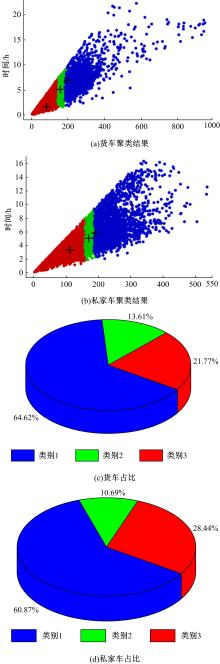
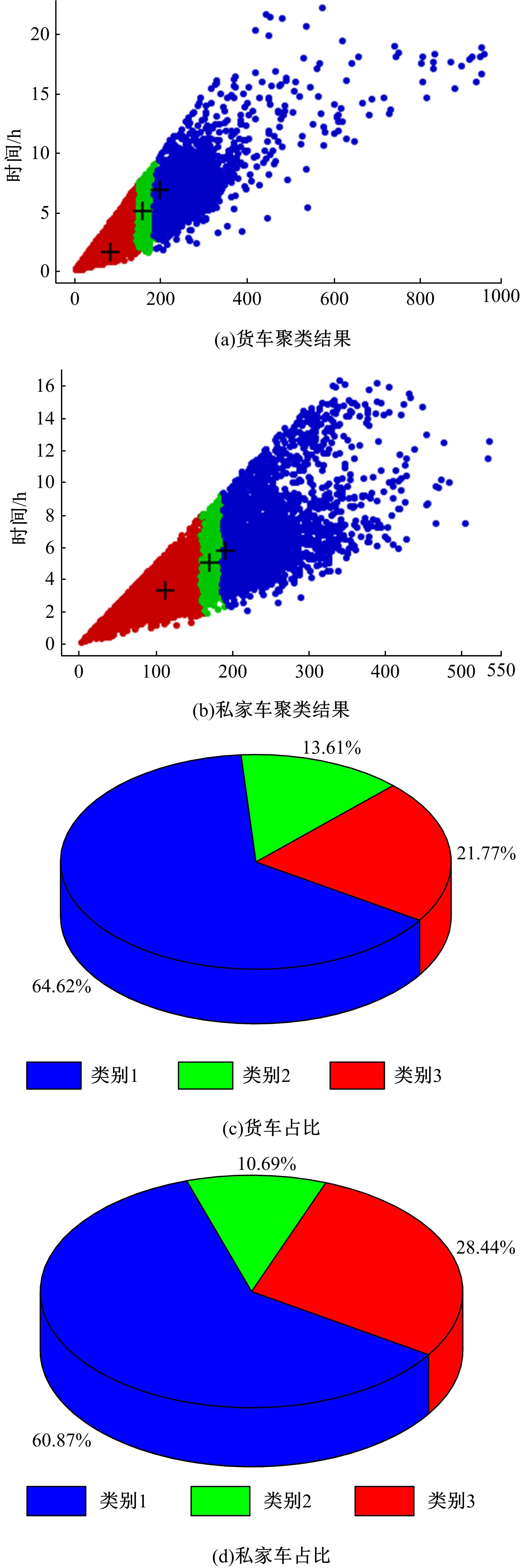
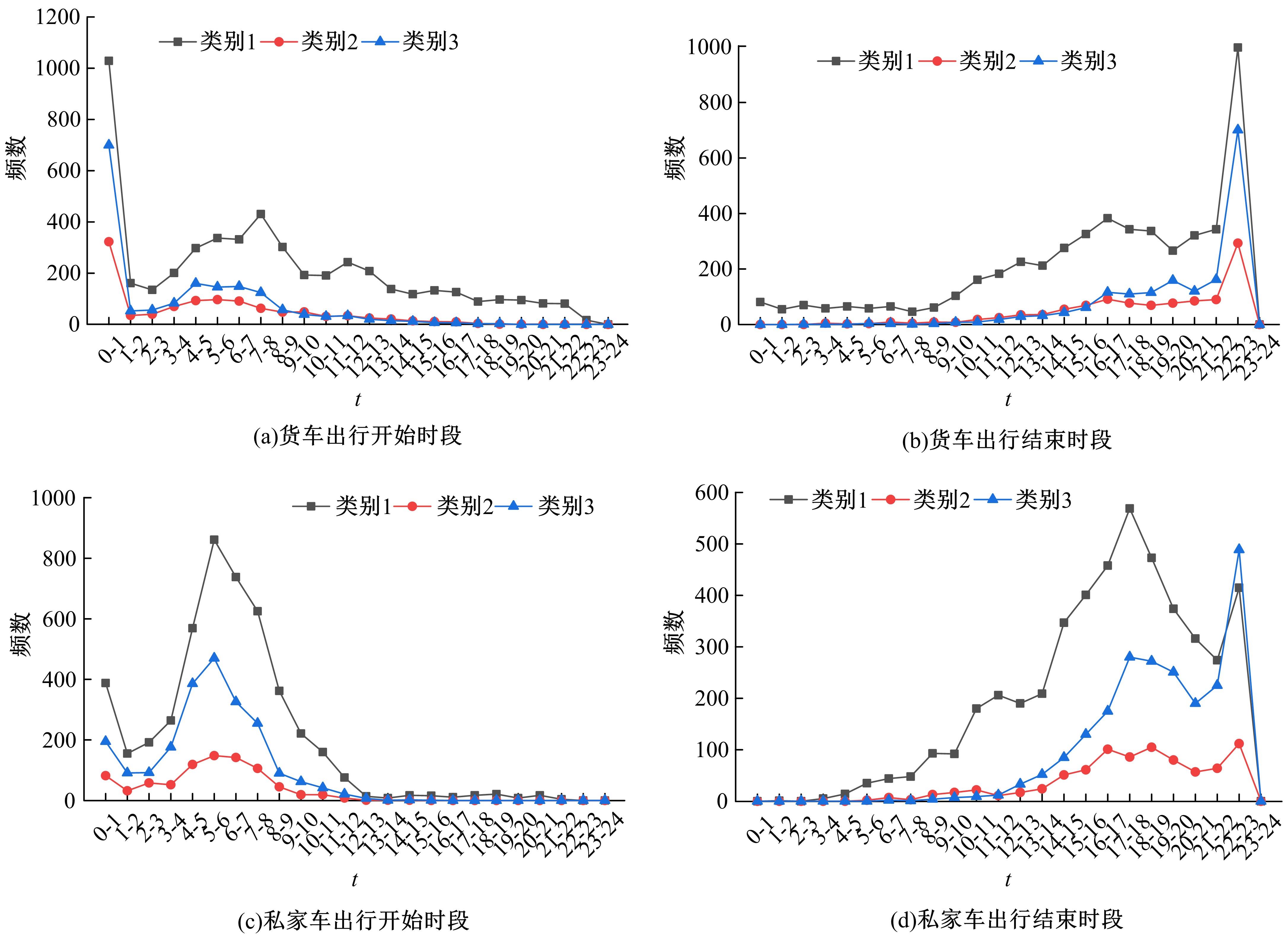
以货车和私家车出行轨迹数据为基础,以出行开始时间、出行结束时间、总运行时长等7个出行指标作为特征量,提出了基于密度峰值聚类的(CFSFDP)出行群体分类方法,将货车和私家车分别划分为三类出行群体。以出行特征指标为输入,密度聚类算法的分类标签为输出,建立基于BP网络的车辆出行群体类别识别模型,实现对同一车型下的不同出行群体的快速识别。研究结果表明:提出的基于CFSFDP-BP的车辆出行群体分类及识别方法预测精度和可靠性较好,对货车出行群体类别的识别准确率为0.991,对私家车出行群体类别识别准确率为0.988,且对货车出行群体的识别效果优于私家车的识别效果。货车出行群体可划分为灵活型-低强度、传统型-中强度以及传统型-高强度三类;私家车出行群体可划分为通勤型-低强度、通勤型-中强度以及灵活型-高强度三类出行特征群体。研究结果能够为交管部门制定精细化的交通管理策略,提高交通运行效率提供支持。
中图分类号:
- U491.1

| [1] | Zhou T, Zhang J. Analysis of commercial truck drivers' potentially dangerous driving behaviors based on 11-month digital tachograph data and multilevel modeling approach[J]. Accident Analysis & Prevention, 2019, 132: No.105256. |
| [2] | Du J, Aultman-hall L. Increasing the accuracy of trip rate information from passive multi-day GPS travel datasets: automatic trip end identification issues[J]. Transportation Research Part A: Policy and Practice, 2007, 41(3): 220-232. |
| [3] | 周荣贵, 高沛, 李雨璇, 等. 基于轨迹数据的高速公路小客车异常驾驶行为阈值[J]. 吉林大学学报:工学版,2024,54(9):2581-2587. |
| Zhou Rong-gui, Gao Pei, Li Yu-xuan, et al. Abnormal driving behavior thresholds of highway minibuses based on trajectory data[J]. Journal of Jilin University(Engineering and Technology Edition),2024,54(9):2581-2587. | |
| [4] | 张健钦, 仇培元, 杜明义. 基于时空轨迹数据的出行特征挖掘方法[J]. 交通运输系统工程与信息, 2014, 14(6): 72-78. |
| Zhang Jian-qin, Qiu Pei-yuan, Du Ming-yi. Mining method of travel characteristics based on spatio-temporal trajectory data[J]. Journal of Transportation Syatem Engineering and Information Technology, 2014, 14(6): 72-78. | |
| [5] | 张文畅. 基于轨迹数据的货车司机货运特征画像及应用研究[D]. 成都:西南交通大学交通运输与物流学院, 2021. |
| Zhang Wen-chang. Research on the characteristic portrait of truck drivers based on trajectory data[D]. Chengdu: School of Transportation and Logistics,Southwest Jiaotong University, 2021. | |
| [6] | 薛倩, 李旭, 王建春. 基于GPS数据的青岛市货运车辆出行特征分析[J]. 中阿科技论坛, 2023(5): 96-100. |
| Xue Qian, Li Xu, Wang Jian-chun. Research on the travel characteristics of freight vehicles in Qingdao based on GPS data[J]. China-Arab States Science and Technology Forum, 2023(5): 96-100. | |
| [7] | 王静. 基于GPS数据的货运车辆出行特性研究[D]. 北京:北京交通大学交通运输学院, 2022. |
| Wang Jing. Research on travel characteristics of freight vehicles based on GPS data[D]. Beijing: School of Traffic and Transportation, Beijing Jiaotong University, 2022. | |
| [8] | Gan M, Nie Y M, Liu X, et al. Whereabouts of truckers: an empirical study of predictability[J]. Transportation Research Part C: Emerging Technologies, 2019, 104: 184-195. |
| [9] | 魏广奇, 苏跃江, 吴德馨, 等. 基于高速公路流水数据的通勤车辆特征研究[J]. 交通运输系统工程与信息, 2019, 19(3): 237-244. |
| Wei Guang-qi, Su Yue-jiang, Wu De-xin, et al. Trip characteristics of vehicle with commuting property based on highway ticket data[J]. Journal of Transportation Systems Engineering and Information Technology, 2019, 19(3): 237-244. | |
| [10] | 杨帅, 刘樟伟, 杨宇星, 等. 基于高快速路卡口数据的车辆出行特征分析[C]∥中国城市交通规划年会, 青岛, 2018:No.13. |
| Yang Shuai, Liu Zhang-wei, Yang Yu-xing, et al. Analysis of vehicle travel characteristics based on tollgate data of highways and expressways[C]∥Annual Conference of Urban Transport Planning in China, Qingdao, China,2018:No.13. | |
| [11] | Zhou K, Tian Z, Yang Y. Periodic pattern detection algorithms for personal trajectory data based on spatiotemporal multi-granularity[J]. IEEE Access, 2019,7: 99683-99693. |
| [12] | Zhao J, Qu Q, Zhang F, et al. Spatio-temporal analysis of passenger travel patterns in massive smart card data[J]. IEEE Transactions on Intelligent Transportation Systems, 2017, 18(11): 3135-3146. |
| [13] | Zhang S, Tang J, Wang H, et al. Revealing intra-urban travel patterns and service ranges from taxi trajectories[J]. Journal of Transport Geography, 2017, 61: 72-86. |
| [14] | 汪涛. 基于历史行车轨迹集的车辆出行模式可视分析方法研究[D]. 合肥:合肥工业大学计算机与信息学院, 2021. |
| Wang Tao. Research on visual analysis method of vehicle travel pattern based on historical driving track set[D]. Hefei: School of Computer and Information, Hefei University of Technology, 2021. | |
| [15] | 黄正国. 基于车牌识别数据的车辆出行特征研究[D]. 成都:西南交通大学交通运输与物流学院, 2019. |
| Huang Zheng-guo. Research on vehicle travel feature based on license plate recognition data[D]. Chengdu: School of Transportation and Logistics, Southwest Jiaotong University, 2019. | |
| [16] | 梁泉, 翁剑成, 林鹏飞, 等. 基于个体出行图谱的公共交通通勤行为辨别方法研究[J]. 交通运输系统工程与信息, 2018, 18(2): 100-107. |
| Liang Quan, Weng Jian-cheng, Lin Peng-fei, et al. Public transport commuter identification based on individual travel graph[J]. Journal of Transportation Systems Engineering and Information Technology, 2018, 18(2): 100-107. | |
| [17] | 马晓磊, 姚李亮, 沈宣良. 基于OBD数据的驾驶人出行模式挖掘[J]. 交通信息与安全, 2021, 39(2): 70-77. |
| Ma Xiao-lei, Yao Li-liang, Shen Xuan-liang. Drivers' travel pattern mining based on OBD data[J]. Journal of Transport Information and Safety, 2021, 39(2): 70-77. | |
| [18] | Alex Rodriguez, Alessandro Laio. Clustering by fast search and find of density peaks[J]. Science, 2014, 344(6191): 1492-1496. |
| [1] | 马书红,张俊杰,陈西芳,廖国美. 利用出租车时序数据识别城市功能区[J]. 吉林大学学报(工学版), 2025, 55(2): 603-613. |
| [2] | 黄晓明,赵润民. 道路交通基础设施韧性研究现状及展望[J]. 吉林大学学报(工学版), 2023, 53(6): 1529-1549. |
| [3] | 潘恒彦,张文会,梁婷婷,彭志鹏,高维,王永岗. 基于MIMIC与机器学习的出租车驾驶员交通事故诱因分析[J]. 吉林大学学报(工学版), 2023, 53(2): 457-467. |
| [4] | 马社强,邵春福,刘东,王军利,马壮林. 基于差异驱动原理的道路交通安全评价[J]. 吉林大学学报(工学版), 2010, 40(04): 981-0985. |
| [5] | 刘研,高青,黄勇,于鸣,张忠进. 地能利用中道路融雪逐年运行过程分析[J]. 吉林大学学报(工学版), 2010, 40(01): 72-0076. |
| [6] | 秦进,史峰,邓连波,肖龙文. 道路交通网络效率定量评价方法及其应用[J]. 吉林大学学报(工学版), 2010, 40(01): 47-0051. |
| [7] | 王殿海,孙锋,金盛 . 两相位交叉口左转车通行能力计算方法[J]. 吉林大学学报(工学版), 2007, 37(04): 767-771. |
|
||