Journal of Jilin University(Medicine Edition) ›› 2025, Vol. 51 ›› Issue (6): 1646-1654.doi: 10.13481/j.1671-587X.20250620
• Research in clinical medicine • Previous Articles
Comparison of clinical efficacy between microwave ablation and surgical treatment for Hashimoto’s thyroiditis complicated with T1aN0M0 papillary thyroid carcinoma
Yixuan XU,Hui WANG( )
)
- Department of Ultrasound,China-Japan Union Hospital,Jilin University,Changchun 130033,China
-
Received:2025-05-24Accepted:2025-07-12Online:2025-11-28Published:2025-12-15 -
Contact:Hui WANG E-mail:whui66@jlu.edu.cn

CLC Number:
- R736.1
Cite this article
Yixuan XU,Hui WANG. Comparison of clinical efficacy between microwave ablation and surgical treatment for Hashimoto’s thyroiditis complicated with T1aN0M0 papillary thyroid carcinoma[J].Journal of Jilin University(Medicine Edition), 2025, 51(6): 1646-1654.
share this article
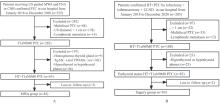
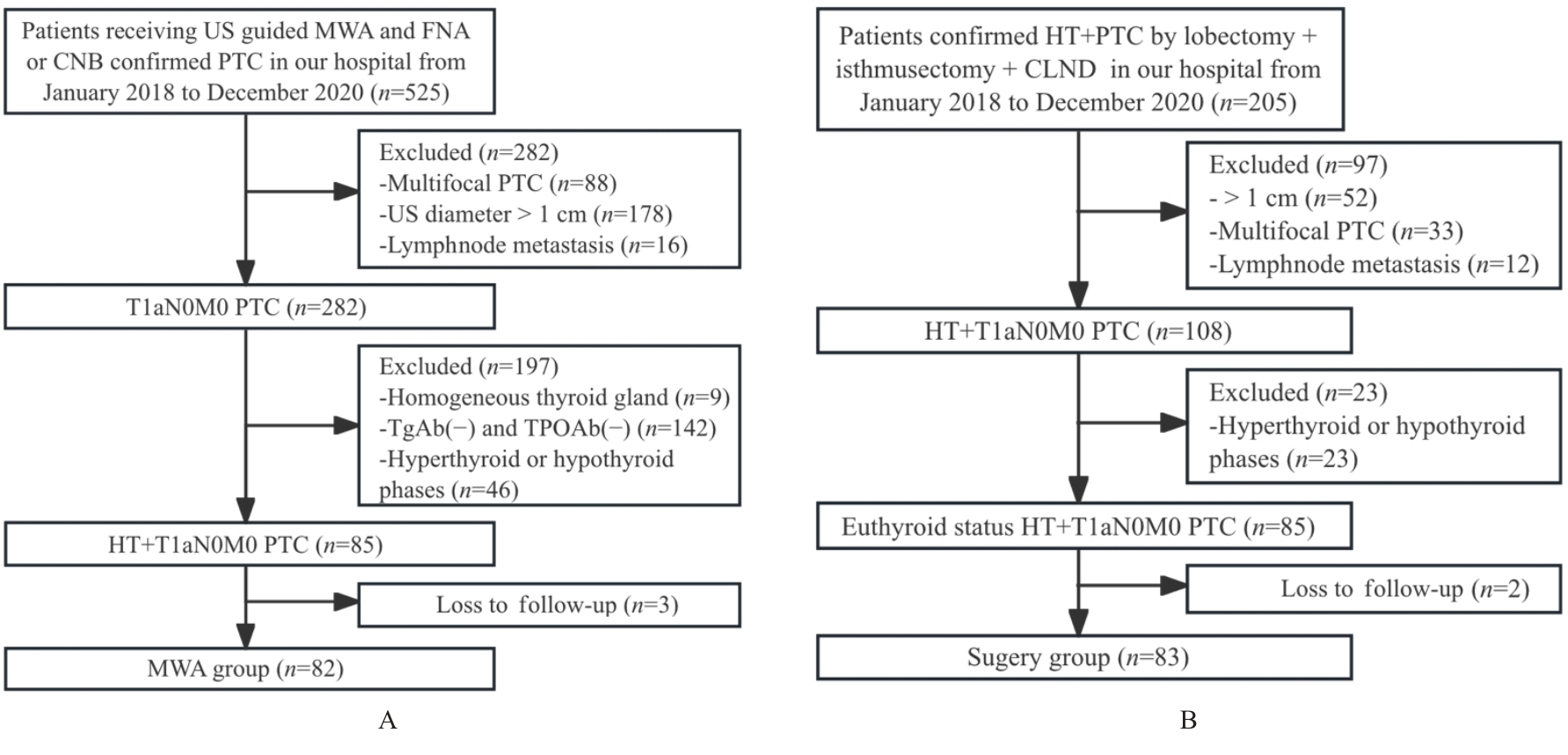
Fig. 1
Selection flowchart for patient in 2 groups"
Tab.1
General materials of patients in two groups"
| Group | n | Age(x±s, year) | Gender [n/(η/%)] | Median follow-up(x±s, month) | |
|---|---|---|---|---|---|
| Male | Female | ||||
| MWA | 82 | 44.90 | 9(11.0) | 73(89.0) | 65.62 |
| Surgery | 83 | 42.27 | 6(7.2) | 77(92.8) | 66.45 |
| P | 0.057 | 0.431 | 0.472 | ||
Tab.3
Tumor volume and VRR in ablation area of patients in MWA group after ablation at different time"
| Time(month) | Volume (V/cm3) | VRR (η/%) | ||
|---|---|---|---|---|
| Mean Range | Mean Range | |||
| 1 | 0.59±0.36 | 0.51-0.66 | 22.27±75.31 | 5.72-38.82 |
| 3 | 0.35±0.26 | 0.29-0.21 | 49.83±78.19 | 32.65-67.01 |
| 6 | 0.06±0.07 | 0.04-0.07 | 94.03±7.58 | 92.36-95.70 |
| 12 | 0.02±0.03 | 0.01-0.02 | 98.49±2.70 | 97.89-99.08 |
| 18 | 0.00±0.00 | 0.00-0.00 | 1.00±0.00 | 100.00-100.00 |
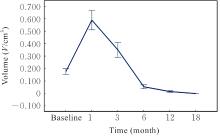
Fig. 2
Tumor volumes in ablation areas of patients in MWA group after ablation at different time"
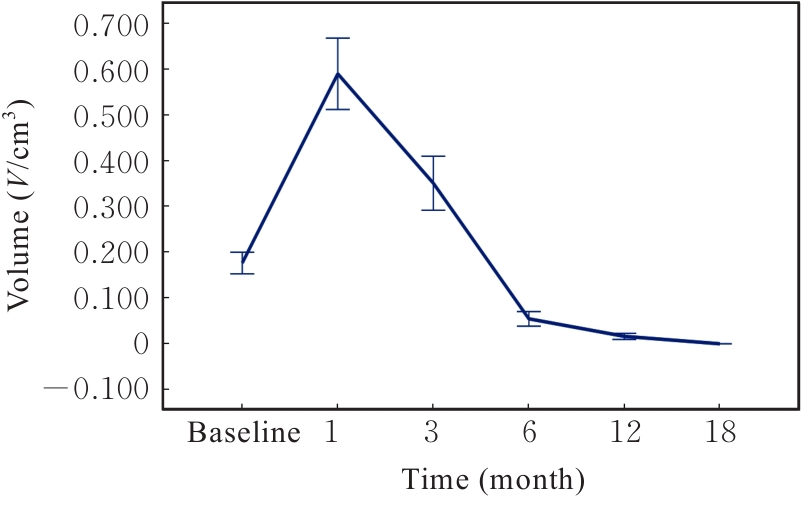
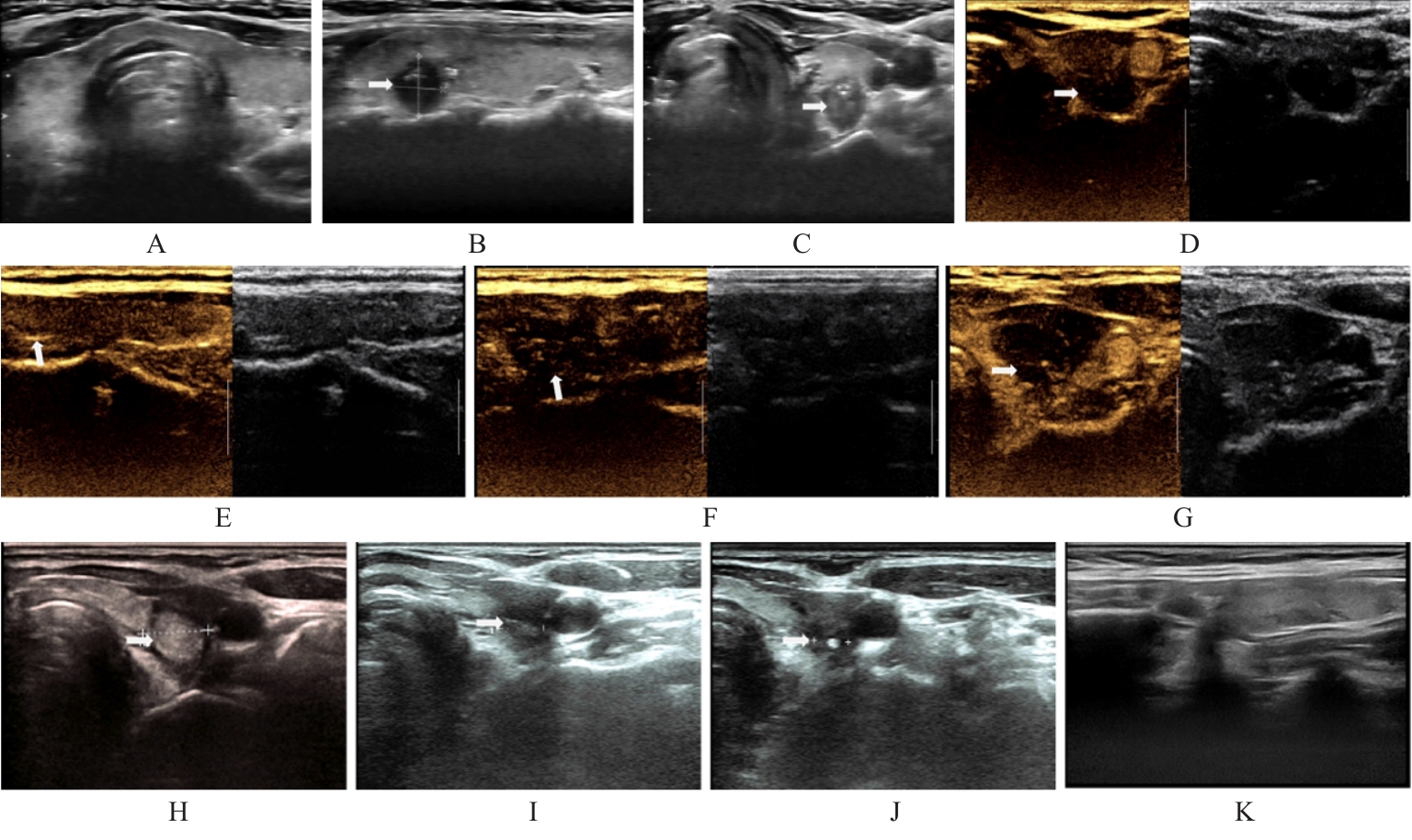
Fig. 3
Ultrasound images of therapy and follow-up of one patient in MWA group"
Tab.4
Tumor progression of patients in two groups"
| Group | n | New lession | Lymphnode metastasis | Distant metastasis | |||
|---|---|---|---|---|---|---|---|
| Recurrence | No recurrence | Metastasis | No metastasis | Metastasis | No metastasis | ||
| MWA | 82 | 2(2.4) | 80(97.6) | 1(1.2) | 81(98.8) | 0(0.0) | 82(100.0) |
| Surgery | 83 | 0(0.0) | 83(100.0) | 0(0.0) | 83(100.0) | 0(0.0) | 83(100.0) |
| P | 0.245 | 0.497 | - | ||||
Tab.5
THYCA-QoL scores of patients in two groups"
| Group | n | Neuromuscular | Voice | Concentration | Sympathetic | Throat/mouth problems | Psychological | Sensory | ||
|---|---|---|---|---|---|---|---|---|---|---|
| MWA | 82 | 1.03 | 1.02 | 1.01 | 1.00 | 1.01 | 1.05 | 1.04 | ||
| Surgery | 83 | 1.07 | 1.14 | 1.02 | 1.17 | 1.07 | 1.12 | 1.17 | ||
| P | 0.087 | <0.01 | 0.179 | <0.01 | <0.01 | 0.013 | <0.01 | |||
| Group | n | Problems with scar | Felt chilly | Tingling hands/feet | Gained weight | Headache | Less interest in sex | Total | ||
| MWA | 82 | 1.00 | 1.02 | 1.00 | 1.01 | 1.01 | 1.04 | 13.24 | ||
| Surgery | 83 | 1.27 | 1.04 | 1.02 | 1.06 | 1.05 | 1.07 | 14.27 | ||
| P | <0.01 | 0.662 | 0.159 | 0.100 | 0.179 | 0.315 | <0.01 | |||
| [1] | WALCZYK A, KOPCZYŃSKI J, GĄSIOR-PERCZAK D, et al. Poorly differentiated thyroid cancer in the context of the revised 2015 American Thyroid Association Guidelines and the Updated American Joint Committee on Cancer/Tumor-Node-Metastasis Staging System (eighth edition)[J]. Clin Endocrinol, 2019, 91(2): 331-339. |
| [2] | RAHIB L, SMITH B D, AIZENBERG R, et al. Projecting cancer incidence and deaths to 2030: the unexpected burden of thyroid, liver, and pancreas cancers in the United States[J]. Cancer Res, 2014, 74(11): 2913-2921. |
| [3] | MEGWALU U C, MOON P K. Thyroid cancer incidence and mortality trends in the United States: 2000-2018[J]. Thyroid, 2022, 32(5): 560-570. |
| [4] | RALLI M, ANGELETTI D, FIORE M, et al. Hashimoto’s thyroiditis: an update on pathogenic mechanisms, diagnostic protocols, therapeutic strategies, and potential malignant transformation[J]. Autoimmun Rev, 2020, 19(10): 102649. |
| [5] | XU J Y, DING K, MU L, et al. Hashimoto’s thyroiditis: a “double-edged sword” in thyroid carcinoma[J]. Front Endocrinol, 2022, 13: 801925. |
| [6] | IENI A, VITA R, MAGLIOLO E, et al. One-third of an archivial series of papillary thyroid cancer (years 2007-2015) has coexistent chronic lymphocytic thyroiditis, which is associated with a more favorable tumor-node-metastasis staging[J]. Front Endocrinol, 2017, 8: 337. |
| [7] | LUSTER M, AKTOLUN C, AMENDOEIRA I, et al. European perspective on 2015 American thyroid association management guidelines for adult patients with thyroid nodules and differentiated thyroid cancer: proceedings of an interactive international symposium[J]. Thyroid, 2019, 29(1): 7-26. |
| [8] | SUN R H, LI C, FAN J C, et al. Meta-analysis of the clinical significance of thyroidectomy combined with central neck dissection in differentiated thyroid carcinoma at the first treatment[J]. Zhonghua Er Bi Yan Hou Tou Jing Wai Ke Za Zhi, 2014, 49(2): 157-163. |
| [9] | ULLMANN T M, PAPALEONTIOU M, SOSA J A. Current controversies in low-risk differentiated thyroid cancer: reducing overtreatment in an era of overdiagnosis[J]. J Clin Endocrinol Metab, 2023, 108(2): 271-280. |
| [10] | XU S Y, HUANG H, QIAN J X, et al. Prevalence of Hashimoto thyroiditis in adults with papillary thyroid cancer and its association with cancer recurrence and outcomes[J]. JAMA Netw Open, 2021, 4(7): e2118526. |
| [11] | PAPINI E, MONPEYSSEN H, FRASOLDATI A, et al. 2020 European thyroid association clinical practice guideline for the use of image-guided ablation in benign thyroid nodules[J]. Eur Thyroid J, 2020, 9(4): 172-185. |
| [12] | GAO X M, YANG Y, WANG Y T, et al. Efficacy and safety of ultrasound-guided radiofrequency, microwave and laser ablation for the treatment of T1N0M0 papillary thyroid carcinoma on a large scale: a systematic review and meta-analysis[J]. Int J Hyperthermia, 2023, 40(1): 2244713. |
| [13] | 刘 洁, 高 静, 唐 媛, 等. 中文版甲状腺癌特异性生命质量量表的信效度评价[J]. 肿瘤, 2019, 39(3): 178-187. |
| [14] | CARDELLA J F, KUNDU S, MILLER D L, et al. Society of interventional radiology clinical practice guidelines[J]. J Vasc Interv Radiol, 2009, 20(7): S189-S191. |
| [15] | HAUGEN B R, ALEXANDER E K, BIBLE K C, et al. 2015 American thyroid association management guidelines for adult patients with thyroid nodules and differentiated thyroid cancer: the American thyroid association guidelines task force on thyroid nodules and differentiated thyroid cancer[J]. Thyroid, 2016, 26(1): 1-133. |
| [16] | RESENDE DE PAIVA C, GRØNHØJ C, FELDT-RASMUSSEN U, et al. Association between Hashimoto’s thyroiditis and thyroid cancer in 64, 628 patients[J]. Front Oncol, 2017, 7: 53. |
| [17] | DURANTE C, MONTESANO T, TORLONTANO M, et al. Papillary thyroid cancer: time course of recurrences during postsurgery surveillance[J]. J Clin Endocrinol Metab, 2013, 98(2): 636-642. |
| [18] | CANG Y C, FAN F Y, LIU Y, et al. Efficacy of microwave ablation in the treatment of large benign thyroid nodules: a multi-center study[J]. Eur Radiol, 2024, 34(10): 6852-6861. |
| [19] | RAGUSA F, FALLAHI P, ELIA G, et al. Hashimotos’ thyroiditis: Epidemiology, pathogenesis, clinic and therapy[J]. Best Pract Res Clin Endocrinol Metab, 2019, 33(6): 101367. |
| [20] | YEONG J, MYEON S, BAE J, et al. Incidence and risk factors of hypoparathyroidism and hypocalcemia after hemithyroidectomy[J]. Langenbecks Arch Surg, 2023, 408(1): 298. |
| [21] | NING K, YU Y C, ZHENG X Y, et al. Risk factors of transient and permanent hypoparathyroidism after thyroidectomy: a systematic review and meta-analysis[J]. Int J Surg, 2024, 110(8): 5047-5062. |
| [22] | YAN L, LIU Y, LI W H, et al. Long-term outcomes of ultrasound-guided thermal ablation for the treatment of solitary low-risk papillary thyroid microcarcinoma: a multicenter retrospective study[J]. Ann Surg, 2023, 277(5): 846-853. |
| [23] | BARRANCO H, FAZENDIN J, LINDEMAN B, et al. Thyroid hormone replacement following lobectomy: Long-term institutional analysis 15 years after surgery[J]. Surgery, 2023, 173(1): 189-192. |
| [24] | UHLIAROVA B, HAJTMAN A. Hashimoto’s thyroiditis-an independent risk factor for papillary carcinoma[J]. Braz J Otorhinolaryngol, 2018, 84(6): 729-735. |
| [25] | 顾美琴, 奚 静, 李 尊, 等. 超声引导下微波消融治疗多灶性T1N0M0甲状腺乳头状癌的可行性研究[J]. 介入放射学杂志, 2024, 33(5): 495-499. |
|
||