吉林大学学报(工学版) ›› 2025, Vol. 55 ›› Issue (12): 3955-3963.doi: 10.13229/j.cnki.jdxbgxb.20240325
• 交通运输工程·土木工程 • 上一篇
基于黏聚区模型的沥青混凝土SCB试验模拟分析
周正峰1,2( ),唐虎城1,2,欧信旺1,2
- 1.西南交通大学 土木工程学院,成都 610031
2.西南交通大学 道路工程四川省重点实验室,成都 610031
Simulation analysis on SCB test of asphalt concrete using cohesive zone model
Zheng-feng ZHOU1,2(),Hu-cheng TANG1,2,Xin-wang OU1,2
- 1.School of Civil Engineering,Southwest Jiaotong University,Chengdu 610031,China
2.Highway Engineering Key Laboratory of Sichuan Province,Southwest Jiaotong University,Chengdu 610031,China
摘要:
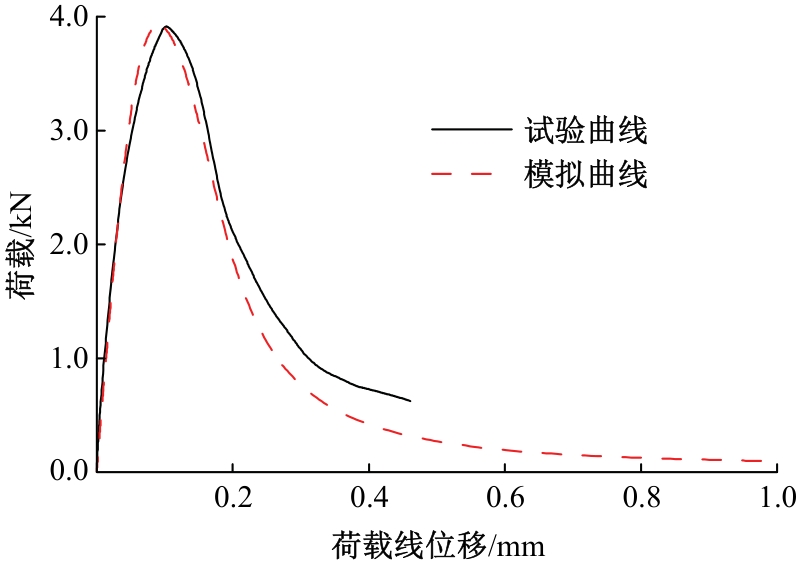
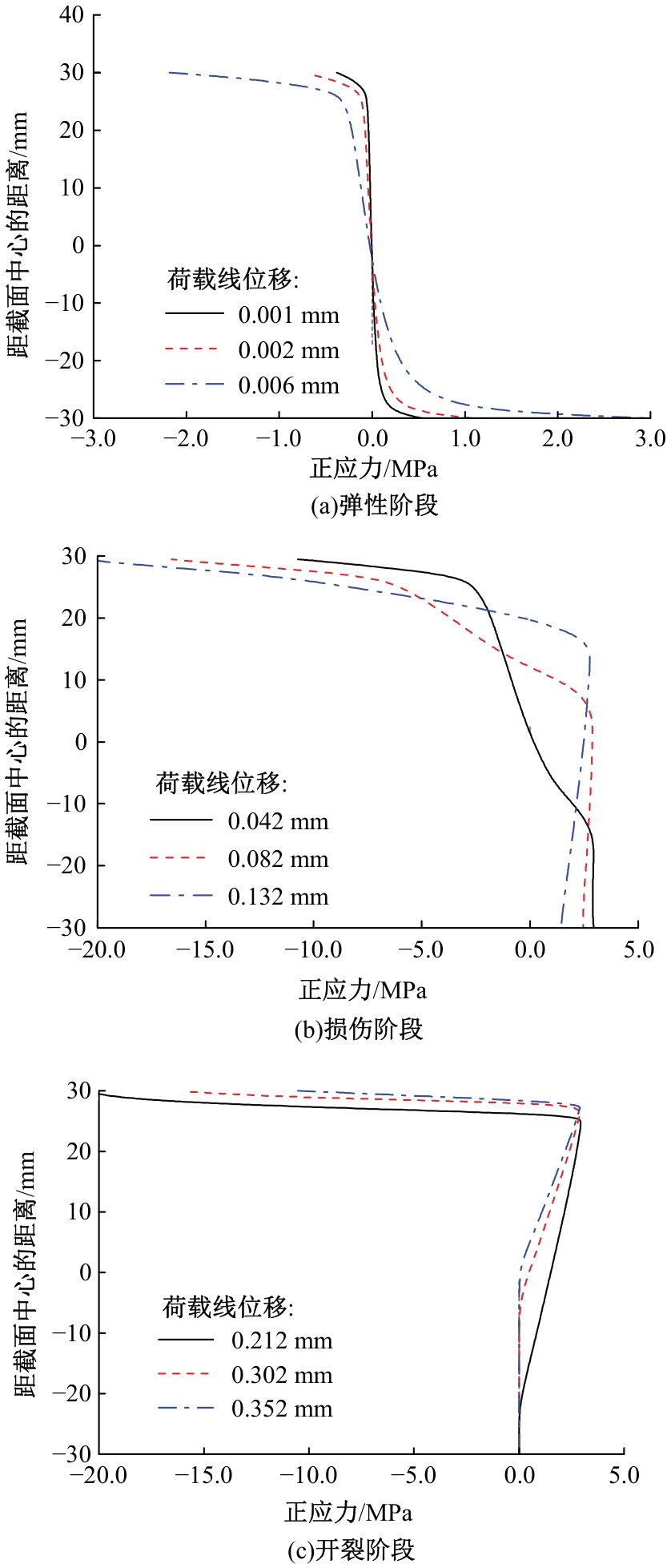
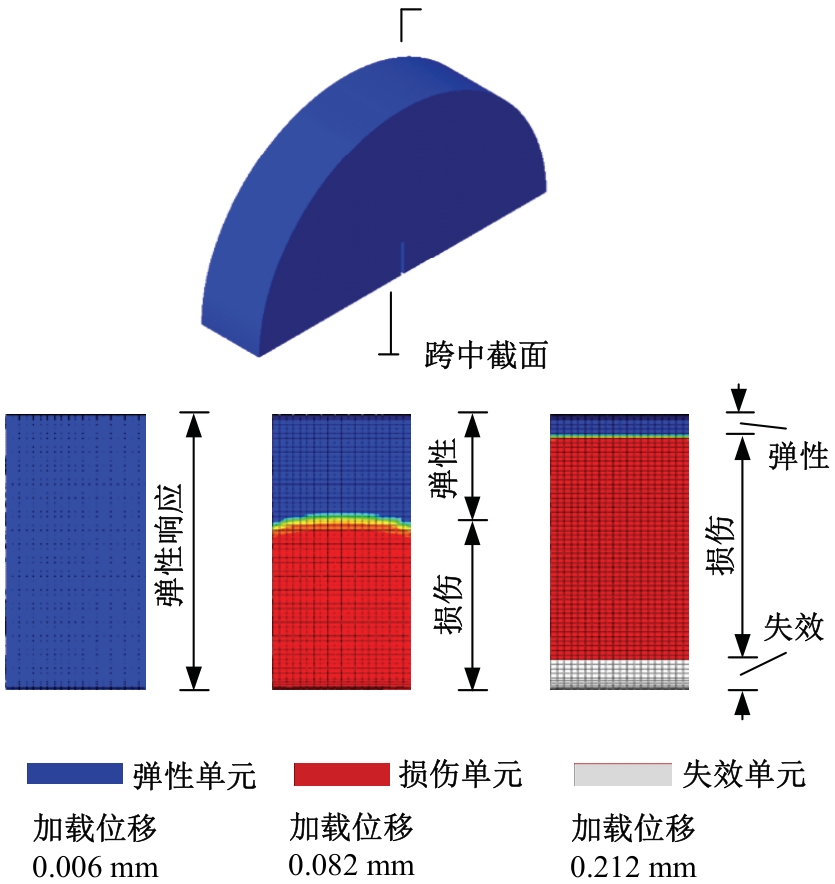
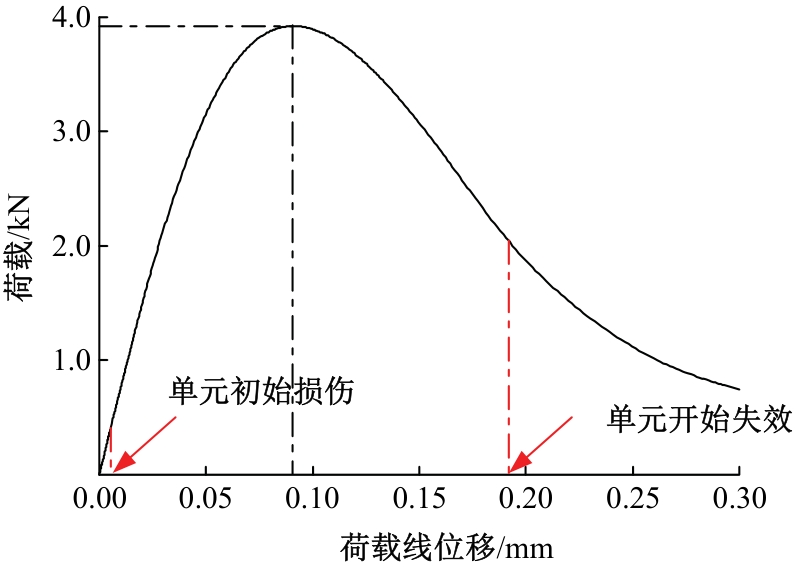
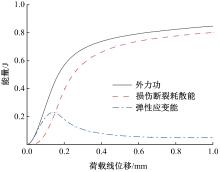
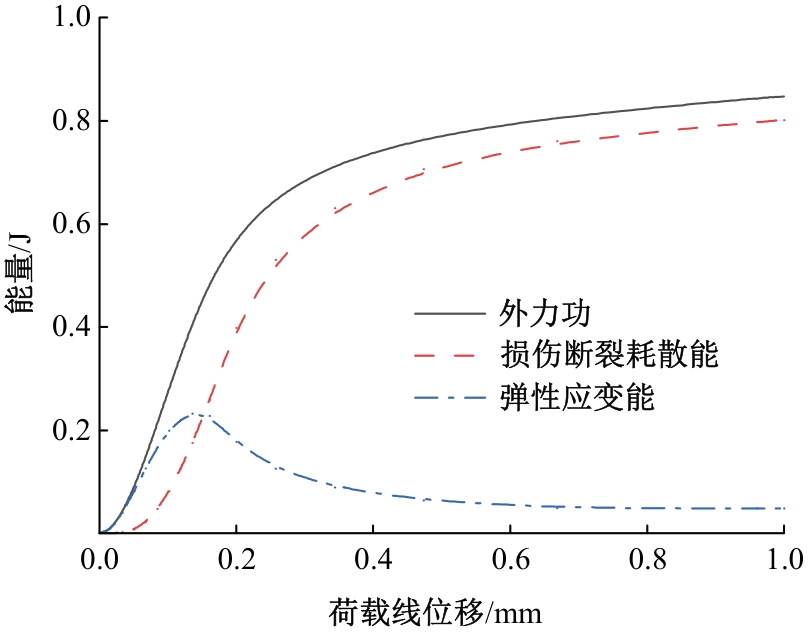
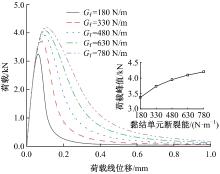
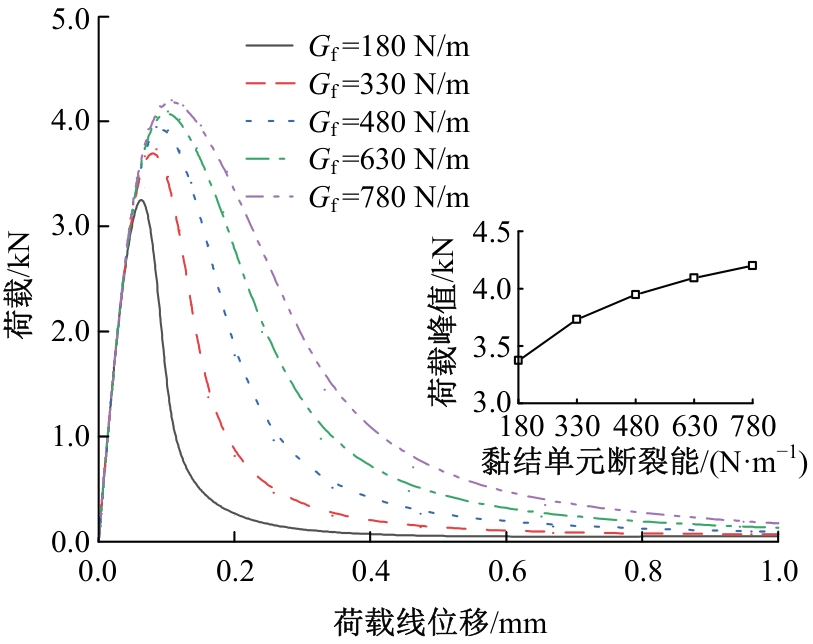
为了揭示沥青混凝土的开裂特性,基于有限元软件ABAQUS,采用双线形黏聚区模型对沥青混凝土半圆弯曲试验进行模拟,将模拟得到的荷载-线位移曲线与试验结果进行对比以验证黏聚区模型在开裂分析中的适用性,进一步分析半圆弯曲试件在开裂过程中的内部应力分布、系统能量平衡和断裂性能参数,以及黏聚区模型参数对试件荷载-线位移的影响。结果表明:双线形黏聚区模型在沥青混凝土开裂分析中具有良好适用性;在加载过程中半圆弯曲试件经历了弹性、损伤和断裂阶段,裂纹失稳扩展点并非对应峰值载荷,采用峰值载荷计算断裂韧度结果将会偏大,少部分断裂功会转换为试件未开裂区域的弹性应变能,采用断裂功计算断裂能结果也将会偏大;半圆弯曲试件开裂过程中所能承受的峰值载荷主要取决于沥青混凝土抗拉强度而非断裂能。
中图分类号:
- U416.217
| [1] | Wagoner M P, Buttlar W G, Paulino G H, et al. Investigation of the fracture resistance of hot-mix asphalt concrete using a disk-shaped compact tension test[J]. Transportation Research Record, 2005,1929: 183-192. |
| [2] | Wagoner M P, Buttlar W G, Paulino G H. Disk-shaped compact tension test for asphalt concrete fracture[J]. Experimental Mechanics, 2005, 45(3): 270-277. |
| [3] | Radeef H R, Hassan N A, Abidin A R Z, et al. Determining fracture energy in asphalt mixture: a review[C]∥IOP Conference Series: Earth and Environmental Science, Putrajaya, Malaysia,2021: 1-11. |
| [4] | Meng Y, Kong W, Gou C, et al. A review on evaluation of crack resistance of asphalt mixture by semi-circular bending test[J]. Journal of Road Engineering, 2023, 3(1): 87-97. |
| [5] | 李萍, 吴中, 马科, 等. 基于SCB试验的沥青混合料低温抗裂性研究[J]. 武汉理工大学学报:交通科学与工程版, 2015,39(2): 238-241. |
| Li Ping, Wu Zhong, Ma Ke, et al. Cracking resistant of asphalt mixture at the low temperature based on the SCB test[J]. Journal of Wuhan University of Technology (Transportation Science & Engineering), 2015,39(2): 238-241. | |
| [6] | 罗培峰. 基于半圆弯曲试验的沥青混合料断裂试验方法和评价指标研究[D]. 西安: 长安大学公路学院, 2017. |
| Luo Pei-feng. Research on the asphalt mixture crack test methods and evaluation indexes based on SCB[D]. Xi′an: School of Highway, Chang′an University, 2017. | |
| [7] | 陈巧巧, 凌天清, 何立. 基于SCB试验的沥青混合料抗裂性能影响因素研究[J]. 公路交通技术, 2018,34(4): 37-41. |
| Chen Qiao-qiao, Ling Tian-qing, He Li. Study on factors affecting crack resistance of asphalt mixture based on SCB test[J]. Technology of Highway and Transport, 2018,34(4): 37-41. | |
| [8] | 冯德成, 崔世彤, 易军艳, 等. 基于SCB试验的沥青混合料低温性能评价指标研究[J]. 中国公路学报, 2020, 33(7): 50-57. |
| Feng De-cheng, Cui Shi-tong, Yi Jun-yan, et al. Evaluation index of low-temperature asphalt mixture performance based on semi-circular bending test[J]. China Journal of Highway and Transport, 2020, 33(7): 50-57. | |
| [9] | 姜鑫龙, 杨树, 李庭予. 基于半圆弯曲试验的沥青混凝土低温性能指标研究[J]. 铁道科学与工程学报, 2022, 19(2): 428-434. |
| Jiang Xin-long, Yang Shu, Li Ting-yu. Research on low-temperature performance index of asphalt concrete based on semi-circular bending test[J]. Journal of Railway Science and Engineering, 2022, 19(2): 428-434. | |
| [10] | Vega A M M, Yang S, Braham A, et al. Evaluation of semi-circular bend geometric properties for asphalt concrete testing[J]. Journal of Materials in Civil Engineering, 2021, 33(12): No.04021342. |
| [11] | Mobasher B, Mamlouk M S, Lin H M. Evaluation of crack propagation properties of asphalt mixtures[J]. Journal of Transportation Engineering, 1997, 123(5): 405-413. |
| [12] | Yang S, Braham A F. Influence of binder grade, gradation, temperature and loading rate on R-curve of asphalt concrete[J]. Construction and Building Materials, 2017, 154:780-790. |
| [13] | Huang R, Yang S, Liu T, et al. Determination of J-integral of asphalt concrete based on SC(B) test configuration and image analysis[J]. Construction and Building Materials, 2020, 248:No. 118727. |
| [14] | . Standard test method for evaluation of asphalt mixture cracking resistance using the semi-circular bend test (SCB) at intermediate temperatures [S]. |
| [15] | AA . Determining the fracture potential of asphalt mixtures using the Illinois flexibility index test (I-FIT)[S]. |
| [16] | Ayatollahi M R, Alliha M R M, Saghafi H. An improved semi-circular bend specimen for investigating mixed mode brittle fracture[J]. Engineering Fracture Mechanics, 2011, 78(1): 110-123. |
| [17] | Ameri M, Mansourian A, Pirmohammad S, et al. Mixed mode fracture resistance of asphalt concrete mixtures[J]. Engineering Fracture Mechanics, 2012, 93: 153-167. |
| [18] | Aliha M R M, Behbahani H, Fazaeli H, et al. Study of characteristic specification on mixed mode fracture toughness of asphalt mixtures[J]. Construction and Building Materials, 2014, 54: 623-635. |
| [19] | Mehdinedjad S, Fazaeli H, Moniri A, et al. Comparison of two criteria of stress intensity factor and fracture energy to investigate the behavior of asphalt mixtures under combined tensile-shear loading modes-A statistical approach[J]. Construction and Building Materials, 2021, 290:No. 123230. |
| [20] | Liu P, Chen J, Lu G, et al. Numerical simulation of crack propagation in flexible asphalt pavements based on cohesive zone model developed from asphalt mixtures[J]. Materials, 2019, 12:No.1278. |
| [21] | Al-Qudsi A, Falchetto A C, Wang D, et al. Finite element cohesive fracture modeling of asphalt mixture based on the semi-circular bending (SCB) test and self-affine fractal cracks at low temperatures[J]. Cold Regions Science and Technology, 2020, 169: No.102916. |
| [22] | 张东, 黄晓明, 赵永利. 基于内聚力模型的沥青混合料劈裂试验模拟[J]. 东南大学学报:自然科学版, 2010, 40(6): 1276-1281. |
| Zhang Dong, Huang Xiao-ming, Zhao Yong-li. Simulation of indirect tension test of asphalt mixtures based on cohesive zone model[J]. Journal of Southeast University (Natural Science Edition), 2010, 40(6): 1276-1281. | |
| [23] | 赵永利, 张东. 基于内聚力模型的沥青路面低温缩裂研究[J]. 公路交通科技, 2010, 27(1): 11-16. |
| Zhao Yong-li, Zhang Dong. Study of low temperature cracking of asphalt pavement based on cohesive zone model[J]. Journal of Highway and Transportation Research and Development, 2010, 27(1): 11-16. | |
| [24] | 钮凯健, 李昶. 基于内聚力模型的沥青路面低温缩裂数值模拟[J]. 公路交通科技, 2012, 29(6): 11-15, 21. |
| Niu Kai-jian, Li Chang. Numerical simulation of low-temperature shrinkage cracking of asphalt pavement based on cohesive zone model[J]. Journal of Highway and Transportation Research and Development, 2012, 29(6): 11-15, 21. | |
| [25] | Song S H, Paulino G H, Buttlar W G. A bilinear cohesive zone model tailored for fracture of asphalt concrete considering viscoelastic bulk material[J]. Engineering Fracture Mechanics, 2006,73(18):2829-2848. |
| [26] | Kim H, Buttlar W G. Finite element cohesive fracture modeling of airport pavements at low temperatures[J]. Cold Regions Science and Technology, 2009,57(2):123-130. |
| [27] | Dave E V, Buttlar W G. Thermal reflective cracking of asphalt concrete overlays[J]. International Journal of Pavement Engineering, 2010,11(6):477-488. |
| [28] | Ban H, Im S, Kim Y R, et al. Laboratory tests and finite element simulations to model thermally induced reflective cracking of composite pavements[J]. International Journal of Pavement Engineering, 2017,19(3):220-230. |
| [29] | Rith M, Kim Y K, Lee S W. Reflective cracking from thermal loading in asphalt-concrete composite pavements[J]. Proceedings of the Institution of Civil Engineers-Transport, 2022,175(3):178-186. |
| [30] | Mu F, Vandenbossche J. A superimposed cohesive zone model for investigating the fracture properties of concrete-asphalt interface debonding[J]. Fatigue & Fracture of Engineering Materials & Structures, 2017, 40: 496-511. |
| [31] | Kim Y R, Aragão F T S. Microstructure modeling of rate-dependent fracture behavior in bituminous paving mixtures[J]. Finite Elements in Analysis and Design, 2013, 63: 23-32. |
| [32] | 周正峰, 蒲卓桁, 刘超. 黏聚区模型在沥青路面反射裂缝模拟中的应用[J]. 交通运输工程学报, 2018, 18(3): 5-14. |
| Zhou Zheng-feng, Pu Zhuo-heng, Liu Chao. Application of cohesive zone model to simulation reflective crack of asphalt pavement[J]. Journal of Traffic and Transportation Engineering, 2018, 18(3): 5-14. | |
| [33] | Falchetto A C, Moon K H, Lee C B, et al. Correlation of low temperature fracture and strength properties between SCB and IDT tests using a simple 2D FEM approach[J]. Road Materials and Pavement Design, 2017, 18(Sup2): 329-338. |
| [1] | 李博,梁媛,马云东,于露. 寒区高铁隧道口边坡冻融失稳智能监测预警方法[J]. 吉林大学学报(工学版), 2025, 55(9): 2985-2997. |
| [2] | 张航,孙煜,马宝林,牛世豪,王星月,吕能超. 高速公路双车道出口辅助车道长度可靠性设计[J]. 吉林大学学报(工学版), 2025, 55(8): 2611-2618. |
| [3] | 徐凌,王小兵,袁捷,任华平,韩乙锋,徐西永. 回填狭窄区粉砂基可控低强度材料制备与性能[J]. 吉林大学学报(工学版), 2025, 55(8): 2657-2668. |
| [4] | 田耀刚,蒋静,赵成,杨小敏,张军,贾侃. 水性环氧树脂改性高早强砂浆的耐温机制[J]. 吉林大学学报(工学版), 2025, 55(7): 2203-2211. |
| [5] | 姚康,董侨,陈雪琴,史斌,颜世傲,王翔. 基于相场正则化黏聚区模型的混凝土混合型细观断裂行为[J]. 吉林大学学报(工学版), 2025, 55(7): 2286-2297. |
| [6] | 龙志友,万昭龙,董是,杨超,刘肖扬. 基于变分模态分解和极端梯度提升的公路边坡位移预测[J]. 吉林大学学报(工学版), 2025, 55(7): 2320-2332. |
| [7] | 韦万峰,张洪刚,张仰鹏,杨帆,唐伯明,孔令云. 废胶粉改性沥青改性机理、制备及性能研究进展[J]. 吉林大学学报(工学版), 2025, 55(6): 1834-1853. |
| [8] | 杨轸,郑瑞平,巩喆. 路网道路服役性能和交通状态耦合仿真预测[J]. 吉林大学学报(工学版), 2025, 55(6): 1973-1983. |
| [9] | 赵勇,金文明,郑祺峰,寇淑清. 裂解槽深度对减速器壳体轴承座裂解性能的影响[J]. 吉林大学学报(工学版), 2025, 55(5): 1552-1558. |
| [10] | 张安顺,付伟,张军辉,高峰. 长沙压实黏土剪切特性及应力-应变关系表征[J]. 吉林大学学报(工学版), 2025, 55(5): 1604-1616. |
| [11] | 王黎明,宋子坤,周辉,魏文,袁浩. 超声处置石油沥青的流变学响应及响应机理[J]. 吉林大学学报(工学版), 2025, 55(4): 1346-1355. |
| [12] | 徐俊鹏,郑传峰,杜艳韬,王雨航,路政,范文军. 寒区沥青混合料在水-热-力三场耦合作用下的损伤效应[J]. 吉林大学学报(工学版), 2025, 55(3): 877-887. |
| [13] | 俞靖洋,李东钊,张志清,王真,孙海林,布海玲,李明春. 环保型蓄盐沥青混合料性能损伤演变[J]. 吉林大学学报(工学版), 2025, 55(3): 888-898. |
| [14] | 杨彦海,李百川,杨野,王崇骅,岳靓. 基于虚拟劈裂试验的集料椭球表面基构造[J]. 吉林大学学报(工学版), 2025, 55(2): 653-663. |
| [15] | 念腾飞,韩召,魏智强,王国伟,戈锦果,李萍. 考虑骨料形态的沥青混合料细观数值建模方法[J]. 吉林大学学报(工学版), 2025, 55(2): 639-652. |
|
||