吉林大学学报(工学版) ›› 2026, Vol. 56 ›› Issue (3): 819-829.doi: 10.13229/j.cnki.jdxbgxb.20240926
• 计算机科学与技术 • 上一篇
基于高效门控与目标区域关注的实时视频超分辨率
林乐平1,2( ),苏治2,欧阳宁1,2()
- 1.桂林电子科技大学 广西无线宽带通信与信号处理重点实验室,广西 桂林 541004
2.桂林电子科技大学 信息与通信学院,广西 桂林 541004
Efficient gating and target region attention based real-time video super-resolution
Le-ping LIN1,2(),Zhi SU2,Ning OUYANG1,2()
- 1.Guangxi Key Laboratory of Wireless Broadband Communication and Signal Processing,Guilin University of Electronic Technology,Guilin 541004,China
2.School of Information and Communication,Guilin University of Electronic Technology,Guilin 541004,China
摘要:
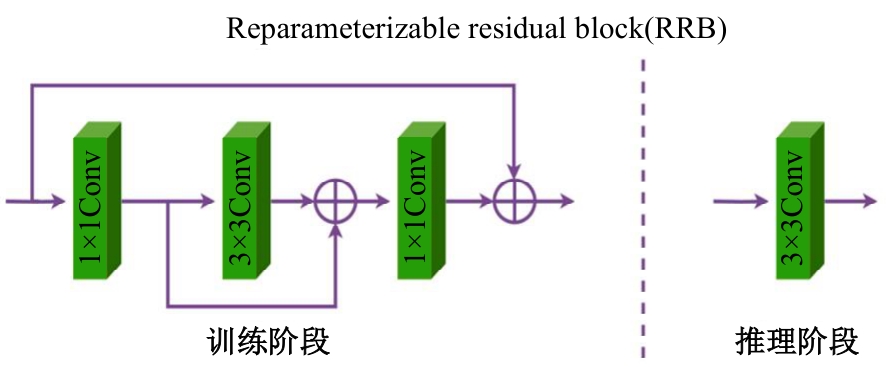
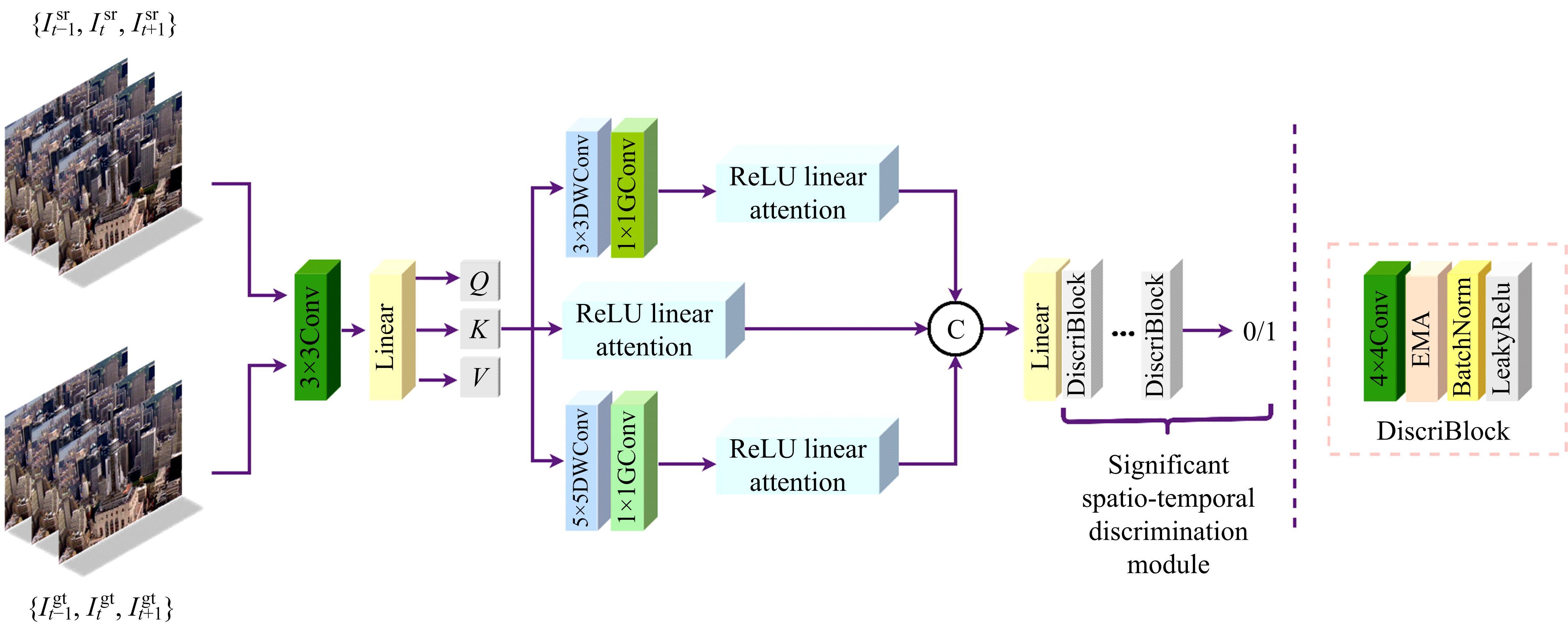
面对大运动幅度的复杂视频场景,实时视频超分辨率算法难以重建纹理细节、遮挡区域。本文基于生成对抗网络,提出了一种基于高效门控与目标区域关注的实时视频超分辨率方法。该方法首先使用高效门控重建网络作为生成网络,在保持高效的同时,通过简化的门控机制自适应选择复杂区域信息,以提升重建结果。进一步地,该方法提出了目标区域关注鉴别网络,为生成网络提供多尺度及时空信息反馈,通过多尺度机制和ReLU线性注意力获取复杂视频的多尺度信息;通过显著时空鉴别模块,限制鉴别网络关注复杂区域,以更好地获取复杂区域的时空信息。实验结果表明,所提方法相较于其他先进算法具有显著的优越性;在模型效率方面,实现了13.36 ms的推理延迟及65.806的实时得分,显示了模型高效的实时性能。
中图分类号:
- TP391.4

| [1] | Claudio Rota, Marco Buzzelli, Simone Bianco, et al. Video restoration based on deep learning: a comprehensive survey[J]. Artificial Intelligence Review, 2023, 56(6): 5317-5364. |
| [2] | Caballero J, Ledig C, Aitken A P, et al. Real-time video super-resolution with spatio-temporal networks and motion compensation[C]∥Proceedings of the IEEE Conference on Computer Vision and Pattern Recognition, 2017: 4778-4787. |
| [3] | Vemulapalli R, Brown M, Mehdi S M. Frame-recurrent video super-resolution[C]∥Proceedings of the IEEE Conference on Computer Vision and Pattern Recognition, Salt Lake City, UT, USA,2018: 6626-6634. |
| [4] | Wang L, Guo Y, Liu L, et al. Deep video super-resolution using HR optical flow estimation[J].IEEE Transactions on Image Processing, 2020, 29: 4323-4336. |
| [5] | Chan K C K, Wang X, Yu K, et al. Basicvsr: the search for essential components in video super-resolution and beyond[C]∥Proceedings of the IEEE/CVF Conference on Computer Vision and Pattern Recognition, TN, USA, 2021: 4947-4956. |
| [6] | Chan K C K, Zhou S, Xu X,et al. Basicvsr++: improving video super-resolution with enhanced propagation and alignment[C]∥Proceedings of the IEEE/CVF Conference on Computer Vision and Pattern Recognition, New Orleans, LA, USA,2022: 5972-5981. |
| [7] | Ouyang Ning, Zhi-shan Ou, Lin Le-ping. Video super-resolution network with gated high-low resolution frames[J]. Applied Sciences, 2023, 13(14): 1-16. |
| [8] | Zhou X, Zhang L, Zhao X,et al. Video super-resolution transformer with masked inter & intra-frame attention[C]∥Proceedings of the IEEE/CVF Conference on Computer Vision and Pattern Recognition, 2024: 25399-25408. |
| [9] | Cao Y, Wang C, Song C, et al. Real-time super-resolution system of 4k-video based on deep learning[C]∥2021 IEEE 32nd International Conference on Application-Specific Systems, Architectures and Processors(ASAP), NJ, USA, 2021: 69-76 |
| [10] | Xia Bin, He Jing-wen, Zhang Yu-lun, et al. Structured sparsity learning for efficient video super-resolution[C]//Proceedings of the IEEE/CVF Conference on Computer Vision and Pattern Recognition. Vancouver, Canada. 2023: 22638-22647 |
| [11] | Xiao Jun, Jiang Xin-yang, Zheng Ning-xin, et al.Online video super-resolution with convolutional kernel bypass grafts[J]. IEEE Transactions on Multimedia, 2023, 25: 8972-8987. |
| [12] | Li Gen, Ji Jie, Qin Ming-hai, et al. Towards high-quality and efficient video super-resolution via spatial-temporal data overfitting[C]//2023 IEEE/CVF Conference on Computer Vision and Pattern Recognition (CVPR). IEEE, Vancouver, Canada. 2023: 10259-10269. |
| [13] | Chu Meng-yu, Xie You, Laura Leal-Taixé, et al. Temporally coherent gans for video super-resolution (tecogan)[J]. arXiv Preprint, 2018, 1(2): 3. |
| [14] | Chen Rui, Mu Yang, Zhang Yan. High-order relational generative adversarial network for video super-resolution[J]. Pattern Recognition, 2024, 146: 110059. |
| [15] | Chen L, Chu X, Zhang X,et al. Simple baselines for image restoration[C]∥European Conference on Computer Vision. Cham: Springer, 2022: 17-33. |
| [16] | Ding X, Zhang X, Han J, et al. Diverse branch block: Building a convolution as an inception-like unit[C]∥Proceedings of the IEEE/CVF Conference on Computer Vision and Pattern Recognition, TN, USA, 2021: 10881-10890,. |
| [17] | Cai H, Li J, Gan C, et al. Efficientvit: Lightweight multi-scale attention for high-resolution dense prediction[C]//Proceedings of the IEEE/CVF International Conference on Computer Vision. Paris, France. 2023: 17302-17313. |
| [18] | Ouyang D, He S, Zhan J, et al. Efficient multi-scale attention module with cross-spatial learning[C]∥ICASSP 2023-2023 IEEE International Conference on Acoustics, Speech and Signal Processing (ICASSP). ArXiv, 2023, abs/2305.13563. |
| [19] | Xue Tian-fan, Chen Bai-an, Wu Jia-jun, et al. Video enhancement with task-oriented flow[J]. International Journal of Computer Vision, 2019, 127: 1106-1125. |
| [20] | Liu Ce, Sun De-qing. On Bayesian adaptive video super resolution[J]. IEEE Transactions on Pattern Analysis and Machine Intelligence, 2013, 36(2): 346-360. |
| [21] | Yi P, Wang Z, Jiang K,et al. Progressive fusion video super-resolution network via exploiting non-local spatio-temporal correlations[C]∥Proceedings of the IEEE/CVF International Conference on Computer Vision,Seoul, Korea (South), 2019: 3106-3115. |
| [22] | Nah S, Baik S, Hong S,et al. Ntire 2019 challenge on video deblurring and super-resolution: Dataset and study[C]∥Proceedings of the IEEE/CVF Conference on Computer Vision and Pattern Recognition Workshops, Long B, CA, USA, 2019, 1996-2005. |
| [23] | Ignatov A, Romero A, Kim H,et al. Real-time video super-resolution on smartphones with deep learning, Mobile AI2021 challenge: Report[C]∥Proceedings of the IEEE/CVF Conference on Computer Vision and Pattern Recognition, Nashville, TN, USA, 2021: 2535-2544. |
| [1] | 张刘,梁嘉新,刘赫,张贵祥,刘威,李岩,章家保. 基于实时星点定位的感兴趣区域星图压缩方法[J]. 吉林大学学报(工学版), 2026, 56(3): 802-810. |
| [2] | 林琳,陈雨欣,佴威至. 基于手势帧序列提取的自适应实时手势分类算法[J]. 吉林大学学报(工学版), 2025, 55(9): 3042-3048. |
| [3] | 朴燕,康继元. RAUGAN:基于循环生成对抗网络的红外图像彩色化方法[J]. 吉林大学学报(工学版), 2025, 55(8): 2722-2731. |
| [4] | 肖红,刘显德. 基于混合智能的学习状态实时采集与动态分析方法[J]. 吉林大学学报(工学版), 2025, 55(7): 2402-2408. |
| [5] | 文斌,彭顺,杨超,沈艳军,李辉. 多深度自适应融合去雾生成网络[J]. 吉林大学学报(工学版), 2025, 55(6): 2103-2113. |
| [6] | 赵靖华,刘妲,周宇麒,闻龙,刘倩妤,刘捷,解方喜. 基于高斯过程回归进气量预测的空燃比控制[J]. 吉林大学学报(工学版), 2025, 55(6): 1854-1861. |
| [7] | 刘广文,赵绮莹,王超,高连宇,才华,付强. 基于渐进递归的生成对抗单幅图像去雨算法[J]. 吉林大学学报(工学版), 2025, 55(4): 1363-1373. |
| [8] | 季渊,虞雅淇. 基于密集卷积生成对抗网络与关键帧的说话人脸视频生成优化算法[J]. 吉林大学学报(工学版), 2025, 55(3): 986-992. |
| [9] | 严利民,金炜烨. 基于块方向预测的AV1快速帧内编码算法[J]. 吉林大学学报(工学版), 2025, 55(3): 993-1000. |
| [10] | 赵宏,马宇轩,宋馥荣. 基于Diff-AdvGAN的图像对抗样本生成方法[J]. 吉林大学学报(工学版), 2025, 55(12): 4052-4062. |
| [11] | 罗向龙,魏欣语,赵茂军,刘若辰. 融合对比学习和生成对抗网络的图像去雾算法[J]. 吉林大学学报(工学版), 2025, 55(10): 3296-3308. |
| [12] | 张曦,库少平. 基于生成对抗网络的人脸超分辨率重建方法[J]. 吉林大学学报(工学版), 2025, 55(1): 333-338. |
| [13] | 温晓岳,钱国敏,孔桦桦,缪月洁,王殿海. TrafficPro:一种针对城市信控路网的路段速度预测框架[J]. 吉林大学学报(工学版), 2024, 54(8): 2214-2222. |
| [14] | 赖丹晖,罗伟峰,袁旭东,邱子良. 复杂环境下多模态手势关键点特征提取算法[J]. 吉林大学学报(工学版), 2024, 54(8): 2288-2294. |
| [15] | 郭昕刚,何颖晨,程超. 抗噪声的分步式图像超分辨率重构算法[J]. 吉林大学学报(工学版), 2024, 54(7): 2063-2071. |
|
||