吉林大学学报(工学版) ›› 2025, Vol. 55 ›› Issue (6): 2103-2113.doi: 10.13229/j.cnki.jdxbgxb.20230813
多深度自适应融合去雾生成网络
文斌1,2( ),彭顺1,2,杨超1(),沈艳军1,李辉3
- 1.三峡大学 电气与新能源学院,湖北 宜昌 443002
2.湖北省输电线路工程技术研究中心,湖北 宜昌 443002
3.电子科技大学 航空航天学院,成都 611731
Multi⁃depth adaptive fusion dehazing generation network
Bin WEN1,2(),Shun PENG1,2,Chao YANG1(),Yan-jun SHEN1,Hui LI3
- 1.School of Electrical and New Energy,China Three Gorges University,Yichang 443002,China
2.Hubei Provincial Engineering Technology Research Center for Power Transmission Line,Yichang 443002,China
3.School of Aeronautics and Astronautics,University of Electronic Science and Technology of China,Chengdu 611731,China
摘要:
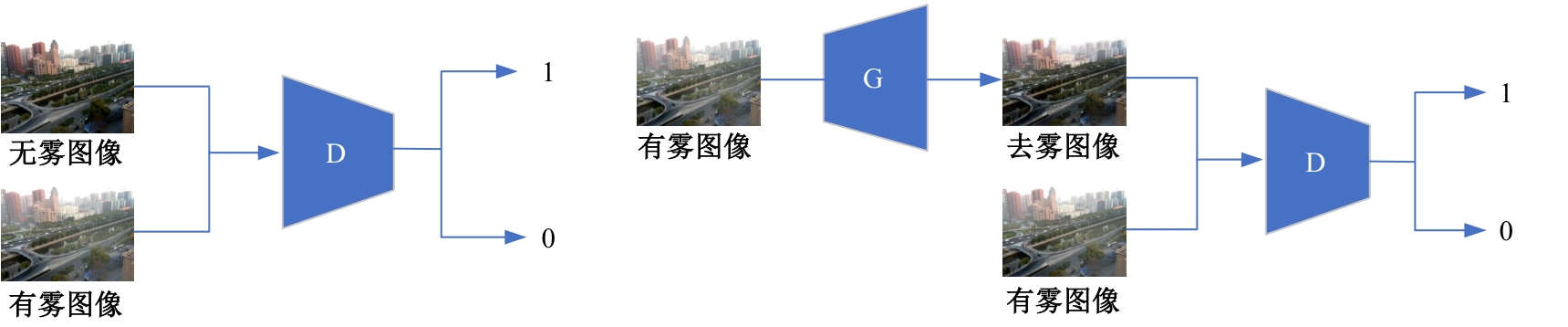
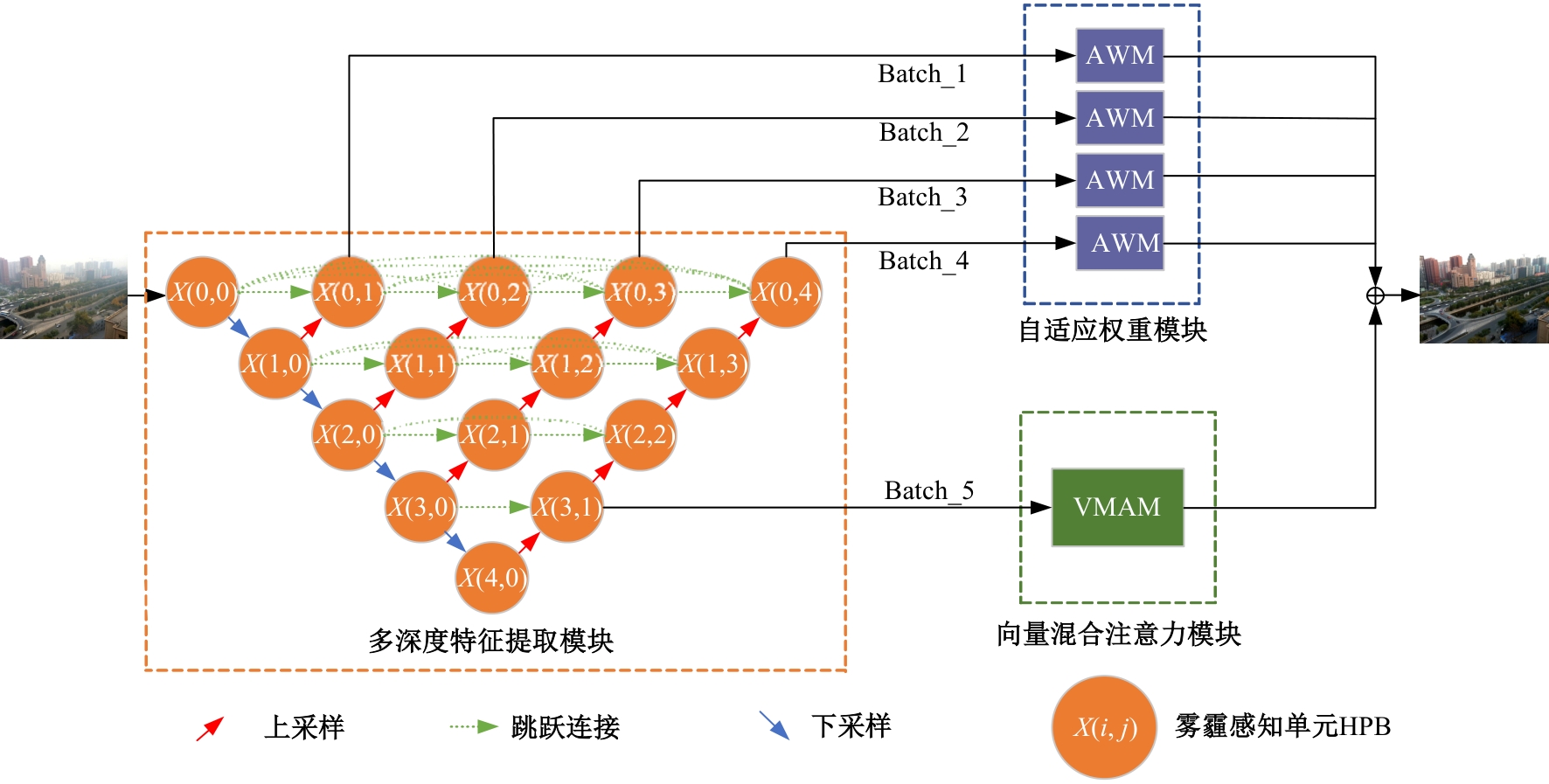
针对图像去雾不彻底和失真等问题,采用生成对抗的训练方式,提出了一种多深度自适应融合的去雾生成网络。首先,采用U-Net++结构和雾霾感知单元来学习雾霾特征。其次,提出一种向量混合注意力模块扩张底层信息,补充去雾图像的细节;再次,从部分和整体维度构建自适应权重来选取不同深度的特征,提升网络对有效信息的利用率;最后,采用混合损失来确保生成图像的质量,并在对抗损失中引入Wasserstein距离。为了验证本文算法的有效性,在RESIDE和Haze4k数据集上将本文算法和10种主流去雾算法进行客观定量对比,然后在真实图像上进行主观评价。实验结果表明:在SOTS Outdoor验证集上PSNR达到36.20 dB,SSIM达到0.988 4,具有更好的去雾效果。
中图分类号:
- TP391.4

| [1] | Yao D N L, Bade A, Zolkifly I A, et al. A naive but effective post-processing approach for dark channel prior (DCP)[C]∥Data Science and Emerging Technologies: Proceedings of DaSET 2022, Petaling Jaya, Malaysia, 2022: 67-76. |
| [2] | He K M, Sun J, Tang X O. Single image haze removal using dark channel prior[J]. IEEE Transactions on Pattern Analysis and Machine Intelligence, 2011, 33(12): 2341-2353. |
| [3] | Raanan F. Dehazing using color-lines[J]. ACM Transactions on Graphics, 2014, 34(1): 1-14. |
| [4] | Tan R T. Visibility in bad weather from a single image[C]∥Proceedings of the 2008 IEEE Computer Society Conference on Computer Vision and Pattern Recognition (CVPR 2008), Anchorage, USA, 2008: 1-8. |
| [5] | Zhu Q S, Mai J M, Shao L. A fast single image haze removal algorithm using color attenuation prior[J]. 2015, 24(11): 3522-3533. |
| [6] | Cai B, Xu X, Jia K, et al. Dehazenet: an end-to-end system for single image haze removal[J]. IEEE Transactions on Image Processing, 2016, 25(11): 5187-5198. |
| [7] | Li B, Peng X, Wang Z, et al. Aod-net: all-in-One dehazing network[C]∥proceedings of the 2017 IEEE International Conference on Computer Vision (ICCV), Venice, Italy, 2017: 4780-4788. |
| [8] | Liu X, Ma Y, Shi Z, et al. Grid dehaze net: attention-based multi-scale network for image dehazing[C]∥Proceedings of the 2019 IEEE/CVF International Conference on Computer Vision (ICCV), Seoul, Korea, 2019: 7313-7322. |
| [9] | Qu Y, Chen Y, Huang J, et al. Enhanced pix2pix dehazing network[C]∥Proceedings of the IEEE/CVF Conference on Computer Vision and Pattern Recognition, Long Beach, 2019: 8152-8160. |
| [10] | Dong Y, Liu Y, Zhang H, et al. Fd-gan: generative adversarial networks with fusion-discriminator for single image dehazing[J]. Proceedings of the AAAI Conference on Artificial Intelligence, 2020, 34(7): 10729-10736. |
| [11] | Mehta A, Sinha H, Narang P, et al. HIDeGan: a hyperspectral-guided image dehazing GAN[J]. IEEE/CVF Conference on Computer Vision and Pattern Recognition Workshops (CVPRW), Seattle, USA, 2020: 846-856. |
| [12] | Qin X, Wang Z L, Bai Y C, et al. FFA-Net: feature fusion attention network for single image dehazing[J/OL]. [2023-07-22]. |
| [13] | Yang X, Yan J C, Ming Q, et al. Rethinking rotated object detection with gaussian wasserstein distance loss[J/OL]. [2023-07-23]. |
| [14] | Isola P, Zhu J Y, Zhou T, et al. Image-to-image translation with conditional adversarial networks[C]∥Proceedings of the IEEE Conference on Computer Vision and Pattern Recognition, Honolulu, USA, 2017: 5967-5976. |
| [15] | Zhao C, Shuai R, Ma L, et al. Segmentation of skin lesions image based on U-Net++[J]. Multimedia Tools and Applications, 2022, 81(6): 8691-8717. |
| [16] | Fu H X, Song G Q, Wang Y C. Improved YOLOv4 marine target detection combined with CBAM[J]. Symmetry, 2021, 13(4): No.623. |
| [17] | Li B, Ren W, Fu D, et al. Benchmarking single-image dehazing and beyond[J]. IEEE Transactions on Image Processing, 2018, 28(1): 492-505. |
| [18] | Liu Y, Zhu L, Pei S D, et al. From synthetic to real: image dehazing collaborating with unlabeled real data[J/OL]. [2023-07-23]. |
| [19] | Sun Z, Zhang Y, Bao F, et al. SADnet: semi-supervised single image dehazing method based on an attention mechanism[J]. ACM Transactions on Multimedia Computing, Communications, and Applications, 2022, 18(2): 1-23. |
| [20] | Manu C M, Sreeni K G. GANID: a novel generative adversarial network for image dehazing[J]. The Visual Computer, 2022, 39: 2923-3936. |
| [1] | 张汝波,常世淇,张天一. 基于深度学习的图像信息隐藏方法综述[J]. 吉林大学学报(工学版), 2025, 55(5): 1497-1515. |
| [2] | 薛雅丽,俞潼安,崔闪,周李尊. 基于级联嵌套U-Net的红外小目标检测[J]. 吉林大学学报(工学版), 2025, 55(5): 1714-1721. |
| [3] | 聂为之,尹斐,苏毅珊. 任务驱动下成像声呐水下目标识别方法综述[J]. 吉林大学学报(工学版), 2025, 55(4): 1163-1175. |
| [4] | 刘广文,赵绮莹,王超,高连宇,才华,付强. 基于渐进递归的生成对抗单幅图像去雨算法[J]. 吉林大学学报(工学版), 2025, 55(4): 1363-1373. |
| [5] | 程德强,刘规,寇旗旗,张剑英,江鹤. 基于自适应大核注意力的轻量级图像超分辨率网络[J]. 吉林大学学报(工学版), 2025, 55(3): 1015-1027. |
| [6] | 单泽彪,薛泓垚,刘小松,姚瑞广,陈广秋. Alpha稳定分布噪声下基于近似l0范数稀疏重构的波达方向估计[J]. 吉林大学学报(工学版), 2025, 55(3): 1093-1102. |
| [7] | 季渊,虞雅淇. 基于密集卷积生成对抗网络与关键帧的说话人脸视频生成优化算法[J]. 吉林大学学报(工学版), 2025, 55(3): 986-992. |
| [8] | 张曦,库少平. 基于生成对抗网络的人脸超分辨率重建方法[J]. 吉林大学学报(工学版), 2025, 55(1): 333-338. |
| [9] | 赖丹晖,罗伟峰,袁旭东,邱子良. 复杂环境下多模态手势关键点特征提取算法[J]. 吉林大学学报(工学版), 2024, 54(8): 2288-2294. |
| [10] | 温晓岳,钱国敏,孔桦桦,缪月洁,王殿海. TrafficPro:一种针对城市信控路网的路段速度预测框架[J]. 吉林大学学报(工学版), 2024, 54(8): 2214-2222. |
| [11] | 郭昕刚,何颖晨,程超. 抗噪声的分步式图像超分辨率重构算法[J]. 吉林大学学报(工学版), 2024, 54(7): 2063-2071. |
| [12] | 段锦,姚安妮,王震,于林韬. 改进的麻雀搜索算法优化无线传感器网络覆盖[J]. 吉林大学学报(工学版), 2024, 54(3): 761-770. |
| [13] | 肖剑,刘经纬,胡欣,齐小刚. 基于改进非洲秃鹫算法的TDOA-AOA定位[J]. 吉林大学学报(工学版), 2024, 54(12): 3558-3567. |
| [14] | 王勇,边宇霄,李新潮,徐椿明,彭刚,王继奎. 基于多尺度编码-解码神经网络的图像去雾算法[J]. 吉林大学学报(工学版), 2024, 54(12): 3626-3636. |
| [15] | 陈绵书,于录录,李晓妮,郑宏宇. 基于均匀ORB特征的回环检测算法[J]. 吉林大学学报(工学版), 2023, 53(9): 2666-2675. |
|