吉林大学学报(医学版) ›› 2026, Vol. 52 ›› Issue (1): 192-198.doi: 10.13481/j.1671-587X.20260120

• 临床研究 • 上一篇    下一篇

血浆致动脉粥样硬化指数与高血压发病风险关联性的前瞻性动态队列研究

闫金利1,闫涛1,沈媛2,祁兴月2,张楠2,李海玲3,张春发1,许蕾1,包含1(),张星光1()   

  1. 1.内蒙古医科大学公共卫生学院卫生统计学教研室,内蒙古 呼和浩特 010000
    2.内蒙古医科大学公共卫生学院卫生检验与检疫学教研室,内蒙古 呼和浩特 010000
    3.内蒙古医科大学公共卫生学院流行病学教研室,内蒙古 呼和浩特 010000
  • 收稿日期:2025-03-29 接受日期:2025-05-16 出版日期:2026-01-28 发布日期:2026-02-24
  • 通讯作者: 包含,张星光 E-mail:baohan5082@163.com;zxg311@126.com
  • 作者简介:闫金利(1997-),女,山东省泰安市人,在读硕士研究生,主要从事心血管流行病学方面的研究。
  • 基金资助:
    国家自然科学基金项目(82160639);国家自然科学基金项目(82460666);内蒙古自治区科技厅自然科学基金项目(2023QN08030);内蒙古自治区科技厅自然科学基金项目(2024QN08016);内蒙古自治区科技厅自然科学基金项目(2024MS08016);内蒙古自治区科技厅自然科学基金项目(2024MS08074);内蒙古自治区卫健委科技计划项目(202202123);内蒙古自治区卫健委科技计划项目(202201227);内蒙古自治区教育厅高等学校科学研究项目(NJZY22617);内蒙古医科大学面上项目(2020MS08048);内蒙古医科大学面上项目(YKD2021MS044);内蒙古医科大学面上项目(YKD2022MS079);内蒙古医科大学面上项目(YKD2023MS024);内蒙古医科大学学科建设项目(YKD2022XK012);内蒙古医科大学学科建设项目(YKD2023XK015);内蒙古医科大学科技创新团队项目(YKD2022TD015);内蒙古医科大学致远人才计划善学人才项目(ZY20242120);内蒙古医科大学致远人才计划治学人才项目(ZY20241204)

Prospective dynamic cohort study on correlation between atherogenic index of plasma and risk of hypertension

Jinli YAN1,Tao YAN1,Yuan SHEN2,Xingyue QI2,Nan ZHANG2,Hailing LI3,Chunfa ZHANG1,Lei XU1,Han BAO1(),Xingguang ZHANG1()   

  1. 1.Department of Health Statistics,School of Public Health,Inner Mongolia Medical University,Hohhot 010000,China
    2.Department of Health Inspection and Quarantine,School of Public Health,Inner Mongolia Medical University,Hohhot 010000,China
    3.Department of Epidemiology,School of Public Health,Inner Mongolia Medical University,Hohhot 010000,China
  • Received:2025-03-29 Accepted:2025-05-16 Online:2026-01-28 Published:2026-02-24
  • Contact: Han BAO,Xingguang ZHANG E-mail:baohan5082@163.com;zxg311@126.com

摘要:

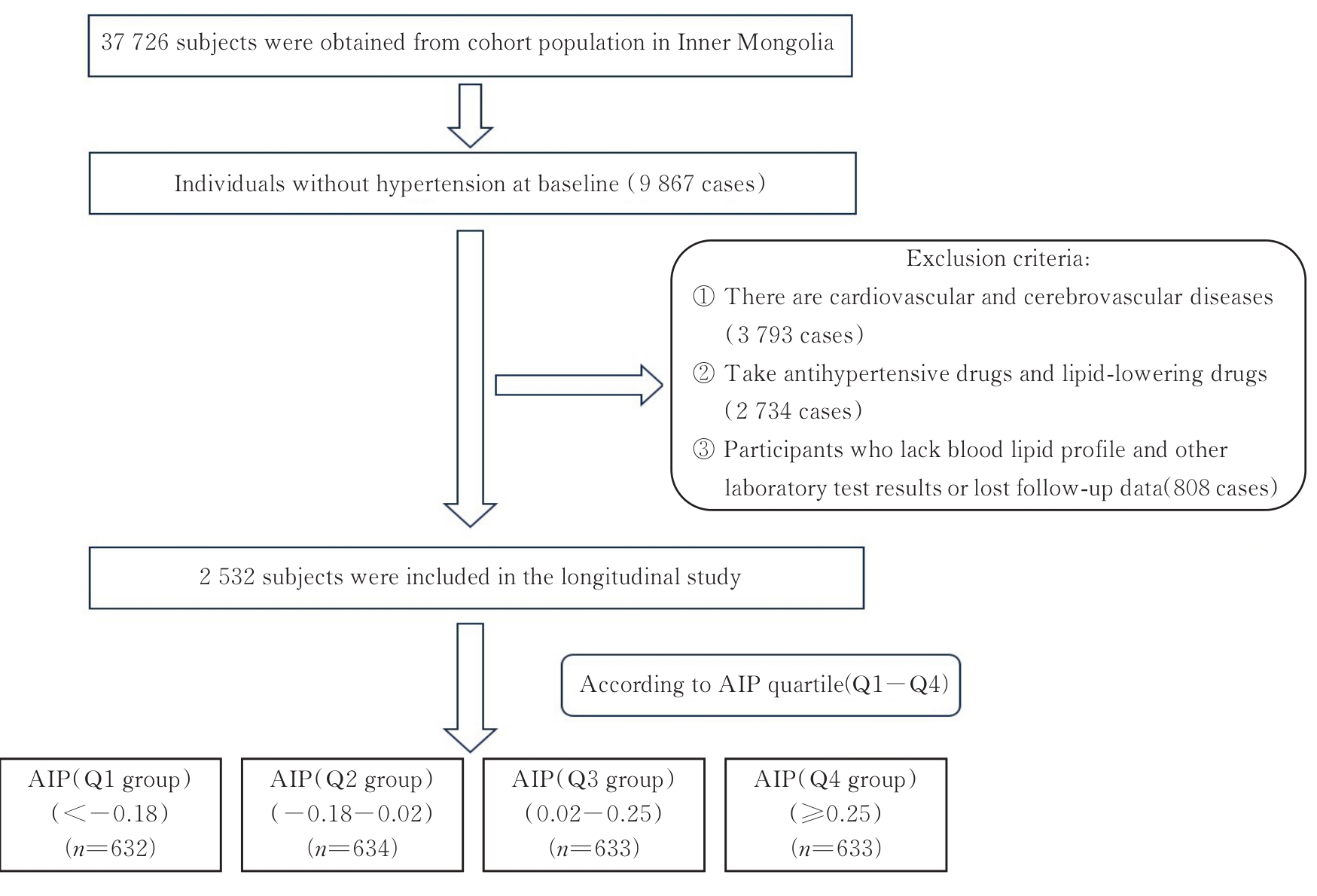
目的 探讨血浆致动脉粥样硬化指数(AIP)与高血压发病风险的关联,并阐明AIP作为高血压发病风险预测指标的应用价值。 方法 研究对象来源于采用多阶段分层整群抽样方法建立的前瞻性队列人群。根据AIP四分位数,将纳入的研究对象分为4组(Q1组、Q2组、Q3组和Q4组),并采用Cox回归模型探讨AIP与高血压发生风险的关联性,使用亚组分析和交互作用检验评估AIP与高血压发生风险关联的性别和年龄差异。 结果 本研究共纳入2 532名研究对象(Q1组632人、Q2组634人、Q3组633人、Q4组633人),中位随访时间为4.69年,其中有1 587例研究对象最终发生高血压(发病率为62.68%)。与Q1、Q2和Q3组比较,Q4组研究对象男性占比为35.70%、吸烟者占比为36.90%,体质量指数(BMI)和FPG值升高(P<0.001)。基于队列研究,通过多因素Cox回归模型分析,与Q1组比较,Q4组研究对象高血压发病风险增加24%[风险比(HR)=1.24,95%置信区间(CI)=1.07~1.44,P=0.004]。交互作用检验结果和亚组分析,年龄和性别与AIP之间存在交互作用(P<0.05);在女性人群(HR=1.42,95%CI=1.16~1.73,P=0.001)和<60岁人群(HR=1.31,95%CI=1.11~1.54,P=0.001)中,高AIP是发生高血压的危险因素。 结论 升高的AIP与较高的高血压发病风险有关,特别是较高的AIP与女性人群和<60岁人群中高血压发生密切相关。

关键词: 高血压, 血浆致动脉粥样硬化指数, 前瞻性队列研究, 预测指标, Cox回归模型

Abstract:

Objective To explore the association between atherogenic index of plasma (AIP) and the risk of hypertension, and to clarify the application value of AIP as a risk predictor for hypertension. Methods The subjects were derived from a prospective cohort population established using a multi-stage stratified cluster sampling method. Based on the AIP quartiles, the included subjects were divided into four groups (Q1 group, Q2 group, Q3 group, and Q4 group). The association between AIP and the risk of hypertension was explored using the Cox regression model, and subgroup analysis and interaction tests were employed to assess gender and age differences in this association. Results A total of 2 532 subjects were included in this study (632 in Q1 group, 634 in Q2 group, 633 in Q3 group, and 633 in Q4 group). The median follow-up time was 4.69 years, and 1 587 subjects eventually developed hypertension (the incidence rate was 62.68%). Compared with Q1, Q2, and Q3 groups, the male proportion in Q4 group was 35.70%, and a smoking proportion was 36.90%; the body mass index(BMI) and fasting plasma glucose(FPG) levels (P<0.001). Based on a cohort study and multiple factor Cox regression model analysis, compared with Q1 group, the risk of hypertension in Q4 groups was increased by 24% [hazard ratio(HR)=1.24, 95% confidence interval (CI)=1.07-1.44, P=0.004]. The interaction test results and subgroup analysis showed that there was an interaction between age and gender and AIP (P<0.05); in the female population (HR=1.42, 95%CI=1.16-1.73, P=0.001) and<60 year old population (HR=1.31, 95%CI=1.11-1.54, P=0.001), high AIP was a risk factor for developing hypertension. Conclusion An elevated AIP is associated with a higher risk of hypertension, particularly in the female and<60 year old populations where a higher AIP is closely related to the occurrence of hypertension.

Key words: Hypertension, Atherogenic index of plasma, Prospective cohort study, Predictive index, Cox regression model

中图分类号: 

  • R181