吉林大学学报(工学版) ›› 2025, Vol. 55 ›› Issue (11): 3686-3696.doi: 10.13229/j.cnki.jdxbgxb.20240222
• 计算机科学与技术 • 上一篇
基于多尺度注意力信息复用网络的胸片图像分类
张瑞峰( ),郭芳兆,李锵()
- 天津大学 微电子学院,天津 300072
Chest X-ray images classification based on multi-scale attention information multiplexing network
Rui-feng ZHANG(),Fang-zhao GUO,Qiang LI()
- School of Microelectronics,Tianjin University,Tianjin 300072,China
摘要:
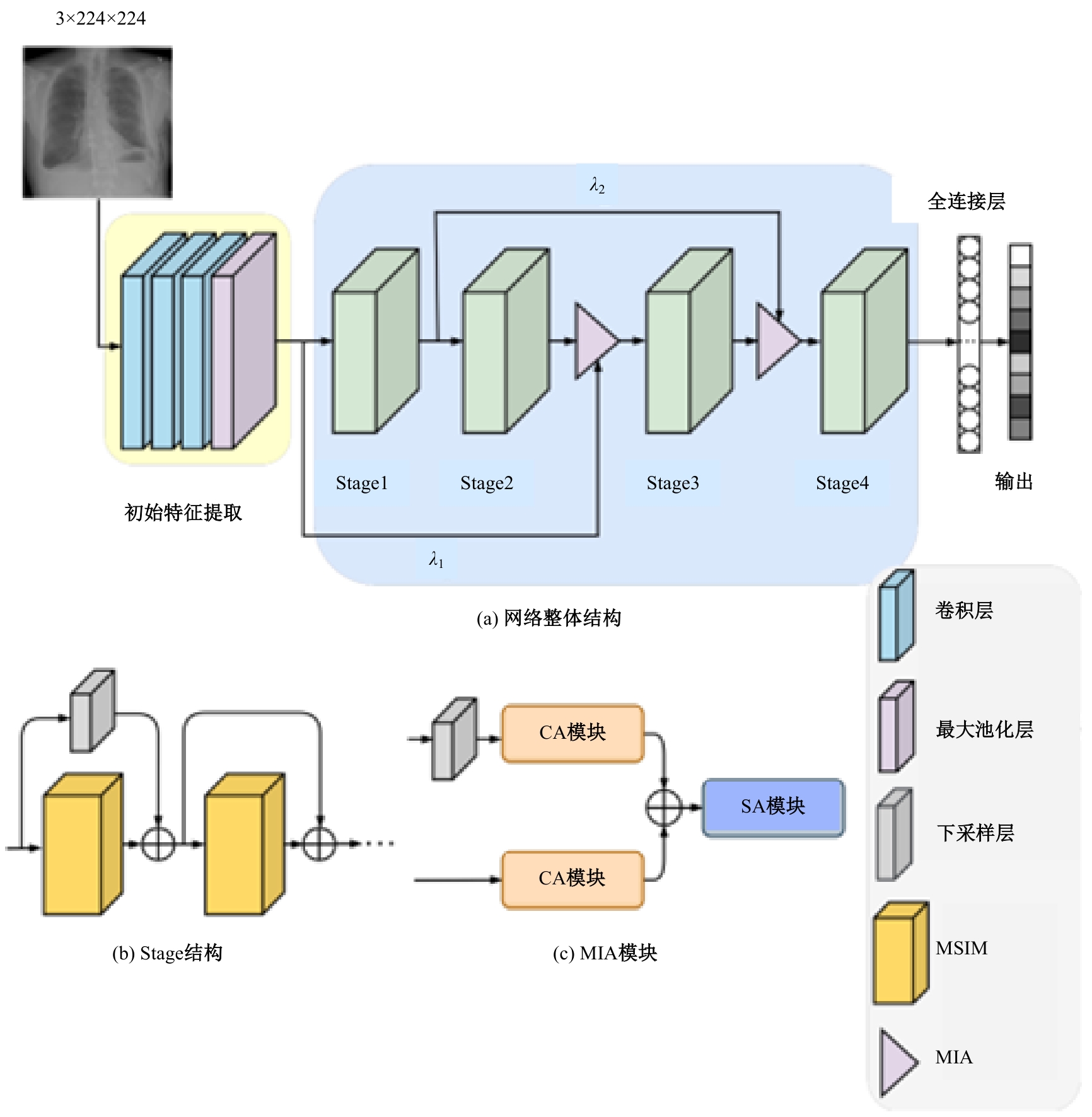
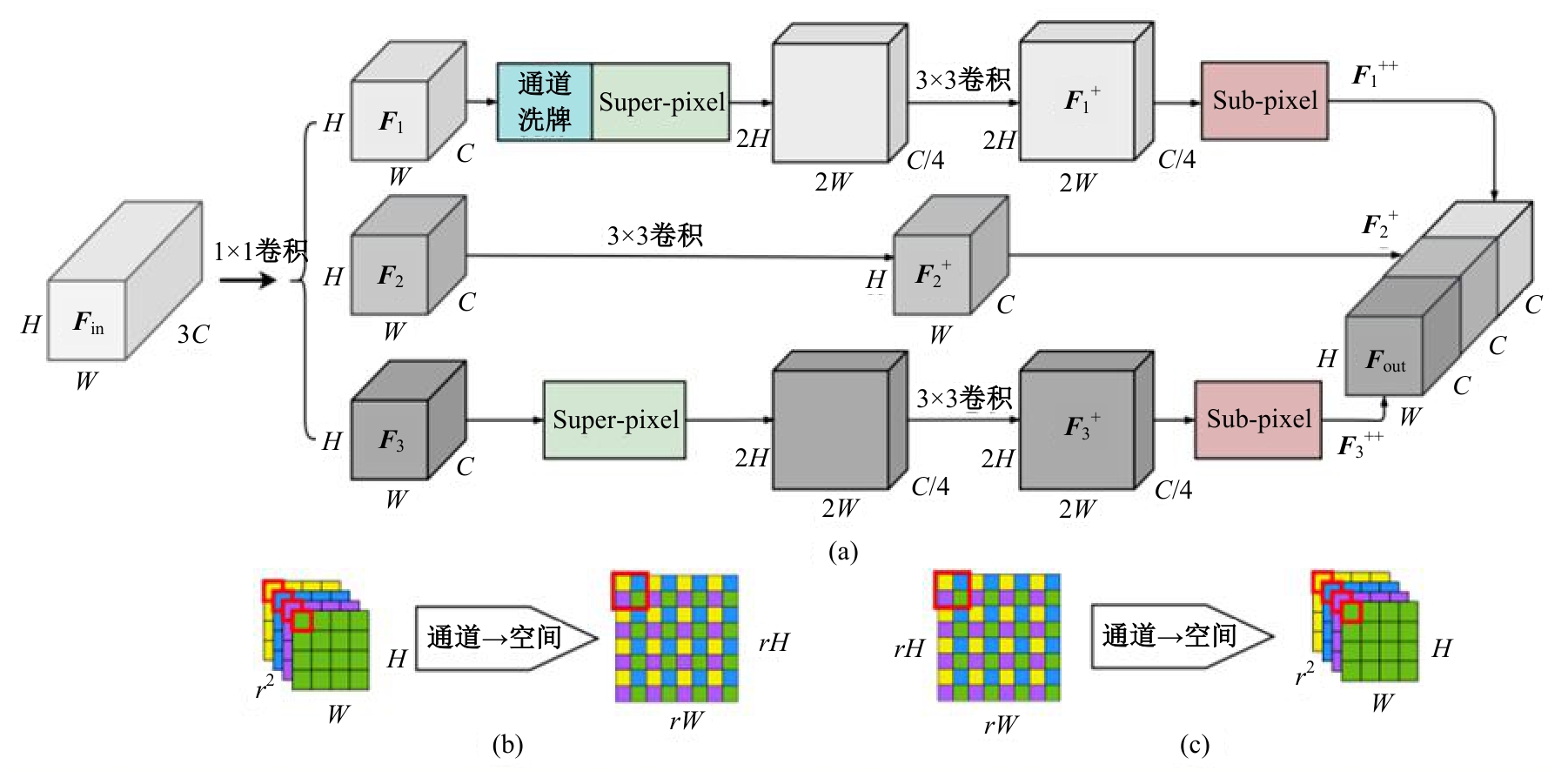
针对胸部X射线图像的病变区域辨识度低、准确捕捉病变空间位置难等问题,提出了一种有利于提高胸片图像分类精度的多尺度注意力信息复用网络。首先,通过引入多路空间信息复用模块,增强疾病部位在特征图及通道之间的位置联系;其次,通过多尺度融合注意力模块,整合多尺度图像特征信息,自动捕捉病灶位置变化,以实现对关键病理信息的灵活关注;最后,通过非对称移位焦点损失函数,缓解胸部疾病样本分布不平衡的问题。在公开数据集ChestX-ray14和CheXpert上的多组实验表明:本文网络在两个数据集上的平均AUC值分别达到0.847和0.901,优于近年来较为先进的网络模型,表明该网络能有效地提高胸部疾病的分类精度。
中图分类号:
- TP391

| [1] | Wei X L, Li W, Zhang M M, et al. Medical hyperspectral image classification based on end-to-end fusion deep neural network[J]. IEEE Transactions on Instrumentation and Measurement, 2019, 68(11): 4481-4492. |
| [2] | 刘桂霞, 田郁欣, 王涛, 等. 基于双输入3D卷积神经网络的胰腺分割算法[J]. 吉林大学学报: 工学版, 2023, 53(12): 3565-3572. |
| Liu Gui-xia, Tian Yu-xin, Wang Tao, et al. Pancreas segmentation algorithm based on dual input 3D convolutional neural network[J]. Journal of Jilin University (Engineering and Technology Edition), 2023, 53(12): 3565-3572. | |
| [3] | 王雪, 李占山, 吕颖达. 基于多尺度感知和语义适配的医学图像分割算法[J]. 吉林大学学报: 工学版, 2022, 52(3): 640-647. |
| Wang Xue, Li Zhan-shan, Ying-da Lyu. Medical image segmentation based on multi-scale context-aware and semantic adaptor[J]. Journal of Jilin University (Engineering and Technology Edition), 2022, 52(3): 640-647. | |
| [4] | Wang X S, Peng Y F, Lu L, et al. ChestX-ray8: Hospital-scale chest X-ray database and benchmarks on weakly-supervised classification and localization of common thorax diseases[C]∥IEEE Conference on Computer Vision and Pattern Recognition. Piscataway, NJ: IEEE, USA, 2017: 3462-3471. |
| [5] | Krizhevsky A, Sutskever I, Hinton E G. ImageNet classification with deep convolutional neural networks[J]. Communications of the ACM, 2017, 60(6): 84-90. |
| [6] | He K M, Zhang X Y, Ren S Q, et al. Deep residual learning for image recognition[C]∥IEEE Conference on Computer Vision and Pattern Recognition (CVPR). Piscataway, NJ: IEEE, USA, 2016: 770-778. |
| [7] | Irvin J, Rajpurkar P, Ko M, et al. CheXpert: A large chest radiograph dataset with uncertainty labels and expert comparison[C]∥Proceedings of the AAAI Conference on Artificial Intelligence Washington, DC: AAAI Press, 2019: 590-597. |
| [8] | Jiang X B, Zhu Y, Cai G, et al. MXT: A new variant of pyramid vision transformer for multi-label chest x-ray image classification[J]. Cognitive Computation, 2022, 14(4): 1362-1377. |
| [9] | Wang W H, Xie E Z, Li X, et al. Pyramid vision transformer: A versatile backbone for dense prediction without convolutions[C]∥2021 IEEE/CVF International Conference on Computer Vision. Piscataway, NJ: IEEE, 2021: 548-558. |
| [10] | 胡锦波, 聂为之, 宋丹, 等. 可形变Transformer辅助的胸部X光影像疾病诊断模型[J]. 浙江大学学报:工学版, 2023, 57(10): 1923-1932. |
| Hu Jin-bo, Nie Wei-zhi, Song Dan, et al. Chest X-ray imaging disease diagnosis model assisted by deformable transformer[J]. Journal of Zhejiang University (Engineering Science), 2023, 57(10): 1923-1932. | |
| [11] | Wang H Y, Wang S S, Qin Z B, et al. Triple attention learning for classification of 14 thoracic diseases using chest radiography[J]. Medical Image Analysis, 2021, 67: 101846. |
| [12] | Zhu X F, Pang S M, Zhang X X, et al. PCAN: Pixel-wise classification and attention network for thoracic disease classification and weakly supervised localization[J]. Computerized Medical Imaging and Graphics, 2022, 102: 102137. |
| [13] | Chen K, Wang X Q, Zhang S W. Thorax disease classification based on pyramidal convolution shuffle attention neural network[J]. IEEE Access, 2022, 10: 85571-85581. |
| [14] | Lu Z C, Deb K, Boddeti V N. MUXConv: Information multiplexing in convolutional neural networks[J]. Proceedings of the IEEE Computer Society Conference on Computer Vision and Pattern Recognition, 2020, 6: 12041-12050. |
| [15] | Woo S H, Park J, Lee J Y, et al. CBAM: Convolutional block attention module[C]∥Computer Vision-ECCV 2018. Cham, Switzerland: Springer Mature Switzerland AG, 2018: 3-19. |
| [16] | Ridnik T, Ben B E, Zamir N, et al. Asymmetric loss for multi-label classification[C]∥IEEE/CVF International Conference on Computer Vision. Piscataway, NJ: IEEE, 2021: 82-91. |
| [17] | Guan Q J, Huang Y P, Luo Y W, et al. Discriminative feature learning for thorax disease classification in chest X-ray images[J]. IEEE Transactions on Image Processing, 2021, 30: 2476-2487. |
| [18] | Lee Y W, Huang S K, Chang R F. CheXGAT: A disease correlation-aware network for thorax disease diagnosis from chest X-ray images[J]. Artificial Intelligence in Medicine, 2022, 132: 102382. |
| [19] | Chen B Z, Zhang Z, Li Y J, et al. Multi-label chest X-ray image classification via semantic similarity graph embedding[J]. IEEE Transactions on Circuits and Systems for Video Technology, 2022, 32(4): 2455-2468. |
| [20] | Pham H, Le T, Tran D, et al. Interpreting chest X-rays via CNNs that exploit hierarchical disease dependencies and uncertainty labels[J]. Neurocomputing, 2021, 437: 186-194. |
| [21] | Selvaraju R, Cogswell M, Das A, et al. Grad-CAM: Visual explanations from deep networks via gradient-based localization[C]∥IEEE International Conference on Computer Vision. Piscataway, NJ: IEEE, 2017: 618-626. |
| [1] | 张宇飞,王丽敏,赵建平,贾智尧,李明洋. 基于中心选择大逃杀优化算法的机器人逆运动学求解[J]. 吉林大学学报(工学版), 2025, 55(8): 2703-2710. |
| [2] | 李文辉,杨晨. 基于对比学习文本感知的小样本遥感图像分类[J]. 吉林大学学报(工学版), 2025, 55(7): 2393-2401. |
| [3] | 车翔玖,李良. 融合全局与局部细粒度特征的图相似度度量算法[J]. 吉林大学学报(工学版), 2025, 55(7): 2365-2371. |
| [4] | 王健,贾晨威. 面向智能网联车辆的轨迹预测模型[J]. 吉林大学学报(工学版), 2025, 55(6): 1963-1972. |
| [5] | 周丰丰,郭喆,范雨思. 面向不平衡多组学癌症数据的特征表征算法[J]. 吉林大学学报(工学版), 2025, 55(6): 2089-2096. |
| [6] | 车翔玖,孙雨鹏. 基于相似度随机游走聚合的图节点分类算法[J]. 吉林大学学报(工学版), 2025, 55(6): 2069-2075. |
| [7] | 车翔玖,武宇宁,刘全乐. 基于因果特征学习的有权同构图分类算法[J]. 吉林大学学报(工学版), 2025, 55(2): 681-686. |
| [8] | 梁礼明,周珑颂,尹江,盛校棋. 融合多尺度Transformer的皮肤病变分割算法[J]. 吉林大学学报(工学版), 2024, 54(4): 1086-1098. |
| [9] | 拉巴顿珠,扎西多吉,珠杰. 藏语文本标准化方法[J]. 吉林大学学报(工学版), 2024, 54(12): 3577-3588. |
| [10] | 叶育鑫,夏珞珈,孙铭会. 增强现实环境中基于假想键盘的手势输入方法[J]. 吉林大学学报(工学版), 2024, 54(11): 3274-3282. |
| [11] | 车娜,朱奕明,赵剑,孙磊,史丽娟,曾现伟. 基于联结主义的视听语音识别方法[J]. 吉林大学学报(工学版), 2024, 54(10): 2984-2993. |
| [12] | 薛珊,张亚亮,吕琼莹,曹国华. 复杂背景下的反无人机系统目标检测算法[J]. 吉林大学学报(工学版), 2023, 53(3): 891-901. |
| [13] | 时小虎,吴佳琦,吴春国,程石,翁小辉,常志勇. 基于残差网络的弯道增强车道线检测方法[J]. 吉林大学学报(工学版), 2023, 53(2): 584-592. |
| [14] | 王振,杨宵晗,吴楠楠,李国坤,冯创. 基于生成对抗网络的序列交叉熵哈希[J]. 吉林大学学报(工学版), 2023, 53(12): 3536-3546. |
| [15] | 周丰丰,颜振炜. 基于混合特征的特征选择神经肽预测模型[J]. 吉林大学学报(工学版), 2023, 53(11): 3238-3245. |
|
||