吉林大学学报(工学版) ›› 2026, Vol. 56 ›› Issue (2): 416-430.doi: 10.13229/j.cnki.jdxbgxb.20240775
• 交通运输工程·土木工程 • 上一篇
混合交通流环境下车辆编队与碳排放特性
张文会( ),叶梅茹,席聪,宋子文
- 东北林业大学 土木与交通学院,哈尔滨 150040
Vehicle formation and carbon emission characteristics in mixed traffic flow environment
Wen-hui ZHANG(),Mei-ru YE,Cong XI,Zi-wen SONG
- School of Civil Engineering and Transportation,Northeast Forestry University,Harbin 150040,China
摘要:
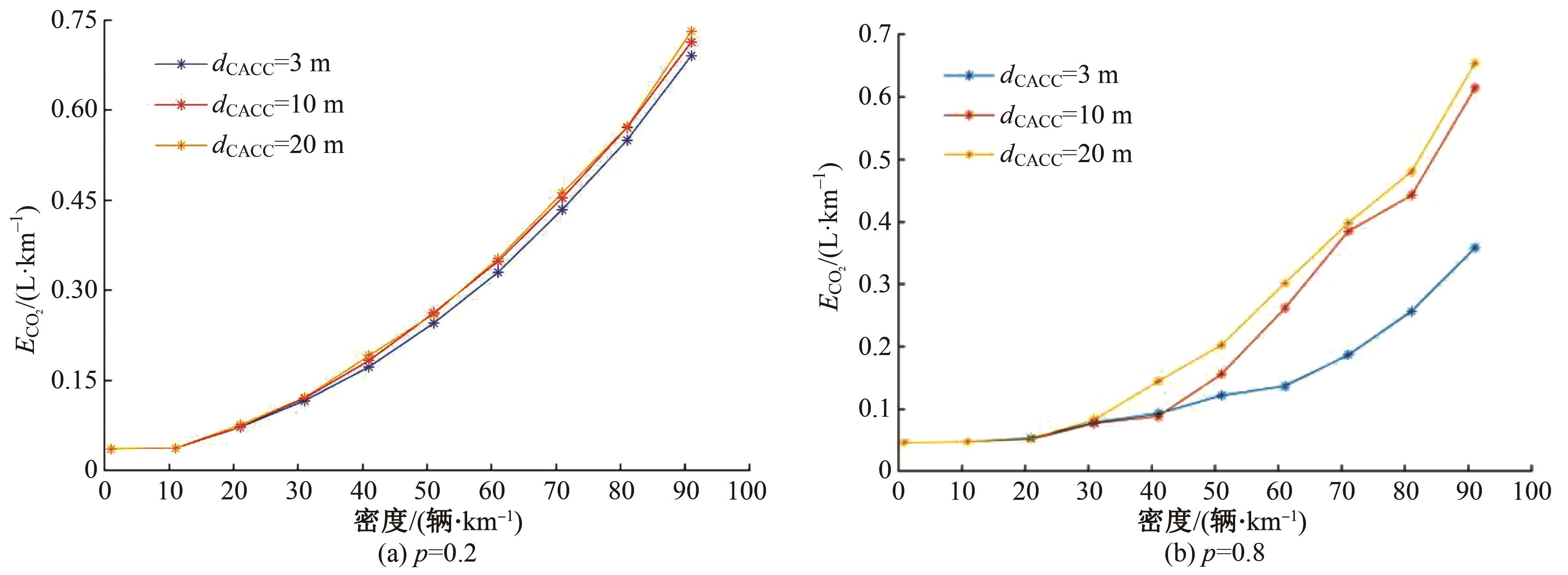
针对混合交通流中传统模型难以精准刻画车队动态演化与人工驾驶车辆(HDV)异质行为交互的问题,提出了一种融合离散运动规则与动态编队演化的混合交通流建模框架。首先,设计离散运动安全距离模型,通过元胞间距整数决策规则解决连续加速度建模的失真问题;其次,构建基于马尔可夫链的车队规模转移概率矩阵,动态表征车队分裂、合并与重组过程;最后,基于多场景仿真数据量化队内车间距、反应时间、换道行为及车队规模对CO?排放的影响机制。结果表明:当智能网联车辆(CAV)渗透率>0.6时,编队模式才能有效改善混合交通流的运行状态,并显著降低CO?排放,降幅达18.2%~25.1%;优化队内车间距可提升减排效率,减排峰值高达42.5%;换道策略需适配交通密度,低密度下提升HDV换道概率可实现碳减排,而高密度时CAV换道概率需控制在0.4~0.6;3~5辆编队规模为减排效率最优区间。本文揭示了队列动态参数对碳排放的作用机制,为智能网联车队协同控制策略优化及低碳交通系统设计提供了理论支撑。
中图分类号:
- U491

| [1] | 邱小平, 于丹, 孙若晓, 等. 基于安全距离的元胞自动机交通流模型研究[J]. 交通运输系统工程与信息, 2015, 15(2): 54-60. |
| Qiu Xiao-ping, Yu Dan, Sun Ruo-xiao, et al. Cellular automata model based on safety distance[J]. Journal of Transportation Systems Engineering and Information Technology, 2015, 15(2): 54-60. | |
| [2] | 常玉林, 张成祥, 张鹏. 车联网环境下基于间隙优化的无信号交叉口车速控制方法[J]. 重庆理工大学学报:自然科学, 2021, 35(3): 10-17. |
| Chang Yu-lin, Zhang Cheng-xiang, Zhang Peng. A speed control method of non-signalized intersection based on gap optimization under connected vehicle environment[J]. Journal of Chongqing University of Technology (Natural Science), 2021, 35(3): 10-17. | |
| [3] | 王曦, 杨秀建, 贾晓寒, 等. 面向队列实际行为特性的混合交通流建模及分析[J]. 系统仿真学报, 2024, 36(4): 929-940. |
| Wang Xi, Yang Xiu-jian, Jia Xiao-han, et al. Modeling and analysis of hybrid traffic flow considering actual behavior of platoon[J]. Journal of System Simulation, 2024, 36(4): 929-940. | |
| [4] | Hu G, Lu W, Whalin R, et al. Analytical approximation for macroscopic fundamental diagram of urban corridor with mixed human and connected & autonomous traffic[J]. IET Intelligent Transport System, 2021, 15: 261-272. |
| [5] | Qin Y, Wang H. Analytical framework of string stability of connected and autonomous platoons with electronic throttle angle feedback[J]. Transportation A: Transport Science, 2018, 17(1): 59-80. |
| [6] | Sharma A, Zheng Z D, Kim J, et al. Assessing traffic disturbance, efficiency, and safety of the mixed traffic flow of connected vehicles and traditional vehicles by considering human factors[J]. Transportation Research Part C: Emerging Technologies, 2021, 124: No.102934. |
| [7] | 杨志发, 孙勃, 樊贤俊, 等. 车路协同背景下高速公路货车车队的能耗仿真[J]. 吉林大学学报: 工学版, 2023, 53(12): 3452-3457. |
| Yang Zhi-fa, Sun Bo, Fan Xian-jun, et al. Simulation on energy consumption of truck fleet on expressway under background of vehicle-infrastructure cooperative environment[J]. Journal of Jilin University (Engineering and Technology Edition), 2023, 53(12): 3452-3457. | |
| [8] | Liang K Y, Mårtensson J, Johansson K H. Heavy-duty vehicle platoon formation for fuel efficiency[J]. IEEE Transactions on Intelligent Transportation Systems, 2016, 17(4): 1051-1061. |
| [9] | 杨秀建, 李金雨. 基于非线性模型预测控制的车辆纵向队列协调控制[J]. 汽车工程, 2020, 42(2): 184-190. |
| Yang Xiu-jian, Li Jin-yu. Coordinated control of vehicular platooning based on nonlinear model predictive control[J]. Automotive Engineering, 2020, 42(2): 184-190. | |
| [10] | 秦严严, 王昊, 冉斌. CACC车辆跟驰建模及混合交通流分析[J]. 交通运输系统工程与信息, 2018, 18(2): 60-65. |
| Qin Yan-yan, Wang Hao, Ran Bin. Car-following modeling for CACC vehicles and mixed traffic flow analysis[J]. Journal of Transportation Systems Engineering and Information Technology, 2018, 18(2): 60-65. | |
| [11] | Veldhuizen R, Raemdonck G V, Krieke V D. Fuel economy improvement by means of two European tractor semi-trailer combinations in a platooning formation[J]. Journal of Wind Engineering and Industrial Aerodynamics, 2019, 188: 217-234. |
| [12] | Zhai C J, Luo F, Liu Y G. Cooperative look-ahead control of vehicle platoon for maximizing fuel efficiency under system constraints[J]. IEEE Access, 2018, 99: 1-11. |
| [13] | 徐明诚, 徐利伟, 殷国栋, 等. 燃油车和纯电车混杂智能网联队列系统的节能与稳定控制[J]. 汽车安全与节能学报, 2024, 15(1): 71-82. |
| Xu Ming-cheng, Xu Li-wei, Yin Guo-dong, et al. Stability control and energy-saving of an intelligent networked platoon system composed of fuel vehicles and pure electric vehicles[J]. Journal of Automotive Safety and Energy, 2024, 15(1): 71-82. | |
| [14] | 蒋阳升, 王思琛, 高宽, 等. 混入智能网联车队的混合交通流元胞自动机模型[J]. 仿真学报, 2022, 34(5): 1025-1032. |
| Jiang Yang-sheng, Wang Si-chen, Gao Kuan, et al. Cellular automata model of mixed traffic flow composed of intelligent connected vehicles' platoon[J]. Journal of System Simulation, 2022, 34(5): 1025-1032. | |
| [15] | 魏丽英, 吴润泽. 基于鱼群效应的智能网联车队形成与演化机理研究[J]. 交通运输系统工程与信息, 2024, 24(2): 76-85. |
| Wei Li-ying, Wu Run-ze. Formation and evolution mechanism of connected and autonomous fleet based on fish streaming effect[J]. Journal of Transportation Systems Engineering and Information Technology, 2024, 24(2): 76-85. | |
| [16] | 惠飞, 吴丽宁, 景首才, 等. 基于轨迹数据的多工况典型驾驶行为能耗评估[J]. 计算机应用与软件, 2020, 37(5): 50-56. |
| Hui Fei, Wu Li-ning, Jing Shou-cai, et al. Energy consumption assessment of typical driving behavior under multiple driving conditions based on trajectory date[J]. Computer Applications and Software, 2020, 37(5): 50-56. |
| [1] | 慈玉生,黄轶康. 基于文献计量的交叉口车路协同研究综述[J]. 吉林大学学报(工学版), 2026, 56(2): 313-332. |
| [2] | 马壮林,毕宇明,周备,邓亚娟,兆雪. 公交换乘优惠政策下居民换乘意向的异质性分析[J]. 吉林大学学报(工学版), 2026, 56(1): 158-169. |
| [3] | 曲昭伟,王铭阳,王喆,宋现敏,张云翔,黄镜尘. 基于自动驾驶模块化车辆主辅功能分配的公交自适应调度方法[J]. 吉林大学学报(工学版), 2025, 55(9): 2946-2957. |
| [4] | 王琳虹,刘宇阳,刘子昱,鹿应佳,张宇恒,黄桂树. 基于YOLOv5的轻量化桥梁缺陷识别[J]. 吉林大学学报(工学版), 2025, 55(9): 2958-2968. |
| [5] | 张云翔,宋现敏,谢渝,湛天舒. 基于用户满意度的停车预约服务智能体行为仿真[J]. 吉林大学学报(工学版), 2025, 55(9): 2978-2984. |
| [6] | 吴德华,陈荣峰. 智能网联客货混合交通流特性及集聚换道策略[J]. 吉林大学学报(工学版), 2025, 55(8): 2588-2596. |
| [7] | 穆长儒,徐亮,程国柱. 基于能量合理分配的外包U型钢-混凝土组合护栏防撞性能[J]. 吉林大学学报(工学版), 2025, 55(8): 2669-2680. |
| [8] | 李艳波,汪静远,陈圆媛,程绍峰,吕浩楠,陈俊硕. 面向高速公路服务区自洽能源系统的RAMS评价方法[J]. 吉林大学学报(工学版), 2025, 55(7): 2243-2250. |
| [9] | 戢晓峰,邓若凡,乔新,关昊天. 建成环境对共享单车时间集聚模式的非线性影响[J]. 吉林大学学报(工学版), 2025, 55(7): 2233-2242. |
| [10] | 于江波,翁剑成,林鹏飞,孙宇星,柴娇龙. 基于混合Transformer的对外客运枢纽抵站客流预测模型[J]. 吉林大学学报(工学版), 2025, 55(7): 2251-2259. |
| [11] | 柴树山,周志强,李海涛,徐炅旸. 基于图时空模式学习网络的路网实时交通事件自动检测方法[J]. 吉林大学学报(工学版), 2025, 55(7): 2145-2161. |
| [12] | 赵红专,吴泽健,张鑫,石胜文,李文勇,展新,许恩永,王佳明. 基于密度离散度和信息传输延迟的网联商用车弯道格子模型[J]. 吉林大学学报(工学版), 2025, 55(6): 2015-2029. |
| [13] | 闫晟煜,程铭杰,田宏策,王洪瑀,周永恒,马博浩. 封闭式景区纯电动客车调度方法[J]. 吉林大学学报(工学版), 2025, 55(6): 1984-1993. |
| [14] | 潘福全,牛远征,张丽霞,杨金顺,陈秀锋,陈德启. 智能网联环境下无信号交叉口车辆通行控制策略[J]. 吉林大学学报(工学版), 2025, 55(6): 1948-1962. |
| [15] | 于树友,谢华城,李文博,李永福,陈虹,林宝君. 数字孪生驱动的商用车队列纵横向控制[J]. 吉林大学学报(工学版), 2025, 55(6): 1994-2002. |
|
||