吉林大学学报(工学版) ›› 2025, Vol. 55 ›› Issue (7): 2145-2161.doi: 10.13229/j.cnki.jdxbgxb.20230875
• 综述 •
基于图时空模式学习网络的路网实时交通事件自动检测方法
柴树山1( ),周志强1,李海涛2(),徐炅旸1
- 1.公安部道路交通安全研究中心,北京 100062
2.吉林大学 交通学院,长春 130022
Real-time road network traffic anomaly incident detection based on graph spatial-temporal pattern learning network
Shu-shan CHAI1(),Zhi-qiang ZHOU1,Hai-tao LI2(),Jiong-yang XU1
- 1.Research Institute for Road Safety of the Ministry of Public Security,Beijing 100062,China
2.College of Transportation,Jilin University,Changchun 130022,China
摘要:
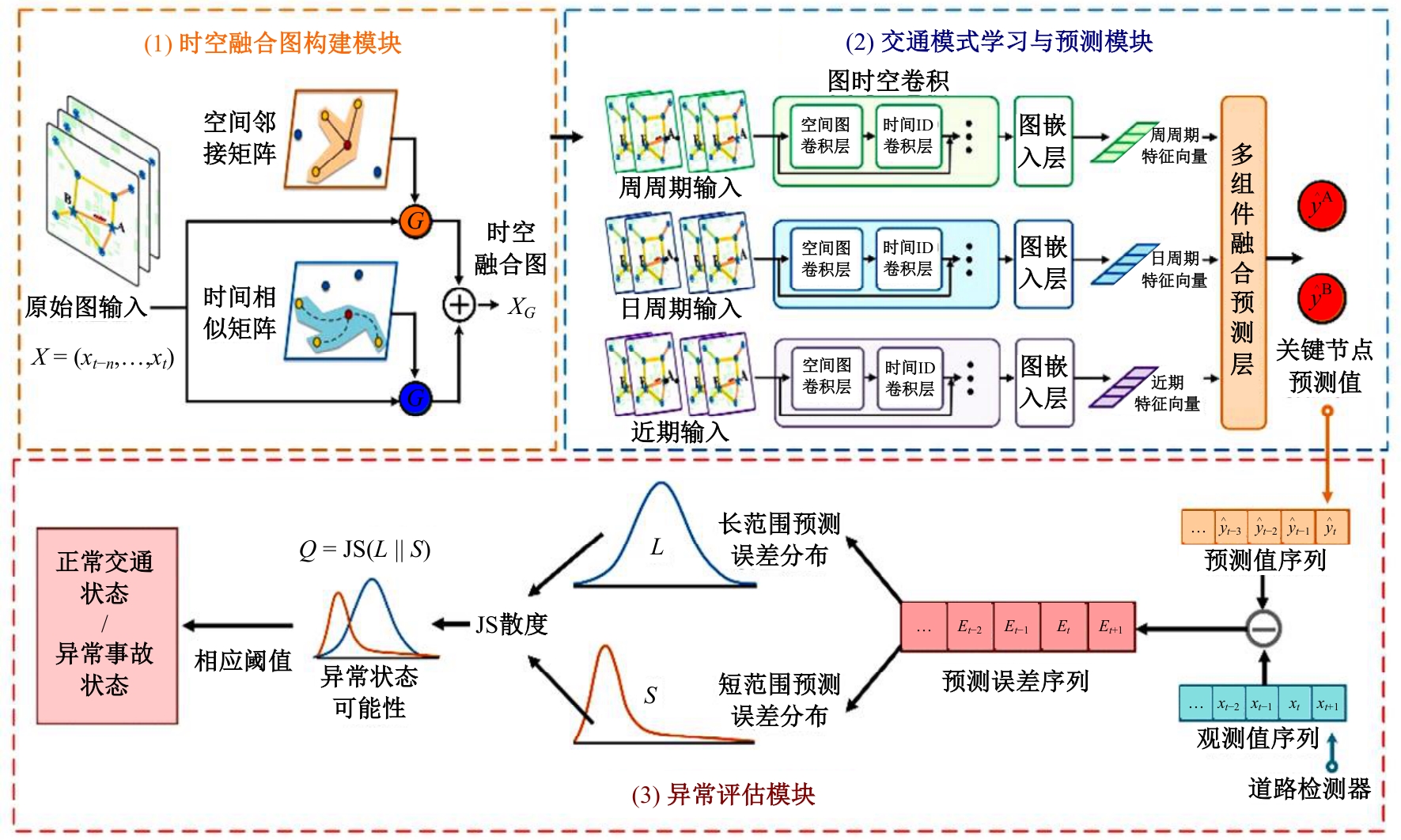
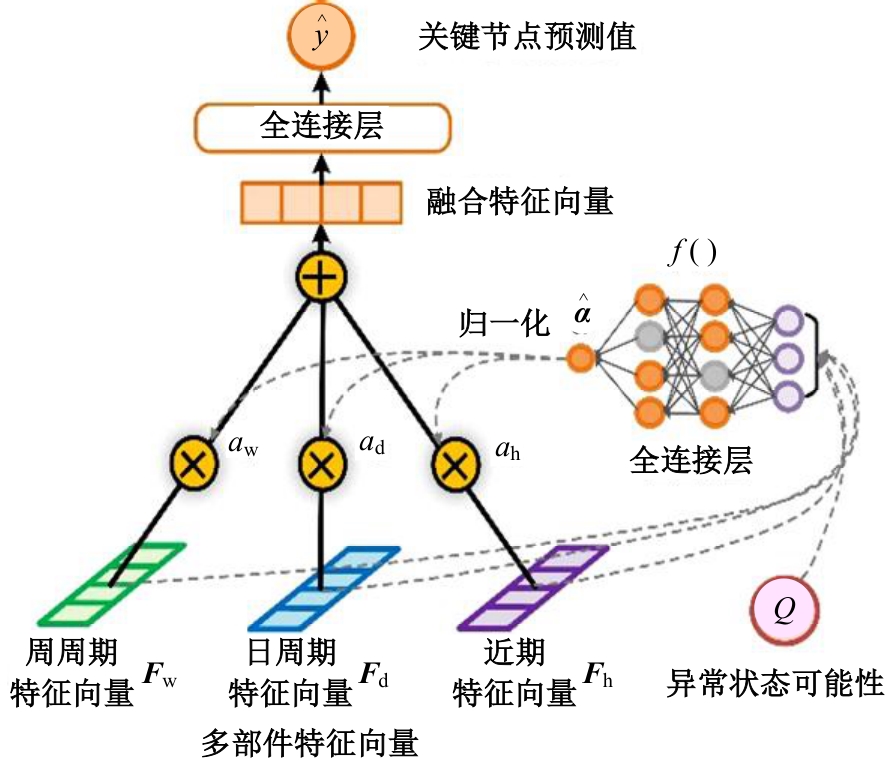
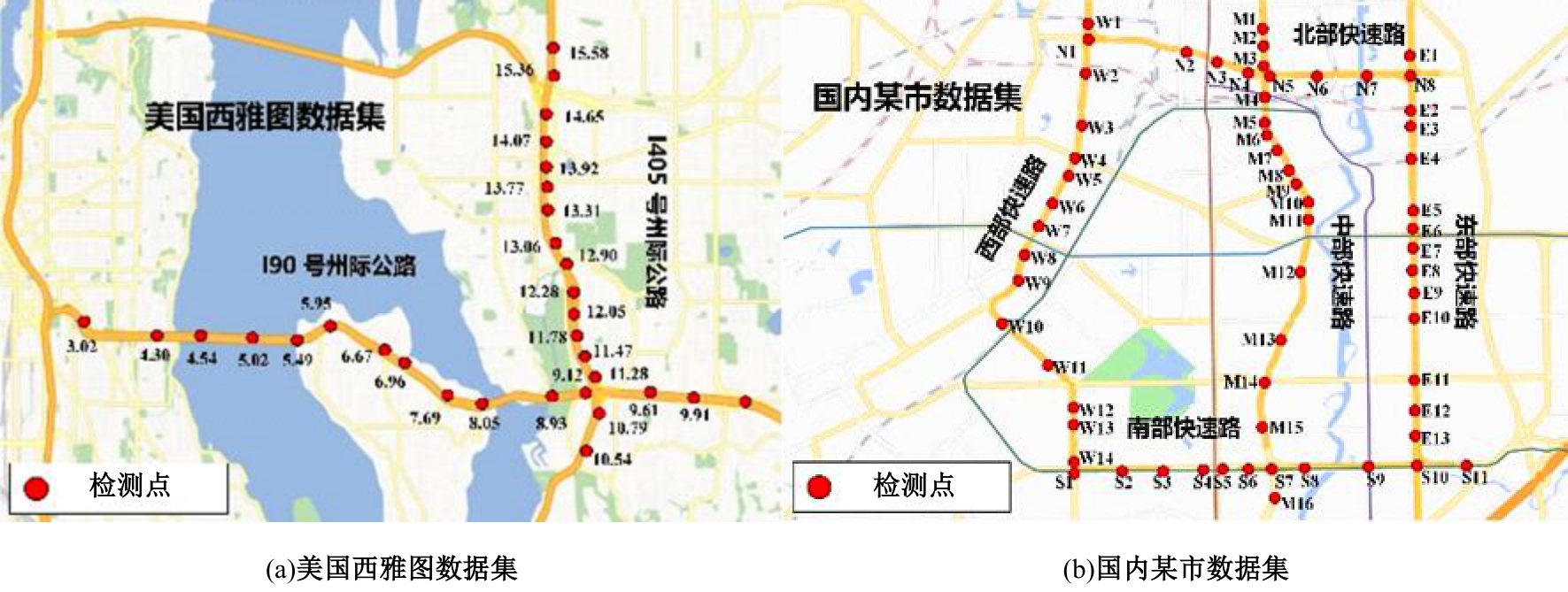
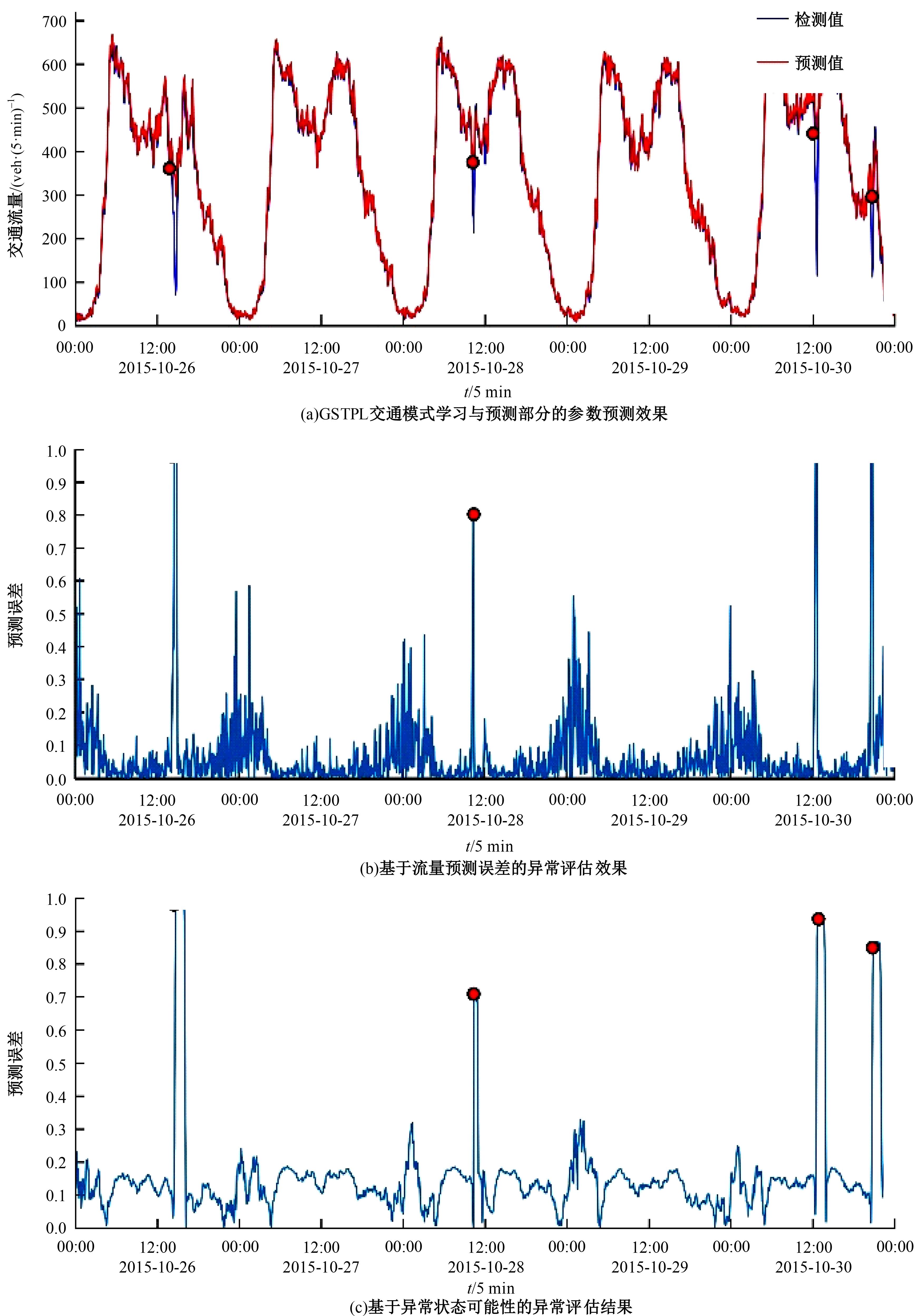
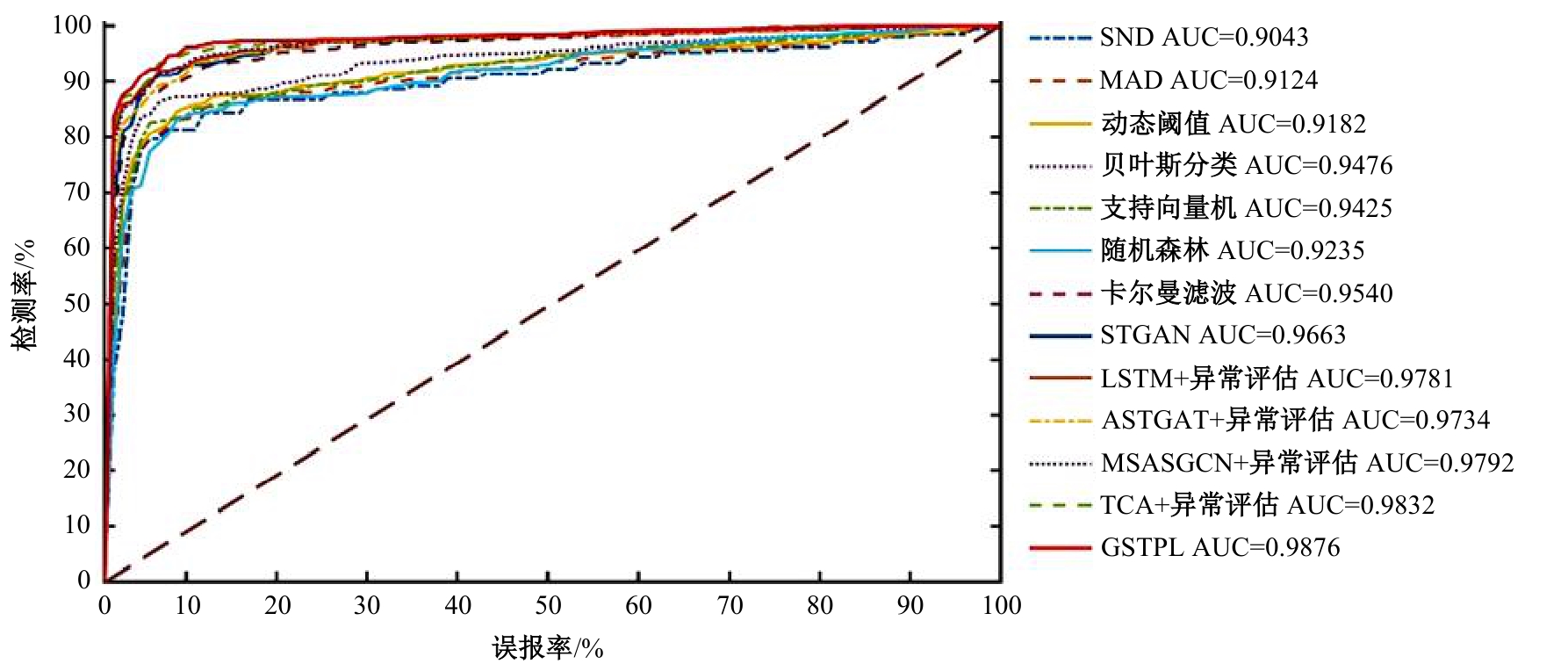
为提升路网交通异常事件的检测精度并降低误报率,提出了一种基于图时空模式学习网络(GSTPL)的路网实时交通事件自动检测方法。将路网交通事件检测问题抽象为图结构异常检测任务;设计了交通时空融合图表达方法,筛选具有强时空依赖性与模式规律性的图节点信息作为网络输入;引入图时空卷积与图嵌入层对时空模式特征进行提取,构造多组件输入与融合预测结构对不同时间维的交通模式规律进行融合;设计了异常状态评估方法,通过对模型预测误差分布的学习,结合当前检测数据给出最终的异常事件判定结果。采用2个真实交通路网数据进行算法验证,实验结果表明,提出的GSTPL交通事件检测方法具有较高的检测精度、较低的误报率与更短的平均检测时间;在可接受误检率为5%与10%时,对异常交通事件的检测率可分别达到91%与96%以上。
中图分类号:
- U458

| [1] | 刘擎超, 陆建, 陈淑燕. 基于随机森林的交通事件检测方法设计与分析[J]. 东南大学学报: 英文版, 2014, 30(1): 88-95. |
| Liu Qing-chao, Lu Jian, Chen Shu-yan. Design and analysis of traffic detection based on random forest[J]. Journal of Southeast University (English Edition), 2014, 30(1): 88-95. | |
| [2] | Evans J, Waterson B, Hamilton A. Evolution and future of urban road incident detection algorithms[J]. Journal of Transportation Engineering, Part A: Systems, 2020, 146(6): No.03120001. |
| [3] | Payne H J, Tignor S C. Freeway incident-detection algorithms based on decision trees with states[J]. Transportation Research Record, 1978, 682: 30-37. |
| [4] | Chakraborty P, Hegde C, Sharma A. Data-driven parallelizable traffic incident detection using spatio-temporally denoised robust thresholds[J]. Transportation Research Part C: Emerging Technologies, 2019, 105: 81-99. |
| [5] | 程小洋. 交通事件检测算法的阈值自适应调整与优化[D]. 南京: 东南大学交通学院, 2021. |
| Cheng Xiao-yang. Threshold adaptive adjustment and optimization of traffic incident detection algorithm[D]. Nanjing: School of Transportation, Southeast University, 2021. | |
| [6] | Liu Q C, LU J, Chen S Y, et al. Multiple naive bayes classifiers ensemble for traffic incident detection[J]. Mathematical Problems in Engineering, 2014, 2014: No.383671. |
| [7] | Srinivasan D, Jin X, Cheu R L. Evaluation of adaptive neural network models for freeway incident detection[J]. IEEE Transactions on Intelligent Transportation Systems, 2004, 5(1): 1-11. |
| [8] | Liu G W, Jin H L, Li J Z, et al. A Bayesian deep learning method for freeway incident detection with uncertainty quantification[J]. Accident Analysis & Prevention, 2022, 176: No.106796. |
| [9] | 商强, 林赐云, 杨兆升, 等. 基于变量选择和核极限学习机的交通事件检测[J]. 浙江大学学报: 工学版, 2017, 51(7): 1339-1346. |
| Shang Qiang, Lin Ci-yun, Yang Zhao-sheng, et al. Traffic incident detection based on variable selection and kernel extreme learning machine[J]. Journal of Zhejiang University (Engineering Science), 2017, 51(7): 1339-1346. | |
| [10] | Dogru N, Subasi A. Traffic accident detection using random forest classifier[C]∥The 15th Learning and Technology Conference: L&T, Jeddah, Saudi Arabia, 2018: 40-45. |
| [11] | Wang L L, Ngan H Y T, Yung N H C. Automatic incident classification for large-scale traffic data by adaptive boosting SVM[J]. Information Sciences, 2018, 467: 59-73. |
| [12] | Xiao J L. SVM and KNN ensemble learning for traffic incident detection[J]. Physica A: Statistical Mechanics and Its Applications, 2019, 517: 29-35. |
| [13] | Wang R, Work D B, Sowers R. Multiple model particle filter for traffic estimation and incident detection[J]. IEEE Transactions on Intelligent Transportation Systems, 2016, 17(12): 3461-3470. |
| [14] | 尹春娥, 陈宽民, 万继志. 基于小波方程的高速公路交通事故自动检测方法[J]. 中国公路学报, 2014, 27(12): 106-112. |
| Yin Chun-er, Chen Kuan-min, Wan Ji-zhi. Automatic detection method for expressway traffic accidents based on wavelet equation[J]. China Journal of Highway and Transport, 2014, 27(12): 106-112. | |
| [15] | Adeli H, Samant A. An adaptive conjugate gradient neural network–wavelet model for traffic incident detection[J]. Computer‐Aided Civil and Infrastructure Engineering, 2000, 15(4): 251-260. |
| [16] | Lu J, Chen S Y, Wang W, et al. A hybrid model of partial least squares and neural network for traffic incident detection[J]. Expert Systems with Applications, 2012, 39(5): 4775-4784. |
| [17] | Tang S M, Gao H J. Traffic-incident detection-algorithm based on nonparametric regression[J]. IEEE Transactions on Intelligent Transportation Systems, 2005, 6(1): 38-42. |
| [18] | Jiang W W, Luo J Y. Graph neural network for traffic forecasting: A survey[J]. Expert Systems with Applications, 2022, 207: 117921. |
| [19] | 冯宁, 郭晟楠, 宋超, 等. 面向交通流量预测的多组件时空图卷积网络[J]. 软件学报, 2019, 30(3): 759-769. |
| Feng Ning, Guo Sheng-nan, Song Chao, et al. Multi-component spatial-temporal graph convolution networks for traffic flow forecasting[J]. Journal of Software, 2019, 30(3): 759-769. | |
| [20] | Cui Z Y, Henrickson K, Ke R M, et al. Traffic graph convolutional recurrent neural network: A deep learning framework for network-scale traffic learning and forecasting[J]. IEEE Transactions on Intelligent Transportation Systems, 2020, 21(11): 4883-4894. |
| [21] | 李海涛. 基于深度学习的交通流运行风险评估方法研究[D]. 长春: 吉林大学交通学院, 2021. |
| Li Hai-tao. Research on traffic flow operation risk evaluation based on deep learning[D]. Changchun: College of Transportation, Jilin University, 2021. | |
| [22] | Deng L Y, Lian D F, Huang Z Y, et al. Graph convolutional adversarial networks for spatiotemporal anomaly detection[J]. IEEE Transactions on Neural Networks and Learning System, 2022, 33(6): 2416-2428. |
| [23] | Zhang H Y, Zhao S Y, Liu R H, et al. Automatic traffic anomaly detection on the road network with spatial-temporal graph neural network representation learning[J]. Wireless Communications & Mobile Computing, 2022: No.4222827. |
| [24] | Keogh E, Ratanamaharana C A. Exact indexing of dynamic time warping[J]. Knowledge and Information Systems, 2005, 7(3): 358-386. |
| [25] | Ge L, Li S Y, Wang Y Q, et al. Global spatial-temporal graph convolutional network for urban traffic speed prediction[J]. Applied Sciences, 2020, 10(4): 1509. |
| [26] | Qiu J, Dong Y, Ma H, et al. Network embedding as matrix factorization: unifying deepwalk, line, PTE, and node2vec[C]∥The 11th ACM International Conference on Web Search and Data Mining. New York: ACM, 2018: 459-467. |
| [27] | 李海涛, 李志慧, 王鑫, 等. 基于时间卷积自编码网络的实时交通事件自动检测方法[J]. 中国公路学报, 2022, 35(6): 265-276. |
| Li Hai-tao, Li Zhi-hui, Wang Xin, et al. Real-time automatic method of detecting traffic incidents based on temporal convolutional autoencoder network[J]. China Journal of Highway and Transport, 2022, 35(6): 265-276. | |
| [28] | Wang J J, Kumbasar T. Parameter optimization of interval Type-2 fuzzy neural networks based on PSO and BBBC methods[J]. IEEE/CAA Journal of Automatica Sinica, 2019, 6(1): 247-257. |
| [29] | Balke K, Conrad L D, Christopher E M. Using probe-measured travel times to detect major freeway incidents in Houston, Texas[J]. Transportation Research Record, 1996, 1554(1): 213-220. |
| [30] | Zhao Z, Chen W H, Wu X M, et al. LSTM network: a deep learning approach for short‐term traffic forecast[J]. IET Intelligent Transport Systems, 2017, 11(2): 68-75. |
| [31] | Kong X, Zhang J, Wei X, et al. Adaptive spatial-temporal graph attention networks for traffic flow forecasting[J]. Applied Intelligence, 2021, 52: 4300-4316. |
| [32] | Cao Y, Liu D T, Yin Q Z, et al. MSASGCN: Multi-head self-attention spatiotemporal graph convolutional network for traffic flow forecasting[J]. Journal of Advanced Transportation, 2022: 1-15. |
| [1] | 赵红专,吴泽健,张鑫,石胜文,李文勇,展新,许恩永,王佳明. 基于密度离散度和信息传输延迟的网联商用车弯道格子模型[J]. 吉林大学学报(工学版), 2025, 55(6): 2015-2029. |
| [2] | 车翔玖,孙雨鹏. 基于相似度随机游走聚合的图节点分类算法[J]. 吉林大学学报(工学版), 2025, 55(6): 2069-2075. |
| [3] | 潘福全,牛远征,张丽霞,杨金顺,陈秀锋,陈德启. 智能网联环境下无信号交叉口车辆通行控制策略[J]. 吉林大学学报(工学版), 2025, 55(6): 1948-1962. |
| [4] | 闫晟煜,程铭杰,田宏策,王洪瑀,周永恒,马博浩. 封闭式景区纯电动客车调度方法[J]. 吉林大学学报(工学版), 2025, 55(6): 1984-1993. |
| [5] | 潘义勇,徐家聪,尤逸文,全勇俊. 网约车出行需求影响因素多尺度空间异质性分析[J]. 吉林大学学报(工学版), 2025, 55(5): 1567-1575. |
| [6] | 卢凯明,陈艳艳,仝瑶,张健,李永行,罗莹. 数据驱动的信号交叉口排队尾车驶离状态预测[J]. 吉林大学学报(工学版), 2025, 55(4): 1275-1286. |
| [7] | 周成栋,宋菲,赵小梅,姚俊杰. 基于多模式双动态演化的拥堵收费模型[J]. 吉林大学学报(工学版), 2025, 55(4): 1319-1327. |
| [8] | 张河山,范梦伟,谭鑫,郑展骥,寇立明,徐进. 基于改进YOLOX的无人机航拍图像密集小目标车辆检测[J]. 吉林大学学报(工学版), 2025, 55(4): 1307-1318. |
| [9] | 秦严严,肖腾飞,罗钦中,王宝杰. 雾天高速公路车辆跟驰安全分析与控制策略[J]. 吉林大学学报(工学版), 2025, 55(4): 1241-1249. |
| [10] | 宋现敏,湛天舒,李海涛,刘博,张云翔. 考虑用户成本和泊位利用率的停车预约分配模型[J]. 吉林大学学报(工学版), 2025, 55(4): 1287-1297. |
| [11] | 郭祎,魏书威,姜涛. 基于区位势能和多源数据的城市客运交通规划算法[J]. 吉林大学学报(工学版), 2025, 55(4): 1328-1335. |
| [12] | 潘义勇,徐翔宇. 数据不平衡的MobileViT网络交通事故严重程度预测模型[J]. 吉林大学学报(工学版), 2025, 55(3): 947-953. |
| [13] | 陈永恒,杨家伟,孙经宇. 借道左转交叉口的网联左转车辆最佳轨迹控制[J]. 吉林大学学报(工学版), 2025, 55(2): 614-622. |
| [14] | 陈发城,鲁光泉,林庆峰,张浩东,马社强,刘德志,宋会军. 有条件自动驾驶下驾驶人接管行为综述[J]. 吉林大学学报(工学版), 2025, 55(2): 419-433. |
| [15] | 何永明,冯佳,魏堃,万亚楠. 超高速公路曲线路段车辆制动侧滑影响因素分析[J]. 吉林大学学报(工学版), 2025, 55(2): 591-602. |
|
||