吉林大学学报(工学版) ›› 2026, Vol. 56 ›› Issue (2): 497-508.doi: 10.13229/j.cnki.jdxbgxb.20240810
• 交通运输工程·土木工程 • 上一篇
基于预测与重构的桥梁异常状态检测模型
火久元1,2( ),窦瑞翔1,常琛1,陈峰1,张耀南2
- 1.兰州交通大学 电子与信息工程学院,兰州 730070
2.国家冰川动土沙漠科学数据中心,兰州 730000
Prediction and reconstruction based anomaly condition detection model for bridges
Jiu-yuan HUO1,2(),Rui-xiang DOU1,Chen CHANG1,Feng CHEN1,Yao-nan ZHANG2
- 1.School of Electronic and Information Engineering,Lanzhou Jiaotong University,Lanzhou 730070,China
2.National Cryosphere Desert Data Center(NCDC),Lanzhou 730000,China
摘要:
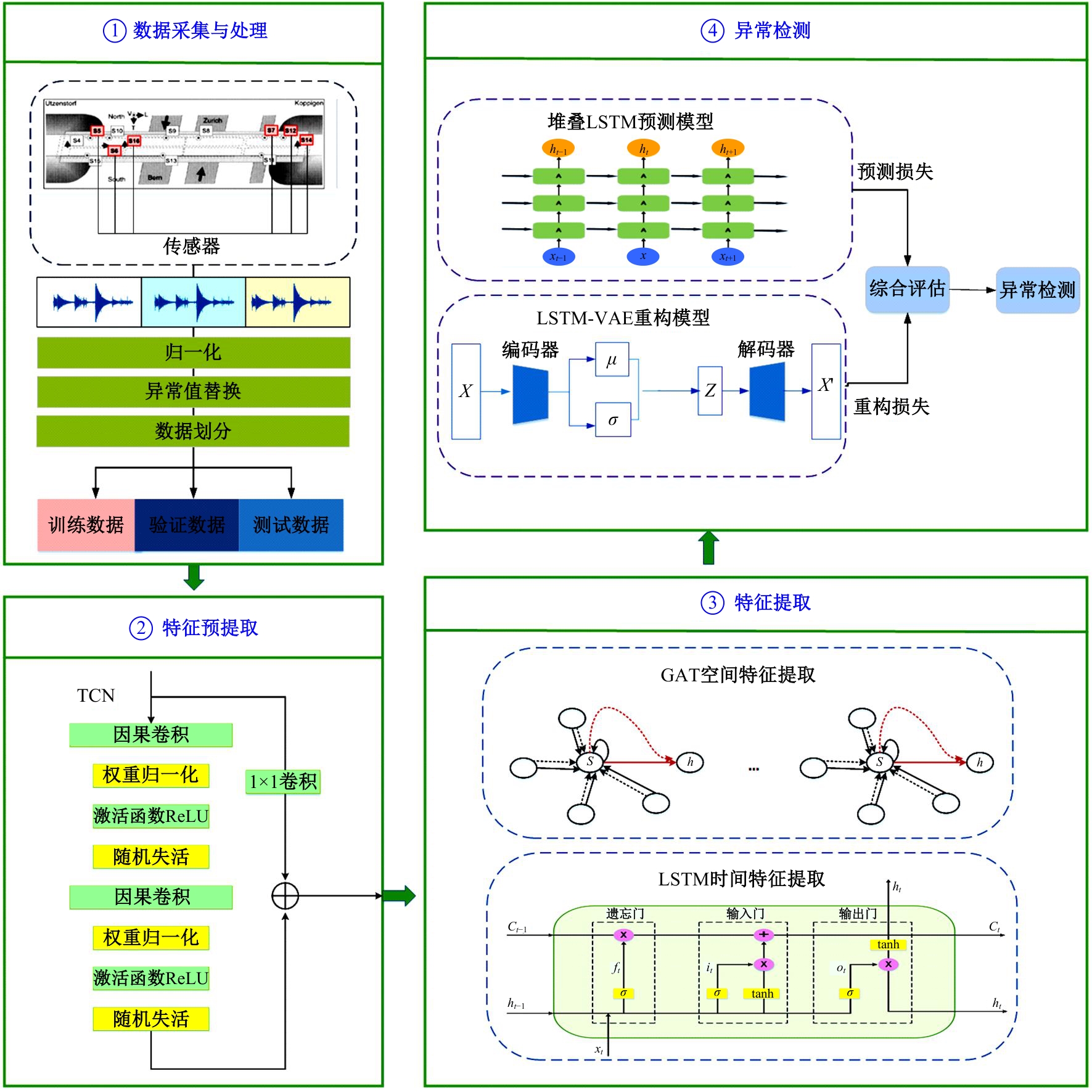
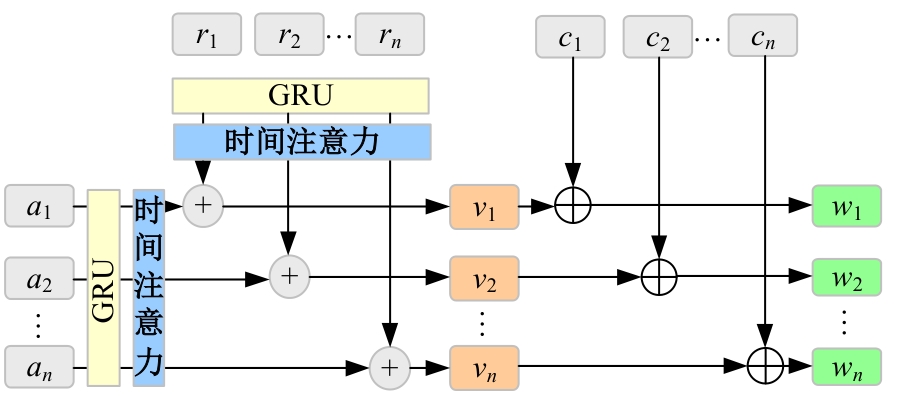
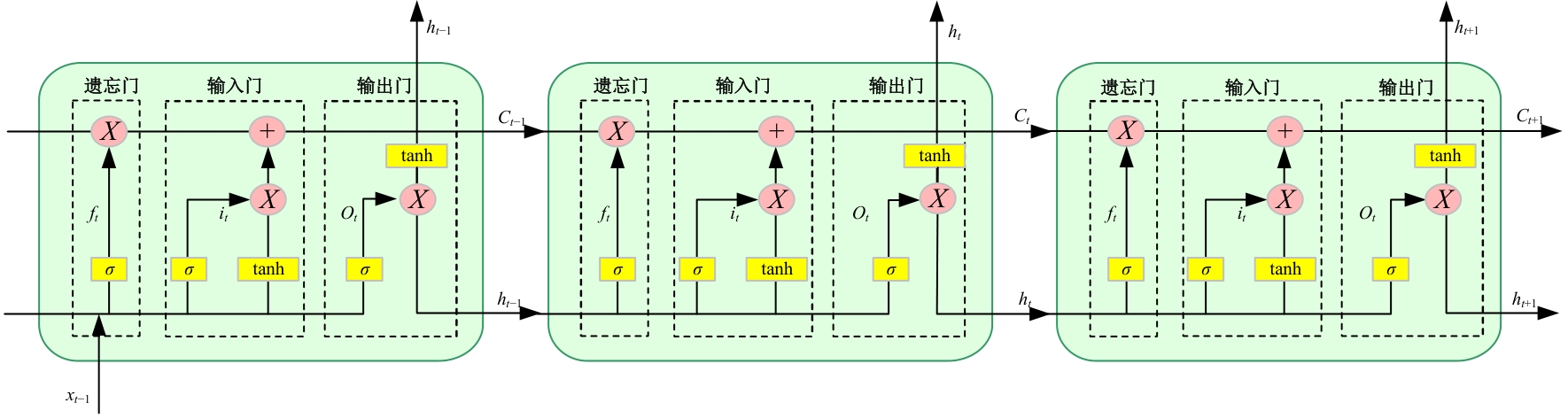
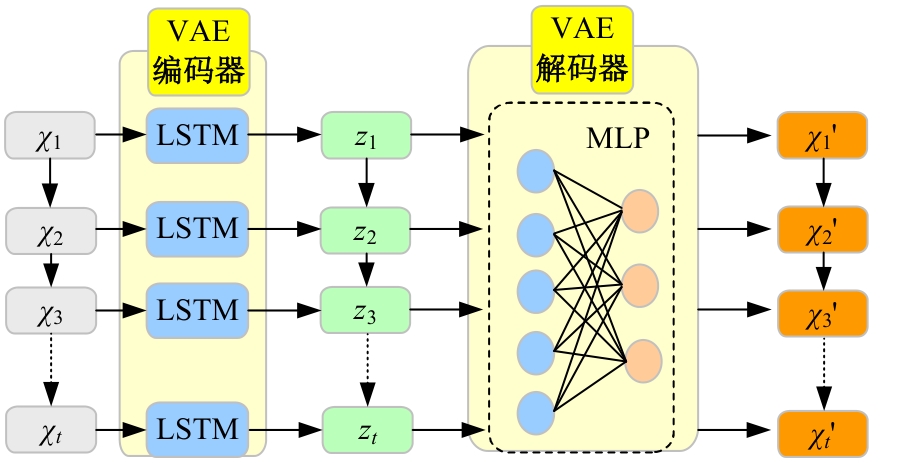
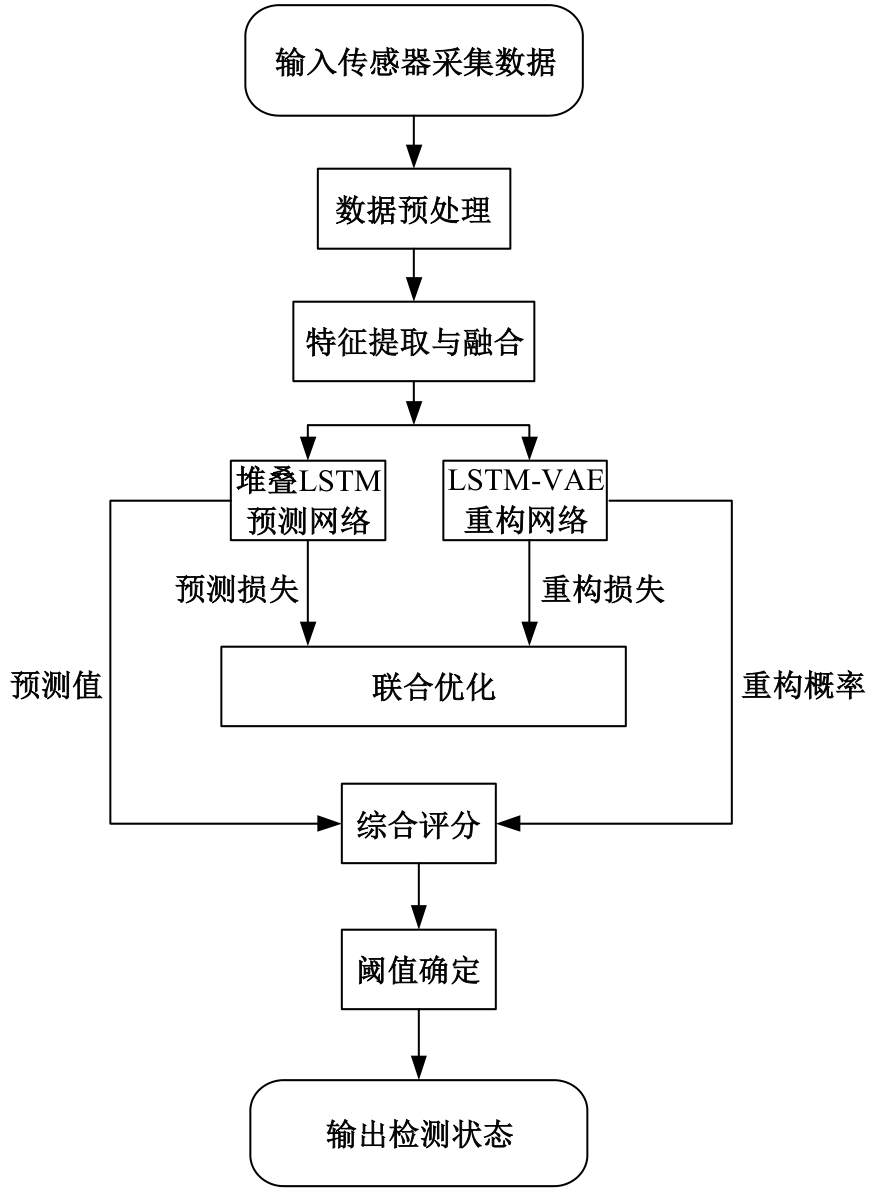
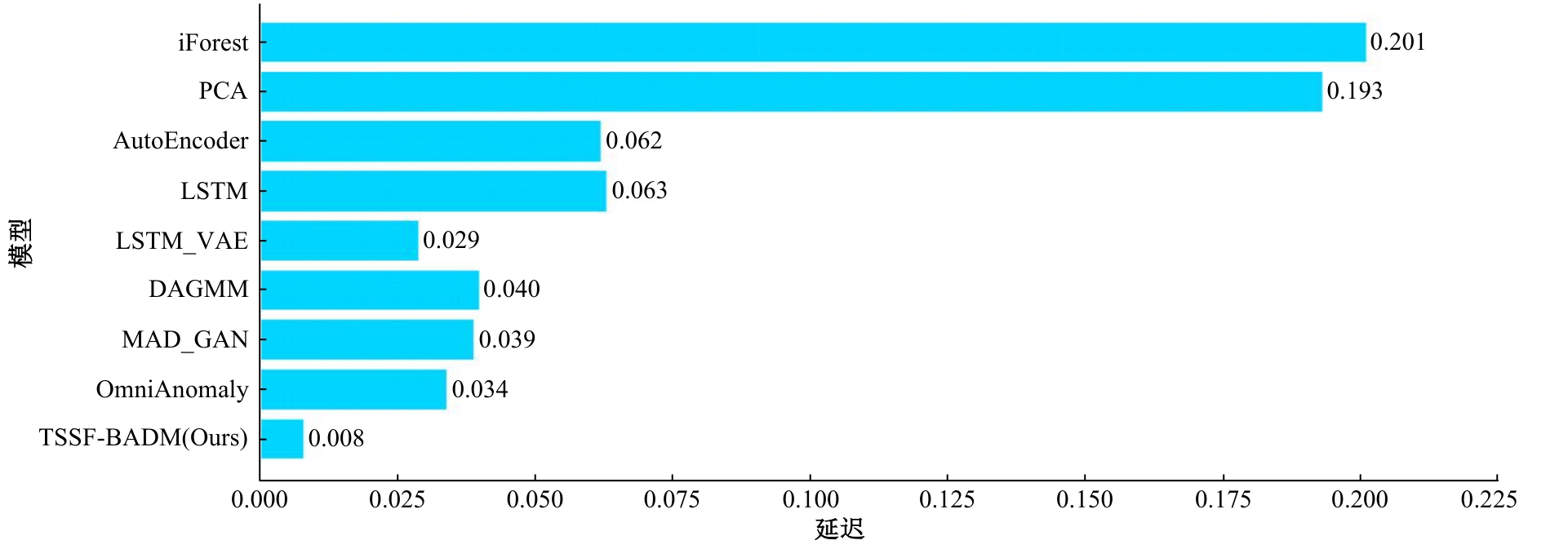
提出了一种时间特征与空间特征融合的桥梁异常状态检测模型TSSF-BADM,通过图注意力网络(GAT)和长短期记忆网络(LSTM)提取时间和空间的数据特征,将不同维度的特征通过门控循环单元(GRU)进行融合并捕获时间序列的顺序模式;融合后的数据再通过预测和重构模型进行联合优化,分别使用堆叠LSTM网络和变分自编码器(VAE)进行预测和重构;最后,使用峰值超过阈值(POT)方法对模型的预测和重建误差进行分析,获得阈值并进行异常检测,将超过异常阈值的样本视为异常样本。实验对比结果表明:本文模型在真实桥梁Z24上取得了良好效果,识别的准确率达到了0.986 8,识别延迟仅有0.008,均优于LSTM_VAE、MAD_GAN、OmniAnomaly等其他对比模型,能够有效进行桥梁异常状态检测,可为桥梁安全检测、预防性维护等提供决策。
中图分类号:
- TP399

| [1] | 交通运输部. 2022年交通运输行业发展统计公报[EB/OL]. [2024-03-31]. . |
| [2] | Entezami A, Sarmadi H, Behkamal B. A novel double-hybrid learning method for modal frequency-based damage assessment of bridge structures under different environmental variation patterns[J]. Mechanical Systems and Signal Processing, 2023, 201:No. 110676. |
| [3] | Domenico D. A review of vibration-based methods for damage detection in structures[J]. Journal of Structural Health Monitoring, 2018, 17: 3-35. |
| [4] | Gao T, Wang X, Li Z. Sensor-based methods for structural health monitoring of bridges: a review[J]. Measurement, 2018, 115: 243-261. |
| [5] | Abdeljaber O, Avci O, Kiranyaz M S, et al. 1-D CNNs for structural damage detection: verification on a structural health monitoring benchmark data[J]. Neurocomputing, 2018, 275: 1308-1317. |
| [6] | Cha Y J, Wang Z. Unsupervised novelty detection–based structural damage localization using a density peaks-based fast clustering algorithm[J]. Structural Health Monitoring, 2018, 17(2): 313-324. |
| [7] | Rafiei M H, Adeli H. A novel unsupervised deep learning model for global and local health condition assessment of structures[J]. Engineering Structures, 2018, 156: 598-607. |
| [8] | Silva M F, Santos A, Santos R, et al. Damage‐sensitive feature extraction with stacked autoencoders for unsupervised damage detection[J]. Structural Control and Health Monitoring, 2021, 28(5):No. e2714. |
| [9] | Soleimani B M H, Sepasdar R, Nasrollahzadeh K, et al. Toward a general unsupervised novelty detection framework in structural health monitoring[J]. Computer‐Aided Civil and Infrastructure Engineering, 2022, 37(9): 1128-1145. |
| [10] | Sony S, Gamage S, Sadhu A, et al. Vibration-based mul ticlass damage detection and localization using long short-term memory networks[J]. Structures Elsevier, 2022, 35: 436-451. |
| [11] | Li L, Morgantini M, Betti R. Structural damage assessment through a new generalized autoencoder with features in the quefrency domain[J]. Mechanical Systems and Signal Processing, 2023, 184: No.109713. |
| [12] | Fan J, Zhang K, Huang Y, et al. Parallel spatio-temporal attention-based TCN for multivariate time series prediction[J]. Neural Computing and Applications, 2023, 35(18): 13109-13118. |
| [13] | Hinton G E, Salakhutdinov R R. Reducing the dimensionality of data with neural networks[J]. Science, 2006, 313(5786): 504-507. |
| [14] | Chen N, Tu H, Duan X, et al. Semisupervised anomaly detection of multivariate time series based on a variational autoencoder[J]. Applied Intelligence, 2023, 53(5): 6074-6098. |
| [15] | Dubey A K, Kumar A, García D V, et al. Study and analysis of SARIMA and LSTM in forecasting time series data[J]. Sustainable Energy Technologies and Assessments, 2021, 47: No.101474. |
| [16] | Ding C, Sun S, Zhao J. MST-GAT: a multimodal spatial-temporal graph attention network for time series anomaly detection[J]. Information Fusion, 2023, 89: 527-536. |
| [17] | Tang C, Xu L, Yang B, et al. GRU-based interpretable multivariate time series anomaly detection in industrial control system[J]. Computers & Security, 2023, 127: No.103094. |
| [18] | Lei T, Gong C, Chen G, et al. A novel unsupervised framework for time series data anomaly detection via spectrum decomposition[J]. Knowledge-Based Systems, 2023, 280:No. 111002. |
| [19] | Shan D, Yao K, Zhang X. Sequential learning network with residual blocks: incorporating temporal convolutional information into recurrent neural networks[J]. IEEE Transactions on Cognitive and Developmental Systems, 2023, 16(1): 396-401. |
| [20] | Lin M, Wu J, Meng J, et al. State of health estimation with attentional long short-term memory network for lithium-ion batteries[J]. Energy, 2023, 268: No.126706. |
| [21] | 刘嫣然, 孟庆瑜, 郭洪艳, 等. 图注意力模式下融合高精地图的周车轨迹预测[J]. 吉林大学学报: 工学版, 2023, 53(3): 792-801. |
| Liu Yan-ran, Meng Qing-yu, Guo Hong-yan, et al. Vehicle trajectory prediction combined with high definition map in graph attention mode[J].Journal of Jilin University(Engineering and Technology Edition), 2023, 53(3): 792-801. | |
| [22] | Siffer A, Fouque P A, Termier A, et al. Anomaly detection in streams with extreme value theory[C]∥ Proceedings of the 23rd ACM SIGKDD International Conference on Knowledge Discovery and Data Mining, Halifax, Canada, 2017: 1067-1075. |
| [23] | Peeters B, Roeck D. One year monitoring of the z24-bridge: environmental influences versus damage events[J]. Proceedings of the International Modal Analysis Conference, 2000, 2: 1570-1576. |
| [24] | Maeck J, Roeck D. Description of Z24 benchmark[J]. Mechanical Systems and Signal Processing, 2003, 17(1): 127-131. |
| [25] | Reynders E, Roeck D. Vibration-based damage identification: the Z24 benchmark[J]. Living Reference Work Entry, 2015, 1: 1-8. |
| [26] | Liu F T, Ting K M, Zhou Z H. Isolation forest[C]∥ Eighth IEEE International Conference on Data Mining, Pisa, Italy, 2008: 413-422. |
| [27] | Borghesi A, Bartolini A, Lombardi M, et al. Anomaly detection using autoencoders in high performance computing systems[C]∥ Proceedings of the AAAI Conference on Artificial Intelligence, 2019, 33(1): 9428-9433. |
| [28] | Hundman K, Constantinou V, Laporte C, et al. Detecting spacecraft anomalies using lstms and nonparametric dynamic thresholding[C]∥ Proceedings of the 24th ACM SIGKDD International Conference on Knowledge Discovery & Data Mining, London, UK, 2018: 387-395. |
| [29] | Park D, Hoshi Y, Kemp C C. A multimodal anomaly detector for robot-assisted feeding using an lstm-based variational autoencoder[J]. IEEE Robotics and Automation Letters, 2018, 3(3): 1544-1551. |
| [30] | Zong B, Song Q, Min M R, et al. Deep autoencoding gaussian mixture model for unsupervised anomaly detection[C]∥ International Conference on Learning Representations, Vancouver, Canada, 2018: 1-19. |
| [31] | Li D, Chen D, Jin B, et al. MAD-GAN: multivariate anomaly detection for time series data with generative adversarial networks[C]∥ International Conference on Artificial Neural Networks, Budapest, Hungary, 2019: 703-716. |
| [32] | Su Y, Zhao Y, Niu C, et al. Robust anomaly detection for multivariate time series through stochastic recurrent neural network[C]∥ Proceedings of the 25th ACM SIGKDD International Conference on Knowledge Discovery & Data Mining, Anchorage, USA, 2019: 2828-2837. |
| [1] | 卢荡,索艳茹,孙宇航,吴海东. 基于无量纲格式的轮胎侧倾侧偏力学特性预测[J]. 吉林大学学报(工学版), 2025, 55(5): 1516-1524. |
| [2] | 卢晓红,洛家庆,丛晨,徐凯. 铝合金LF21微铣削顶端毛刺尺寸预测与工艺优化[J]. 吉林大学学报(工学版), 2025, 55(1): 125-131. |
| [3] | 马洁,刘智丽,王书灵,董皓. 轨道交通车站出入口客流预测——以北京市为例[J]. 吉林大学学报(工学版), 2024, 54(8): 2197-2205. |
| [4] | 朱国庆,刘显成,田从祥. 基于长短期记忆网络的公共建筑短期能耗预测模型[J]. 吉林大学学报(工学版), 2024, 54(7): 2009-2014. |
| [5] | 方宇,孙立军. 基于生存分析的城市桥梁使用性能衰变模型[J]. 吉林大学学报(工学版), 2020, 50(2): 557-564. |
| [6] | 王鹏辉,乔宏霞,冯琼,曹辉,温少勇. 氯氧镁涂层钢筋混凝土两重因素耦合作用下的耐久性模型[J]. 吉林大学学报(工学版), 2020, 50(1): 191-201. |
| [7] | 徐戊矫,刘承尚,鲁鑫垚. 喷丸处理后6061铝合金工件表面粗糙度的模拟计算及预测[J]. 吉林大学学报(工学版), 2019, 49(4): 1280-1287. |
| [8] | 马知行, 赵琦, 张浩. 基于傅立叶分析的持家基因预测模型[J]. 吉林大学学报(工学版), 2016, 46(5): 1639-1643. |
| [9] | 郭洪强, 何洪文, 卢兵. 电动汽车复合制动预测模型[J]. 吉林大学学报(工学版), 2015, 45(3): 696-702. |
| [10] | 袁媛, 张焕杰, 苗雨田, 吴思佳, 林松毅, 刘静波. 鲜切薯片油炸过程中丙烯酰胺形成的贡献率[J]. 吉林大学学报(工学版), 2014, 44(5): 1525-1530. |
| [11] | 高振海, 吴涛, 赵会. 车辆虚拟跟随避撞中驾驶人制动时刻模型[J]. 吉林大学学报(工学版), 2014, 44(5): 1233-1239. |
| [12] | 王宝杰, 王炜, 杨敏, 华雪东. 基于Kalman滤波行程时间预测的BRT车速诱导[J]. 吉林大学学报(工学版), 2014, 44(01): 41-46. |
| [13] | 司建波, 杨芳, 郭蔚莹, 姚燕. 基于BP神经网络的两阶段疾病预测模型[J]. 吉林大学学报(工学版), 2013, 43(增刊1): 481-484. |
| [14] | 于德新, 仝倩, 杨兆升, 高鹏. 重大灾害条件下应急交通疏散时间预测模型[J]. 吉林大学学报(工学版), 2013, 43(03): 654-658. |
| [15] | 苏丽俐, 王登峰, 王倩. 基于GRNN的车内噪声品质预测[J]. 吉林大学学报(工学版), 2011, 41(增刊2): 82-86. |
|
||