吉林大学学报(医学版) ›› 2026, Vol. 52 ›› Issue (2): 536-542.doi: 10.13481/j.1671-587X.20260227

• 方法学 • 上一篇    下一篇

TAGLN2 shRNA慢病毒载体的构建及其稳定转染细胞系的建立

张育添1,2,吴海灵2,廖科棋2,梁淑铃1,李胜男1,2(),李友1,2()   

  1. 1.广东医科大学 广东省衰老相关心脑疾病重点实验室,广东 湛江 524002
    2.广东医科大学附属 医院神经病学研究所,广东 湛江 524002
  • 收稿日期:2025-05-19 接受日期:2025-07-14 出版日期:2026-03-28 发布日期:2026-04-15
  • 通讯作者: 李胜男,李友 E-mail:nancylee@gdmu.edu.cn;youli805@163.com
  • 作者简介:张育添(1999-),男,广东省梅州市人,在读硕士研究生,主要从事脑血管疾病发病机制方面的研究。
  • 基金资助:
    国家自然科学基金项目(81571157);广东省卫健委医学科研基金项目(A2022139);广东省卫健委医学科研基金项目(A2023193);广东省湛江市科技局科技攻关计划项目(2021B01370)

Construction of TAGLN2 shRNA lentiviral vector and establishment of its stably transfected cell line

Yutian ZHANG1,2,Hailing WU2,Keqi LIAO2,Shuling LIANG1,Shengnan LI1,2(),You LI1,2()   

  1. 1.Guangdong Provincial Key Laboratory of Age-Related Cardiac and Cerebral Diseases,Guangdong Medical University,Zhanjiang 524002,China
    2.Institute of Neurology,Affiliated Hospital,Guangdong Medical University,Zhanjiang 524002,China
  • Received:2025-05-19 Accepted:2025-07-14 Online:2026-03-28 Published:2026-04-15
  • Contact: Shengnan LI,You LI E-mail:nancylee@gdmu.edu.cn;youli805@163.com

摘要:

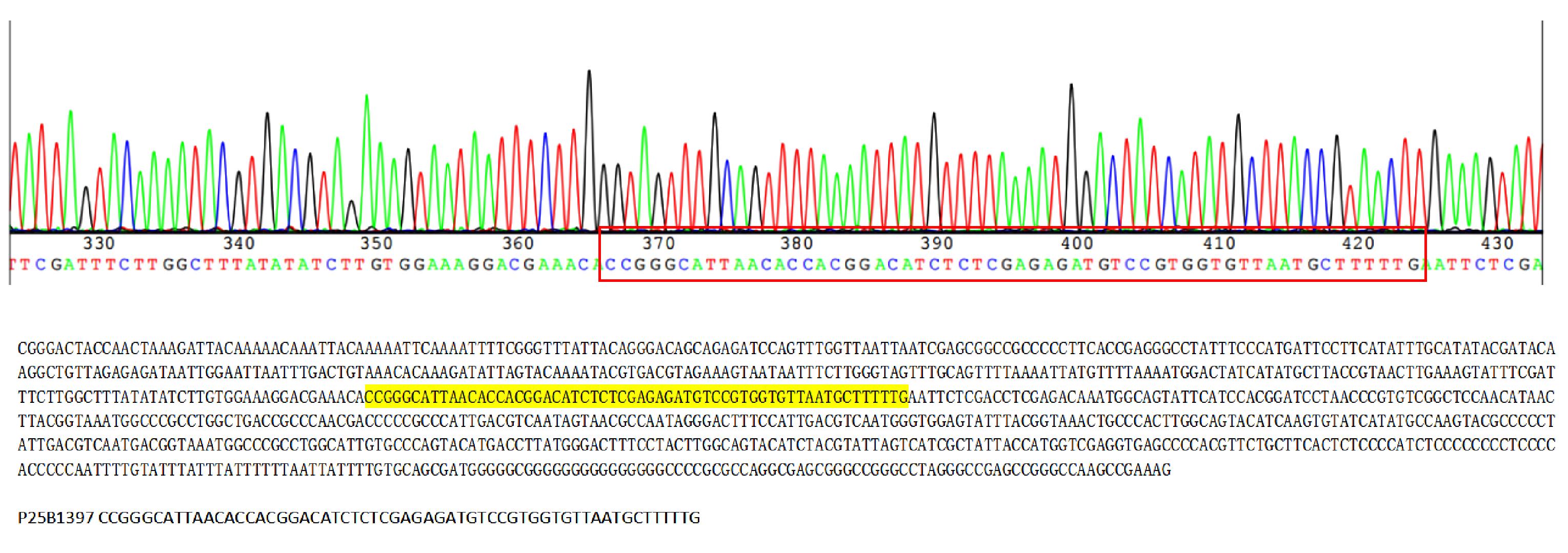
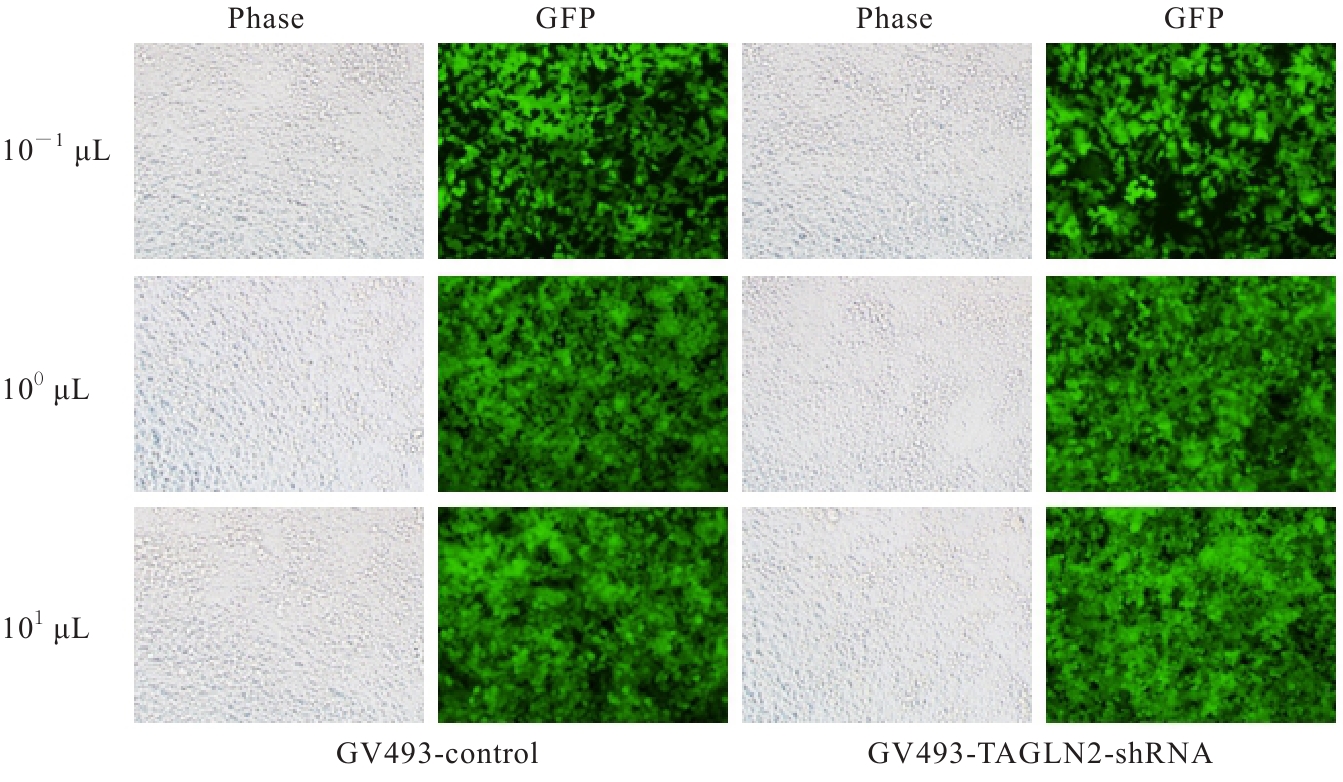
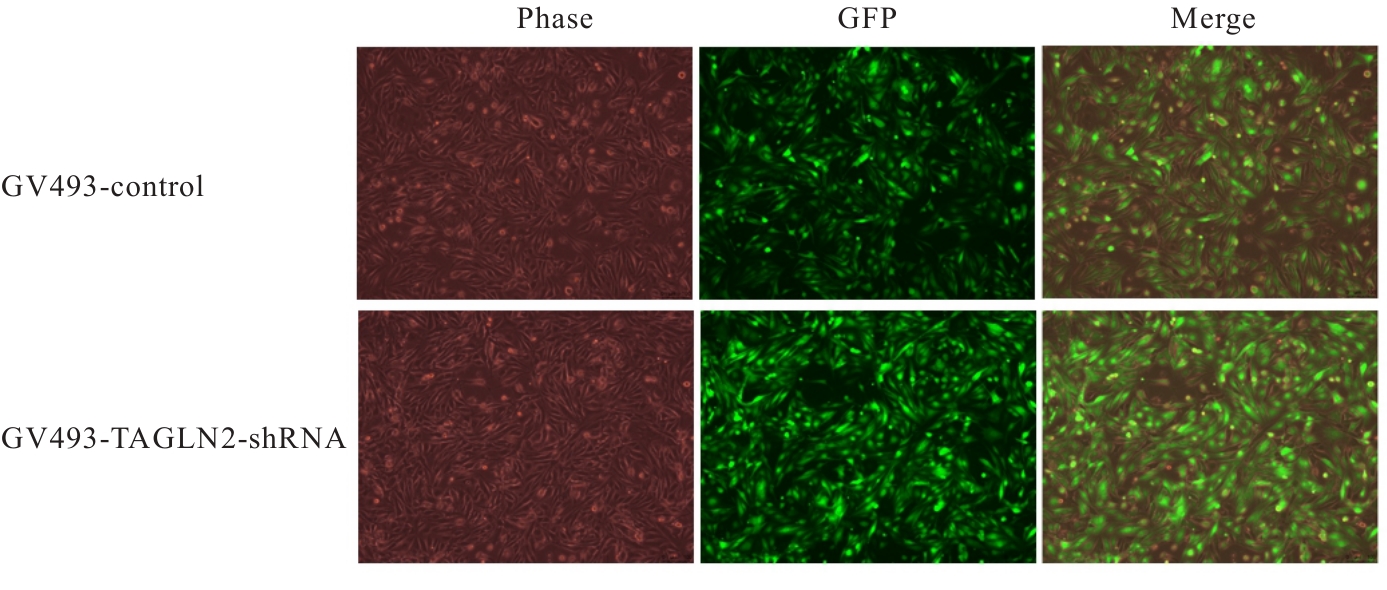
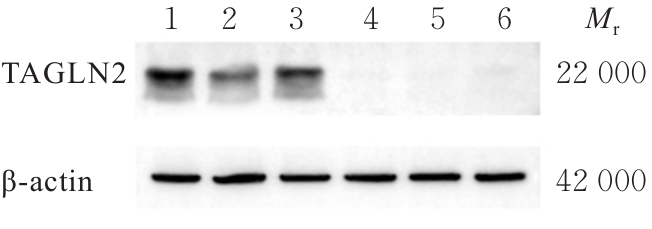
目的 构建针对小鼠脑微血管内皮细胞系bEnd.3细胞肌动蛋白结合蛋白2(TAGLN2)基因的慢病毒载体,并鉴定其沉默作用。 方法 依据TAGLN2基因编码区设计短发夹RNA(shRNA)干扰靶点,将其扩增产物连接至经EcoR Ⅰ和Age Ⅰ双酶切线性化的GV493慢病毒载体,构建GV493-TAGLN2-shRNA重组慢病毒载体,PCR法筛选阳性克隆并测序鉴定。将GV493对照慢病毒载体和GV493-TAGLN2-shRNA重组慢病毒载体分别转染至HEK293T细胞,收集纯化上清并测定病毒滴度。以感染复数(MOI)为100,分别感染bEnd.3细胞,感染48 h更换含10 mg·L-1嘌呤霉素的完全培养基筛选培养14 d。采用倒置荧光显微镜观察2组细胞中绿色荧光蛋白(GFP)表达情况,实时荧光定量PCR(RT-qPCR)法检测2组细胞中TAGLN2 mRNA表达水平,Western blotting法检测2组细胞中TAGLN2蛋白表达水平。 结果 荧光显微镜观察,转染后的HEK293T细胞中有强烈的GFP荧光信号,表明慢病毒包装体系构建成功。GV493对照慢病毒的滴度为5×10¹¹ TU·L-1TAGLN2干扰慢病毒滴度为6×10¹¹ TU·L-1。转染后,2组bEnd.3细胞均呈现明显GFP荧光信号,稳转细胞系构建成功。RT-qPCR法,与GV493对照组比较,GV493-TAGLN2-shRNA组细胞中TAGLN2 mRNA表达水平明显降低(P<0.01)。Western blotting法,与GV493对照组比较,GV493-TAGLN2-shRNA组细胞中TAGLN2蛋白表达水平明显降低(P<0.01)。 结论 成功构建靶向bEnd.3细胞TAGLN2基因的慢病毒载体,其可高效沉默TAGLN2表达。

关键词: 肌动蛋白结合蛋白2, 稳定转染细胞系, 慢病毒, bEnd.3细胞, 短发夹RNA

Abstract:

Objective To construct a lentiviral vector targeting the transgelin-2 (TAGLN2) gene in the mouse brain microvascular endothelial cell line bEnd.3 cells, and to identify its silencing effect. Methods Short hairpin RNA (shRNA) interference target sites were designed based on the coding region of the TAGLN2 gene. The amplified products were ligated into the GV493 lentiviral vector linearized by double digestion with EcoR Ⅰ and Age Ⅰ to construct the GV493-TAGLN2-shRNA recombinant lentiviral vector. The positive clones were screened by PCR and identified by sequencing. The GV493 control lentiviral vector and the GV493-TAGLN2-shRNA recombinant lentiviral vector were respectively transfected into the HEK293T cells, and the supernatants were collected and purified, and the viral titers were determined. The bEnd.3 cells were infected with a multiplicity of infection (MOI) of 100. After 48 h of infection, the complete medium containing 10 mg·L-1 puromycin was replaced for screening and culture for 14 d. An inverted fluorescence microscope was used to observe the expression of green fluorescence protein (GFP) in the cells in two groups; real-time fluorescence quantitative PCR (RT-qPCR) method was used to detect the expression levels of TAGLN2 mRNA in cells in two groups; Western blotting method was used to detect the expression levels of TAGLN2 protein in the cells in two groups. Results The fluorescence microscope observation results showed that there was a strong GFP fluorescence signal in the transfected HEK293T cells, indicating that the lentiviral packaging system was successfully constructed. The titer of the GV493 control lentivirus was 5×10¹¹ TU·L-1, and the titer of the TAGLN2 interference lentivirus was 6×10¹¹ TU·L-1. After transfection, the bEnd.3 cells in two groups showed obvious GFP fluorescence signals, indicating that the stable transfected cell lines were successfully constructed. The RT-qPCR results showed that compared with GV493 control group, the expression level of TAGLN2 mRNA in the cells in GV493-TAGLN2-shRNA group was significantly decreased (P<0.01). The Western blotting results showed that compared with GV493 control group, the expression level of TAGLN2 protein in the cells in GV493-TAGLN2-shRNA group was significantly decreased (P<0.01). Conclusion A lentiviral vector targeting the TAGLN2 gene in bEnd.3 cells is successfully constructed, which can efficiently silence TAGLN2 expression.

Key words: Transgelin-2, Stably transfected cell line, Lentivirus, bEnd.3 cell, Short hairpin RNA

中图分类号: 

  • R392