Journal of Jilin University(Medicine Edition) ›› 2025, Vol. 51 ›› Issue (3): 770-777.doi: 10.13481/j.1671-587X.20250322
• Research in clinical medicine • Previous Articles
Clinical analysis on temporomandibular joint disc anchorage for treatment of irretrievable forward displacement of temporomandibular joint disc
Chong LIU1,Boyuan WANG2,Yang JIANG1,Aizhuo SONG2,Minghe LI2( )
)
- 1.Department of Oral and Maxillofacial Surgery,Stomatology Hospital,Jilin University,Changchun 130021,China
2.Department of Stomatology,Second Hospital,Jilin University,Changchun 130022,China
-
Received:2024-07-10Accepted:2024-09-16Online:2025-05-28Published:2025-07-18 -
Contact:Minghe LI E-mail:liminghe@jlu.edu.cn

CLC Number:
- R782.61
Cite this article
Chong LIU,Boyuan WANG,Yang JIANG,Aizhuo SONG,Minghe LI. Clinical analysis on temporomandibular joint disc anchorage for treatment of irretrievable forward displacement of temporomandibular joint disc[J].Journal of Jilin University(Medicine Edition), 2025, 51(3): 770-777.
share this article
Fig. 1
Schematic diagram of assessment of preoperative opening degree of ADDWoR patients"
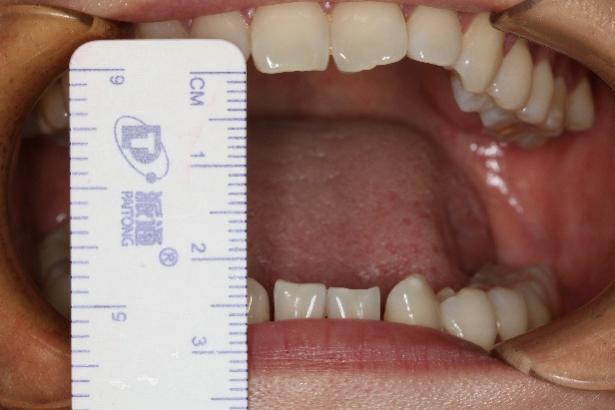
Fig. 2
Measurement methods of articular disc length, displacement distance of articular disc, and condylar height of ADDWoR patients"
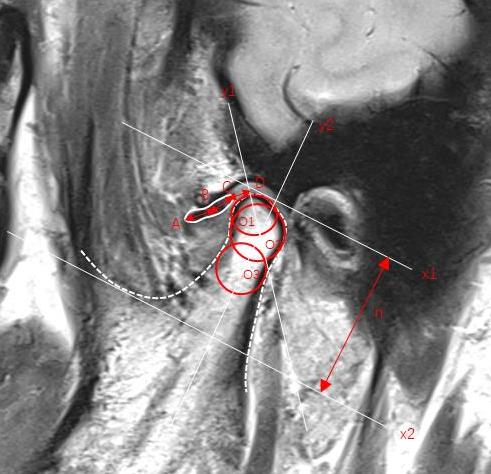
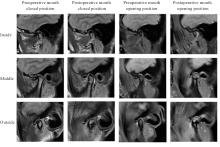
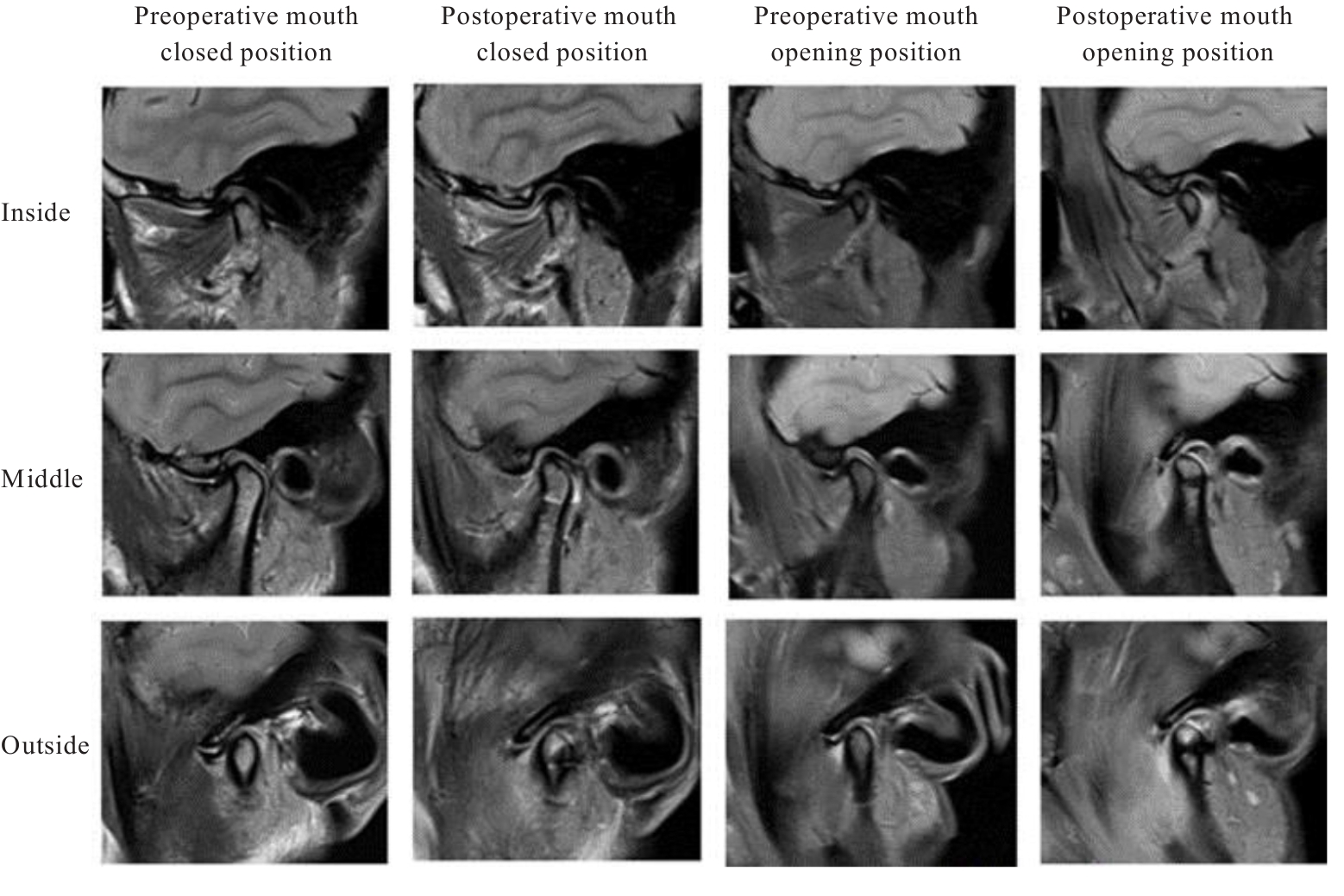
Fig. 3
Preoperative and postoperative MRI images of ADDWoR patients with “excellent” efficacy evaluation"
Tab.1
Numbers of patients with different Di grades before operation"
| Di grade | Helkimo index | n |
|---|---|---|
| Di 0 | 0 | 0 |
| DiⅠ | 1-4 | 0 |
| DiⅡ | 6 | 1 |
| 7 | 5 | |
| 8 | 2 | |
| 9 | 1 | |
| DiⅢ | 10 | 4 |
| 11 | 2 | |
| 12 | 2 | |
| 13 | 2 | |
| 16 | 1 | |
| 21 | 1 |
Tab.2
Numbers of patients with different Helkimo scores after operation"
| Helkimo TMD fractionation | Helkimo index | n | Total |
|---|---|---|---|
| Di 0 | 0 | 2 | 2 |
| DiⅠ | 1 | 9 | 16 |
| 2 | 4 | - | |
| 3 | 3 | - | |
| DiⅡ | 5 | 2 | 3 |
| 6 | 1 | - | |
| DiⅢ | 10-25 | 0 | 0 |
Tab.3
Di grades of patients before and after operation"
| Group | Di 0 | DiⅠ | DiⅡ | DiⅢ |
|---|---|---|---|---|
| Before operation | 0(0) | 0(0) | 9(42.86) | 12(57.14) |
| After operation | 2(9.52) | 16(76.19) | 3(14.29) | 0(0) |
| [1] | XIONG X, YE Z, TANG H H, et al. MRI of temporomandibular joint disorders: recent advances and future directions[J]. J Magn Reson Imaging, 2021, 54(4): 1039-1052. |
| [2] | GOSS A N. Report of the second International Consensus meeting, April 1992, Buenos Aires, Argentina[J]. Int J Oral Maxillofac Surg, 1993, 22(2): 78-81. |
| [3] | SIDEBOTTOM A J. Current thinking in temporomandibular joint management[J]. Br J Oral Maxillofac Surg, 2009, 47(2): 91-94. |
| [4] | MEHRA P, WOLFORD L M. Use of the Mitek anchor in temporomandibular joint disc-repositioning surgery[J]. Proc (Bayl Univ Med Cent), 2001, 14(1): 22-26. |
| [5] | ZHANG S Y, LIU X M, YANG X J, et al. Temporomandibular joint disc repositioning using bone anchors: an immediate post surgical evaluation by magnetic resonance imaging[J]. BMC Musculoskelet Disord, 2010, 11: 262. |
| [6] | ZHOU Q, ZHU H M, HE D M, et al. Modified temporomandibular joint disc repositioning with mini-screw anchor: part Ⅱ-stability evaluation by magnetic resonance imaging[J]. J Oral Maxillofac Surg, 2019, 77(2): 273-279. |
| [7] | HE D M, YANG C, ZHU H M, et al. Temporomandibular joint disc repositioning by suturing through open incision: a technical note[J]. J Oral Maxillofac Surg, 2018, 76(5): 948-954. |
| [8] | HE D M, YANG C, ZHANG S Y, et al. Modified temporomandibular joint disc repositioning with miniscrew anchor: part I: surgical technique[J]. J Oral Maxillofac Surg, 2015, 73(1): 47.e1-47.e9. |
| [9] | WANG P, LIU Y, BI R Y, et al. TMJ anterior disc displacement anchorage surgery: a retrospective study based on a suture-free titanium screw strategy[J]. Clin Oral Investig, 2023, 27(8): 4579-4584. |
| [10] | 刘秀明. 颞下颌关节盘锚固术长期疗效评价及盘后移位动物模型研究[D]. 上海: 上海交通大学, 2020. |
| [11] | HELKIMO M. Studies on function and dysfunction of the masticatory system. Ⅳ. Age and sex distribution of symptoms of dysfunction of the masticatory system in Lapps in the north of Finland[J]. Acta Odontol Scand, 1974, 32(4): 255-267. |
| [12] | NOKAR S, SADIGHPOUR L, SHIRZAD H, et al. Evaluation of signs, symptoms, and occlusal factors among patients with temporomandibular disorders according to Helkimo index[J]. Cranio, 2019, 37(6): 383-388. |
| [13] | ZANIN R F, OMMIZOLO G, WEBER A, et al. Oral health-related quality of life in women with temporomandibular joint disk anterior displacement before and after disk repositioning and anchoring surgery assessed with the Oral Health Impact Profile (OHIP-14)[J]. Oral Surg Oral Med Oral Pathol Oral Radiol, 2019, 128(2): 112-116. |
| [14] | 王学宏, 陈旭卓, 毛懿, 等. 青少年不同发育阶段颞下颌关节盘锚固术后复发率的差异[J]. 上海交通大学学报(医学版), 2022, 42(2): 173-177. |
| [15] | LIU Z Y, XIE Q Y, CHEN M J, et al. Measurement of mandibular condylar height based on magnetic resonance imaging[J]. J Craniofac Surg, 2020, 31(4): e415-e418. |
| [16] | WILKES C H. Internal derangements of the temporomandibular joint. Pathological variations[J]. Arch Otolaryngol Head Neck Surg, 1989, 115(4): 469-477. |
| [17] | MCCARTY W L, FARRAR W B. Surgery for internal derangements of the temporomandibular joint[J]. J Prosthet Dent, 1979, 42(2): 191-196. |
| [18] | HU Y K, YANG C, XIE Q Y. Changes in disc status in the reducing and nonreducing anterior disc displacement of temporomandibular joint: a longitudinal retrospective study[J]. Sci Rep, 2016, 6: 34253. |
| [19] | 许颖捷, 童乔莹, 尚婷荷, 等. 异常应力对MIF、COX2和PGE2在颞下颌关节骨关节炎中的促进作用及其机制[J]. 解放军医学杂志, 2023, 48(11): 1294-1304. |
| [20] | 张 锦, 袁建桥, 崔梦琦, 等.再定位咬合板治疗颞下颌关节盘可复性前移位的临床疗效和形态学评价[J]. 郑州大学学报(医学版), 2024, 59(1): 72-77. |
| [21] | LIU X M, ZHOU Z H, MAO Y, et al. Temporomandibular joint anchorage surgery: a 5-year follow-up study[J]. Sci Rep, 2019, 9(1): 19106. |
| [22] | SANDHU S, KLEIN B A, AL-HADLAQ M, et al. Oral lichen planus: comparative efficacy and treatment costs-a systematic review[J]. BMC Oral Health, 2022, 22(1): 161. |
| [23] | OPRIS H, BACIUT M, BRAN S, et al. Lateral cephalometric analytical uses for temporomandibular joint disorders: the importance of cervical posture and hyoid position[J]. Int J Environ Res Public Health, 2022, 19(17): 11077. |
| [24] | 孙美荣, 周 洁. MR检查技术在颞颌关节疾病诊治中的应用[J].影像研究与医学应用, 2022, 6(21): 154-156. |
| [25] | FAN P D, XIONG X, CHENG Q Y, et al. Risk estimation of degenerative joint disease in temporomandibular disorder patients with different types of sagittal and coronal disc displacements: MRI and CBCT analysis[J]. J Oral Rehabil, 2023, 50(1): 12-23. |
| [26] | CAI X Y, JIN J M, YANG C. Changes in disc position, disc length, and condylar height in the temporomandibular joint with anterior disc displacement: a longitudinal retrospective magnetic resonance imaging study[J]. J Oral Maxillofac Surg, 2011, 69(11): e340-e346. |
| [27] | ASKAR H, ARONOVICH S, CHRISTENSEN B J, et al. Is arthroscopic disk repositioning equally efficacious to open disk repositioning? A systematic review[J]. J Oral Maxillofac Surg, 2021, 79(10): 2030-2041.e2. |
| [28] | 王琰, 王靖虓, 郭倩倩, 等. 颞下颌关节盘不可复性前移位行锚固术后的临床疗效及影像学分析[J]. 中华全科医学, 2021, 19(7): 1125-1127. |
| [29] | PUTHUKKUDIYIL J S, BHUTIA O, ROYCHOUDHURY A, et al. Does repositioning of temporomandibular joint disc with bone anchors provide better clinical outcomes than conventional disc plication procedures for anterior disc displacements without reduction in patients refractory to nonsurgical treatments?[J]. J Oral Maxillofac Surg, 2020, 78(12): 2160-2168. |
| [30] | 蔡 琦, 李 松, 吴仲寅, 等. 改良切口锚固术在颞下颌关节盘不可复性前移位中的近期疗效[J]. 局解手术学杂志, 2023, 32(10): 890-893. |
| [31] | QIU Y T, YANG C, CHEN M J, et al. Can a novel surgical approach to the temporomandibular joint improve access and reduce complications?[J]. J Oral Maxillofac Surg, 2016, 74(7): 1336-1342. |
| [32] | GONZÁLEZ L V, LÓPEZ J P, DÍAZ-BÁEZ D, et al. Correlation between MRI-diagnosed joint effusion and demographic, clinical, imaging, and arthroscopic findings of the temporomandibular joint[J]. J Craniomaxillofac Surg, 2021, 49(12): 1169-1174. |
| [33] | PIRES P F, DE CASTRO E M, PELAI E B, et al. Analysis of the accuracy and reliability of the Short-Form Fonseca Anamnestic Index in the diagnosis of myogenous temporomandibular disorder in women[J]. Braz J Phys Ther, 2018, 22(4): 276-282. |
| [34] | 王铁彪, 周五超, 肖 寅, 等. 改良关节盘锚固术在颞下颌关节盘穿孔、破裂治疗中的应用[J]. 华西口腔医学杂志, 2023, 41(4): 434-442. |
| [1] | Fanjun SUN,Xingchen PAN,Dan TONG. Research progress in MRI neuroimaging for patients with functional gastrointestinal diseases and inflammatory bowel disease [J]. Journal of Jilin University(Medicine Edition), 2025, 51(2): 541-548. |
| [2] | Zilong GAO,Biao LIU,Le QI,Jingyu LANG,Yan LIU. Giant cell-rich osteosarcoma with special imaging findings: A case report and literature review [J]. Journal of Jilin University(Medicine Edition), 2025, 51(1): 222-227. |
| [3] | Shengnan YANG,Xue WANG,Xuefeng WANG,Tianyu ZHAO,Ying PAN,Dayong DING. Retroperitoneal giant lymphangioma: A case report and literature review [J]. Journal of Jilin University(Medicine Edition), 2023, 49(2): 508-513. |
| [4] | Ping HU,Nan JIANG,Yinghua LI,Hongguang ZHAO. Analysis on characteristics of 18F-FDG PET/CT imaging of patient with primary small cell osteosarcoma of coccyx:A case report and literature review [J]. Journal of Jilin University(Medicine Edition), 2022, 48(1): 216-221. |
| [5] | Dong CHEN, Zhiyao LI, Haitao CHEN, Zhirui CHUAN, Yingxian ZHANG, Xin JIN, Shicong TANG, Xiaomao LUO. Diagnostic values of three-dimensional transrectal ultrasound and MRI in diagnosis of T substages and circumferential resection margin of patients with middle and lower rectal cancer [J]. Journal of Jilin University(Medicine Edition), 2021, 47(3): 753-760. |
| [6] | Dong CHEN,Zhiyao LI,Haitao CHEN,Zhirui CHUAN,Yingxian ZHANG,Xin JIN,Shicong TANG,Xiaomao LUO. Diagnostic value of three-dimensional transrectal ultrasound in preoperative N-staging of middle and lower rectal cancer [J]. Journal of Jilin University(Medicine Edition), 2021, 47(2): 497-504. |
| [7] | Dong CHEN,Haitao CHEN,Zhiyao LI,Fengming RANG,Xi ZHANG,Zhirui CHUAN,Shicong TANG,Xiaomao LUO. Effects of three-dimensional transrectal ultrasound and MRI in evaluation of extramural vascular invasion degrees of middle and lower rectal cancer [J]. Journal of Jilin University(Medicine Edition), 2021, 47(1): 203-209. |
| [8] | Lingxue SHI,Shuo LIU,Xuewei ZHENG,Xiaoliang CHENG,Zhaohui CHEN,Baolin MA,Hongguo ZHANG,Jun DING. Application of magnetic resonance diffusion weighted imaging ADC and rADC in differential diagnosis of benign and malignant parotid gland tumors [J]. Journal of Jilin University(Medicine Edition), 2020, 46(6): 1309-1314. |
| [9] | ZHOU Dongkui, LU Mingqian, FENG Xuesong, LIU Yufei, SONG Hao, XU Liang. Follicular dendritic cell sarcoma of small intestine and ileocecal region: A case report and literature review [J]. Journal of Jilin University(Medicine Edition), 2020, 46(04): 858-862. |
| [10] | ZHANG Ping, ZHOU Jia, TANG Yan, LIU Hongyu. Preparation of PR-SPIO-PLGA molecular probe and its property [J]. Journal of Jilin University(Medicine Edition), 2018, 44(06): 1307-1311. |
| [11] | ZHU Gang, SUN Haibin, WANG Hu, XU Gang. Comparison of diagnosis value of MRI, CT and histopathological features on liposarcoma of extremities [J]. Journal of Jilin University Medicine Edition, 2017, 43(06): 1215-1219. |
| [12] | ZHU Zhen, SUN Qi, YANG Junxing, YANG Nan, SONG Lijie, WANG Yao, ZHAO Chuqiao, LIU Zhihui. Comparisons of effect and safety of MRI of head and neck in patients with fixed partial dentures made by different materials [J]. Journal of Jilin University Medicine Edition, 2017, 43(06): 1220-1225. |
| [13] | ZHOU Hong, LIU Jincai, XIE Peihan, YOU Yong, LUO Guanghua, YANG Juan, QING Weipeng. Comparison of diagnostic values between magnetic susceptibility-weighted imaging and routine MRI in patients with cerebral amyloid angiopathy-related hemorrhage [J]. Journal of Jilin University Medicine Edition, 2017, 43(05): 1042-1046. |
| [14] | LIAO Ruikun, DENG Xiaolin, ZENG Danni, WU Xiaofeng, WEN Ming. Changes of signals in tumor tissue of tumor-bearing nude mice after SPIO-shRNA molecular probe injection at different time points and optimal scanning time of MRI [J]. Journal of Jilin University Medicine Edition, 2016, 42(06): 1220-1225. |
| [15] | SONG Zhiqiang, SHEN Haishan, SHEN Jun, WU Jianchen, ZHANG Ming, LI Ranwei, ZHANG Jizhen, LI Shengwen. Establishment of rat model of orthotopic bladder cancer induced by MNU and diagnosis value of MRI [J]. Journal of Jilin University Medicine Edition, 2016, 42(04): 685-689. |
|
||