吉林大学学报(工学版) ›› 2025, Vol. 55 ›› Issue (6): 2038-2049.doi: 10.13229/j.cnki.jdxbgxb.20230940
混合策略改进WOA-BiLSTM的快速路出口匝道车速预测
何庆龄( ),裴玉龙(),侯琳,刘静,潘胜
- 东北林业大学 土木与交通学院,哈尔滨 150040
Hybrid strategy improves WOA⁃BiLSTM speed prediction of expressway exit ramp
Qing-ling HE(),Yu-long PEI(),Lin HOU,Jing LIU,Sheng PAN
- College of Civil Engineering and Transportation,Northeast Forestry University,Harbin 150040,China
摘要:
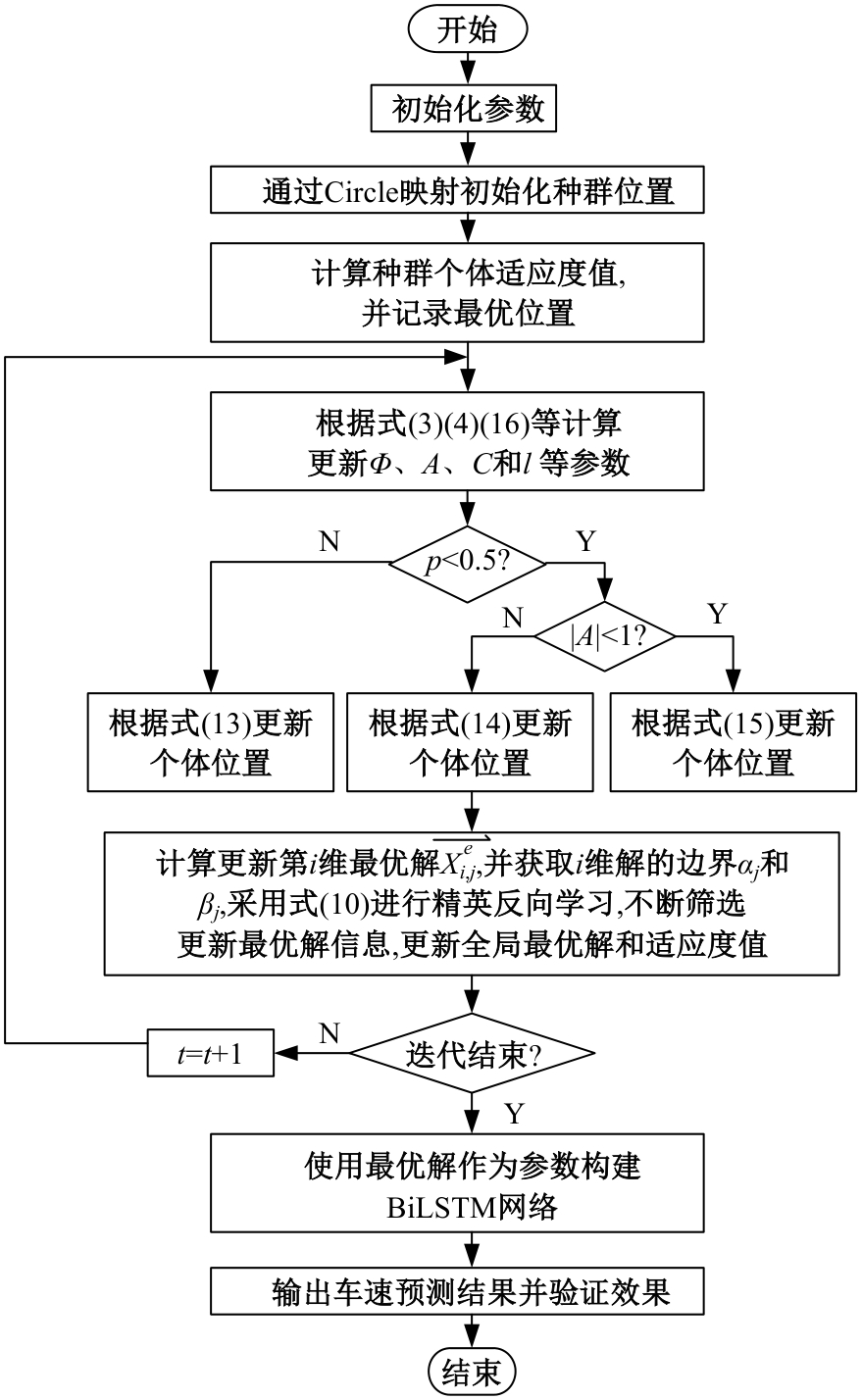
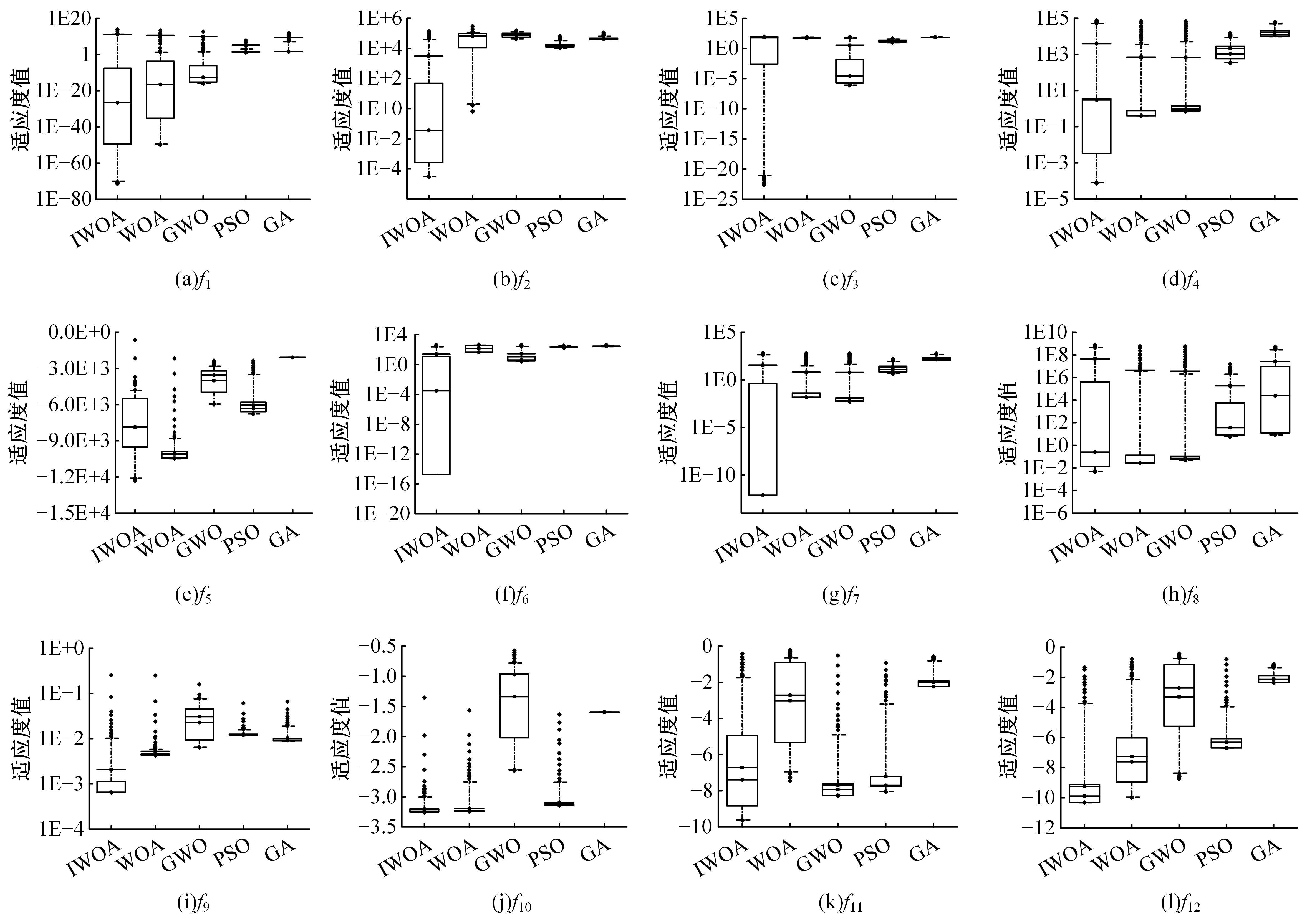
针对现有元启发式算法在优化神经网络预测车速过程中收敛速度慢和误差大的问题,提出了基于改进鲸鱼优化算法优化双向长短期记忆网络(IWOA-BiLSTM)的快速路出口匝道车速预测方法。首先,采用Circle混沌映射取代鲸鱼优化算法中随机产生的初始种群,增加种群的多样性并提高质量。其次,使用精英反向学习策略,提高种群个体择优位置的多样性,降低算法陷入局部最优和过早收敛的风险。最后,采用余弦函数改变自适应收敛因子和引入惯性权重的策略,在保留鲸鱼优化算法优点的前提下,平衡算法的全局搜索和局部开发能力。仿真结果表明:与现有元启发式算法和车速预测模型相比,IWOA算法在寻优求解精度、收敛速度和预测精度等方面均有明显提升。
中图分类号:
- U491

| [1] | Hou L, Pei Y, He Q. A car following model in the context of heterogeneous traffic flow involving multilane following behavior[J].Physica A: Statistical Mechanics and its Applications, 2023, 632: No.129307. |
| [2] | 朱洁玉, 马艳丽. 合流区域多车交互风险实时评估方法[J]. 吉林大学学报: 工学版, 2022, 52(7): 1574-1581. |
| Zhu Jie-yu, Ma Yan-li. Real-time assessment method of multi-vehicle interaction risk in confluence area[J].Journal of Jilin University (Engineering Edition), 2022, 52(7): 1574-1581. | |
| [3] | Boukerche A, Wang J. Machine learning-based traffic prediction models for intelligent transportation systems[J]. Computer Networks, 2020, 181: No. 107530. |
| [4] | Tedjopurnomo D A, Bao Z, Zheng B, et al. A survey on modern deep neural network for traffic prediction: trends, methods and challenges[J].IEEE Transactions on Knowledge and Data Engineering, 2020, 34(4): 1544-1561. |
| [5] | Lee S, Lee Y I, Cho B. Short‐term travel speed prediction models in car navigation systems[J]. Journal of Advanced Transportation, 2006, 40(2): 122-139. |
| [6] | Zhang Z, Wang Y, Chen P, et al. Probe data-driven travel time forecasting for urban expressways by matching similar spatiotemporal traffic patterns[J]. Transportation Research Part C: Emerging Technologies, 2017, 85: 476-493. |
| [7] | Chen P, Ding C, Lu G, et al. Short-term traffic states forecasting considering spatial-temporal impact on an urban expressway[J]. Transportation Research Record, 2016, 2594(1): 61-72. |
| [8] | Tang K, Chen S, Cao Y, et al. Short-Term travel speed prediction for urban expressways: hybrid convolutional neural network models[J]. IEEE Transactions on Intelligent Transportation Systems, 2020, 23(3): 1829-1840. |
| [9] | George S, Santra A K. An improved long short‐term memory networks with Takagi‐Sugeno fuzzy for traffic speed prediction considering abnormal traffic situation[J]. Computational Intelligence, 2020, 36(3): 964-993. |
| [10] | Manne S, Lydia E L, Pustokhina I V, et al. An intelligent energy management and traffic predictive model for autonomous vehicle systems[J]. Soft Computing, 2021, 25(18): 11941-11951. |
| [11] | Jia X, Zhou W, Yang H, et al. Short-term traffic travel time forecasting using ensemble approach based on long short‐term memory networks[J]. IET Intelligent Transport Systems, 2023, 17: 1262-1273. |
| [12] | Shuai C, Wang W C, Xu G, et al. Short-term traffic flow prediction of expressway considering spatial influences[J]. Journal of Transportation Engineering, Part A: Systems, 2022, 148(6): No.04022026. |
| [13] | Wolpert D H, Macready W G. No free lunch theorems for optimization[J].IEEE Transactions on Evolutionary Computation, 1997, 1(1): 67-82. |
| [14] | Yuan J, Abdel-Aty M, Gong Y, et al. Real-time crash risk prediction using long short-term memory recurrent neural network[J]. Transportation research record, 2019, 2673(4): 314-326. |
| [15] | Mirjalili S, Lewis A. The whale optimization algorithm[J]. Advances in Engineering Software, 2016, 95: 51-67. |
| [16] | Kaur G, Arora S. Chaotic whale optimization algorithm[J]. Journal of Computational Design and Engineering, 2018, 5(3): 275-284. |
| [17] | Seif Z, Ahmadi M B. An opposition-based algorithm for function optimization[J]. Engineering Applications of Artificial Intelligence, 2015, 37: 293-306. |
| [18] | 刘嫣然, 孟庆瑜, 郭洪艳, 等. 图注意力模式下融合高精地图的周车轨迹预测[J]. 吉林大学学报: 工学版, 2023, 53(3): 792-801. |
| Liu Yan-ran, Meng Qing-yu, Guo Hong-yan, et al. Cycle car trajectory prediction with high-precision map fusion under the attention mode of map[J].Journal of Jilin University ( Engineering and Technology Edition ), 2023, 53(3): 792-801. | |
| [19] | 张兵, 周丹丹, 孙健. 基于双向长短期记忆网络的公交到站时间预测模型[J]. 交通运输系统工程与信息, 2023, 23(2): 148-160. |
| Zhang Bing, Zhou Dan-dan, Sun Jian, et al. Bus arrival time prediction model based on bidirectional long short-term memory network[J]. Transportation System Engineering and Information, 2023, 23(2): 148-160. |
| [1] | 徐慧智,郝东升,徐小婷,蒋时森. 基于深度学习的高速公路小目标检测算法[J]. 吉林大学学报(工学版), 2025, 55(6): 2003-2014. |
| [2] | 孟祥海,王国锐,张明扬,田毕江. 基于选择集成的山区高速事故预测模型[J]. 吉林大学学报(工学版), 2025, 55(4): 1298-1306. |
| [3] | 岳昊,常笑,刘建业,曲秋莳. 引入车辆窗的定制公交线路优化[J]. 吉林大学学报(工学版), 2025, 55(4): 1266-1274. |
| [4] | 吴文静,邓淳淳,贾洪飞,孙舒航. 内涝影响下路网畅通可靠度评估及关键路段识别[J]. 吉林大学学报(工学版), 2025, 55(4): 1250-1257. |
| [5] | 马书红,张俊杰,陈西芳,廖国美. 利用出租车时序数据识别城市功能区[J]. 吉林大学学报(工学版), 2025, 55(2): 603-613. |
| [6] | 高天洋,胡大伟,姜瑞森,吴雪,刘慧甜. 基于模块化车辆的区域灵活接驳公交线路优化[J]. 吉林大学学报(工学版), 2025, 55(2): 537-545. |
| [7] | 李昱燃,汪飞,朱才华,韩飞,李岩. 污染天气居民通勤模式选择影响因素的链式效用[J]. 吉林大学学报(工学版), 2025, 55(2): 577-590. |
| [8] | 徐慧智,蒋时森,王秀青,陈爽. 基于深度学习的车载图像车辆目标检测和测距[J]. 吉林大学学报(工学版), 2025, 55(1): 185-197. |
| [9] | 郑长江,陶童统,陈志超. 基于流量可调重分配的级联失效模型[J]. 吉林大学学报(工学版), 2024, 54(9): 2441-2450. |
| [10] | 温晓岳,钱国敏,孔桦桦,缪月洁,王殿海. TrafficPro:一种针对城市信控路网的路段速度预测框架[J]. 吉林大学学报(工学版), 2024, 54(8): 2214-2222. |
| [11] | 闫云娟,查伟雄,石俊刚,严丽平. 基于随机充电需求的充电桩优化双层模型[J]. 吉林大学学报(工学版), 2024, 54(8): 2238-2244. |
| [12] | 曲大义,刘浩敏,杨子奕,戴守晨. 基于车路协同的交通瓶颈路段车流动态分配机制及模型[J]. 吉林大学学报(工学版), 2024, 54(8): 2187-2196. |
| [13] | 陈桂珍,程慧婷,朱才华,李昱燃,李岩. 考虑驾驶员生理信息的城市交叉口风险评估方法[J]. 吉林大学学报(工学版), 2024, 54(5): 1277-1284. |
| [14] | 赵晓华,刘畅,亓航,欧居尚,姚莹,郭淼,杨海益. 高速公路交通事故影响因素及异质性分析[J]. 吉林大学学报(工学版), 2024, 54(4): 987-995. |
| [15] | 杨秀建,贾晓寒,张生斌. 考虑汽车队列动态特性的混合交通流特性[J]. 吉林大学学报(工学版), 2024, 54(4): 947-958. |
|