吉林大学学报(工学版) ›› 2026, Vol. 56 ›› Issue (1): 265-274.doi: 10.13229/j.cnki.jdxbgxb.20240548
基于导电纳米改性纺织纤维材料的可穿戴温度传感器
李志刚1,2( ),王睿鑫1,2,文章3,杨子龙1,2
- 1.东北大学 信息科学与工程学院,沈阳 110819
2.河北省微纳精密光学传感与检测技术重点实验室,河北 秦皇岛 066004
3.中国石油大庆油田有限公司,黑龙江 大庆 163453
Wearable temperature sensor based on conductive nano-modified textile fiber materials
Zhi-gang LI1,2(),Rui-xin WANG1,2,Zhang WEN3,Zi-long YANG1,2
- 1.College of Information Science and Engineering,Northeastern University,Shenyang 110819,China
2.Hebei Key Laboratory of Micro-Nano Precision Optical Sensing and Measurement Technology,Qinhuangdao 066004,China
3.Daqing Oilfield Co. ,Ltd. ,Petro China,Daqing 163453,China
摘要:
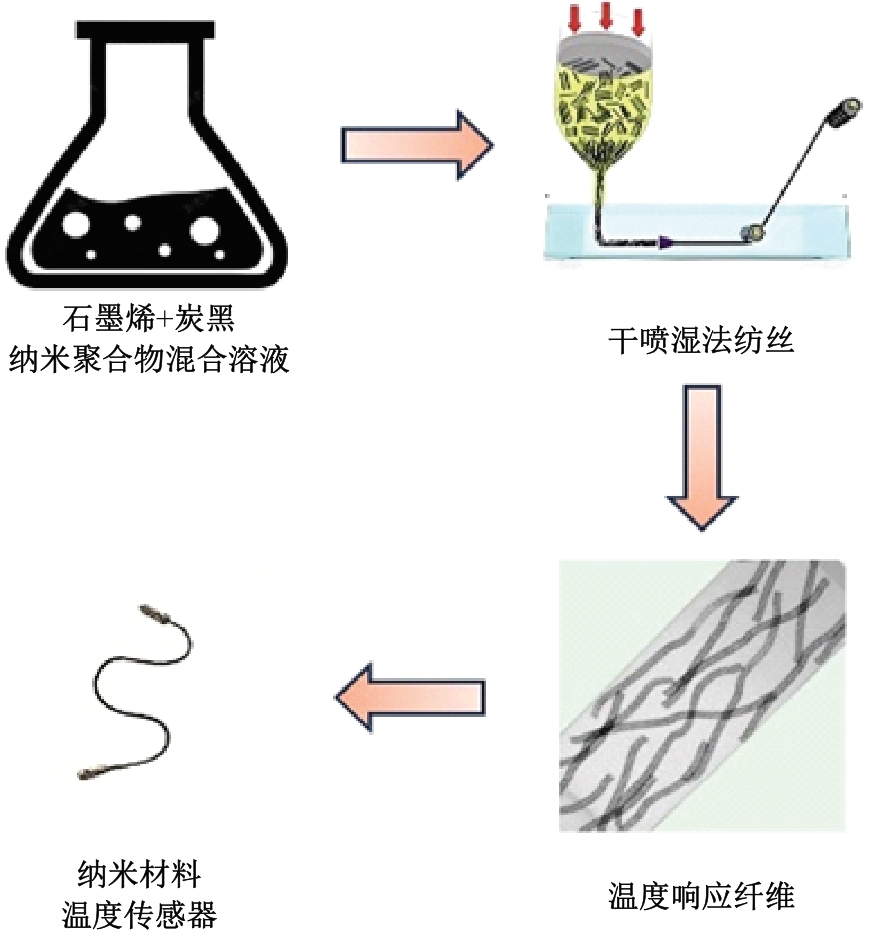
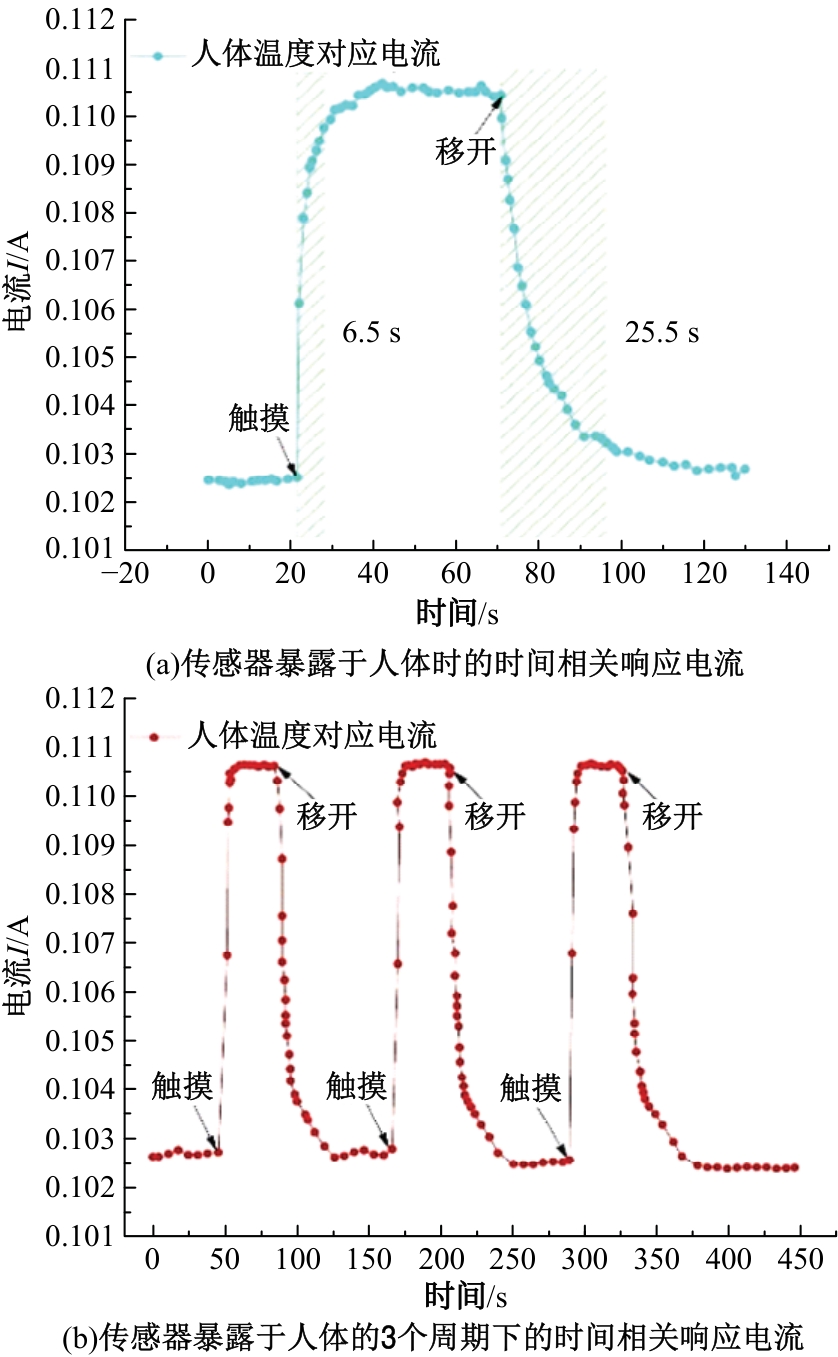
本文采用简单的纺丝(干喷湿纺)方法将石墨烯和炭黑混合纤维素纺成温度响应纤维,提出了一种使用石墨烯和炭黑纤维制造可穿戴式温度传感器新方法。这种传感器具有高抗拉强度、较短的响应时间(6.5 s)和良好的温度恢复时间(25.5 s)。在多次施加机械形变后,其响应保持稳定。通过简单的工艺将其集成在织物中,可由人穿着监控皮肤温度,且具有较强的抗干扰性。上述结果表明:基于导电纳米改性纺织纤维材料的可穿戴温度传感器具有巨大的应用潜力。
中图分类号:
- TP273

| [1] | Liu W, Tian X, Yang D, et al. Evaluation of individual thermal sensation at raised indoor temperatures based on skin temperature build[J]. Building and Environment, 2021, 188(15): No.107486. |
| [2] | El-Radhi A S. Fever in Common Infectious Diseases[M]. Clinical Manual of Fever in Children, 2009: 81-135.. |
| [3] | Korman P, Straburzyńska-Lupa A, Romanowski W, et al. Temperature changes in rheumatoid hand treated with nitrogen vapors and cold air[J]. Rheumatology International, 2012, 32: 2987-2992. |
| [4] | Huang Y, Zhou M, Yuan F. Clinical features and risk factors of fever in acute gouty arthritis[J]. BioMed Research International, 2022: No.8798838. |
| [5] | Knapp J P, Kakish J E, Bridle B W, et al. Tumor temperature: friend or foe of virus-based cancer immunotherapy[J]. Biomedicines, 2022, 10(8): No.2024. |
| [6] | Wu Y, Zhang Z, Liu H, et al. Age differences in thermal comfort and physiological responses in thermal environments with temperature ramp build[J]. Building and Environment,2023, 228(15):No.109887. |
| [7] | Chugh V, Basu A, Kaushik A, et al. E-skin–based advanced wearable technology for health management[J]. Current Research in Biotechnology,2023,5:No.100129. |
| [8] | Yang Y, Cui T, Li D, et al. Breathable electronic skins for daily physiological signal monitoring[J].Nano-micro Lett, 2022, 14(1): No.161. |
| [9] | Deng Z, Guo L, Chen X, et al. Smart wearable systems for health monitoring[J]. Sensors, 2023, 23: No. 2479. |
| [10] | Tarar A A, Mohammad U, Srivastava S K. Wearable skin sensors and their challenges: a review of transdermal, optical, and mechanical sensors[J]. Biosensors, 2020,10(6): No.56. |
| [11] | Lin M, Zheng Z, Yang L, et al. A high-performance, sensitive, wearable multifunctional sensor based on rubber/CNT for human motion and skin temperature detection[J]. Advanced Material,2022, 34:No. 2107309. |
| [12] | Hu X, Xia X X, Huang S C, et al. Development of adhesive and conductive resilin-based hydrogels for wearable sensors[J]. Biomacromolecules, 2019, 20(9): 3283-3293. |
| [13] | Lin X Z, Xue H, Li F, et al.All-nanofibrous ionic capacitive pressure sensor for wearable applications[J].ACS Applied Materials & Interfaces, 2022,14 (38): 43844-43852. |
| [14] | Zhang L, Kumar K S, He H, et al. Fully organic compliant dry electrodes self-adhesive to skin for long-term motion-robust epidermal biopotential monitoring[J]. Nature Communications, 2020, 11: No. 4683. |
| [15] | Mahsa-Hamedi S, Samaneh-Kordrostami Z. Fabrication of a high-sensitive wearable temperature sensor with an improved response time based on PEDOT: PSS/rGO on a flexible kapton substrate[J]. Journal of Materials Science: Materials in Electronics, 2022, 33(9): 6954-6968. |
| [16] | Li X, Chen S, Peng Y, et al. Materials, preparation strategies, and wearable sensor applications of conductive fibers: a review[J]. Sensors,2022,22(8):No.3028. |
| [17] | Chen Y, Hart J, Suh M, et al. Electromechanical characterization of commercial conductive yarns for E-Textiles[J]. Textiles, 2023, 3: 294-306. |
| [18] | 余龙. 碳纳米管纱线的制备与表面功能化及在智能纺织品领域的应用[D]. 无锡: 江南大学纺织科学与工程学院, 2023. |
| Yu Long. Preparation and surface functionalization of carbon nanotube yarn and its application in intelligent textile field[D]. Wuxi: College of Textile Science and Engineering, Jiangnan University, 2023. | |
| [19] | Zhu Q, Wang Z, Zeng H, et al. Effects of graphene on various properties and applications of silicone rubber and silicone resin[J]. Composites Part A: Applied Science and Manufacturing, 2021, 142: No.106240. |
| [20] | Liu J, Wang Y, Li X, et al. Graphene-based wearable temperature sensors: a review[J]. Nanomaterials,2023, 13(16): No.2339. |
| [21] | Tiwari S K, Sahoo S, Wang N, et al.Graphene research and their outputs: status and prospect[J]. Journal of Science: Advanced Materials and Devices,2020, 5(1): 10-29. |
| [22] | Sharma P, Karol V, Kaur S, et al. Fabrication and Interfacial Bonding of CNT-reinforced Metal Matrix Composites[M]. Metal Matrix Composites: A Modern Approach to Manufacturing. Bentham Science Publishers, 2024: 116-146. |
| [23] | Yin Q, Hu Y Y, Qin Y T, et al. Construction of polyimide films with excellent dimensional stability and toughness via incorporating point-to-face multi-coordination structure[J]. Composites Part B: Engineering, 2021, 208: No.108566. |
| [24] | 张春艳. 多层纤维增强环氧复合材料层状结构设计与电磁屏蔽效能简化预测[D]. 太原: 中北大学材料科学与工程学院, 2024. |
| Zhang Chun-yan. Layered structure design and simplified prediction of electromagnetic shielding effectiveness of multilayer fiber reinforced epoxy composites[D]. Taiyuan:College of Materials Science and Engineering,North University of China, 2024. | |
| [25] | Li Y, Zhou Z, He Y. Solid lubrication system and its plasma surface engineering: a review[J]. Lubricants,2023, 11: No.473. |
| [26] | Liu J, Bao S, Wang X. Applications of graphene-based materials in sensors: a review[J]. Micromachines, 2022, 13(2): No.184. |
| [27] | Hou N, Zhao Y, Jiang R, et al. Flexible piezoresistive sensor based on surface modified dishcloth fibers for wearable electronics device[J]. Colloids and Surfaces A: Physicochemical and Engineering Aspects, 2022,650: No.129638. |
| [28] | 石洪富, 邓自刚, 柯志昊, 等. 平板式永磁电动悬浮系统设计与实验研究[J]. 电工技术学报, 2024, 39(5): 1270-1283. |
| Shi Hong-fu, Deng Zi-gang, Ke Zhi-hao, et al. Design and experimental study of flat permanent magnet electric suspension system[J]. Journal of Electrical Technology, 2024, 39(5): 1270-1283. | |
| [29] | Wang Y, Luke J, Privitera A, et al. The critical role of the donor polymer in the stability of high-performance non-fullerene acceptor organic solar cells[J]. Joule, 2023, 7(4): 810-829. |
| [30] | Cui B, Pan F, Ding B, et al. Fiber aggregation in nanocomposites: aggregation degree and its linear relation with the percolation threshold[J]. Materials, 2023, 16(1): No.15. |
| [31] | Jeong S Y, Lee J U, Hong S M, et al. Highly skin-conformal laser-induced graphene-based human motion monitoring sensor[J]. Nanomaterials, 2021, 11:No.951. |
| [32] | Boey J Y, Lee C K, Tay G S. Factors affecting mechanical properties of reinforced bioplastics: a review[J]. Polymers, 2022, 14(18): No.3737. |
| [33] | Tang N, Zheng Y, Jiang X, et al. Wearable sensors and systems for wound healing-related ph and temperature detection[J]. Micromachines,2021,12(4):No.430. |
| [34] | Zhang T, Zhang M, Shen Y, et al. Mitigating the damage of ultra-high performance concrete at elevated temperatures using synergistic flame-retardant polymer fibres[J]. Cement and Concrete Research, 2022,158: No.10683 |
| [35] | Gangwar R K, Kumari S, Pathak A K, et al. Optical fiber based temperature sensors: a review[J]. Optics,2023, 4(1): 171-197. |
| [36] | Shuvo I I, Shah A, Dagdeviren C. Electronic textile sensors for decoding vital body signals: state-of-the-art review on characterizations and recommendations[J]. Advanced Intelligent Systems, 2022, 4(4): No. 2100223. |
| [37] | Wei L, Wang S, Shan M, et al. Conductive fibers for biomedical applications[J]. Bioactive Materials, 2023, 22: 343-364. |
| [38] | Mohamed A, Tonkonogovas A, Stankevičius A, et al. Fabrication of high-strength graphene oxide/carbon fiber nanocomposite membranes for hydrogen separation applications[J]. Process Safety and Environmental Protection, 2023, 172: 941-949. |
| [39] | Wu S. An overview of hierarchical design of textile-based sensor in wearable electronics[J]. Crystals,2022, 12: No.555. |
| [40] | Li X, Cui T, Li X, et al. Wearable temperature sensors based on reduced graphene oxide films[J]. Materials, 2023, 16(17): No.5952. |
| [1] | 李文博,谢华城,于树友,林宝君,陈虹. 基于分布式模型预测的商用车队列避障控制[J]. 吉林大学学报(工学版), 2026, 56(1): 247-256. |
| [2] | 王菲,陆恒辉,卢荡. 基于UniTire轮胎模型的车辆稳定性控制[J]. 吉林大学学报(工学版), 2025, 55(9): 2864-2873. |
| [3] | 于树友,刘泽澎,林宝君,陈虹. 基于数据驱动的车辆编队分布式预测控制[J]. 吉林大学学报(工学版), 2025, 55(9): 3056-3068. |
| [4] | 孙鹏远,陈国栋,张慧峰,陈伟轩,刘帅. 基于自适应观测器的氢内燃机排气流量估计[J]. 吉林大学学报(工学版), 2025, 55(9): 2837-2846. |
| [5] | 李寿涛,贾湘怡,朱军,郭洪艳,于丁力. 基于Level-K的智能驾驶汽车无信控交叉路口决策方法[J]. 吉林大学学报(工学版), 2025, 55(9): 3069-3078. |
| [6] | 高金武,孙少龙,王舜尧,高炳钊. 基于电机转矩补偿的增程器转速波动抑制策略[J]. 吉林大学学报(工学版), 2025, 55(8): 2475-2486. |
| [7] | 李新春,孙鹤源,许驰. 基于深度Q网络算法的空天地边缘计算网络资源分配方法[J]. 吉林大学学报(工学版), 2025, 55(7): 2418-2424. |
| [8] | 于树友,谢华城,李文博,李永福,陈虹,林宝君. 数字孪生驱动的商用车队列纵横向控制[J]. 吉林大学学报(工学版), 2025, 55(6): 1994-2002. |
| [9] | 赵靖华,刘妲,周宇麒,闻龙,刘倩妤,刘捷,解方喜. 基于高斯过程回归进气量预测的空燃比控制[J]. 吉林大学学报(工学版), 2025, 55(6): 1854-1861. |
| [10] | 赵男男,金凤,丁宏钰. 基于权重优化AF的非线性主动噪声控制算法[J]. 吉林大学学报(工学版), 2025, 55(5): 1722-1727. |
| [11] | 宫洵,任航,张华霖,汪介瑜,胡云峰,孙耀. 冬季网联纯电动汽车热泵空调生态制热控制方法[J]. 吉林大学学报(工学版), 2025, 55(3): 820-828. |
| [12] | 沈鹏,李小华,刘辉. 具有输入缓冲的机械臂预设定有限时间跟踪控制[J]. 吉林大学学报(工学版), 2025, 55(1): 63-73. |
| [13] | 刘果,熊坚,杨秀建,何扬帆. 基于曲率增广的智能车辆轨迹跟踪控制[J]. 吉林大学学报(工学版), 2024, 54(12): 3717-3728. |
| [14] | 曹昊哲,周金笨,李丽华. 量化Wiener系统的重复梯度学习参数估计[J]. 吉林大学学报(工学版), 2024, 54(12): 3673-3680. |
| [15] | 宋秀兰,柴伟豪,何德峰,应颂翔. DoS攻击下网联车队安全协同自适应预测巡航控制[J]. 吉林大学学报(工学版), 2024, 54(11): 3406-3416. |
|
||