吉林大学学报(工学版) ›› 2025, Vol. 55 ›› Issue (7): 2418-2424.doi: 10.13229/j.cnki.jdxbgxb.20240743
• 通信与控制工程 • 上一篇
基于深度Q网络算法的空天地边缘计算网络资源分配方法
李新春1,2( ),孙鹤源1,许驰3
- 1.辽宁工程技术大学 电子与信息工程学院,辽宁 葫芦岛 125105
2.辽宁理工学院 电气与智能控制学院,辽宁 锦州 121013
3.中国科学院 沈阳自动化研究所,沈阳 110016
Network resource allocation method of aerospace edge computing based on deep Q network algorithm
Xin-chun LI1,2(),He-yuan SUN1,Chi XU3
- 1.School of Electronic and Information Engineering,Liaoning Technical University,Huludao 125105,China
2.School of Electrical and Intelligent Control,Liaoning Institute of Science and Engineering,Jinzhou 121013,China
3.Shenyang Institute of Automation,Chinese Academy of Sciences,Shenyang 110016,China
摘要:
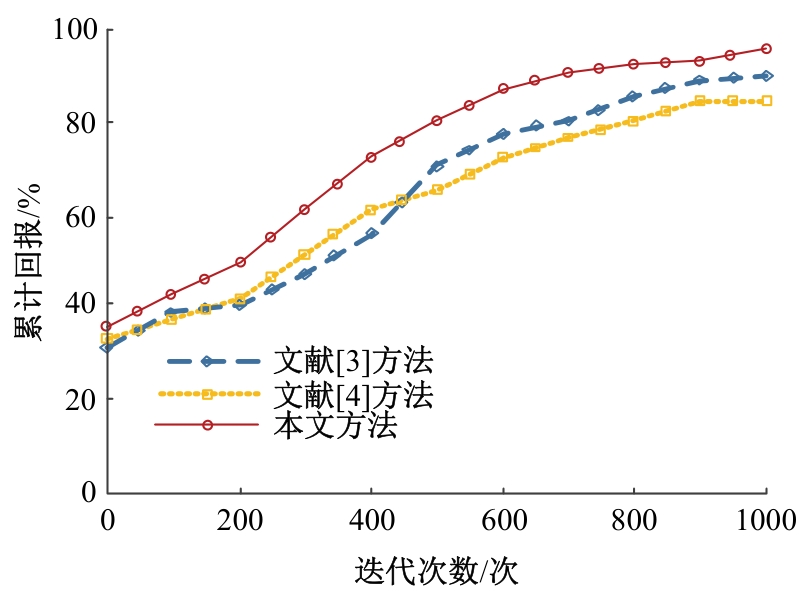
由于卫星、无人机和地面站位置不断变化,导致空天地边缘计算网络链路不固定,且网络需要快速响应用户请求,对吞吐量与实时性的要求较高,增加了网络资源分配的难度。对此,本文提出基于深度Q网络算法的空天地边缘计算网络资源分配方法。首先,考虑网络拓扑的动态性和资源异构性,建立资源间的通信模型,为资源分配提供基础框架;然后,基于最大吞吐量设计资源分配目标函数,并利用马尔科夫决策模型表述目标函数,将资源分配问题转化为序列决策问题,便于在动态变化的网络环境中作出决策;最后,基于深度Q网络算法求解目标函数,通过强化学习的方式,使算法能够通过与环境的交互学习到最优的资源分配策略,适应网络的实时性和动态性。实验结果表明:应用该方法后,网络累计回报较高,资源任务平均能耗降低,说明该方法实际可行。
中图分类号:
- TP273
| [1] | 徐晓斌, 王琪, 范存群, 等. 面向空天地一体化信息网络的边缘计算资源融合管理方法[J]. 计算机学报, 2023, 46(4): 690-710. |
| Xu Xiao-bin, Wang Qi, Fan Cun-qun, et al. An aggregated edge computing resource management method for space-air-ground integrated information networks[J]. Chinese Journal of Computers, 2023, 46 (4): 690-710. | |
| [2] | 邓平科, 张同须, 施南翔, 等. 星算网络——空天地一体化算力融合网络新发展[J]. 电信科学, 2022, 38(6): 71-81. |
| Deng Ping-ke, Zhang Tong-xu, Shi Nan-xiang, et al. Computing satellite networks—the novel development of computing-empowered space-air-ground integrated networks[J].Telecommunications Science, 2022, 38(6): 71-81. | |
| [3] | 张航, 唐冬, 黄高飞, 等. 无线供能协作计算网络中的时延最小化资源分配方案[J]. 计算机应用研究,2022, 39(1): 214-220. |
| Zhang Hang, Tang Dong, Huang Gao-fei, et al.Latency minimization resource allocation scheme in wireless powered cooperative computing network[J]. Application Research of Computers, 2022, 39(1): 214-220. | |
| [4] | 李云, 高倩, 姚枝秀, 等. 移动边缘计算中智能服务编排和算网资源分配联合优化方法[J]. 通信学报, 2023, 44(7): 51-63. |
| Li Yun, Gao Qian, Yao Zhi-xiu, et al. Joint optimization method of intelligent service arrangement and computing-networking resource allocation for MEC [J]. Journal on Communications, 2023, 44 (7): 51-63. | |
| [5] | Li Y H, Liu Z L, Tao Q. A resource allocation strategy for internet of vehicles using reinforcement learning in edge computing environment[J].Soft Computing, 2022, 27(7): 3999-4009. |
| [6] | 叶迎晖, 施丽琴, 卢光跃. 无线供能移动边缘网络中计算时延最小化资源分配方法研究[J]. 电子与信息学报, 2022, 44(5): 1839-1846. |
| Ye Ying-hui, Shi Li-qin, Lu Guang-yue.Execution delay minimization in wireless powered mobile edge computing networks[J]. Journal of Electronics & Information Technology, 2022, 44(5): 1839-1846. | |
| [7] | 杜丹冰. 一种优化空天地一体化网络吞吐量算法[J].弹箭与制导学报, 2023, 43(5): 109-114. |
| Du Dan-bing. A throughput optimization in space-air-ground integrated networks[J]. Journal of Projectiles, Rockets, Missiles and Guidance, 2023,43(5): 109-114. | |
| [8] | 乔文欣, 卢昱, 刘益岑, 等. 空天地协同的边缘云服务功能链动态编排方法[J]. 西安电子科技大学学报, 2022, 49(2): 79-88. |
| Qiao Wen-xin, Lu Yu, Liu Yi-cen, et al. Dynamic scheduling method for service function chains in space air terrestrial aided edge cloud networks[J]. Journal of Xidian University, 2022, 49(2): 79-88. | |
| [9] | 郭凇岐, 安康, 孙艺夫, 等. 基于深度学习的HARQ辅助空天地融合网络时延受限容量预测[J]. 电讯技术, 2023, 63(7): 963-971. |
| Guo Song-qi, An Kang, Sun Yi-fu, et al. Delay-limited throughput prediction of HARQ-assisted satellite-aerial-terrestrial integrated network: a deep learning approach[J]. Telecommunication Engineering, 2023, 63(7): 963-971. | |
| [10] | 刘芳, 朱天贺, 苏卫星, 等. 基于高斯隐马尔可夫模型的人机共享控制区域化决策算法[J]. 电子学报, 2022, 50(11): 2659-2667. |
| Liu Fang, Zhu Tian-he, Su Wei-xing, et al. Regionalized decision algorithm for human-machine shared control based on gaussian hidden markov model[J]. Acta Electronica Sinica, 2022, 50(11): 2659-2667. | |
| [11] | 朱霸坤, 朱卫纲, 李伟, 等. 基于马尔可夫的多功能雷达认知干扰决策建模研究[J]. 系统工程与电子技术, 2022, 44(8): 2488-2497. |
| Zhu Ba-kun, Zhu Wei-gang, Li Wei, et al. Research on decision-making modeling of cognitive jamming for multi-functional radar based on Markov[J]. Systems Engineering and Electronics, 2022, 44(8): 2488-2497. | |
| [12] | 王浩聪, 付主木, 孙昊琛, 等.改进深度Q学习的燃料电池混合动力汽车能量管理[J].河南科技大学学报: 自然科学版, 2022, 43(4): 34-40. |
| Wang Hao-cong, Fu Zhu-mu, Sun Hao-chen, et al.Energy management of fuel cell hybrid electric vehicle based on improved deep Q-learning[J]. Journal of Henan University of Science And Technology(Natural Science), 2022, 43(4): 34-40. | |
| [13] | 夏天豪, 夏长清, 潘昊, 等. 基于强化学习的算力资源度量方法[J]. 燕山大学学报, 2023, 47(3): 246-254. |
| Xia Tian-hao, Xia Chang-qing, Pan Hao, et al. Computational power resource measurement method based on reinforcement learning[J]. Journal of Yanshan University, 2023, 47(3): 246-254. | |
| [14] | 侯慧, 何梓姻, 陈跃, 等. 基于深度强化学习区间多目标优化的智能建筑低碳优化调度[J]. 电力系统自动化, 2023, 47(21): 47-57. |
| Hou Hui, He Zi-yin, Chen Yue, et al. Low-carbon optimal dispatch of smart building based on interval multi-objective optimization with deep reinforcement learning[J].Automation of Electric Power Systems, 2023,47(21): 47-57. | |
| [15] | 李文武, 周佳妮, 裴本林, 等. 梯级水库深度强化学习长期随机优化调度研究[J]. 水力发电学报, 2023, 42(11): 21-32. |
| Li Wen-wu, Zhou Jia-ni, Pei Ben-lin, et al.Study on long-term stochastic optimal operation of cascade reservoirs by deep reinforcement learning[J]. Journal of Hydroelectric Engineering, 2023,42(11): 21-32. |
| [1] | 苏命峰,王国军,周聪,王田. 边云协作下时延和能耗约束的启发式任务卸载方法[J]. 吉林大学学报(工学版), 2025, 55(5): 1648-1663. |
| [2] | 赵庶旭,孙治朝,王小龙. 移动边缘计算场景中的动态身份认证协议[J]. 吉林大学学报(工学版), 2025, 55(3): 1050-1060. |
| [3] | 黄汉英,李鹏飞. 边缘服务器计算资源分配方法与仿真实验[J]. 吉林大学学报(工学版), 2025, 55(1): 316-324. |
| [4] | 朱思峰,胡家铭,杨诚瑞,蔡江昊. 物联网边缘计算场景下基于优先级任务的卸载决策优化[J]. 吉林大学学报(工学版), 2024, 54(11): 3338-3350. |
| [5] | 朱思峰,蔡江昊,柴争义,孙恩林. 车联网边缘场景下基于免疫算法的计算卸载优化[J]. 吉林大学学报(工学版), 2024, 54(1): 221-231. |
| [6] | 朱思峰,赵明阳,柴争义. 边缘计算场景中基于粒子群优化算法的计算卸载[J]. 吉林大学学报(工学版), 2022, 52(11): 2698-2705. |
| [7] | 李丽娜,魏晓辉,郝琳琳,王兴旺,王储. 大规模流数据处理中代价有效的弹性资源分配策略[J]. 吉林大学学报(工学版), 2020, 50(5): 1832-1843. |
| [8] | 刘毅,肖玲玲,王改静,张武军. 基于联合优化的D2D资源分配算法[J]. 吉林大学学报(工学版), 2020, 50(1): 306-314. |
| [9] | 姜来为, 沙学军, 吴宣利, 张乃通. LTE-A异构网络中新的用户选择接入和资源分配联合方法[J]. 吉林大学学报(工学版), 2017, 47(6): 1926-1932. |
| [10] | 赵晓晖, 杨伟伟, 金晓光. 基于不同时延业务的中继正交频分复用系统资源分配算法[J]. 吉林大学学报(工学版), 2015, 45(6): 2049-2055. |
| [11] | 唐瑞春, 邱悦, 丁香乾, 李静. 基于效用最大化协商机制的云媒体资源分配算法[J]. 吉林大学学报(工学版), 2015, 45(3): 932-937. |
| [12] | 陈健, 樊光辉, 阔永红. 认知无线电中继协助网络资源分层优化算法[J]. 吉林大学学报(工学版), 2014, 44(5): 1498-1505. |
| [13] | 游晓明, 刘升, 王裕明. 量子行为网络资源并行分配优化模型及其应用[J]. 吉林大学学报(工学版), 2012, 42(增刊1): 341-345. |
| [14] | 丛犁, 张海林, 刘毅, 赵力强, 张国鹏. 基于粒子群优化的协作网络资源分配的博弈策略[J]. 吉林大学学报(工学版), 2012, 42(01): 207-212. |
| [15] | 程翔, 李立. 单物品多单元双向拍卖环境下的网格资源分配仿真[J]. 吉林大学学报(工学版), 2010, 40(05): 1359-1365. |
|
||