吉林大学学报(工学版) ›› 2026, Vol. 56 ›› Issue (2): 575-584.doi: 10.13229/j.cnki.jdxbgxb.20240842
• 通信与控制工程 • 上一篇
基于驾驶风险和驾驶能力的人机控制权分配
李坤宸1( ),袁伟1,2(),王畅1,2,张会明1,穆雨薇1
- 1.长安大学 汽车学院,西安 710086
2.汽车运输安全保障技术交通运输行业重点实验室,西安 710086
Allocating control authority based on driving risk and driver's ability
Kun-chen LI1(),Wei YUAN1,2(),Chang WANG1,2,Hui-ming ZHANG1,Yu-wei MU1
- 1.School of Automobile,Chang'an University,Xi'an 710086
2.Key Laboratory of Transportation Industry of Automotive Transportation Safety Enhancement Technology,Xi'an 710086,China
摘要:
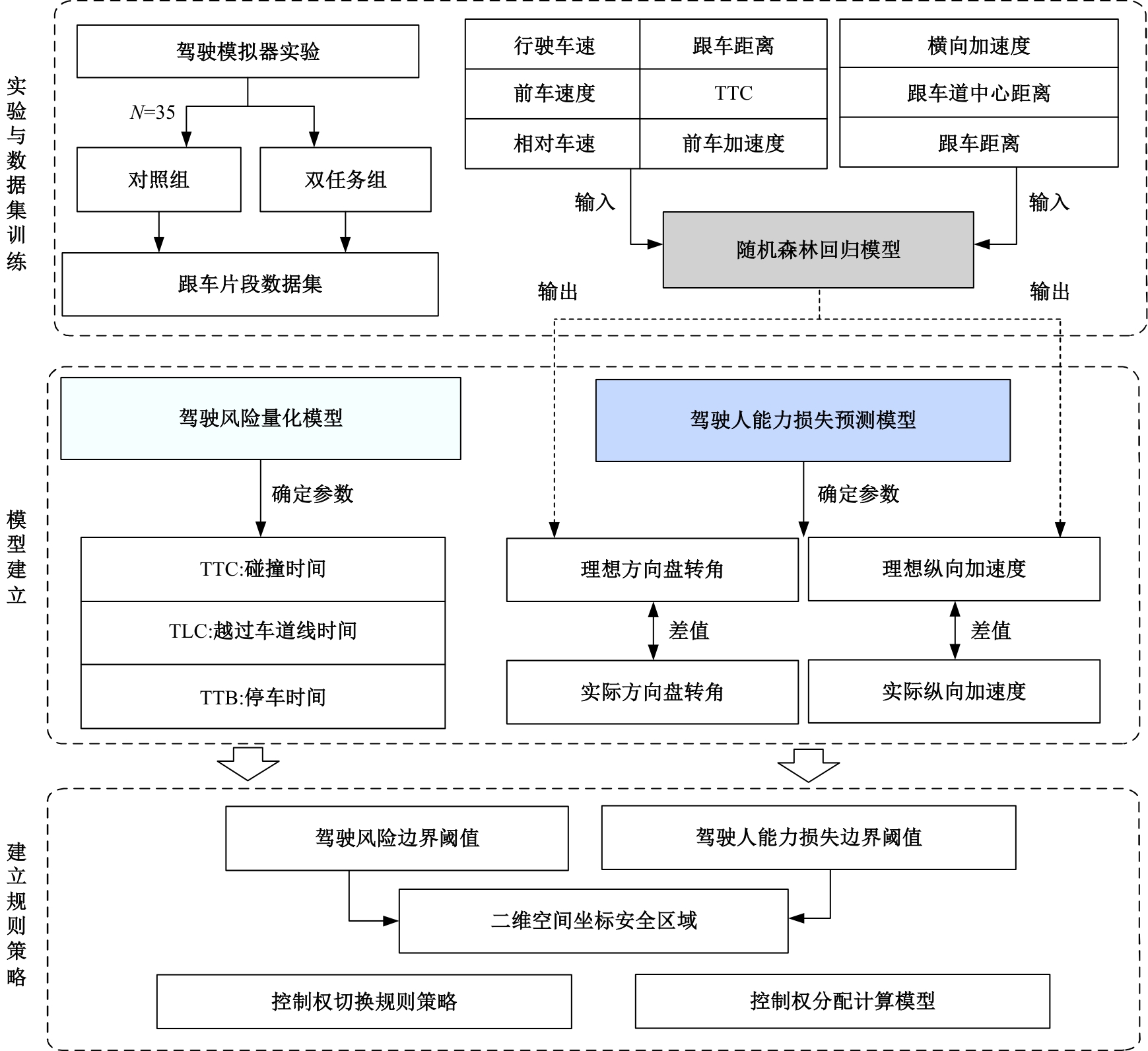
为减少人机协作模式下车辆和驾驶人之间的操控冲突,实现车辆控制权的柔性切换,首先,开展了驾驶模拟器跟车实验,基于碰撞时间、越过车道线时间和制动时间建立驾驶风险评估模型;其次,基于纵向加速度和方向盘转角,使用随机森林回归建立驾驶人跟车能力损失预测模型;最后,基于驾驶风险和驾驶员能力损失边界阈值建立了车辆控制权分配策略。结果表明:在纵向碰撞和濒临碰撞事件中,所提模型建议车辆应干预的时刻分别比驾驶员实际采取制动措施提前了0.62 s和1.03 s,有效识别率为87%。本研究可以为人机协作驾驶模式下车辆与驾驶人的控制权分配和过渡设计提供初步的参考。
中图分类号:
- U491.2

| [1] | Bassani M, Catani L, Hazoor A, et al. Do driver monitoring technologies improve the driving behaviour of distracted drivers? A simulation study to assess the impact of an auditory driver distraction warning device on driving performance[J]. Transportation Research Part F: Traffic Psychology and Behaviour, 2023, 95: 239-250. |
| [2] | You F, Zhang J, Zhang J, et al. A novel cooperation-guided warning of invisible danger from AR-HUD to enhance driver's perception[J]. International Journal of Human-Computer Interaction, 2024, 40(8): 1873-1891. |
| [3] | Yu Z, Xu G, Jiang K, et al. Constructing the behavioral sequence of the takeover process—TOR, behavior characteristics and phases division: a real vehicle experiment[J]. Accident Analysis & Prevention, 2023, 186: No.107040. |
| [4] | Huang C, Naghdy F, Du H, et al. Review on human-machine shared control system of automated vehicles[C]∥2019 3rd International Symposium on Autonomous Systems (ISAS), Shanghai, China, 2019: 47-51. |
| [5] | Sanders D A, Gegov A, Tewkesbury G E, et al. Sharing driving between a vehicle driver and a sensor system using trust-factors to set control gains[C]∥ Intelligent Systems and Applications: Proceedings of the 2018 Intelligent Systems Conference, London, UK, 2019: 1182-1195. |
| [6] | Noh S, An K, Han W. Situation assessment and behavior decision for vehicle/driver cooperative driving in highway environments[C]∥ 2015 IEEE International Conference on Automation Science and Engineering, Gothenburg, Sweden, 2015: 626-633. |
| [7] | Yue M, Fang C, Zhang H, et al. Adaptive authority allocation-based driver-automation shared control for autonomous vehicles[J]. Accident Analysis & Prevention, 2021, 160: No.106301. |
| [8] | Wang Z, Suga S, Nacpil E J C, et al. Adaptive driver-automation shared steering control via forearm surface electromyography measurement[J]. IEEE Sensors Journal, 2020, 21(4): 5444-5453. |
| [9] | Benloucif M A, Sentouh C, Floris J, et al. Online adaptation of the level of haptic authority in a lane keeping system considering the driver's state[J]. Transportation Research Part F: Traffic Psychology and Behaviour, 2019, 61: 107-119. |
| [10] | Goodarzi A, Ghajar M. Integrating lane-keeping system with direct yaw moment control tasks in a novel driver assistance system[J]. Proceedings of the Institution of Mechanical Engineers, Part K: Journal of Multi-body Dynamics, 2014, 229(1): 16-38. |
| [11] | Ko S, Langari R. Shared control between human driver and machine based on game theoretical model predictive control framework[C]∥ 2020 IEEE/ASME International Conference on Advanced Intelligent Mechatronics, Boston, USA, 2020: 649-654. |
| [12] | Zhang W, Zhao Y, Zhang X, et al. Shared control for lane keeping assistance system based on multiple-phase handling inverse dynamics[J]. Control Engineering Practice, 2019, 93: No.104182. |
| [13] | Yang L, Yue M, Zhang H, et al. Toward hazard reduction of road vehicle after tire blowout: a driver steering assist control strategy[C]∥ 2019 Chinese Control Conference, Guangzhou, China, 2019: 6600-6605. |
| [14] | Liang J, Lu Y, Feng J, et al. Robust shared control system for aggressive driving based on cooperative modes identification[J]. IEEE Transactions on Systems, Man, and Cybernetics: Systems, 2023, 53(11): 6672-6684. |
| [15] | Fang Z, Wang J, Liang J, et al. Authority allocation strategy for shared steering control considering human-machine mutual trust level[J]. IEEE Transactions on Intelligent Vehicles, 2024, 9(1): 2002-2015. |
| [16] | 刘芳, 朱天贺, 苏卫星, 等. 基于高斯隐马尔可夫模型的人机共享控制区域化决策算法[J]. 电子学报, 2022, 50(11): 2659-2667. |
| Liu Fang, Zhu Tian-he, Su Wei-xing, et al. Regionalized decision algorithm for human-machine shared control based on gaussian hidden Markov model[J]. Acta Electronica Sinica, 2022, 50(11): 2659-2667. | |
| [17] | Tang F, Gao F, Wang Z. Driving capability-based transition strategy for cooperative driving: from manual to automatic[J]. IEEE Access, 2020, 8: 139013-139022. |
| [18] | 孙博华. 考虑驾驶能力及驾驶习性的个性化人机共驾策略研究[D]. 长春: 吉林大学汽车工程学院, 2020. |
| Sun Bo-hua. Research on personalized shared control considering driver's driving capability and style[D]. Changchun: College of Automotive Engineering, Jilin University, 2020. | |
| [19] | Li X, Wang Y. Shared steering control for human-machine co-driving system with multiple factors[J]. Applied Mathematical Modelling, 2021,100: 471-490. |
| [20] | 徐江. 基于驾驶能力的人机共驾接管策略研究[D]. 重庆: 重庆大学机械与运载工程学院, 2019. |
| Xu Jiang. Study on driver capability based take-over strategy of cooperative driving system[D]. Chongqing: School of Mechanical and Transportation Engineering, Chongqing University, 2019. | |
| [21] | Liu F, Zhu T, Su W. Servo-level human–machine shared control flexible strategy based on driving ability, status and regionalized environmental risk[J]. IEEE Transactions on Transportation Electrification, 2023, 9(3): 4418-4436. |
| [22] | Bausell R B, Li Y. Power Analysis for Experimental Research: a Practical Guide for the Biological, Medical and Social Sciences[M]. London: Cambridge University Press, 2002. |
| [23] | Wang H, Gu M, Wu S, et al. A driver's car-following behavior prediction model based on multi-sensors data[J]. EURASIP Journal on Wireless Communications and Networking, 2020, 2020(1): 1-12. |
| [24] | Kudarauskas N. Analysis of emergency braking of a vehicle[J]. Transport, 2007, 22(3): 154-159. |
| [1] | 张文会,叶梅茹,席聪,宋子文. 混合交通流环境下车辆编队与碳排放特性[J]. 吉林大学学报(工学版), 2026, 56(2): 416-430. |
| [2] | 孙宇,李世武,郭梦竹,金桐彤,宋会军,刘德志,高雯. 多模态数据在驾驶疲劳监测中的有效性分析[J]. 吉林大学学报(工学版), 2026, 56(2): 473-479. |
| [3] | 慈玉生,黄轶康. 基于文献计量的交叉口车路协同研究综述[J]. 吉林大学学报(工学版), 2026, 56(2): 313-332. |
| [4] | 潘义勇,曹天宇,刘宇. 随机交通网络约束最可靠路径乘子交替方向法[J]. 吉林大学学报(工学版), 2026, 56(2): 455-463. |
| [5] | 马壮林,毕宇明,周备,邓亚娟,兆雪. 公交换乘优惠政策下居民换乘意向的异质性分析[J]. 吉林大学学报(工学版), 2026, 56(1): 158-169. |
| [6] | 曲昭伟,王铭阳,王喆,宋现敏,张云翔,黄镜尘. 基于自动驾驶模块化车辆主辅功能分配的公交自适应调度方法[J]. 吉林大学学报(工学版), 2025, 55(9): 2946-2957. |
| [7] | 王琳虹,刘宇阳,刘子昱,鹿应佳,张宇恒,黄桂树. 基于YOLOv5的轻量化桥梁缺陷识别[J]. 吉林大学学报(工学版), 2025, 55(9): 2958-2968. |
| [8] | 张云翔,宋现敏,谢渝,湛天舒. 基于用户满意度的停车预约服务智能体行为仿真[J]. 吉林大学学报(工学版), 2025, 55(9): 2978-2984. |
| [9] | 王东,李宇暄,吴欢,宗芳. 基于随机森林的智能网联汽车开放测试道路评级算法[J]. 吉林大学学报(工学版), 2025, 55(9): 2998-3006. |
| [10] | 穆长儒,徐亮,程国柱. 基于能量合理分配的外包U型钢-混凝土组合护栏防撞性能[J]. 吉林大学学报(工学版), 2025, 55(8): 2669-2680. |
| [11] | 李艳波,汪静远,陈圆媛,程绍峰,吕浩楠,陈俊硕. 面向高速公路服务区自洽能源系统的RAMS评价方法[J]. 吉林大学学报(工学版), 2025, 55(7): 2243-2250. |
| [12] | 戢晓峰,邓若凡,乔新,关昊天. 建成环境对共享单车时间集聚模式的非线性影响[J]. 吉林大学学报(工学版), 2025, 55(7): 2233-2242. |
| [13] | 于江波,翁剑成,林鹏飞,孙宇星,柴娇龙. 基于混合Transformer的对外客运枢纽抵站客流预测模型[J]. 吉林大学学报(工学版), 2025, 55(7): 2251-2259. |
| [14] | 柴树山,周志强,李海涛,徐炅旸. 基于图时空模式学习网络的路网实时交通事件自动检测方法[J]. 吉林大学学报(工学版), 2025, 55(7): 2145-2161. |
| [15] | 赵红专,吴泽健,张鑫,石胜文,李文勇,展新,许恩永,王佳明. 基于密度离散度和信息传输延迟的网联商用车弯道格子模型[J]. 吉林大学学报(工学版), 2025, 55(6): 2015-2029. |
|
||