吉林大学学报(医学版) ›› 2025, Vol. 51 ›› Issue (5): 1390-1398.doi: 10.13481/j.1671-587X.20250528

• 方法学 • 上一篇    

纹带棒杆菌SpaD多克隆抗体的制备及其对纹带棒杆菌强产膜株生物膜形成能力的抑制作用

郭玢欣1,温娟1,刘慧1,王俊瑞2,3()   

  1. 1.内蒙古医科大学第一临床医学院检验科,内蒙古 呼和浩特 010050
    2.内蒙古医科大学附属医院检验科,内蒙古 呼和浩特 010050
    3.内蒙古自治区临床病原微生物重点实验室,内蒙古 呼和浩特 010050
  • 收稿日期:2024-10-24 接受日期:2024-12-19 出版日期:2025-09-28 发布日期:2025-11-05
  • 通讯作者: 王俊瑞 E-mail:wangjunrui123@yeah.net
  • 作者简介:郭玢欣(2000-),女,内蒙古自治区巴彦淖尔市人,在读硕士研究生,主要从事病原微生物致病和耐药机制方面的研究。
  • 基金资助:
    国家自然科学基金项目(82260416);内蒙古自治区科技厅科技计划项目(2022YFSH0072)

Preparation of SpaD polyclonal antibody against Corynebacterium striatum and its inhibitory effect on biofilm formation ability of Corynebacterium striatum strains with strong biofilm production abilities

Binxin GUO1,Juan WEN1,Hui LIU1,Junrui WANG2,3()   

  1. 1.Department of Laboratory Medicine,First School of Clinical Medicine,Inner Mongolia Medical University,Hohhot 010050,China
    2.Department of Laboratory Medicine,Affiliated Hospital,Inner Mongolia Medical University,Hohhot 010050,China
    3.Key Laboratory of Clinical Pathogenic Microorganisms of Inner Mongolia Autonomous Region,Hohhot 010050,China
  • Received:2024-10-24 Accepted:2024-12-19 Online:2025-09-28 Published:2025-11-05
  • Contact: Junrui WANG E-mail:wangjunrui123@yeah.net

摘要:

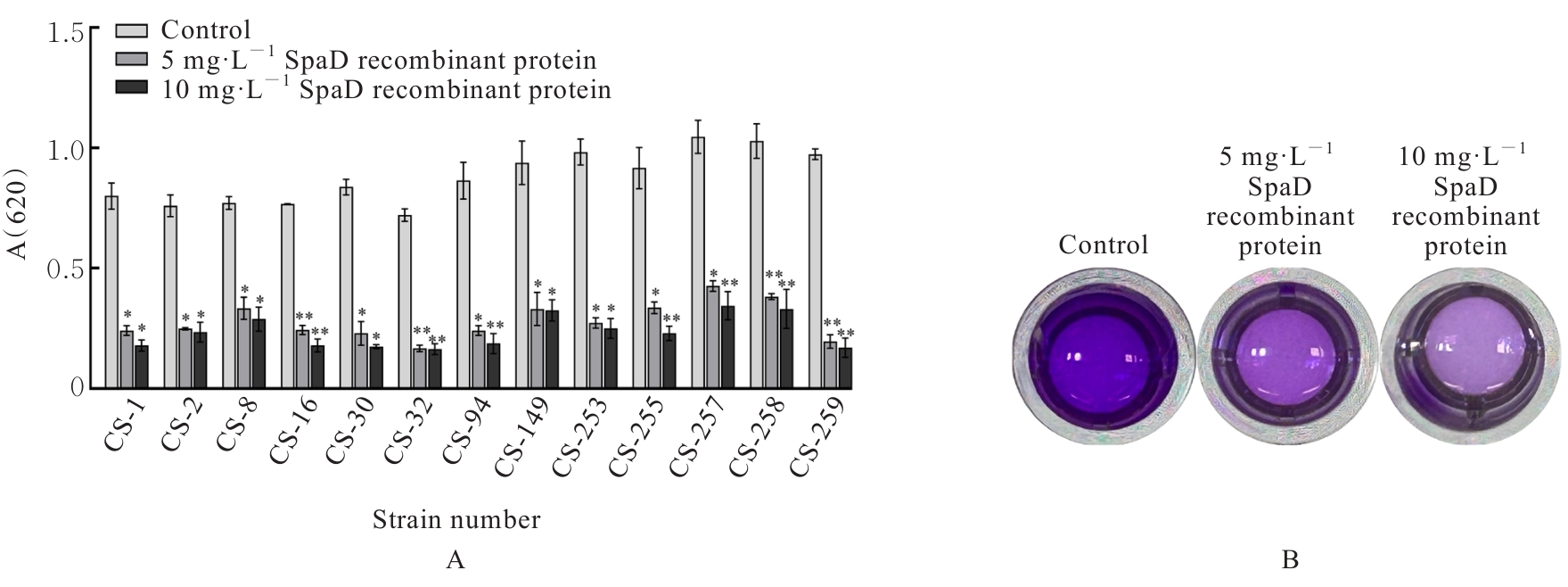
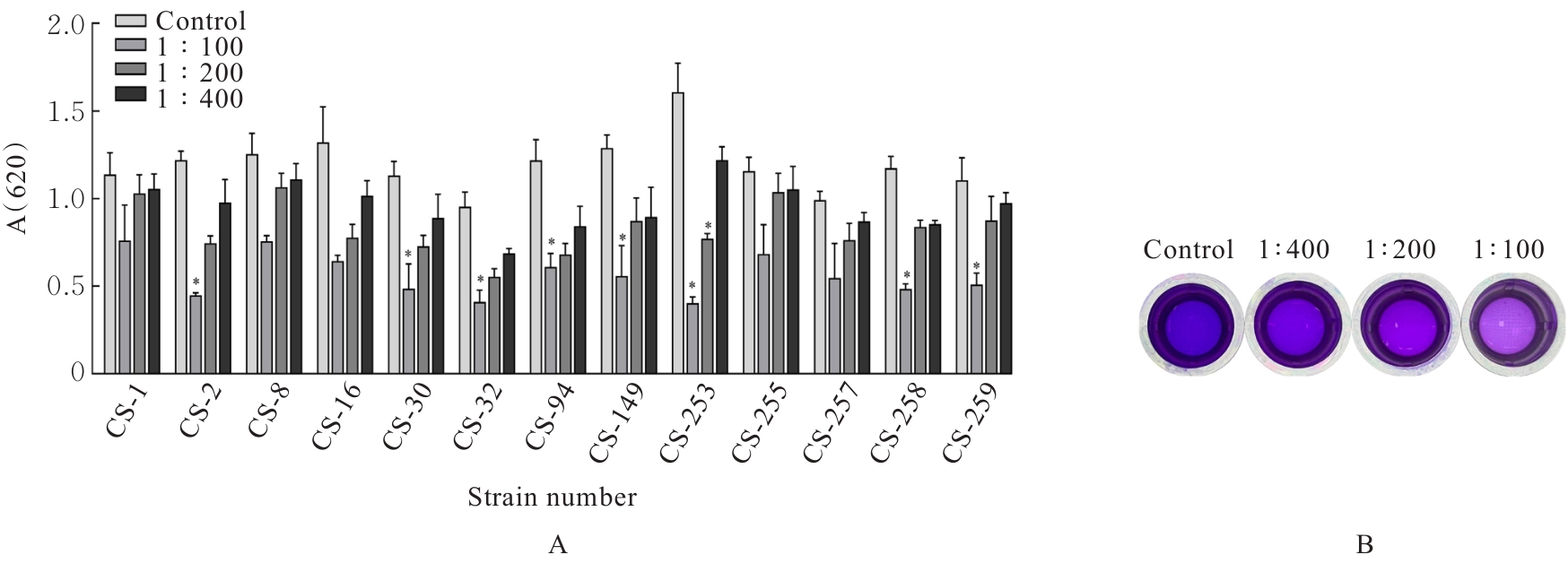
目的 制备纹带棒杆菌(C.striatum)生物膜形成相关蛋白菌毛组装蛋白D(SpaD)多克隆抗体,分析其抑制C.striatum强产膜株生物膜形成的作用和潜在应用价值。 方法 选取2011-2021年内蒙古医科大学附属医院住院患者临床标本中分离的117株C.striatum为研究对象。采用结晶紫染色法检测各菌株生物膜形成能力,实时荧光定量PCR(RT-qPCR)法检测SpaD编码基因spaDC.striatum强产膜株中的分布。将C.striatum强产膜株分为对照组和蛋白酶K组,采用结晶染色法检测蛋白酶对C.striatum强产膜株生物膜形成能力的抑制作用。蛋白重组技术构建C.striatum SpaD重组蛋白,实验分为对照组和5及10 mg·L-1 SpaD重组蛋白组,采用结晶染色法检测SpaD重组蛋白对C.striatum强产膜株生物膜形成能力的抑制作用。并通过动物免疫获得兔抗SpaD多克隆抗体实验分为对照组和1∶400、1∶200及1∶100SpaD多克隆抗体组,采用结晶紫染色法检测SpaD多克隆抗体对C.striatum强产膜临床株生物膜形成能力的抑制作用。 结果 结晶紫染色法检测,强产膜株、中等产膜株和弱产膜株占比分别为47.9%(56/117)、29.0%(34/117)及23.1%(27/117)。RT-qPCR法,所有强产膜株均携带spaD基因。与对照组比较,5和10 mg·L-1 SpaD重组蛋白组13株强产膜菌生物膜形成能力均明显降低(P<0.05)。与对照组比较,1∶100和1∶200倍数稀释SpaD兔多克隆抗体组中分别有61.5%(8/13)及7.7%(1/13)的强产膜菌株生物膜形成能力明显降低(P<0.05)。 结论 spaD基因在C.striatum强产膜株中呈高表达状态SpaD多克隆抗体可明显抑制C.striatum强产膜株生物膜形成,其抑制效应呈浓度依赖性。SpaD可作为防治C.striatum产膜株感染的新靶点。

关键词: 纹带棒杆菌, 生物膜, 纹带棒杆菌毒力, 菌毛组装蛋白D, 多克隆抗体

Abstract:

Objective To prepare the polyclonal antibody against pilus assembly protein(SpaD), a biofilm formation related protein of Corynebacterium striatumC.striatum), and to evaluate its inhibitory effect on biofilm formation by strong biofilm-producing strains of C.striatum along with its potential application value. Methods A total of 117 strains of C.striatum isolated from clinical specimens of hospitalized patients at Affiliated Hospital of Inner Mongolia Medical University from 2011 to 2021 were selected as the study subjects. The biofilm formation ability of each strain was detected by crystal violet staining assay. Real-time fluorescence quantitative PCR(RT-qPCR) method was used to examine the distribution of SpaD proteinencoding gene spaD in strong biofilm-producing strains of C.striatum. The strong biofilm-producing strains of C.striatum were divided into control group, and proteinase K group, and cystol violet staning method was used to detect the inhibitory effect of proteinaskon the biofilm formation abilitys of the strong biofilm-producing strains of C.striatum.The recombinant SpaD protein was constructed using protein recombination technology and the was divided into control group and 5 and 10 mg·L-1 SpaD recombinant proterin groups, and cystol violet staning method was used to detect the inhibitory effect of SpaD recombinant protein. The rabbit anti-SpaD polyclonal antibodies were subsequently obtained through animal immunization, the experiment was divided into control group and 1∶400, 1∶200, and 1∶100 SpaD polyclonal antibody groups, the inhibitory effect of SpaD polyclonal antibodies on biofilm and crystal violet staining method was used to detect abilities of strong biofilm-producing strains of C.striatum. Results The Crystal violet staining results revealed that strong, moderate, and weak biofilm-producing strains accounted for 47.9% (56/117), 29.0% (34/117), and 23.1% (27/117), respectively. The RT-qPCR results showed that all the strong biofilm-producing strains carried the spaD gene. Compared with control group, the biofilm formation abilities of 13 strong biofilm-producing C.striatum strains in both 5 and 10 mg·L-1 SpaD recombinant protein groups were significantly decreased (P<0.05). Compared with control group, the biofilm formation abilities in 61.5% (8/13) and 7.7% (1/13) of strong biofilm-producing C.striatum strains in 1∶100 and 1∶200 SpaD polyclonal antibody groups were decreased, respectively (P<0.05). Conclusions The spaD gene is highly expressed in strong biofilm-producing clinical strains of C.striatum. Anti-SpaD polyclonal antibodies significantly inhibits biofilm formation in these clinical isolates, demonstrating a inhibitory effect as a manner of concentration-dependent. SpaD can be a promising novel target for therapeutic intervention against biofilm-producing C.striatum infections.

Key words: Corynebacterium striatum, Biofilm formation, Virulence of Corynebacterium striatum, Pilus assembly protein D, Polyclonal antibodies

中图分类号: 

  • R378.1